
In brief
- The return of lochia corresponds to the periods after childbirth, and it occurs at a very variable pace depending on hormonal history, fatigue, and breastfeeding.
- Lochia (bleeding in the immediate aftermath) and the small return around day 10–12 are not menstruations, even if the flow can be surprising.
- The first ovulation can precede the first menstruation, which makes the question of fertility and contraception concrete as soon as sexual activity resumes.
- The first periods are often heavier and a bit longer, then the menstrual cycle regularizes over several months.
- Certain signs justify contacting a midwife or a doctor, especially in case of unusually heavy bleeding, fever, strong odor, or increasing pain.
Return of lochia and postpartum recovery: distinguishing lochia, “small return”, and real periods after childbirth
In the days following birth, the body recovers from a major event. The bleeding that accompanies this recovery does not all tell the same story. Confusing them causes a lot of anxiety, especially when the flow changes from one day to the next. The most useful marker is to separate what relates to uterine healing from what relates to the restart of the menstrual cycle.
Lochia are blood and tissue discharges linked to the “resetting” of the uterus. After delivery, the uterus retracts, vessels gradually close, and the lining rebuilds itself. The flow often evolves from bright red to brown-red, then to lighter discharges. Variations exist, especially when fatigue increases or after a day when physical activity has resumed a bit too quickly.
The small return of lochia is a frequent phenomenon. Around day 10 to day 12 after childbirth, bleeding can resume more heavily for about 48 hours. The mechanism is usually mechanical and related to scar tissue. An internal scab detaches, adhesion zones are released, and local circulation changes. This is not yet the signal that the ovaries have restarted ovulation.
The return of lochia, on the other hand, corresponds to the first periods after childbirth. It is a true menstrual episode, the consequence of a coordinated hormonal restart between the brain, pituitary gland, and ovaries. The most confusing thing is that intensity is not a good indicator. A very heavy flow can be a first menstruation, just as it can be a more marked episode of lochia after exertion. The timeline and context help more.
Concrete markers to position yourself without overinterpreting every drop
A flow that clearly increases after a walk, prolonged carrying, or a day spent standing is often explained by gravity and tissue mobilization. In this case, lying down, hydrating, and slowing down for 24 hours generally reduces the bleeding. Conversely, bleeding that “starts” like a period, with a more cyclical lower belly sensation, often occurs without direct link to activity.
The color and odor are concrete markers. Lochia can have a “classic” blood smell, but a very strong and unpleasant odor, associated with increasing pain or fever, warrants medical advice. The postpartum is not a period to “hold on” in the face of unusual signs. It is a period when we observe, adjust, and consult when an objective criterion appears.
Protection is part of maternal care. For lochia and the small return, tampons are often discouraged, especially in case of stitches, episiotomy, or tear, because they can irritate and increase the risk of infection. Postpartum pads and menstrual underwear offer wider absorption and avoid internal friction. Switching to tampons can be discussed later, when vaginal sensitivity has decreased and rehabilitation has started.
For more practical markers around the return of lochia and postpartum follow-up, the resource return of lochia and postpartum usefully completes these distinctions, with concrete markers to reread when fatigue clouds everything.
When the return of lochia occurs: hormones, breastfeeding, and real variability of the menstrual cycle
The calendar for the return of lochia mainly depends on hormones. After pregnancy, estrogen and progesterone levels drop sharply, then gradually rise. The brain restarts its signals, the ovaries resume their dialogue with the pituitary gland, and ovulation eventually reappears. This restart is not linear. It can advance, retreat, stop, then start again.
Without breastfeeding, the first periods often return around 6 to 8 weeks after childbirth. This marker is an average, not a promise. A difficult delivery, anemia, significant weight loss, major stress, or prolonged lack of sleep can delay the clock. Conversely, an earlier return does not mean the recovery is “less good”. It mainly means that the hormonal axis has restarted quickly.
With breastfeeding, the situation changes because suckling stimulates prolactin secretion. This hormone supports lactation and more or less inhibits ovulation. The nuance matters. Very frequent breastfeeding, including at night, is more likely to delay the resumption of the cycle than mixed feeding or a baby spacing their feedings. Variability is large, even at the same nursing frequency, depending on each person’s hormonal sensitivity.
The body does not “resume as before” all at once
The first return of lochia does not always announce a regular cycle. Several months are sometimes necessary to stabilize the rhythm. Some people observe very long cycles, others intermediate bleeding. This does not necessarily indicate pathology. The body comes out of a particular endocrine state and readjusts its thresholds.
This adjustment is also visible in symptoms. Some women who had very painful periods before pregnancy notice an improvement. Others experience heavier flow or different pain, sometimes more “heavy” than “cramp-like.” Vaginal dryness is common in breastfeeding because estrogen exposure is lower. This dryness sometimes makes gynecological examinations, intercourse, or tampon use uncomfortable, without this being worrying.
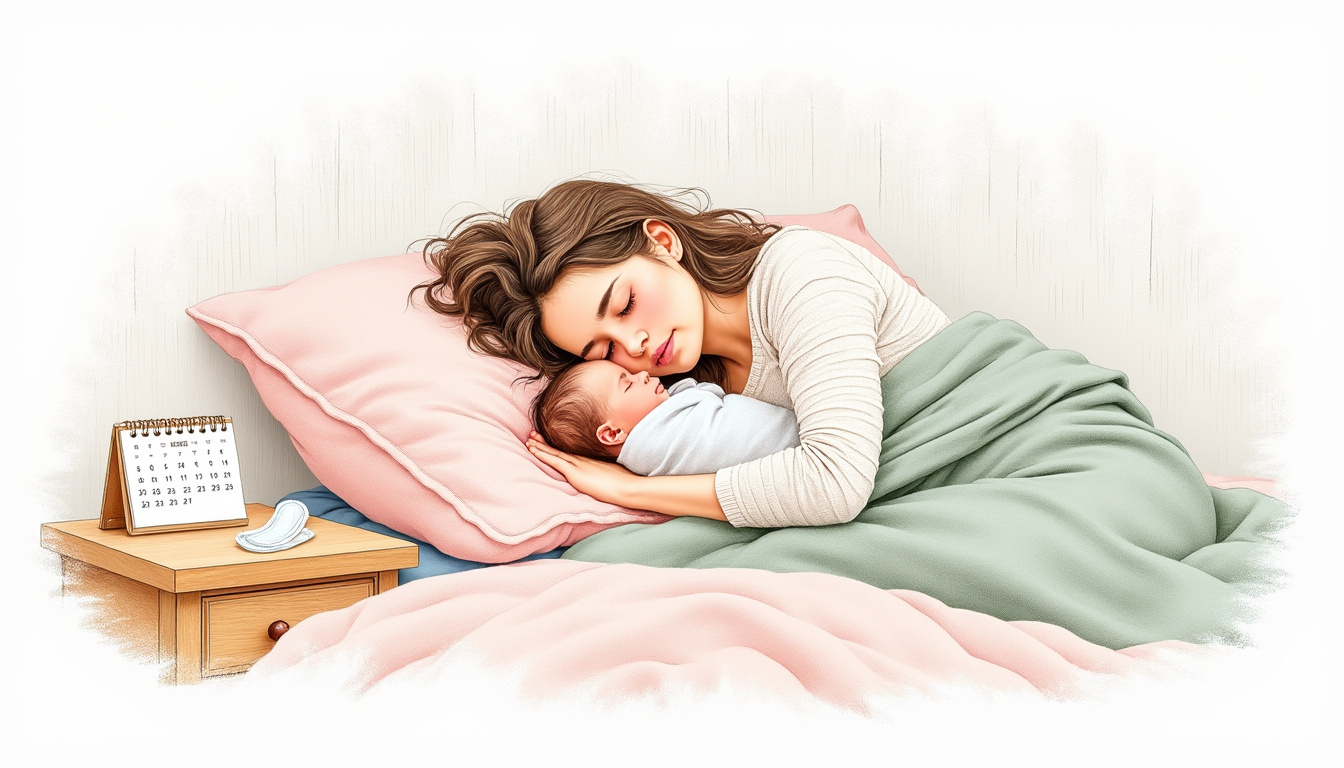
When the date of the return of lochia becomes a source of tension, a simple action helps. Noting on a calendar the date when lochia stop, the moment of the small return, then the appearance of clearly menstrual flow allows reading the weeks objectively. The tired brain reconstructs the chronology poorly. A written marker avoids dramatizing an isolated change.
A clear video can also help put simple words on the hormonal functioning of the postpartum, especially when fatigue makes reading more difficult.
Periods after childbirth: heaviness, pain, duration, and choice of comfortable protection
Periods after childbirth often surprise by their intensity. The flow can be heavier and last longer than usual, especially during the first cycle. The uterus has just gone through a pregnancy. Its lining rebuilds, contractility re-educates, and vascularization remains generous for some time. This physiological reality explains the feeling of “overflow” that many describe, without necessarily being abnormal.
The lower belly can ache. The uterus contracts, and these contractions can recall postpartum afterpains, sometimes more discreetly. If a perineal scar is still sensitive, the overall perception of pain increases. The nervous system associates the areas, and fatigue lowers the tolerance threshold. The goal is not to “cope with it,” but to choose what concretely reduces discomfort.
Pads, menstrual underwear, tampons: the right timing varies depending on recovery
For lochia and the small return, external protections remain the simplest. Postpartum pads are wide, designed for heavy flow, and limit friction on the vulva. Menstrual underwear, if adapted to heavy flow, often offers interesting comfort at night, when getting up multiple times is already a challenge.
For the true return of lochia, tampons are not forbidden in principle. They simply become less comfortable for certain women, especially in case of vaginal dryness linked to breastfeeding or if the perineum lacks tone. A tampon that “descends,” troubles walking, or seems misplaced is not a sign of weakness. It often indicates a pelvic floor that is still recovering.
A simple marker helps decide. If insertion is painful, the scar pulls, or a burning sensation appears, it is more judicious to return to external protections and discuss it with the midwife during check-up. Priority remains tissue recovery and daily comfort.
A table to differentiate what looks alike and choose the right actions
| Situation | Typical timing | What happens in the body | Concrete action | When to seek advice |
|---|---|---|---|---|
| Lochia | Day 0 to several weeks, gradual decrease | Uterine healing, debris evacuation, retraction | External protection, rest if flow increases after effort | Fever, strong odor, increasing pain, discomfort |
| Small return | Often around day 10–12, about 48 hours | Scar variation, tissue detachment | Slow down 24–48 hours, hydrate, observe evolution | Flow saturating protection very quickly, very large clots, dizziness |
| Return of lochia | Often 6–8 weeks without breastfeeding, later with breastfeeding | Hormonal restart, ovulation then menstruation | Choose comfortable protection, anticipate heavier flow | Absence of periods beyond 3 months without breastfeeding, new intense pain |
This reading also prepares for what follows. When bleeding becomes “cyclical” again, the question of ovulation and contraception arises very quickly, sometimes even before feeling ready to think about it.
Fertility, ovulation, and contraception: why pregnancy can occur before the return of lochia
Fertility does not resume when periods return. It resumes at ovulation, and this ovulation can precede the first menstruation. This point changes everything. Many couples wait for the return of lochia as a biological “green light.” In reality, the green light can come on without warning.
Clinical data agree. About 10% of women ovulate before having their first period after birth. This means a new pregnancy is possible even without prior bleeding. Breastfeeding can delay ovulation, but it does not reliably suppress it. A baby who starts spacing feedings, sleeps longer at night, or the introduction of bottles can be enough to shift the hormonal balance. The body reacts before the couple has had time to “feel back to normal.”
Postpartum contraception: options to discuss early, without haste
Contraception is thought of as support for recovery, not as a constraint. After childbirth, a combined pill (estrogen + progestin) can be considered for some women not breastfeeding, sometimes as early as the second or third week depending on medical context, but it requires individual evaluation, notably of thromboembolic risk. In case of breastfeeding, a progestin pill (often called a mini-pill) can be offered, as it has less impact on lactation.
The intrauterine device, copper or hormonal, is an effective option. Many practitioners prefer to wait about 2 to 3 months after birth, enough time for the uterus to involute well and for placement to be more comfortable. In some maternity wards, earlier placement is discussed case by case. The most important point remains continuity of care and the possibility to consult if pain, unusual bleeding, or suspicion of expulsion occurs.
Condoms remain a simple short-term solution, especially when resuming sexual activity gradually and lubrication is decreased. Postpartum vaginal dryness, especially during breastfeeding, often justifies the use of a lubricant. This improves comfort and reduces micro-lesions.
When contraception is part of a global postpartum support, perineal rehabilitation has its full place. Detailed information available via perineal rehabilitation and issues helps understand what this stage concretely changes about comfort, continence, and sometimes sexuality.
The topic of contraception also touches on the couple’s psychic space. Resuming sexual activity can reignite a fear of getting pregnant too quickly or, conversely, a strong desire to “return to how it was before.” The same contraceptive decision does not have the same meaning depending on what each person is going through. This emotional dimension naturally prepares the next section.
Living the return of lochia in the postpartum: sensations, mental load, and truly applicable post-childbirth advice
The postpartum is a period where parameters change quickly. One day, energy returns a bit. The next day, a sleepless night resets everything. The return of lochia often occurs amid this instability, like a reminder that the body continues its adjustments in the background. Emotions are not “in the head.” They are also linked to hormonal variations, sleep, pain, and the feeling of control that crumbles when everything is unpredictable.
Resuming bleeding can immediately trigger worry. Part of that worry is protective. It prompts checking. It becomes overwhelming when it replaces observation. The goal is to give the brain simple markers, then return to daily life without staying on constant alert.
Post-childbirth advice that supports recovery without turning the home into an infirmary
The first useful action is to secure rest when flow increases. Lying down for 20 minutes, legs slightly elevated if possible, and drinking a large glass of water often helps more than a frantic internet search. The temporary increase linked to activity often decreases during the day. If it does not decrease, the body is giving information to take seriously.
The second action is to reduce friction and maceration. Cotton underwear, regular changes, and rinsing with lukewarm water at the end of the day are sufficient in most cases. Scented products and vaginal douches irritate and unbalance the flora. An irritated area bleeds more easily and heals less well, which maintains the “discomfort–worry” loop.
The third action concerns logistics. Having two or three protections, a spare underwear, and a small water bottle within reach avoids the feeling of “crisis management” at the slightest unexpected event. This very simple organization frees up mental space. It is part of maternal care just like a well-applied dressing.
A fourth marker concerns emotional support. Relatives do not always know what to do, but they can do the right thing. Asking for a precise action helps more than a vague request. Leaving a meal at the door, holding the baby for 20 minutes after a feeding, managing a medical appointment—these are concrete actions. The link importance of emotional support well illustrates how this support changes recovery, without idealizing postpartum.
A clear box on signs that justify a consultation
A consultation with a midwife, general practitioner, or gynecologist is indicated if one of these criteria appears. The goal is not to anticipate the worst, but not to miss an objective sign.
- Fever (38 °C or higher), chills, or “flu-like” sensation associated with bleeding.
- Pelvic pain that clearly increases, especially if it becomes unilateral or prevents walking.
- Strong odor and unusual discharge odor, with discomfort or uterine tenderness on palpation.
- Very heavy bleeding soaking through a max protection in less than an hour repeatedly, or very large clots, with dizziness.
- Absence of return of lochia beyond three months without breastfeeding, especially with extreme fatigue, significant weight gain/loss, or history of thyroid disorders.
A video focused on postpartum markers can help normalize what is common while spotting what is not.
Body follow-up after the return of lochia: rehabilitation, sexuality, breastfeeding, and continuity of maternal care
When the first periods reappear, another work often begins. It is about regaining stable bodily comfort. The return of lochia is not a “final point.” It is a milestone. From then on, the question shifts to the continuity of maternal care and consolidation of recovery in the medium term.
Perineal rehabilitation helps regain tone, coordination, and better perception of the pelvis. The perineum is not just a set of muscles. It is a sensory area intimately linked to breathing, posture, and body schema. After birth, proprioception changes. Some women feel less well their support areas or describe a feeling of “heaviness.” This may evolve spontaneously, but rehabilitation often speeds up comfort, notably for sports, urinary leakage, or resuming intercourse.
Postpartum sexuality: hormones directly influence comfort
Resuming intercourse is sometimes eagerly awaited, sometimes dreaded, often a mix of both. Breastfeeding maintains a higher prolactin level, which can decrease lubrication and make the mucosa more fragile. This reality is physiological. It says nothing about the quality of the couple’s bond or desire. It means the body prioritizes lactation and protecting the baby.
A water-based lubricant, gradual resumption, and positions that avoid pressure on a scar concretely change the experience. Pain is not inevitable. When pain persists beyond a few tries or is accompanied by apprehension that blocks the body, advice from a midwife trained in rehabilitation or a gynecologist is relevant. Sometimes, local treatment or pelvic physiotherapy resolves what seemed “psychological.”
Breastfeeding and menstrual cycle return: two realities that coexist
Seeing periods return during breastfeeding is surprising. It does not mean the milk “is no longer good,” nor that breastfeeding is stopping. Some women note nipple sensitivity or a slight transient drop in lactation around periods, often over 24 to 72 hours. The baby may nurse more often, as if compensating. This behavior is common and explained by cyclical hormonal variations.
When nipple pain appears or breastfeeding becomes more difficult at certain times, a technical look at suckling and positioning often makes the difference. The markers of nipples and breastfeeding can help differentiate cyclical sensitivity from a developing feeding problem.
This body follow-up is part of continuity. Short, targeted appointments and questions noted in advance allow getting the most out of a consultation, even when daily life is busy. The return of lochia then becomes one indicator among others, and not an event taking up all the space.
Does the small return of lochia around day 10 mean periods have returned?
No. Around 10 to 12 days after childbirth, a bleeding episode more abundant for about 48 hours often corresponds to a variation of lochia related to healing and uterine retraction. The true return of lochia corresponds to the first periods after childbirth, linked to the resumption of the menstrual cycle and prior ovulation.
Can one get pregnant before the return of lochia?
Yes. Fertility returns at ovulation, and ovulation can occur before the first menstruation. In practice, a non-negligible proportion of women ovulate before having their first period again. Appropriate contraception can therefore be discussed as soon as sexual activity resumes, even if no bleeding has yet appeared.
Breastfeeding and return of lochia: is it necessarily late?
Often, breastfeeding delays the return of lochia because prolactin inhibits ovulation. The timing remains very variable. When feedings space out, when the baby sleeps more at night, or in case of mixed feeding, ovulation can resume earlier. A return of lochia during breastfeeding is not abnormal.
When to consult if periods do not return?
In the absence of breastfeeding, medical advice is reasonable if periods do not appear after three months, or sooner if other signs add up such as extreme fatigue, pelvic pain, foul-smelling discharge, or dizziness. A professional can check for pregnancy, significant anemia, or hormonal imbalance requiring follow-up.
Tampons after childbirth: from when?
Tampons are often avoided during lochia and the small return, especially in case of scars (episiotomy, tear) or significant sensitivity, because they can irritate and increase the risk of infection. For the true return of lochia, their use can be considered if insertion is comfortable and the mucosa is not too dry. In case of discomfort, pads and menstrual underwear remain good options while perineal recovery progresses.