
In brief
- The right timing makes crafting more peaceful, especially with young children at home.
- A successful Christmas wreath relies on a stable base, a coherent choice of materials, and a focal point readable from a distance.
- The most convincing creative ideas often mix only 2 to 3 textures, instead of accumulating.
- Crafting with a baby is thought of as an activity in micro-sequences of 5 to 12 minutes, to respect attention and sensory regulation.
- Ribbons, flowers, and foliage can be beautiful without being fragile if the fastenings and placement are chosen methodically.
- A simple reference point helps decide when to consult if a child ingests an element, shows irritation, or if an adult reacts to a plant.
DIY Christmas Wreaths: Choosing the Right Time and Pace of Crafting
Making a Christmas wreath has something very tangible about it. The hands busy themselves, the eye chooses, the mind slows down. For many households with toddlers, this is not a minor detail. The end-of-year weeks load the days with stimuli, and a baby’s or young child’s nervous system saturates faster than an adult’s. A successful DIY does not depend only on a brilliant idea but on a pace adapted to the home.
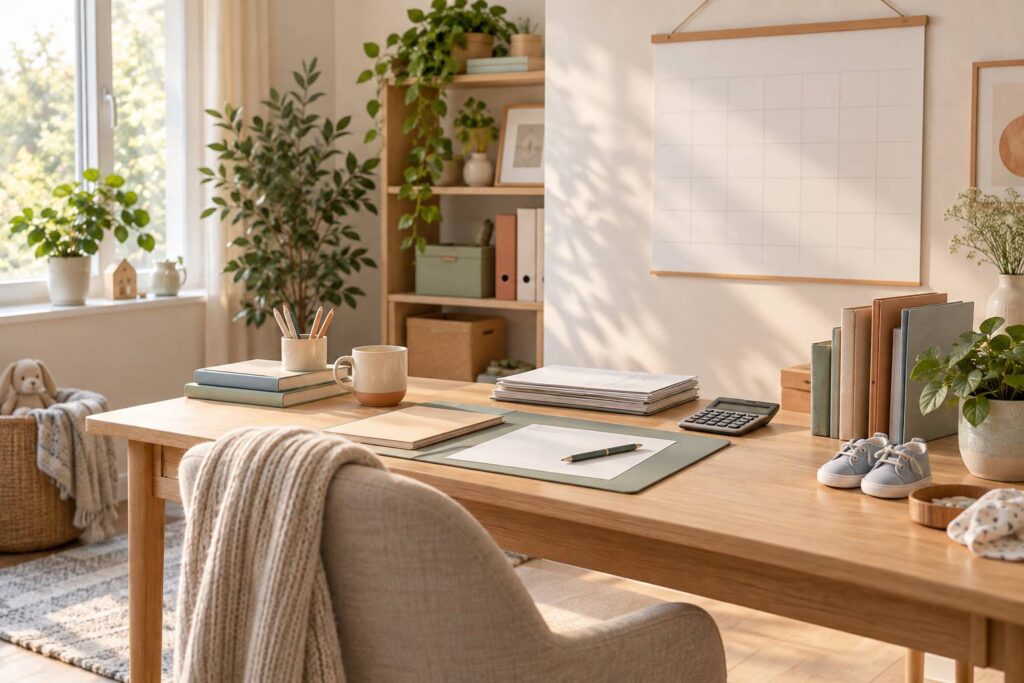
A calendar marker helps avoid crafting at midnight, when fatigue makes everything more complicated. Most families benefit from preparing the Advent calendar around mid-November, because it allows room to buy, dry, paint, or sew without pressure. The wreath, for its part, suits late November, around the last weekend before December. Decoration then arrives at the moment the desire rises, without the plant elements having had time to dull.
The first Sunday of Advent remains a symbolic date to set up a wreath linked to this tradition. In purely decorative use, the placement can be done anytime in December, often alongside the tree or lights. This choice has a practical consequence. The longer the wreath stays in place, the more the materials must be stable, low allergenic, and resistant to variations in indoor heat.
Micro Crafting Sequences When a Baby Is Around
An infant does not “participate” like an older child, but they feel the atmosphere. A manual activity conducted calmly, with a calm voice, often acts as a reference point. Babies, especially before 4 months, have short and variable wake windows, often between 45 and 90 minutes depending on temperament. Within this window, overly dense visual stimulation can excite them instead of soothing them.
The most realistic format is to break the making into small steps of 5 to 12 minutes. Prepare the base one day. Sort the elements the next day. Fix the main pieces when the house is quieter. The effect is immediate on the mental load. A DIY Christmas wreath becomes a succession of simple gestures, rather than a big project to “succeed”.
Vigilance is essential once tiny elements circulate. Pom-poms, beads, mini bells, and artificial berries easily find a curious mouth. For babies who put everything in their mouths, the most protective rule remains no access. The wreath is made up high, stored in a closed box between steps, then hung out of reach.
| Period | What the home best tolerates | Concrete marker to avoid stress |
|---|---|---|
| Mid-November | Homemade Advent calendar | Prepare containers and filling in 2 to 4 short sessions |
| Late November | Christmas wreaths and bases | Build the structure before adding flowers, ribbons, and foliage |
| Just before December 1st | Calendar setup | Set up the day before, when the child is asleep |
| Early December | Overall decoration | Choose a single “party corner” if fatigue is strong |
When the calendar and wreath are thought of as two separate projects, the home breathes better. The next section dives into the heart of the subject, with structured creative ideas to get a wreath that is readable and elegant at first glance.
DIY: 22 Creative Ideas for Unique Christmas Wreaths, Without Visual Overload
A wreath can be read in one second. The door opens, the gaze catches a shape, a contrast, a point of grip. This is why the most successful Christmas wreaths are not those that pile everything up. They choose a palette, a dominant material, then a detail that “signs” the making. This detail can be a bow, a cluster, a central flower, a play of volume.
To help decide, a simple rule works well. A main material, a secondary material, and an accent. The main gives mass, the secondary adds texture, the accent attracts the eye. This method avoids the feeling of having a “busy” result without understanding why.
22 Concrete Leads to Vary Shapes, Flowers, Ribbons, and Materials
These creative ideas adapt to several levels of crafting. Some require just a glue gun and a base. Others involve sewing, paper, or weaving. The common thread remains the readability of the pattern, for decoration that lasts over time.
- Eucalyptus and ribbon wreath with a double knot, with a single pale flower as the focal point.
- Minimalist fir wreath with three lengths of linen ribbons, cut in V for a neat finish.
- Golden ring partially garnished, leaving half bare for a contemporary silhouette.
- Dried flower wreath (statice, immortelles), for a making that lasts through December without wilting.
- “Wool pom-poms” wreath in cream and beige shades, warm and visually soft.
- Paper folded wreath like rosettes, ideal if the home avoids allergenic plants.
- Sewn felt wreath with small leaves, pleasant to make over several short evenings.
- Cinnamon-dried citrus wreath with orange slices, maintaining proper ventilation near heating.
- “Scandinavian” wreath with fine branches + twine + a raw wood star.
- Monochrome sage green wreath mixing three different types of foliage.
- Ribbon wreath tied directly onto a circle, for a dense result without glue.
- Recycled cardboard wreath dressed with fabric, for a light base on a fragile door.
- “Miniature balls” wreath keeping large empty spaces to breathe visually.
- Birch branch wreath woven, with a single velvet knot.
- “Bells” wreath with its sound, ensuring solidity if the door slams.
- Macramé wreath with fringes, very stable indoors, less suited to rain.
- “Gingerbread” wreath (fake pastry with hardening dough), for a family home spirit.
- Bleached pinecone wreath with matte paint, more elegant than glossy white.
- Bare branch wreath with micro-lights, with a secured box out of children’s reach.
- Asymmetrical wreath where flowers are grouped on only one side, for an editorial style.
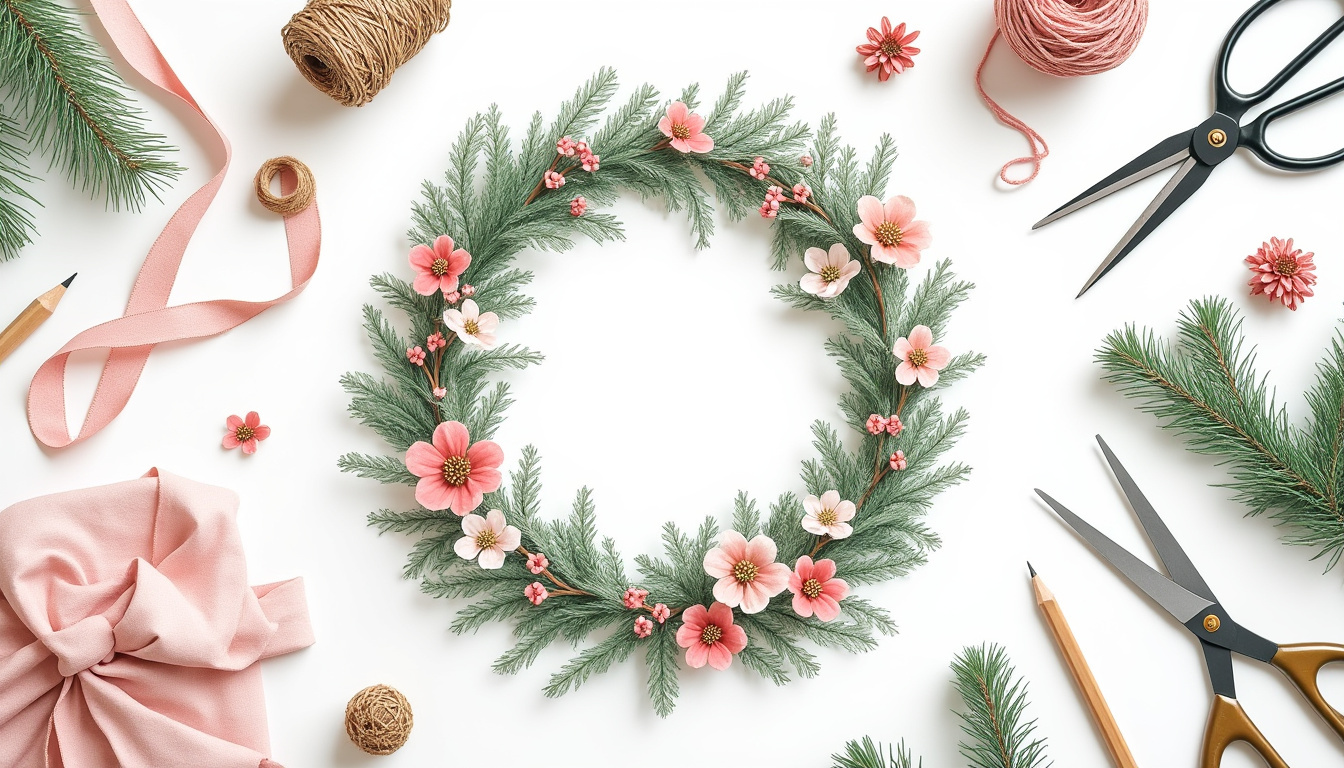
- “Pastel winter” wreath pink powder ribbons + grayish green foliage + neutral berries.
- “Table” wreath as a centerpiece, with a low stand and unscented elements if the baby is sensitive.
A practical question often arises. Where to place the wreath so it remains beautiful and safe with a crawling or barely walking child. A door wreath is handled, bumped, shaken. A wall or above a fireplace wreath lives more calmly. The choice of location guides the making, not the opposite.
The next step is to make these ideas sturdy. The following section details the bases, fastenings, and safety points that make a difference when the home is lively, noisy, and sometimes unpredictable.
A short video often helps visualize the volumes and ribbon fastening gestures before tackling glue or wire.
Making a Christmas Wreath: Base, Fastenings, and Safety in a Home with Children
A wreath that spins, falls, or loses its elements after two days ends up annoying. This is not a matter of talent but of structure. A rigid base better withstands handling. A coherent fastening system avoids continuous “repairs.” In a home with a baby, this comfort also becomes a safety measure.
The base determines 60% of the holding power. Metal rings are very stable and lightweight. Straw bases are easy to pierce, but often require a layer of ribbon or fabric for a clean finish. Wood adds style but can weigh down a thin door. Recycled cardboard rings suit paper or fabric wreaths well, provided the thickness is doubled.
Hot glue, wire, twine: How to Choose Without Getting Stressed
Hot glue fixes quickly and is very useful, but it demands a secured workspace. The gun is placed on a stable support, the cord kept out of reach, and breaks are anticipated. A burn happens in one second. With a child in the room, it is best to glue during a nap or after bedtime, then reserve “soft” tasks in children’s presence, like tying ribbons or sorting flowers.
Floral wire offers superior strength for heavy elements like pinecones, certain dried flower bouquets, or wooden ornaments. It is worked with pliers, then hidden under foliage. Twine suits rustic wreaths and tied ribbons, but it holds less well if the wreath undergoes shocks.
A useful marker is to test the wreath as if the door slammed twice. A sharp shake, held at arm’s length, is enough to spot what detaches. This test is done before installation, above a table, to avoid breakage.
When a Plant or Material Deserves Particular Caution
Some traditional decorations raise questions in a home with toddlers. Holly pricks. Berries, even decorative, attract the eye and mouth. Essential oils or ambient perfumes, often associated with Christmas, easily irritate a baby’s respiratory tract, whose mucous membranes are more reactive. Too fragranced indoor air can increase night awakenings in some sensitive babies.
Signs warranting medical advice are concrete. Suspected ingestion of a small decorative element is treated without delay if the child coughs, drools suddenly, struggles to breathe, or has repeated gagging. Significant skin irritation after contact with a plant, especially around the eyes or mouth, justifies contacting a professional. Respiratory reactions with wheezing, chest retractions, or unusual coloration call for urgent care.
The most soothing wreath is the one that does not require constant monitoring. In the next section, attention focuses on aesthetics. How to compose a decoration that has style, respects the Christmas atmosphere, and remains compatible with a real family life.
To visualize wire fastening gestures and volume balancing, a detailed tutorial video helps get started without fumbling.
Christmas Wreath Decoration: Composing with Flowers, Ribbons, and Colors for a High-End Look
A wreath can be simple and very “finished.” The secret often lies in transitions. Between foliage and ribbon, between a flower and a raw material, between a dense zone and an empty zone. These breaths give a mastered style, even with little material.
Christmas colors are not limited to red-green. Current palettes, very present for several seasons, lean towards softer tones. Sage green, beige, off-white, touches of powder pink. This choice is not only decorative. In a home with an infant, less visually aggressive contrasts can support a calmer atmosphere, especially at the end of the day when fatigue rises.
Flowers and Foliage: Volume, Orientation, Focal Point
Flowers bring direction. A downward-oriented bouquet gives a “falling” wreath, elegant on a door. A side bouquet creates modern asymmetry. A top bouquet remains classic and very readable. The focal point is decided before gluing, by placing the elements dry. This step avoids “correcting” by always adding more.
The focal point must be visible at two meters. A single well-chosen flower may suffice. A dried peony, a stabilized rose, a large wooden star. When several small flowers are used, they benefit from being grouped in a cluster rather than scattered everywhere.
Various foliages create tactile richness. Mixing a round leaf (eucalyptus type), a fine branch (fir type), and a feathery texture (dried gypsophila type) already gives depth. Beyond three textures, the eye tires and the wreath loses its thread.
Ribbons: Getting the Balance Between Rigidity and Flow Right
A ribbon that is too soft droops. A ribbon that is too stiff looks like packaging. The materials that work best are often velvet, grosgrain, thick linen. The length is chosen according to location. On an exterior door exposed to wind, shorter ribbons or tight loops are better. Indoors, a longer fall provides visual softness.
The ribbon is ideally fastened doubly. A knot, then a dot of glue or a discreet thread. This avoids seeing the wreath “come undone” progressively, especially when the air is dry and the fibers slip. A finishing detail immediately gives a higher level. Cut the ends in a V or bevel, then apply a very thin layer of glue on the cut to limit fraying.
Craftsmanship and Heritage: When the Wreath Becomes a Family Landmark
Christmas craftsmanship often ties into memory. In some European regions, the Advent wreath is part of handed-down gestures, with four candles, a weekly rhythm, a time that is marked. In other families, the wreath is solely decorative but remains an object that returns every year and signals to the young child that the calendar advances.
For toddlers, repetitive landmarks structure. A baby does not understand Christmas as a concept but notices changes in light, sounds, smells, and routines. A wreath installed in the same place, handled in the same way, can become a small family ritual without overload. This continuity has real value when weeks are dense.
To conclude, the FAQ below answers the practical questions that most often come up when starting DIY Christmas wreaths at home, with very concrete constraints.
When to make a DIY Christmas wreath so that it stays beautiful?
Late November works well in most households. The wreath is ready for early December, and the plant elements retain their color better. If the wreath contains fresh flowers, a later making, one to two weeks before Christmas, limits wilting.
Which fastening holds best for a wreath hung on a door?
Floral wire and mechanical fasteners hold better than glue alone when the door slams or moves often. Hot glue is useful as a complement, especially to secure a ribbon knot or fix a small element, but heavy pieces benefit from being tied.
Can Christmas wreaths be made with children without risk?
Yes, by separating tasks. Children can sort, tie ribbons, glue large elements with appropriate glue and supervision. Small pieces, berries, the hot glue gun, and wire are kept out of their reach. The finished wreath is placed high, especially with a baby who crawls or puts objects in their mouth.
What to put in a homemade Advent calendar if you want to keep it simple?
Chocolates work, but also small useful objects or very light attentions. Mini drawings, a small piece, a sticker, a figurine, or a sweet note add a personal touch. Preparation in mid-November allows variety without rush.