
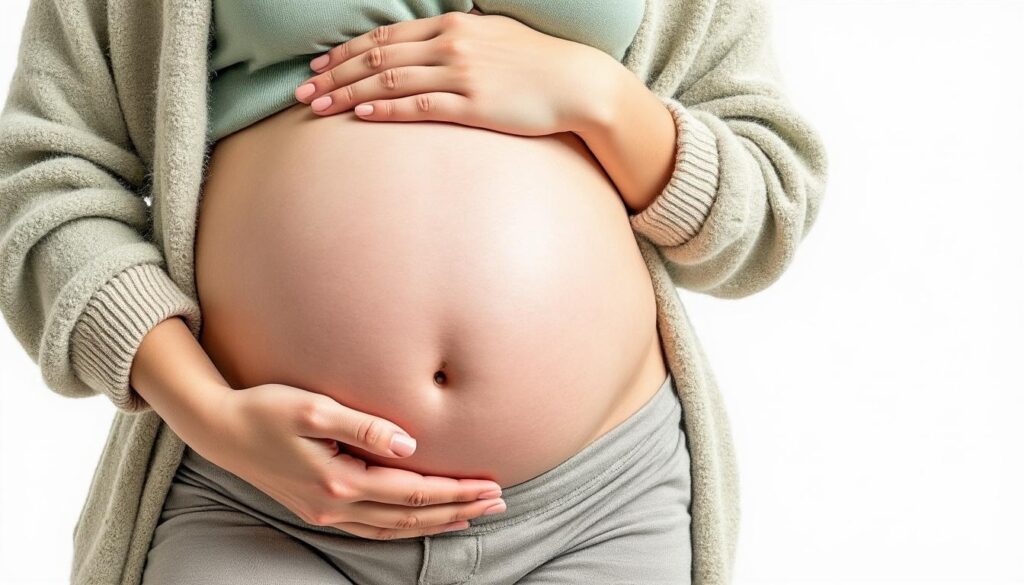
The belly that changes shape during pregnancy can sometimes reveal a separation of the abdominal muscles, a phenomenon known as abdominal diastasis. This common complication affects a majority of pregnant women as they approach term and in the weeks following childbirth. Understanding what triggers this muscle separation, its consequences on the body and posture, as well as realistic solutions to manage it daily, provides essential insight to navigate this stage with calmness and knowledge.
Key points:
- Abdominal diastasis refers to the separation of the rectus abdominis muscles along the white line of the belly.
- It is a common phenomenon in pregnancy, caused by the stretching of these muscles under the pressure of the growing uterus.
- Several risk factors increase the likelihood of diastasis, including maternal age, multiparity, and significant weight gain.
- The impacts go beyond aesthetics and can manifest as lower back pain and postural disorders.
- Abdominal rehabilitation and, in some cases, surgery, are the main therapeutic options after the postpartum period.
What is abdominal diastasis and why does it occur during pregnancy?
Abdominal diastasis, or rectus abdominis diastasis, refers to the separation of the superficial abdominal muscles, known as the “rectus abdominis.” These long, straight, parallel muscles meet at the midline of the belly, the linea alba. This area is made up of fibrous connective tissue, less elastic than muscles, responsible for maintaining their firm union.
During pregnancy, the body’s physiology undergoes an artistic transformation by adapting to the rapid growth of the uterus, which progressively but significantly stretches this white line. The connective tissue must stretch well beyond its usual capacity to make room for the baby. The space between the rectus abdominis widens, sometimes excessively, creating a separation called diastasis. This phenomenon affects about half of pregnant women, estimated between 50 and 60% according to the latest studies.
It is neither an injury nor a tear; muscular integrity is preserved, but the connective tissue undergoes stretching that it cannot always perfectly compensate for. This phenomenon is also observed in newborns, especially premature babies, whose abdominal musculature has not yet fully developed, highlighting that natural repair can be a bodily ability, varying according to age and health status.
Abdominal diastasis during pregnancy therefore represents a physiological response to a necessity: making room for the baby. However, when this separation is too wide, it can be accompanied by symptoms and complications that deserve to be known and monitored.
Risk factors that promote the occurrence of abdominal diastasis during and after pregnancy
Individual capacity to withstand this connective tissue stretching varies from one woman to another. No single, decisive risk factor has been identified absolutely, but certain elements seem to promote the occurrence of abdominal diastasis more.
The first common factor is maternal age over 34 years. Over time, the tone of connective tissue decreases, which can make the midline more susceptible to excessive stretching. Multiparity, meaning having had multiple pregnancies, is also a recognized factor, as repeated stretching further weakens the muscular and tendinous structure.
Rapid significant weight gain during pregnancy, the presence of a large baby or multiple pregnancy, and a marked increase in abdominal volume also contribute to increasing the pressure exerted on the abdominal muscles. A cesarean section can indirectly affect the abdominal musculature if the scar limits good distribution of muscular force or hinders postnatal rehabilitation.
Finally, a lack of suitable physical exercise during pregnancy is regularly observed among women who develop more pronounced diastasis. Maintaining gentle muscle tone helps support the stretching with some assistance, without unnecessarily forcing the midline.
These factors should not be considered as inevitabilities but as indicators of an increased need for vigilance and preventive actions to limit the consequences of this muscle separation.
How to identify abdominal diastasis after pregnancy and understand its impacts on posture and comfort?
After childbirth, abdominal diastasis may become more visible. To check for its presence, a simple and accessible method is to lie down comfortably, bend the knees slightly, and lift the head toward the knees, as if attempting a partial sit-up. Placing a hand on the midline of the belly, around the navel, one may feel a gap or space between the two abdominal muscles. The width of this gap varies and gives an idea of the diastasis’s significance.
The separation is normal immediately postpartum, but if the gap exceeds approximately 2 cm, it is regarded as significant. A very wide midline can cause postural changes because the abdominal muscles actively contribute to trunk and pelvis stability. Their weakening or separation often leads to compensation by lumbar and dorsal muscles, a frequent source of lower back pain.
A belly that maintains a rounded shape, sometimes described as a persistent “mommy belly,” is also a visual sign of diastasis. Posture may change since the usual support is lacking, which can fatigue back muscles, generate tension, and limit comfortable movement during daily life.
It is not uncommon for this muscle separation to cause a sensation of instability or discomfort in the abdomen during certain physical efforts. Understanding that these symptoms originate from the muscle separation allows adapting activities without unnecessarily straining the body.
Effective strategies to reduce abdominal diastasis: prevention and abdominal rehabilitation
The dissociation of the abdominal muscles is not irreversible. After pregnancy, adequate water intake helps keep the connective tissue hydrated and facilitates recovery. Maintaining upright posture without forcing the midline reduces overuse and promotes repair.
Abdominal rehabilitation is the method of choice to effectively act on this diastasis. Supervised by a trained professional, this physiotherapy uses targeted exercises to gently strengthen the abdominal belt without accentuating the separation.
Among these exercises, those that engage the transverse abdominal muscles are preferred. These deep muscles function like a corset that stabilizes the trunk and protects the white line. Gradual strengthening of this area facilitates the rapprochement of the rectus abdominis muscles.
It is essential to avoid classic “crunch” or sit-up exercises, which can worsen the gap by creating outward pressure on the white line. Patience is also a key factor: connective tissue gradually regains its tone, often over several months.
At the same time, postural improvement and management of lower back pain may involve breathing work, baby carrying, and back support. These actions are part of a holistic approach aiming to restore bodily balance.
In some women, when the diastasis is very wide or persistent despite rehabilitation, a surgical intervention called abdominoplasty may be considered. This operation brings the muscles closer together using sutures but is recommended only if no new pregnancy is planned in the short term and is overseen by precise medical criteria.
Signs that warrant a specialized consultation and advice to support this process
Muscle separation does not always cause serious complications, but certain signs require close monitoring by a healthcare professional. Intense abdominal pain, unusual digestive disorders, a feeling of abdominal heaviness or instability that does not fade after several weeks should prompt consultation.
Persistent lower back pain that does not respond to postural advice or significant functional discomfort in daily life can also be reasons for referral to specialized physiotherapy. The cesarean scar deserves particular attention: any sign of infection or localized pain must be medically examined.
Advice to accompany this process is simple to integrate into daily life. It involves avoiding certain movements such as bending forward suddenly, carrying heavy loads without support, and favoring well-supported postures with a straight back. Caution is also required when returning to sports activity.
In this context, cooperation with a midwife, specialized physiotherapist, or a pelvic rehabilitation coach becomes valuable. Personalized support allows adapting exercises and measures to each individual situation.
By understanding the mechanism of abdominal diastasis, most women can find appropriate solutions and preserve their physical comfort as well as postural balance long-term.
The video above shows exercises adapted to approach abdominal rehabilitation postpartum.
Here is another video resource detailing the recovery process and practical advice for new moms.
| Factors Promoting Abdominal Diastasis | Possible Impact | Recommendations |
|---|---|---|
| Maternal age > 34 years | Reduced connective tissue tone, increased risk of separation | Increased monitoring, appropriate physical activity |
| Multiparity | Progressive weakening of the white line | Postpartum abdominal rehabilitation |
| Significant weight gain during pregnancy | Increased abdominal pressure, excessive stretching | Balanced diet, medical follow-up |
| Multiple pregnancy or large baby | Significant expansion of the abdominal wall | Gentle exercises, professional advice |
| Lack of exercise during pregnancy | Muscle weakness, slower recovery | Appropriate and regular physical activity |
- Test for the presence of diastasis postpartum by slightly lifting the head while lying down to feel the gap.
- Avoid early classic abdominal exercises that aggravate the separation.
- Supervise abdominal rehabilitation with a professional for targeted strengthening.
- Maintain good hydration to facilitate tissue flexibility.
- Adopt proper posture and limit heavy loads without support.
What exactly is abdominal diastasis?
Abdominal diastasis is the separation of the rectus abdominis muscles of the belly along the midline caused by excessive stretching of connective tissue, particularly common during pregnancy.
How do I know if I have diastasis after pregnancy?
In the postpartum period, lying down and slightly lifting the head, you can feel a gap between the abdominal muscles with your hand placed on the belly at the navel level.
Which exercises should be avoided to not worsen diastasis?
Early classic sit-up or ‘crunch’ exercises are discouraged because they increase separation. Focusing on strengthening the transverse muscle is more appropriate.
When should I consult a professional for abdominal diastasis?
In case of significant pain, persistent sensation of abdominal instability, or functional disorders, as well as if a cesarean scar shows abnormal signs.
Is surgery often necessary to treat diastasis?
Surgery is an option for severe and stable cases, particularly when rehabilitation has not been sufficient and no new pregnancy is planned.