
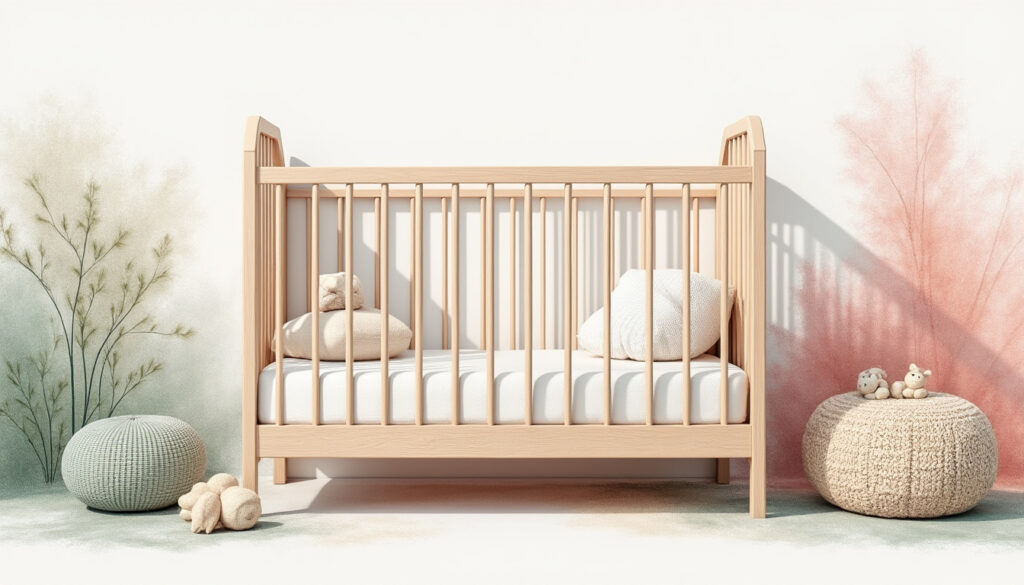
In brief
- A baby bed is first chosen based on measurable safety criteria, then on the real comfort for the child and parents.
- Safety standards to look for in-store or online already largely structure the decision, especially for a crib, bassinet, or carrycot.
- The bed size must correspond to the age, the available space, and the intended duration of use, without neglecting daily ergonomics.
- The mattress + bed frame duo matters as much as the model, as millimeter-perfect adjustment reduces risks and stabilizes the position.
- The infant’s sleep remains safer with a sleep position on the back, in a sleeping bag, and a clear bed.
- Ease of cleaning becomes a key criterion from the first regurgitations, leaking diapers, or infectious episodes.
Understanding what makes a baby bed truly safe from the first nights
The first nights with a newborn have a particular texture. The silence is light, interrupted by micro-awakenings, sighs, sometimes a startle. The Moro reflex, common up to 4-5 months, can cause “throwing” the arms back and waking a baby who was finally falling asleep. In this context, safety is not a matter of intuition. It is built with concrete, observable, and stable criteria, even when fatigue blurs everything.
A safe baby bed starts with a structure compliant with safety standards. For barred beds, the most common reference in Europe remains NF EN 716. For a bassinet, NF EN 1130. For a carrycot, NF EN 1466. These references are not administrative. They frame stability, resistance, absence of pinch points, and dimensions compatible with a bedding free of “trap zones.”
The spacing of the bars matters as much as the solidity. A gap exceeding 6.5 cm increases the risk of head passage or pinching, especially when baby becomes more mobile and turns on themselves. Old beds, recovered or bought second-hand, are not automatically bad, but they must be checked with the same rigor as new ones. A tape measure and inspection of the fastenings already provide much of the answer.
The height of the sides and how the elements lock also play a role. A baby starting to sit up around 5-7 months, depending on their motor skills, turns the bed into a support area. If the sides are low or if a movable barrier is unreliable, falling becomes a real risk. Safety here lies in the mechanics. A barrier that closes “halfway” or moves when shaken slightly is not a detail.
Non-toxic materials are not a marketing argument. A baby explores with their mouth, gnaws edges when gums work, sometimes long before the first visible tooth. Paint that flakes or varnish emitting a persistent odor should be avoided. A strong smell in a closed room is a simple signal to take seriously, as the exposure is repeated and prolonged.
Sleep safety does not depend solely on the bed itself. It also depends on what is placed inside. One rule remains stable, and it simplifies life when in doubt. An infant sleeps on the back, on a firm and fitted mattress, without pillow, duvet, blanket, or crib bumper. Plush toys have their place in the room, not in the bed before age 2. This choice does not detract from tenderness. It reduces avoidable risks.
When respiratory discomfort, whistles, paleness, an unusually limp baby, or difficulty waking occur, the right reflex is to quickly contact a professional. Safety also relies on this discernment, without dramatizing. The next section gets into the specifics of models, because the shape of the bed influences both usage and safety.
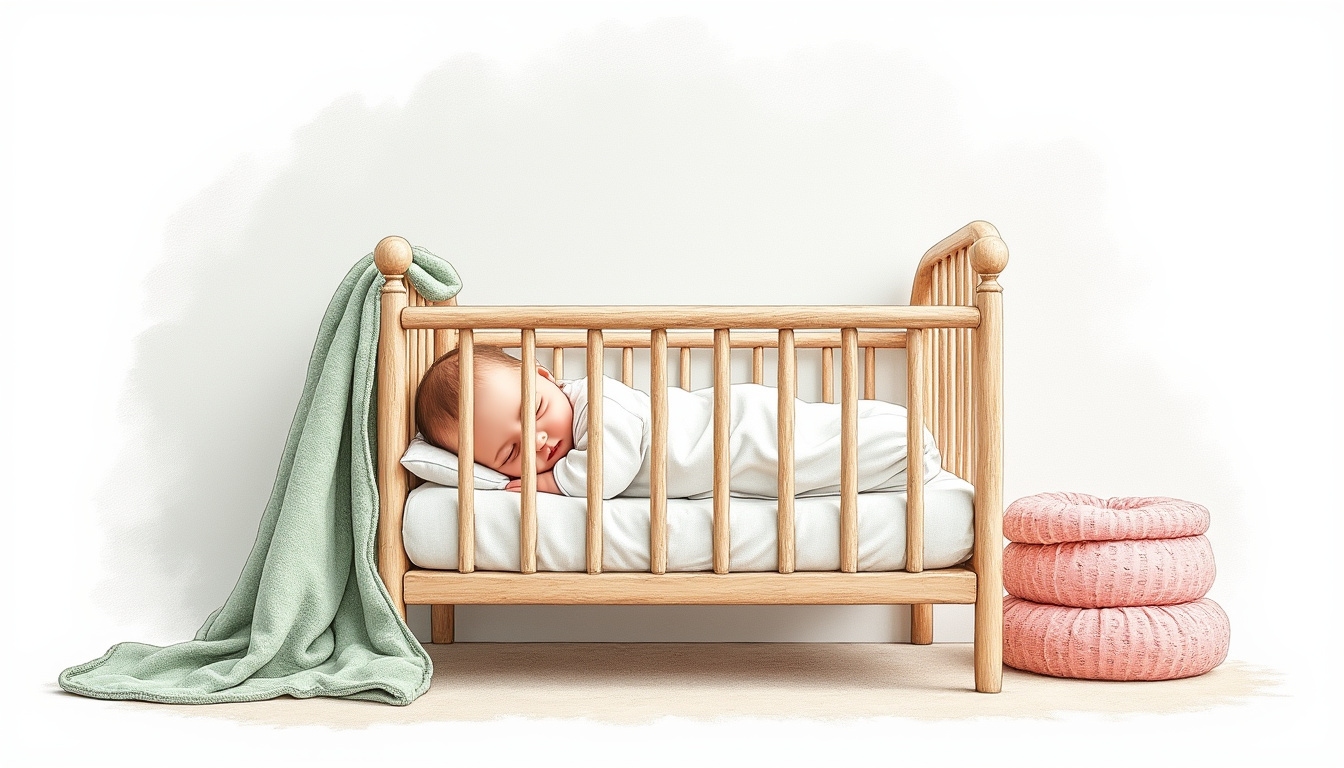
Choosing between bassinet, co-sleeping, carrycot, and barred bed according to age and home organization
The choice of the ideal bed does not follow the same logic at birth as at 8 months, and this is often where parents get lost. Options exist, catalogs overload, and yet the question is simple. Where will baby sleep, how long will this bedding be used, and how does this choice fit the reality of your nights? A perfect bed on paper can become an obstacle if the space is poorly adapted or if nighttime routines are complicated.
For the very first months, many families appreciate a bassinet. Its small size “contains” the newborn, who moves from a very enveloping environment to a vast and bright world. In most cases, this size is used up to about 6 months, sometimes less if baby sits up early. As soon as the child starts to rest on the forearms, then seeks to sit, bedding that is too light or too narrow can become unstable or unsuitable.
The co-sleeping bed often appeals for very practical reasons. An infant awakens frequently. Between birth and 3 months, many babies take 8 to 12 feedings (breast or bottle) per 24 hours, with normal variations. Reducing the distance to cover at night reduces exhaustion and facilitates resleeping. A co-sleeping bed designed to attach to the parental bed, with a secure opening and adjustable height, can support daily life. The basic rule remains the same. Baby has their own space, mattress, and flat surface.
The carrycot has another advantage. It moves easily, which can be valuable in a home where space changes throughout the day. Some models rest on a support, others are portable. This mobility should not overshadow stability. A carrycot placed on a couch or coffee table increases tipping risks. A dedicated stable support and monitoring of movements become necessary as soon as baby becomes more restless.
The barred bed can be used from birth, including when the budget does not allow multiple purchases. It is also the bedding that most often lasts until 2-3 years old. Models with adjustable bed bases relieve parents’ backs. It is not a luxury. When rising ten times, a bed base that is too low makes every movement an effort and increases the risk of strain when carrying baby.
Convertible beds, more expensive, often adapt up to 5-6 years, sometimes longer depending on kits provided. They transform into junior beds by removing one or two sides or extending the bed base. This option makes sense if the room allows and if one wants to avoid a new purchase when the child starts school and already has many transitions to go through.
For travel, the travel crib is an ally. It serves on trips, at grandparents’, sometimes as a backup at home. It is designed to fold, transport, and limit bulk. Dedicated comparisons help sort without exhausting oneself reading all over the web, like a guide on travel cots suitable for mobile families. The point of caution remains the mattress, often thinner, and the use must remain consistent with occasional bedding.
The next logical step is to look at the heart of comfort and safety every day. This heart is the mattress, its fitting, and how the bed cleans when real life knocks.
Mattress, bed size, and bed rails: the trio that makes the difference between comfort and avoidable risk
A baby bed can be beautiful yet unsuitable if the mattress is not right. Many domestic incidents related to bedding stem not from a broken bed, but from imperfect adjustment. A gap between mattress and frame, even small, can become a pinching zone. A mattress that is too soft encourages sinking and makes breathing less free, especially for a newborn whose tone and ability to free themselves remain immature.
The bed size is chosen thinking of real use. The 60×120 cm size is common for barred beds. The 70×140 cm is typical for convertible models, with longer use duration. The aim is not to provide “more space.” The aim is to have a stable structure and a perfectly fitted mattress, without lateral play. A good guideline is to check that two fingers cannot fit between the mattress and the edge all around.
The comfort of an infant is measured differently than that of an adult. A baby does not seek softness. It seeks postural stability. A firm mattress supports the spine and limits curling positions that may hinder airway alignment. A newborn’s breathing is more irregular, with brief pauses that are part of physiology. Reducing factors that add mechanical difficulty is a pragmatic approach.
Bed rails are sometimes confused with reassuring accessories. In a barred bed, they are part of the furniture. In a junior bed, they can be added. Their usefulness depends on age and mobility. An 18-24 month old child moving to an open bed may need a protective rail, especially if nighttime movement starts. A newborn does not need an added rail but a clear and stable bedding.
The question of the “big kid bed” often arises around 2 years, sometimes earlier if the child tries to climb. The main risk then becomes falling. The transition is considered based on observed behavior, not a calendar date. A barred bed with a removable side can offer a smooth transition, as the child gets on and off alone while keeping a familiar reference.
For comfort to last, ease of cleaning must be thought of from the purchase. A removable and washable mattress cover, a breathable protective sheet, smooth surfaces that clean without harsh products change life. Regurgitations, saliva, small diaper accidents are not exceptions. They are part of daily life. A simple routine prevents trapped moisture and limits odors.
A short list often helps keep these habits in mind when assembling the bed or preparing the bedding for the night.
- Check the mattress fit to the bed’s dimensions, without spaces on the sides.
- Choose a sleeping bag appropriate to size and season, rather than blankets.
- Keep the bed empty of soft objects, cushions, bumpers, and plush toys before age 2.
- Check fastenings and locking of movable elements weekly at first, then regularly.
The next angle is materials, breathed air, and temperature. These details directly affect sleep quality and perceived safety level, especially when baby goes through phases of frequent awakenings.
| Type of bedding | Most frequent age of use | Main point of attention | Typical price range (2026) |
|---|---|---|---|
| Bassinet | Birth to ~6 months | Stop as soon as baby sits up | About €80 to €500 |
| Carrycot | Birth to ~6 months | Support stability and secure transport | About €60 to €200 |
| Co-sleeping bed | Birth to ~6 months | Adjusted height, stable attachment, fitted mattress | Varies by model |
| Barred bed | Birth to 2-3 years | Bar spacing ≤ 6.5 cm, adjustable base | About €75 to €800 |
| Convertible barred bed | Birth to 5-6 years | Reliable transformation, parts and manuals kept | About €290 to €1,000 |
| Travel crib | Up to 2-3 years (occasional) | Mattress often thin, occasional use | About €40 to €220 |
Non-toxic materials, finishes, and room air: creating a healthy and soothing sleep environment
A baby’s room is not just decor. It is a micro-environment breathed in for many hours. The skin is thin, the body surface proportionally larger than an adult’s, and oral exploration is a learning path. When a bed releases a solvent smell, when paint flakes at the edge, or when textiles retain moisture, it isn’t “just aesthetic.” It affects the baby’s daily life without immediate awareness.
Non-toxic materials concern the structure as well as accessories. Properly treated wood, low-emission varnish, and stable paint reduce the risk of ingesting microparticles when babies gnaw. Chewing is frequent during teething, sometimes as early as 3-4 months, even if the tooth appears later. Padded bumpers or thick textile accessories may seem comforting but increase obstacles to air circulation and are not recommended.
Ambient temperature is a simple and very effective lever. A room around 19°C is a commonly well-tolerated reference, with an adapted sleeping bag. A baby who sweats at the neck, has a damp back, or awakens agitated without other explanation deserves a thermal adjustment before seeking a complex cause. An infant regulates temperature less well. Overdressing is a common trap, especially when night awakenings give the impression that baby “is cold” when they are mainly in light sleep phases.
Noise and light also contribute to comfort. Between 6 and 12 weeks, the circadian rhythm gradually sets in. Before that, many babies do not clearly distinguish day from night. A quiet room, soft light in the evening, and constant reference points help. In some families, the sound environment cannot be fully controlled, especially in apartments. Useful support then involves modulating exposure. For outings and very noisy situations, a guide on baby noise-cancelling headphones can clarify choice criteria without overprotection.
Air quality also comes from simple actions. Ventilate a few minutes morning and evening, avoid scented air fresheners, limit strongly scented laundry detergents on sheets, reduces irritations. A baby who sneezes a little is not necessarily sick. Mucous membranes react to dry air, dust, odors. If whistles, respiratory discomfort at rest, persistent cough, or rapid breathing appear, a pediatric consultation is justified because the boundary between irritation and pathology cannot be guessed by feel.
Ease of cleaning again appears here strongly. Painted surfaces should clean without harsh rubbing that degrades finishes. Textiles must withstand repeated washings. For the skin, products used around the bed must remain simple. Highly perfumed wipes can irritate. Gentle cleaning followed by complete drying is often more protective than intensive disinfection. For daily care, clear guidance on liniment and its uses helps distinguish what is useful from what overloads the skin.
A healthy environment is not a perfect room. It is a coherent, breathable, and stable room where the bed remains the fixed point. The next section addresses a topic that reassures many when nights are broken: sleep position, accessories to avoid, and signs that justify seeking professional advice.
Sleep position, accessories, and warning signs: securing without rigidifying daily life
The sleep position is a sensitive topic because it touches the most intimate fear of parents. The most stable and best-supported recommendation remains sleeping on the back. This is not a doctrinal detail. It is a measure that reduces risks related to airway obstruction and re-inhalation of exhaled air, especially when bedding contains soft items.
A baby on the back, on a firm mattress, in a sleeping bag, breathes in a clearer configuration. Parents sometimes observe a baby turning their head to one side, then the other. This is habitual. If the head always stays on the same side, with marked flattening setting in, professional advice can help, as postural asymmetry corrects better the earlier it is detected. This is not an emergency, but a good reason for routine consultation.
“Reassuring” accessories can paradoxically increase risk. Thick bumpers, positioning cushions, blankets, bulky comfort toys create heat zones, compression, or obstacles to air. The infant’s bed benefits from remaining minimalist. This simplicity does not prevent comfort. Comfort comes much more from a regular bedtime, calm presence, and steady gesture.
The subject of the reducer often comes up, especially when the barred bed seems large for a tiny one. The sensation of “losing” baby in a big space is common and understandable. Devices that reduce the sleeping space must be approached cautiously and according to age, mobility level, and manufacturer recommendations. Dedicated lighting can help sort, like a detailed guide on age and conditions of use of a bed reducer. The aim remains the same. Keep a flat, breathable bedding without elements that can move during the night.
Safety is also played out in verification routine. Fragmented nights make it easy to forget to tighten a screw or reset a fixture. A simple habit is to check the bed in daylight once a week at first, then at each bed base height change. This is not perfectionism. It’s the same logic as checking a car seat. A well-made installation protects better than any added accessory.
Some signs justify a consultation without “waiting to see if it passes.” A baby refusing to feed, wetting diapers much less, having fever before 3 months, or breathing with difficulty needs medical advice. An isolated sleep disorder often results from rhythm adjustment or a developmental stage, especially around big changes at 4 months when sleep architecture changes and cycles get closer to those of an adult.
Safety is not a state of permanent vigilance. It is a clear framework that frees energy for bonding. When the bed is chosen and installed methodically, attention can return to what matters. Observing baby, recognizing signals, adjusting without judgment.
At what age can a baby sleep directly in a barred bed?
From birth, a baby can sleep in a barred bed, provided the bed meets safety standards and the mattress is firm and perfectly fitted. The bed base in the high position facilitates parental movements the first weeks, then lowers as the baby becomes more mobile.
What is the most reliable rule for choosing a baby bed mattress?
The mattress must match the bed size exactly, without gaps on the sides, and provide a firm surface. A concrete guideline is to check there is no significant lateral play all around, as a gap creates a pinching zone. A removable cover also improves ease of cleaning.
Is co-sleeping compatible with sleep safety?
A co-sleeping bed designed to attach to the parental bed can be a practical option in the first months, especially for frequent awakenings. Safety depends on the stability of the attachment, aligned height, fitted mattress, and respect of a back sleeping position in a clear sleeping space.
When to remove bars or switch to a big kid bed?
The transition happens when the child tries to climb the barred bed or when the remaining height becomes insufficient to prevent a fall. Many children change around 2-3 years, but agility varies. A model with removable side can ease the transition while keeping a familiar reference.
Why are bumpers and blankets discouraged before age 2?
Soft elements in the bed increase obstacles to air circulation and can approach the face during sleep. The simplest solution remains a clear bed, a sleeping bag adapted to temperature, and back sleeping.