
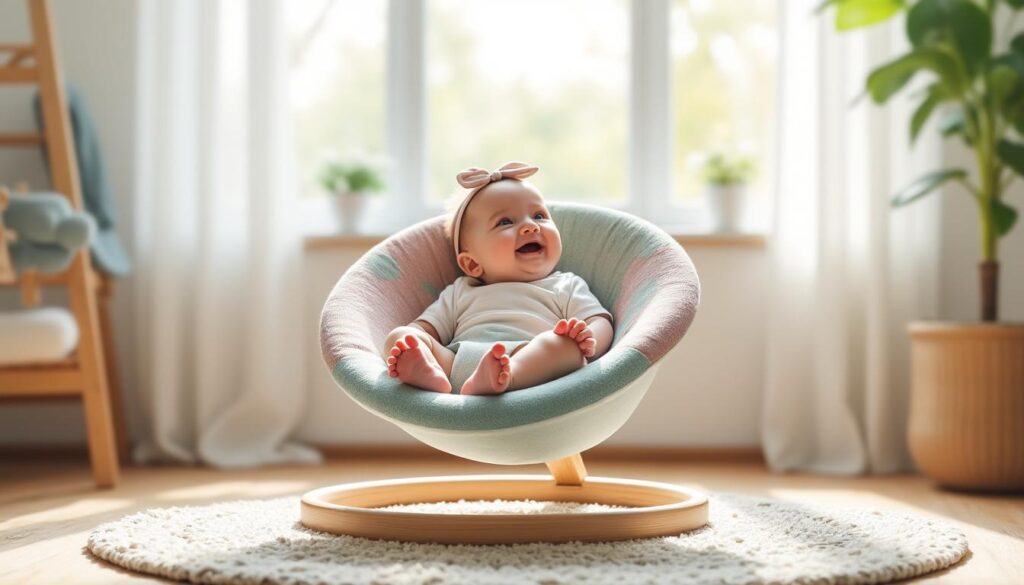
Baby bouncers often establish themselves as a daily ally, practical for placing your child without constantly engaging them. However, their use requires a clear understanding of the appropriate age to start and the suitable duration to ensure optimal baby comfort while guaranteeing flawless baby bouncer safety. Knowing how to balance time spent in the bouncer helps support your infant’s development without hindering their motor skills. This document provides valuable insights to guide your choices.
- The baby bouncer can be used from birth, with an appropriate reducer that respects the infant’s natural curl.
- It is recommended to limit the bouncer usage time to 20 consecutive minutes, not exceeding one hour throughout the day, to preserve motor skills and avoid cranial deformations.
- Adjustable models allow use up to 6 or 9 months, up to about 9 kg, but cease to be suitable once baby can sit up independently.
- Baby comfort depends on a proper position in the bouncer, its inclination, and the quality of head and back support, which also determines baby bouncer safety.
- Using the bouncer does not replace the parents’ arms, which are essential for stimulation, bonding, and awakening.
At what age to safely start using a baby bouncer?
The baby bouncer is designed to provide a safe place to put your newborn, especially during moments when your arms are unavailable. From birth, a good bouncer often offers a reducer or support cushion that respects the baby’s natural posture: their back is rounded, the head supported, reflecting the fetal curl necessary for their still-flexible spine. This positioning prevents compression and promotes appropriate muscle tone.
An infant, especially in the early weeks, cannot control head coordination. Using an inclined bouncer allows positioning the head slightly elevated, which facilitates digestion and limits the frequency of regurgitations. However, it is important that the model is specifically adapted for newborns to ensure proper support. Early use of a baby bouncer without a reducer can expose the baby to poor positioning, placing tension on the spine and risking postural tone alteration.
The most recent and reliable models on the market include a 5-point safety harness to secure the baby without risk of falling. Particular care should be taken when choosing the bouncer to ensure it meets the European standard NF EN 12790, a guarantee of compliance and regulated safety. It is not recommended to place your baby in a bouncer on a table, sofa, or bed; a stable floor remains the best option to prevent accidents.
Specialists allow installation in a bouncer from birth, with caution on duration, prioritizing a position that respects the infant’s physiology. This precaution ensures the child does not suffer from excessive pressure at the cervical level nor uncontrolled stretching. Psychomotor therapist Marie-Agnès Dussauze-Chami recalls how vital it is for the baby to keep their curled spine, as in utero, during the first weeks in a bouncer. This also contributes to optimal comfort and a good sense of physical security in posture.
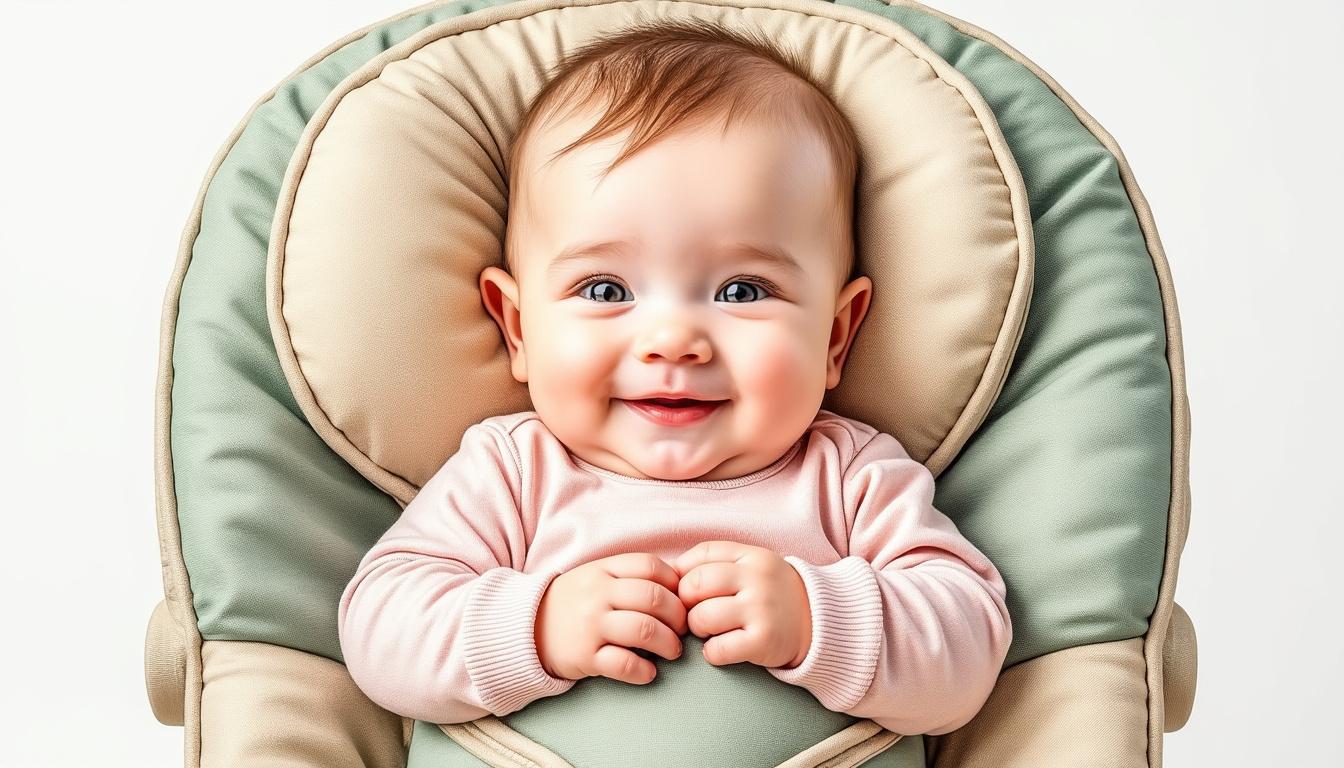
Recommended usage duration to preserve motor development
The bouncer usage time is a central topic because a baby’s willingness to settle there must not lead to prolonged immobilization. The bouncer immobilizes the pelvis and prevents free spontaneous movement, essential for your child’s neurological and muscular growth. Free movement is the foundation of motor development: it solicits archaic reflexes maturing between 0 and 6 months, notably the Moro reflex, curling, and rolling.
The psychomotor therapist mentions a limit of 20 consecutive minutes for use, repeatable several times during the day but not exceeding one hour total. This limit aims to reduce the risk of plagiocephaly, an asymmetry of the head linked to prolonged pressure on a specific area of the skull, particularly malleable in very young babies. Too frequent use of the bouncer may also hinder the acquisition of rocking, grasping, and rolling movements essential to sensorimotor adaptation.
It is recommended to regularly alternate phases where your baby is on the floor, on a play mat, or in your arms, allowing them to explore movements at their own pace and safely. This stimulates not only motor skills but also cognitive awakening. In short, the bouncer is a practical tool but must remain occasional, never a substitute for contact and free postures.
Beyond motor aspects, staying too long in equipment can cause discomfort. If your baby shows persistent crying or agitation in the bouncer, it indicates the need to vary positions and return to carrying. Carrying, through tactile stimulation and micro-movements, activates the emotional bond and supports the infant’s emotional regulation.
Adjustable bouncer: the adaptable solution for your baby’s changing needs
The very concept of adjustable bouncer aims to accompany the infant’s rapid growth by offering several positions adjustable in inclination and height. These models, such as BabyBjörn or Béaba’s Up & Down, often feature removable reducers and allow personalized adjustment for each stage of your child’s development.
An adjustable bouncer reduces risks related to an unsuitable static position, as it allows a gradual transition from the semi-reclined position to a more seated posture over the months. This evolution supports motor awakening while continuing to provide comfortable and safe support. Some references also offer a rocking function, promoting soothing motion to calm crying without necessarily using an electric system, which is useful in cases of agitation or gastric reflux.
Use of these bouncers can extend up to 6 to 9 months, or approximately 9 kg, when baby gains the ability to sit steadily without assistance. This stage marks the end of the bouncer’s relevance, as active motor skills become predominant and passive support becomes inadequate. For optimal safety, it is always advisable to regularly check that the harnesses are properly fastened and the seat stability is perfect. This point is especially important for use over several months.
However, baby’s specific build should be taken into account. Some infants, depending on their development, may quickly exceed the recommended weight or age limit. Reading the manufacturer’s recommendations is a reliable guide to ensure a perfect match.
Benefits of the baby bouncer, limits, and essential precautions
A bouncer, more than just a seat, is a secure space that plays a role in organizing awake times, digestion, and the baby’s ability to discover their environment visually while being comfortably held. The semi-sitting position facilitates breathing and is especially recommended for infants prone to gastroesophageal reflux (GERD), common in the first months.
Benefits of the bouncer also include the parents’ ability to temporarily put down their child to prepare a meal, attend to household tasks, or take a moment to care for older siblings. Facing this reality, it is a valuable substitute when carrying or arms are temporarily not possible. Visual and kinesthetic stimulation can be enhanced by installing a suitable play arch, offering grasping zones to encourage fine motor skills.
However, the major limitation lies in the restricted movements imposed by this position. The psychomotor therapist emphasizes a deprivation of free movement which can slow certain sensory and motor learnings if time in the bouncer is too long. It cannot replace floor time or moments of direct contact necessary for awakening and emotional development.
Careful use of this equipment secures both body and psyche, provided recommended usage times are applied and any prolonged immobilization is avoided. For your child’s well-being, avoiding overreliance on the bouncer and promoting a variety of postures remains a solid guideline.
Simple safety rules must be respected: never leave a baby unattended, always use the harness, and place the bouncer on a stable surface. These precautions are fundamental to prevent domestic accidents. To deepen your knowledge of childcare equipment that ensures comfort and protection, you can consult the article on baby bouncers comfort safety, as well as the one dedicated to high chairs comfort safety.
This video sheds light on various safety practices around the use of the bouncer, concretely illustrating the advice discussed.
Recognizing when the bouncer is no longer suitable or requires increased vigilance
Use cessation becomes clear once baby can sit independently, generally between 6 and 9 months. This is a reliable indicator as, at this stage, active supports replace passive posture. Usage should not continue beyond this stage to avoid hindering balance and postural coordination stimulation.
It is important to watch for signs of discomfort in the bouncer: repeated agitation, unusual crying, skin redness, or visible skull deformation. If cranial asymmetry appears, it should be discussed with a healthcare professional. Moreover, if your child shows unusual hypertonia (muscle stiffness) or hypotonia (tone weakness), these signs warrant medical evaluation.
| Criteria | Normal Variation | Signs Requiring Consultation |
|---|---|---|
| Age of bouncer use | Birth to 6-9 months | Continuing use after independent sitting ability |
| Installation duration | 20 minutes per session, max 1 hour per day | Prolonged and recurring use for several hours |
| Cranial position | Curled position, head well supported | Plagiocephaly, visible skull deformities |
| Baby behavior | Calm, alert, no sign of discomfort | Persistent crying, agitation, skin redness |
This resource shows how to identify usage limits appropriate to each stage of baby’s development.
At what age can a baby be placed in a bouncer?
A bouncer with an appropriate reducer can accommodate a newborn from birth, ensuring support that respects the baby’s curled posture. Caution regarding the model and position is essential.
How long can a baby stay in a bouncer?
It is recommended not to exceed 20 consecutive minutes and one hour throughout the day to avoid hindering motor skills or promoting cranial deformations.
When should bouncer use be stopped for a baby?
Stopping generally occurs once the baby can sit alone, which happens between 6 and 9 months depending on individual motor development.
Is the bouncer dangerous for baby’s development?
If used respecting recommended times and proper positioning, the bouncer poses no danger. Prolonged and inappropriate use can however hinder free motor skills and contribute to cranial misalignments.
How to choose an adjustable bouncer?
Prioritize a model with multiple inclination positions, a newborn reducer, a 5-point safety harness, and ensure it complies with NF EN 12790 to guarantee comfort and safety.