

In brief
- The right moment is not the same for everyone. The pregnancy announcement can be considered according to medical history, level of fatigue, and the ability to receive unpredictable reactions.
- An original and touching announcement often depends on three concrete parameters: an intimate setting, a short and true sentence, and a lasting medium (photograph, letter, object).
- The surprise works better when it respects the sensitivity of loved ones. A brief and clear staging avoids awkwardness.
- Digital amplifies emotion but also exposes. A simple choice helps: private first, public later, or not at all.
- The personalized gift has more impact when it tells a family story. A useful, dated object linked to a memory creates an unforgettable moment.
- A safety benchmark remains a priority: if the pregnancy is at risk or if a previous miscarriage still weighs on, the announcement can be gradual and supported.
Choosing the right timing for an original and touching pregnancy announcement without betraying yourself
The first days after a positive test have a particular texture. The body sometimes changes even before the belly shows, with sudden fatigue, waves of nausea, hypersensitivity to smells, or a more tender chest. In this context, preparing a pregnancy announcement requires less performance than accuracy. An original and touching idea only matters if it respects how the pregnancy is experienced, here and now.
The “three months” rule has long served as a social benchmark. It is based on a real medical fact, the decrease in miscarriage risk after the first trimester, but it can also be confining. Some people choose to speak early to a close circle because keeping silent adds loneliness to the wait. Others prefer to postpone, because personal history or medical follow-up requires caution. The most useful criterion remains concrete. Who will support if a complication occurs, and who risks adding anxiety through their comments.
The body does not wait for the social calendar. Between 6 and 10 weeks of amenorrhea, fatigue is often maximal, due to the combined effect of progesterone and cardiovascular adaptation. Planning a spectacular announcement at a time when standing up already costs can turn a good intention into exhaustion. A simpler gesture, a short sentence, an intimate setting can convey more emotion than a long staging.
The way of announcing can also depend on the type of pregnancy. After assisted reproductive technology, after a previous spontaneous termination, or in a context of close monitoring, excitement can mix with fear. A gradual announcement allows the surprise to be kept while protecting oneself. First telling the partner, then a resource person, then the rest of the family in circles, gives the nervous system time to settle.
A practical benchmark helps. Prepare two versions of the message, an “intimate” one and an “extended” one. The intimate version can contain a sentence about the feeling. The extended version can remain factual, with an approximate date, without going into medical details. The sentence that sounds right is often the one that fits in one or two lines, because it leaves room for reactions.
Reactions, indeed, are not always those expected. One relative may cry, another remain silent, another make an awkward joke. This is not an indicator of the quality of the announcement. It is often a question of shock, generation, or experience. Planning a simple exit avoids getting stuck. “We wanted to tell you now, and we let you time to realize” is enough to release much tension.
The rest often plays out in the chosen medium. A verbal announcement is strong but may fade in the turmoil. An object or a photograph anchors the memory and naturally prepares the ground for the next section, that of creative media that become family traces.
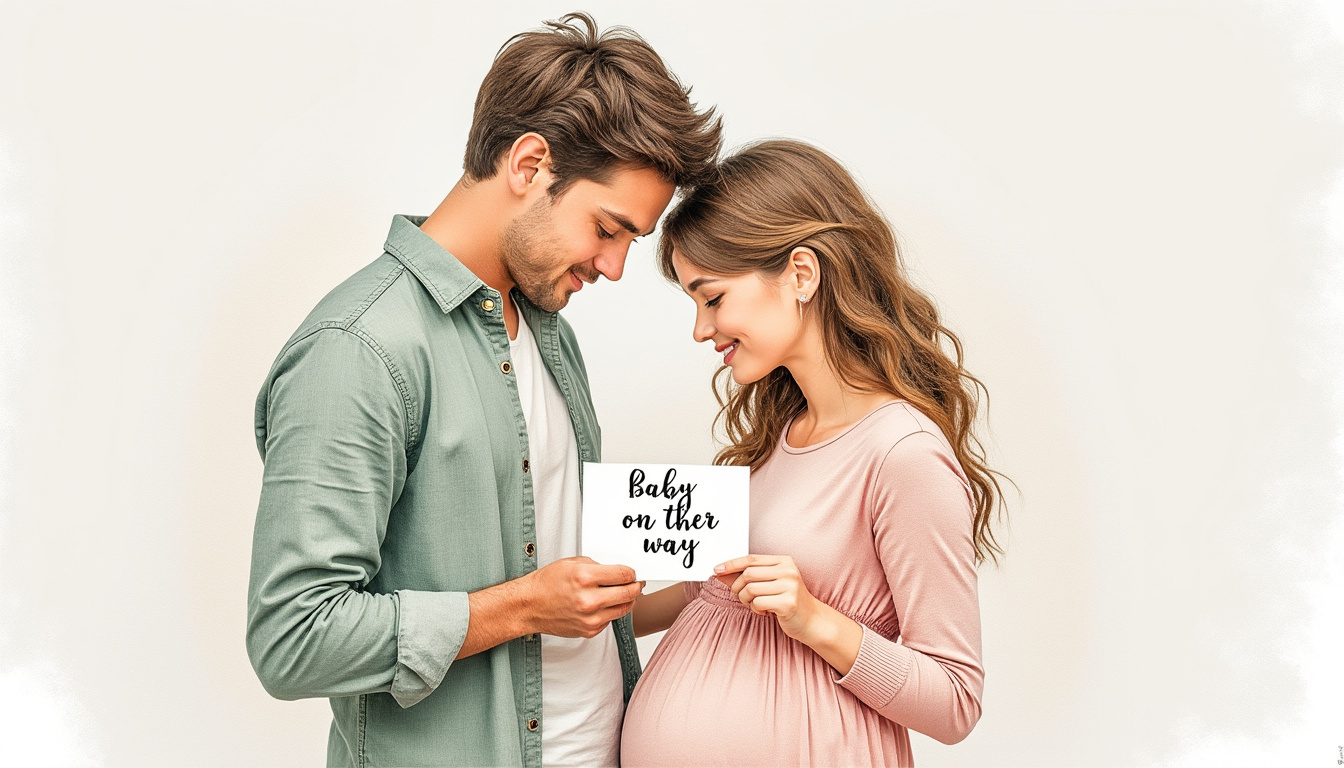
Creative ideas that last: photograph, letter, and gentle staging for an unforgettable moment
An announcement that marks does not depend on volume or complexity. It depends on coherence between the message and the relationship. A creative idea works when it remains readable in five seconds. The human brain first grasps a global scene, then the details. Too busy a staging dilutes the information. A simple scene, on the contrary, triggers surprise and lets the emotion rise.
Photography is a particularly powerful medium because it freezes the turning point. A photo taken in daylight, near a window, with a symbolic object, is enough. A neutral onesie, a pair of booties, an ultrasound placed next to a book already loved in the family. The setting does not need to be perfect. A light sheet, a wooden table, two hands joining, and the message becomes immediately understandable.
The text matters as much as the image. A message that is too long creates tension. A short, dated sentence can become a family archive. “Estimated arrival around…” or “We’re growing” works well. Adding an approximate date is useful, as it helps those around to grasp time. The brain holds better to a deadline than to an abstraction.
The handwritten letter remains one of the most touching media. It slows down. It forces to choose words. It is particularly suitable when the relationship is complex or when the announcement cannot be made face-to-face. A letter can contain clear information, a thank you, and a simple request. “We would like this to stay between us until…” sets a framework without rigidity.
A gentle staging can also rely on an existing ritual in the family. A Sunday meal, a snack, a walk. The gesture does not have to be theatrical. Slip a card in a passed-down recipe book, offer a box with a tiny object, ask “Can you pass me the salt?” then hand a little note instead of the saltshaker. The surprise comes from the shift, not excess.
Some concrete ideas, easy to adapt, without resorting to Internet copy-pasting, can serve as a starting point.
- Minimalist photo with three pairs of shoes lined up, the third very small, and a short caption.
- Audio message sent to a distant loved one, with a deliberate pause before the announcement, to let anticipation do its work.
- Bookmark slipped into a borrowed novel, with a dated sentence and a small symbol.
- Scratch card homemade, simple, where the word “baby” appears in the center. The surprise is physical, immediate.
A point of caution avoids disappointments. Objects containing medical data, like the ultrasound, can be very intimate. Some people love it, others find it intrusive. It is possible to keep the ultrasound for the very close circle and choose a more neutral symbol for the rest. The more public the announcement, the more the symbol can remain universal.
This logic naturally leads to the digital question. When the announcement goes through social networks, the scene spreads, reactions multiply, and emotional management changes in nature. The next section details how to maintain control without losing the warmth of the moment.
An announcement that goes viral is prepared as a share, not as a spectacle. Social networks have a simple mechanic. They reward the short, the visual, the immediate. This mechanic can conflict with the inner slowness of early pregnancy, especially if the body is still fragile or if the medical history calls for reserve. It is possible to make an online pregnancy announcement that remains touching and respectful, provided clear limits are set.
The first choice is that of the audience. A private account, a story reserved for loved ones, a family group, or an individual message. Each level changes the emotional load. The wider the circle, the faster comments can come, sometimes awkward, sometimes intrusive. The nervous system, already solicited by first trimester hormones, tolerates repeated solicitations less well. Reading fifty messages at night may seem pleasant on paper but becomes exhausting in practice.
The second choice concerns the content. A sober image, a short text, and an approximate date suffice. Avoiding medical details protects. Platforms keep traces. Intimate information can surface in unexpected contexts. A good benchmark is to ask if the sentence would be acceptable on a printed birth announcement placed on a table. If the answer is no, the message is probably too intimate for a network.
The question of timing also matters. Some families want a simultaneous announcement to everyone. Others prefer relational order: first grandparents, then friends, then the public. This second option reduces friction. Learning about a pregnancy through a publication can hurt a loved one who feels “downgraded”. Conflict is not a drama but can damage a sensitive moment. A call or a direct message, even brief, before publication avoids most disappointments.
Digital also opens creative possibilities. A short video, a three-shot montage, a micro-text read softly, a photo of a notebook with the date and a word. The goal is not to make everyone laugh. The goal is to transmit a true emotion. The trends of 2026 favor simple formats, less overproduced, visually more authentic, with soft light and a clean setting.
A rarely anticipated point concerns managing negative or anxious reactions. Some people project their own fear. They immediately ask “Is everything okay?”, “Are you sure?”, “Will you continue to work?”. Planning a short response can protect. “Follow-up is in place, and we share what we can as we go” reframes without closing off.
When the announcement is shared online, a protective gesture can be decided in advance. Disable comments, limit visibility, or wait until the first follow-up appointment. Flexibility is an ally. An announcement can be delayed a few days without losing strength.
Social networks also allow keeping a memory. Screenshots, saved messages, recorded reactions with consent. This can become a small album to revisit later. The album, however, takes full value when it fits into a larger family story. The next section explores how a personalized gift turns the announcement into transmission.
Personalized gift and family symbols: a pregnancy announcement that connects generations
Giving an object at the time of the announcement changes the dynamic. It is no longer only about saying, it is about transmitting. A well-chosen personalized gift touches because it materializes a place. “Grandparent,” “auntie,” “godfather,” “big sister” become concrete roles. The human brain projects better with an object in hand than with an abstract idea. Projection raises emotion and, often, joy.
Personalization does not need to be intrusive. A mug with a sentence can make you smile but can also seem too direct depending on sensitivities. A more elegant alternative is to personalize by a discreet detail. An engraved date, an initial, a color, a reference to a shared story. A keychain with GPS coordinates of a family place, a postcard from a memorable trip, a notebook whose first page contains the announcement. The object speaks to the relationship, not the performance.
Family symbols are a rich ground. A circulated storybook, a knitted blanket, a handwritten recipe. The announcement can slip into this thread. A label sewn inside a fabric, a small card in a memory box, a bookmark in a missal or a photo album. The gesture is simple. The impact is deep because it respects the clan’s history.
The recipient’s emotional context matters. For grandparents who have waited a long time, the announcement can trigger a wave of joy but also protective anxiety. Some will need to check, control, give instructions. Planning a framing sentence protects the expectant mother and the couple. “Follow-up is regular, and we will tell you when we need advice” puts everyone in their place without hardening the relationship.
The case of siblings deserves particular attention. For a child already present, the announcement can be a very exciting surprise or an upheaval. Age changes everything. Before 3 years old, the idea of time is vague. Saying “in a few months” has no concrete meaning. A gentle strategy is to associate the announcement with a seasonal marker. “When it’s warm,” “after your birthday,” “when we put the coats back on.” A small object can help. A “big brother” or “big sister” T-shirt works if the child likes to attract attention. A book about the arrival of a baby works if the child needs to understand calmly.
A simple tool allows choosing the object according to the relationship, without getting lost in options.
| Recipient | Recommended medium | Why it works | Point of caution |
|---|---|---|---|
| Partner | Short letter + tiny object (booties, neutral onesie) | Association between words and symbol; lasting memory | Avoid too long staging if fatigue is strong |
| Grandparents | Discreet personalized gift (engraved date, card in an album) | Immediate projection into role; intergenerational transmission | Anticipate anxious reactions; set a framework on shared info |
| Siblings | Book + concrete time marker (season, event) | Helps understanding without overload; reduces worry | Adapt to temperament; do not require immediate joy |
| Close friends | Printed photo + dated message | Simple trace; shared emotion without pressure | Respect confidentiality if some circles are not yet informed |
Some choices require special attention. Announcing to someone who has experienced infertility, perinatal grief, or recent separation can awaken ambivalent emotions. A touching announcement does not avoid these realities, it respects them. An individual message, without an audience around, with a sentence that leaves space, allows a true reaction without humiliation. Delicacy does not diminish joy, it makes it shareable.
When the announcement is made, another need often arises. Protecting the mother and couple from injunctions, repeated questions, and unsolicited advice. The next section offers short responses and benchmarks to ask for support without justifying yourself.
Managing family reactions: surprise, strong emotions, and boundaries that protect
A pregnancy announcement can trigger a firework of emotion, and sometimes silence. Reactions are not a love barometer. They often reflect a personal ability to process novelty. Some people cry, others laugh, others immediately ask practical questions. This diversity is normal. It becomes difficult when accompanied by intrusion or judgment.
A well-posed boundary is more calming than a long explanation. The brain opposite understands better a short and stable sentence. “We don’t know the sex yet,” “We don’t choose a name for now,” “We prefer to wait to talk about it at work.” These phrases avoid being sucked into tiring discussions. They keep the announcement touching without turning into debate.
Questions about the due date, weight gain, delivery, can come very quickly. They are sometimes tinged with anxiety, sometimes curiosity. When the expectant mother is still nauseous, these questions can feel like an attack. A simple benchmark is to distinguish intention from effect. The intention may be good. The effect may be exhausting. Responding on the effect is legitimate. “These questions tire me at the moment, we’ll talk about it later” gives breathing space.
Another frequent subject concerns sharing the news. In many families, enthusiasm leads to calling everyone. This can feel like a betrayal if the couple wanted to announce themselves. Setting a clear rule from the announcement avoids misunderstanding. “We’re telling you now, and we’d like to keep control over who knows until the next ultrasound” protects without dramatizing.
The psychic experience of the first trimester also deserves a word. Hormonal variations, fatigue, and sometimes worry, can make emotions more intense. A banal remark can hurt. Family pressure can seem huge. Preparing for this is not pessimistic. It’s a way to respect oneself. A couple may decide to announce to the family on a day when there is no other obligation afterwards, to be able to withdraw if necessary.
A clear box helps detect when the announcement is accompanied by distress that deserves professional support. It is not to alarm. It is to avoid isolation when signals are clear.
Consultation box
A midwife, a doctor, or a perinatal psychologist can help quickly if one of these signs appears and lasts several days. Intense almost continuous sadness, panic attacks with the sensation of suffocating, dark thoughts, inability to sleep even when exhausted, re-living a traumatic event related to a previous pregnancy, total isolation with loss of interest in everything. A consultation does not take away the joy of expecting a baby. It provides concrete support.
When boundaries are set, the announcement regains its function. Create a bond, open a space for support, and prepare the future. Many couples like to keep a trace of the moment. Reaction videos, recordings, mini-edits. An audiovisual resource can also inspire without imposing a model, and help choose a format that truly resembles the couple.
A last detail often changes the experience. Thanking the relative for their reaction, even imperfect, when the intention was there. “Thank you for being here” closes the moment on a relational note, without denying boundaries. This way of ending protects what comes after, when questions return and the need for intimacy grows.
When to announce pregnancy so that it is both original and reassuring?
The right timing depends on medical history and the need for support. Many couples choose to first talk to a very close circle from the first weeks, then widen after a reassuring ultrasound. An original and touching announcement works better when it respects your current energy and the ability of loved ones to keep confidentiality.
How to make a surprise pregnancy announcement without causing discomfort?
Surprise works when the message is understood immediately and the staging remains short. A simple object, a card, a printed photo, or a sentence on a small note suffice. Avoiding long games or complicated riddles reduces the risk of embarrassment, especially in front of several people.
Is a photograph a good idea if the pregnancy is still recent?
Yes, if the image remains symbolic and protects intimacy. A photo of an object (booties, notebook, small dated message) can be shared with a close circle without exposing medical information. For wider distribution, a neutral symbol is often more comfortable than an ultrasound.
What personalized gift to offer to announce pregnancy to grandparents?
A discreet personalized gift often touches more than a very demonstrative object. An engraved date, a card slipped into a family album, a small “memory” notebook, or a bookmark with a dated message create lasting emotion. The most important thing is that the object echoes your family story.
What to answer relatives who ask too many questions as soon as the announcement is made?
A short and stable sentence protects without creating conflict. “We share what we can as we go”, “We prefer to keep this for ourselves for now”, or “Follow-up is in place, we will give news” set a framework. If anxiety or sadness becomes overwhelming, a midwife or perinatal psychologist can provide quick and concrete support.