

In short
- Vercingetorix is an Arverni Gallic chief, active at the heart of the 52 BC revolt against Rome, at the moment when the Roman conquest of Gaul accelerates.
- His name, often interpreted as “great king of warriors,” belongs as much to collective memory as to ancient sources, mainly Roman.
- The victory at Gergovia becomes a strong landmark because it shows that Caesar’s army can retreat when terrain, logistics, and local cohesion align.
- The siege of Alesia illustrates another dynamic, that of endurance, hunger, and impossible choices when a community is surrounded.
- After his surrender, Vercingetorix is held for several years then dies in Rome in 46 BC according to the most commonly accepted version, while other later accounts feed the Legend.
- In the 19th century, statues, paintings, and school textbooks reinforce the image of the Gallic defender, and in the 20th century popular culture, from Asterix to television fiction, extends this narrative.
Vercingetorix, Arverni Gallic chief: origins, training, and birth of a revolt
When parents look for a reliable landmark, they quickly learn to distinguish what is documented from what is reconstructed. The history of Vercingetorix demands the same attention. His date of birth is not fixed to the day. Historians generally place it between 82 and 72 BC, on the territory of the Arverni, in present-day Auvergne, at the heart of the Massif Central.
This uncertainty is not a weakness of the narrative; it is a signal. Direct sources are rare and come mainly from the adversary, Rome, through Caesar’s accounts. This requires a reading that keeps in mind the objective of a political text. The Commentaries on the Gallic War seek to persuade in Rome, not to create a neutral portrait of the enemy.
Tradition relates that a druid gave his name during a ceremony. The most frequently cited etymology, “great king of warriors,” speaks of military authority and prestige. In a society where power is negotiated between lineages, alliances, and reputation, a name can function as a program. It is not necessary to believe it literally to understand what it tells about a time when the symbolic held a concrete place.
Vercingetorix is presented as the son of Celtillos, an Arverni figure whose desire for kingship ended in assassination. This family death carries strong explanatory value, even if details are lacking. In leaders’ trajectories, political violence experienced up close changes the perception of risk. It can also make the urgency of internal cohesion more readable, especially in a fragmented Gallic landscape.
Vercingetorix’s training is described as military. This does not mean a uniform “course.” Gallic aristocrats learn to fight, to ride, to negotiate, to maintain a network of men. These are managerial skills, close to what would today be called human logistics. A leader is not reduced to a sword. He knows how to feed, move, motivate, sometimes punish, and above all maintain the alliance when fatigue and fear settle in.
Accounts mention contacts with Caesar’s entourage during this training. Even without detailing a specific scene, the idea is plausible. In a Gaul already influenced by Rome, some aristocrats move around, observe, serve, or negotiate. This proximity to the adversary can strengthen strategic lucidity. When the Roman conquest has been ongoing for several years, understanding Roman methods becomes a weapon.
The 52 BC revolt is understood as a turning point. The Gauls experience fiscal pressure, hostages, symbolic humiliations, and exploited internal rivalries. In this context, Vercingetorix appears as a catalyst. He does not create discontent alone. He transforms it into a coalition, which is much more difficult.
What strikes is the ability to hold together divergent interests. Bringing together competing cities requires precise gestures. Guaranteeing shares of loot, promising protections, recognizing local chiefs, accepting compromises. This assembling skill explains why he quickly becomes an emblematic defender. The logical thread then leads to the next, more concrete question: how does this coalition translate on the ground, facing a Roman army organized to endure?
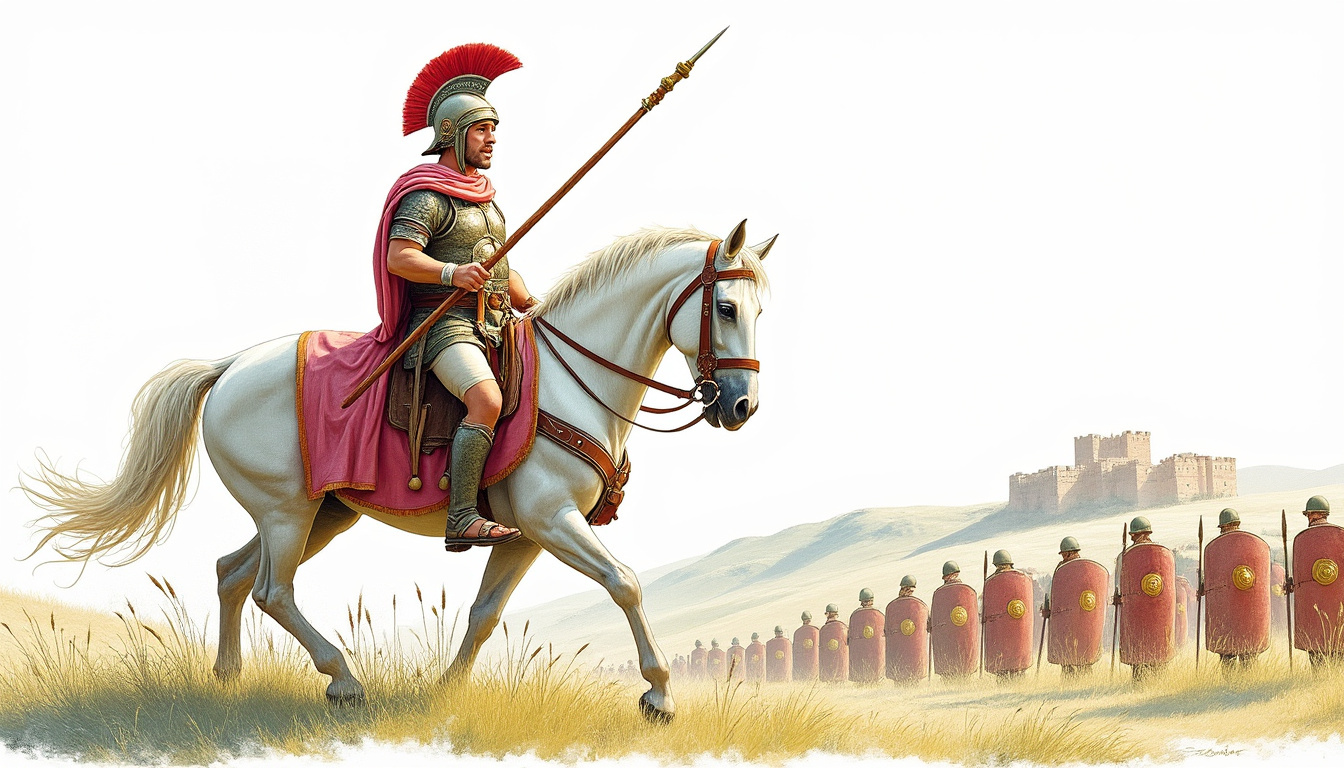
Unifying the Gauls against Rome: strategy, discipline, and difficult choices in the Gallic War
A coalition does not hold only on a speech. It holds on an organization that supports the reality of long days, cold, hunger, and waiting. The armies of Rome are built for this. They know how to dig, fortify, transport, count. Against them, the Gallic force often lies in mobility, knowledge of terrain, and the ability to strike where the adversary least expects.
Ancient sources describe a leader whose name inspires fear. This often-quoted phrase is not mere backhanded flattery. It expresses the psychological power of a leader. When an army believes the other side has a central brain, it begins to anticipate, doubt, and see traps everywhere. In ancient wars, perception can count as much as numbers.
Vercingetorix seeks to gather peoples. This unification is not obvious, because Gaul is not a single state. For Gauls to accept a common leadership, there must be a shared threat but also a method. The strategy attributed to Vercingetorix is based on a hard principle, sometimes misunderstood: weaken the enemy by depriving him of resources, even if it costs the local populations.
When the land feeds the adversary, it becomes a stake. This is called a “scorched earth” policy, often simplified in textbooks. On the human level, it is a decision that leaves marks. Destroying granaries, moving families, accepting the loss of a village to save a larger whole — these are choices where morality and survival clash. Texts do not detail faces but the magnitude of the decision suffices to understand the tension.
For parents, this dynamic is known differently. When a choice protects long-term but costs in the short term, emotion rises quickly. Intelligence lies in clarifying objectives and warning signals. In a coalition, “warning signals” are desertion, renewed rivalries, rumors, depletion of stocks, loss of trust. An effective leader does not just order. He watches these indicators, adjusts, negotiates, decides.
Gallic discipline is often caricatured. It exists, but it is different. Romans have standardized units. Gauls rely more on personal loyalties, aristocrats and their retinues, contingents provided by cities. This makes the whole powerful but more fragile if central authority weakens. Vercingetorix’s success in 52 BC thus rests on a rarely highlighted skill: stabilizing a mosaic.
To make this concrete, some landmarks help visualize the balance of forces without falling into fascination with numbers. The key point is not just how many men fight, but how they are fed, how they move, and how they relieve each other. An army that doesn’t eat collapses. An army that doesn’t sleep becomes unpredictable. An army that no longer feels protected fragments.
When a coalition faces a logistical machine like Rome, strategy becomes a question of rhythms, reserves, and cohesion as much as bravery. This tension between boldness and endurance is then clearly seen in the episode of Gergovia, then in the dramatic shift to Alesia.
To situate the main moments, a table helps keep landmarks without flattening complexity.
| Moment | Place | What is at stake | Effect on the revolt |
|---|---|---|---|
| Rise to power (52 BC) | Gallic territories | Coalition, discipline, attrition tactics | Strengthening of Vercingetorix’s image as a federating Gallic chief |
| Battle of Gergovia | Plateau near present-day Clermont-Ferrand | Favorable terrain, pressure on Roman lines | Gallic victory, Caesar’s retreat, increased confidence |
| Turning point towards Alesia | Mont Auxois (Burgundy) | Encirclement, siege, two-front struggle | Exhaustion, famine, surrender to spare the men |
| Detention and death (46 BC) | Rome | Political display then execution according to the most widespread version | Gradual transformation into Legend and defender figure |
The logical sequence leads to the moment where the coalition seems to hold, then falters. Gergovia and Alesia do not tell the same story. They describe two types of trials.
Gergovia: a Gallic victory explained by terrain, Roman fatigue, and cohesion
In collective memory, Gergovia appears as a bright spot. A clear, almost simple victory. In military reality, a victory is often a pile-up of factors. Terrain first. A plateau, slopes, controllable access. At the time, holding the heights gives a concrete advantage. Communications become more difficult for the attacker. Charges lose effectiveness. Mistakes cost more.
Roman fatigue is another factor. Campaigns last, marches grow longer, wounds accumulate. Even a structured army eventually wears out. Sources mention tested Roman troops and a retreat. This does not detract from the Gauls. It shows that the outcome of a battle also depends on a collective body, with physiological limits.
In accounts, Vercingetorix stands out as a commander able to hold a line and exploit a gap. Again, the romantic vision of a duel of chiefs is misleading. A victory is achieved through orders that function. Signals understood. Groups that do not leave too early or that return when asked. If cohesion is fragile, a pursuit becomes a trap. If cohesion holds, the enemy retreats with losses.
Gergovia also marks a psychological turning point. An army that has won already becomes more confident. This confidence can support discipline, but it can also erode it if it turns into overconfidence. In a coalition, this moment is delicate. Local chiefs may demand more power or contest central authority because success seems to justify them. A leader must then do what many avoid: reaffirm leadership without humiliating.
Parents know this dynamic when a baby reaches a milestone and the entire family balance reorganizes. When a new rhythm appears, expectations rise quickly, and so does pressure. In an army, it is similar. After a victory, people ask “what’s next.” They want to continue, finish, win more. Yet resources do not always keep pace. Stocks, horses, men, alliances – all have limits.
A concrete example helps understand the mechanism. On a high site, defense benefits from a shorter reaction time. It sees the opponent approach. It can concentrate forces on a passage. If the attacker attempts an escalation or frontal attack, he consumes more energy for uncertain gain. Even a minor error in Roman coordination can then cost dearly, because the slope amplifies disorder.
Gergovia reminds us that a victory is not born just from courage, but from the agreement between terrain, tempo, and human cohesion capable of resisting stress. This landmark makes the next episode more readable. After Gergovia, the adversary learns, adjusts, and changes method. It is often thus that the most notable defeats prepare themselves, those that settle over time.
In today’s culture, this battle is often told in accessible documentaries. Guided research can help sort what comes from solid reconstruction and what comes from imagination.
Alesia: siege, hunger, surrender, and what defeat reveals in Vercingetorix’s history
Alesia puts bodies in the foreground. A siege is not a quick clash; it is a test of endurance. Vercingetorix’s troops retreat into an oppidum traditionally identified as Mont Auxois, near Alise-Sainte-Reine in Burgundy. This position offers protection but can turn into a trap if the enemy controls the exits.
Caesar puts in place a strategy striking by its rigor. He surrounds the place with his legions and organizes fortifications to prevent sorties. The siege is often summed up by an image, that of encirclement. In fact, this involves kilometers of earthworks, palisades, ditches, guard posts, rotation of men. Roman strength lies there. Turning an idea into infrastructure, quickly.
Gallic reinforcements, sometimes called the “relief army,” try to attack from outside. Sources mention interventions, notably the Aedui. The ordeal then becomes a two-front struggle. Defend from the inside, attack from the outside, and hold the necessary time. This mechanism is formidable because it creates a difficult synchronization. If the outside attacks too early, the inside does not follow. If the inside breaks out too late, the outside exhausts itself.
One element is often underestimated: hunger. It degrades thinking, patience, ability to cooperate. In a besieged city, rations decrease, tensions rise, decisions become more impulsive. Parents who have experienced exhaustion understand this phenomenon in their flesh. When the body lacks, the mind shrinks. In a siege, this is not a metaphor. It is a physiological mechanism.
The siege of Alesia is said to have lasted about <strongforty days according to commonly spread accounts. Whether this number varies according to interpretations does not change the meaning. It suffices to understand exhaustion. Weeks under pressure, with wounds, cries, risky sorties, and uncertainty about the arrival of help.
Vercingetorix’s surrender is a political gesture. He chooses to deliver himself to preserve his men. In a heroic narrative, one sometimes seeks panache. In a more human reading, this choice resembles taking responsibility. When a community is on the brink of collapse, a leader can decide to be the point of closure of violence. It is a heavy gesture. It does not guarantee forgiveness. It marks a limit.
After surrender, Vercingetorix is imprisoned. He dies in 46 BC, in Rome, several years later. The most widespread version speaks of a display during a triumph then a discreet execution, possibly by strangulation, on Caesar’s order. Other accounts mention a death hidden elsewhere, even in a cave, without decisive archaeological proof. The absence of a body fuels the Legend because the void leaves room for stories.
To remain in a reliable register, a simple guide helps. The closer a version is to ancient sources and consistent with Roman customs, the more probable it is. The later and more romanticized a version appears, the more caution it demands. This does not prevent seeing a function in it. Societies create narratives to carry their wounds.
Alesia shows how a defeat can become a collective anchor point because it condenses hunger, loyalty, strategy, and human limit in one place. After violence comes the long time. The time when stories are told, decisions made, transmission occurs. It is here that Vercingetorix further changes status.
From man to Legend: memory, statues, Asterix, and the cultural heritage of Vercingetorix
The passage from event to memory resembles a maturation. At the start, there is a history written by the enemy, then rewritings, images, political uses. Vercingetorix gradually becomes a collective figure. Everyone projects a need onto him. A origin. A refusal. An identity.
In the 19th century, France rediscovers and reorganizes its national narrative. It is a moment when archaeology, the arts, and school build common landmarks. The monumental statue commissioned by Napoleon III from Aimé Millet, erected at Alise-Sainte-Reine, fulfills this role. Seven meters tall. A silhouette dominating the site associated with the siege of Alesia. This is not scientific proof; it is a memory marker.
19th-century paintings also participate in this fabrication. The surrender scene, often depicted, freezes a posture. The defeated chief, dignified, facing the conqueror. These images have pedagogical power. They bring a narrative into families, books, museums. They sometimes simplify. They also convey an emotion, which can be useful if it then opens the door to a nuanced understanding.
20th-century popular culture extends this movement. In Asterix, Vercingetorix appears from the first album, in the surrender scene, with a defiant gesture made famous. The authors explained they thought of him when inventing the universe and even the musicality of names ending in “-ix.” This cultural filiation counts. It shows how a historical figure can become an imaginary matrix, even for children who do not yet know chronology.
A point deserves clarification for parents wondering what children retain. A child does not first memorize dates. He memorizes an emotion and a stable image. The silhouette of the Gallic chief, helmet, horse, surrender, resistance to Rome. Only afterwards, with school, do temporal landmarks come. This progression is not a flaw. It is a classic cognitive logic. We hook knowledge onto a strong image, then refine.
To accompany this curiosity without overwhelming, a few simple gestures work well at home. A visit to an archaeological site or regional museum, a map of Gaul displayed for a few days, or a short documentary reading separating fact from Legend. When the child asks questions, a helpful answer has two levels. A sure fact, then a nuance. “We know that…” and “We think that…”. This structure protects from the illusion of certainty.
Contemporary memory, in 2026, also relies on more immersive formats. Documentaries, podcasts, 3D reconstructions, virtual site visits. These tools can enrich, provided the reflex to check the source, production date, and content objective is maintained. A program intended for entertainment often mixes attractive hypotheses and established facts. It can remain enjoyable if the framework is clear.
Vercingetorix’s enduring strength comes from this double register, a man caught in a real war, and a figure that became a bearer of transmission, debates, and identities. When this double register is understood, history ceases to be a frozen block. It becomes a tool to think about how a society tells its story.
Did Vercingetorix really exist or is he mostly a legend?
Vercingetorix is indeed a historical figure, attested by ancient sources, notably Caesar’s accounts. The legend develops mainly afterward, as centuries of images, national stories, and popular culture transform a military leader into a symbol. Both levels can coexist if one distinguishes documented facts from representation.
Why is the battle of Gergovia so often highlighted in Gaul’s history?
Gergovia is a strong landmark because it corresponds to a Roman retreat attributed to a combination of favorable terrain, troop fatigue, and effective local cohesion. It shows that the Roman conquest was not an uninterrupted march and that a Gallic coalition can achieve a concrete result under certain conditions.
How did Caesar manage to win at Alesia despite the arrival of Gallic reinforcements?
The siege of Alesia is based on an encirclement strategy and fortifications controlling exits and resisting external attacks. The difficulty for the besieged lies in synchronization with the relief army and progressive exhaustion, notably hunger. When coordination fails and resources collapse, the stronghold becomes a trap.
Where and how did Vercingetorix die?
The most commonly accepted version places his death in Rome in 46 BC, after several years of captivity, with a discreet execution consistent with Roman practices for defeated leaders displayed during a triumph. Other later accounts mention a death hidden elsewhere but lack comparable evidence.
How to talk about Vercingetorix to a child without falling into caricature?
A simple approach is to keep two phrases. The first gives a stable fact, like his role as a Gallic chief leading a revolt against Rome during the Gallic War. The second adds nuance, such as the idea that many details come from Roman sources and that the legend developed afterward. This method helps the child love history while learning to sort information.