
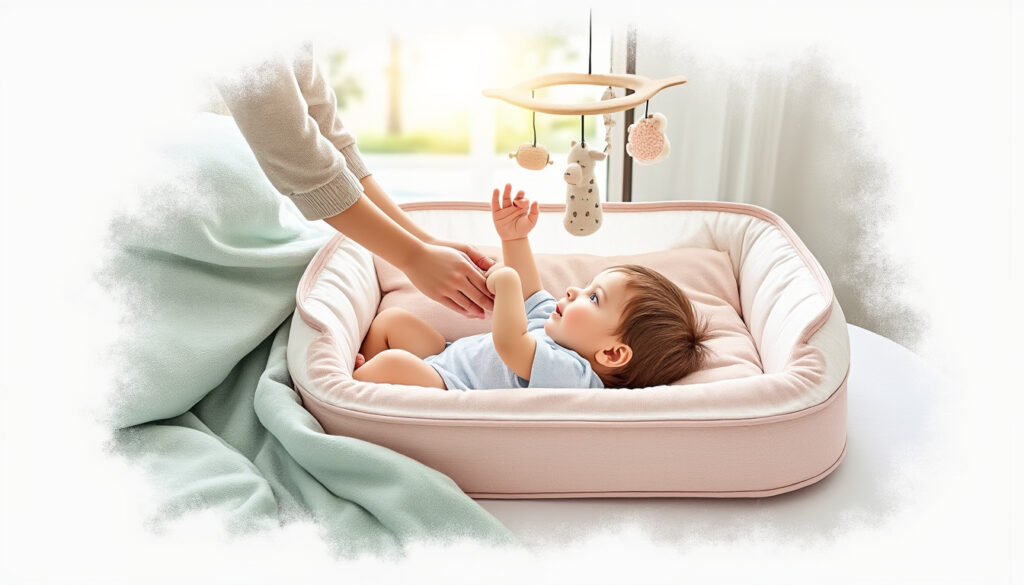
In brief
- A well-chosen travel cot protects the child’s sleep and safety while traveling, without turning every departure into a logistical challenge.
- The included mattress is designed for the portable baby bed structure; adding a topper not provided by the manufacturer increases risks (instability, gaps, overheating).
- Ease of transport depends mainly on weight, folded volume, and bag quality, more than on “bonus” options.
- Options like the second height, playpen mode, or changing table improve practicality but often make the portable furniture heavier.
- Duration of use of a true folding bed often lasts up to 3 years, with variations depending on the child’s size and motor skills.
- Safety is about concrete details: locking bars, floor stability, absence of play in the structure, and strict adherence to the manual.
Top travel cots: understanding what really makes nomadic comfort
On the road, a baby’s sleep quickly changes texture. The air doesn’t smell the same, the light doesn’t fall in the same place, and background noises don’t settle with the same regularity as at home. Nomadic comfort depends not only on a “good bed” in a broad sense but on a coherent combination of stability, ventilation, sensory cues, and rituals that follow the child.
A travel cot precisely meets this need for continuity. Its main advantage, when well designed, lies in a simple mechanism. The frame unfolds quickly, the bedding is set up without tools, and the structure folds around a central axis to become a compact column. Some lighter formats work with a “pop-up” opening, closer to a tent: this is often appreciated when setting up in a narrow hotel room or an already occupied living room.
The comfort of a portable baby bed is first judged by what the baby feels when placed in it. A baby a few weeks old has immature postural control. Their axial tone develops, head-trunk coordination improves, and falling asleep remains very dependent on the quality of support. A mattress that is too soft creates a feeling of instability. A mattress that is too thin and laid on a too rigid base can increase micro-awakenings, especially during sleep cycle transitions, which are more frequent before 4-6 months.
Most travel cots come with a mattress, and this is a point to watch carefully, not to “improve” at all costs but to stay within the configuration validated by the manufacturer. Adding a topper not specifically provided can create gaps between the mattress and the sides or change the effective height of the walls. This is a direct child safety issue, not a comfort detail.
Child mobility also requires reflection on the place of use. A portable bed can be used for baby travel but also as extra bedding at relatives’ homes. In this context, regularity reassures. Keeping the same sleeping bag, the same comfort object (if the child has one), and a short ritual before bedtime support melatonin secretion, which becomes more stable over the months. The best structure in the world does not replace a predictable environment, but it can prevent the installation itself from becoming a source of tension.
Must-have models are not necessarily those that pile up the most features. They are the ones that open without struggle, lock without ambiguity, don’t creak, and remain stable even when the baby starts to stand up. This stage usually occurs between 8 and 10 months, with normal variability. From then on, an unstable folding bed is quickly noticed because the baby tests the limits of the structure by moving around, bouncing, or grabbing the sides.
The next step is to turn these criteria into concrete and verifiable choices, so that practicality is not a marketing argument but a real experience daily.
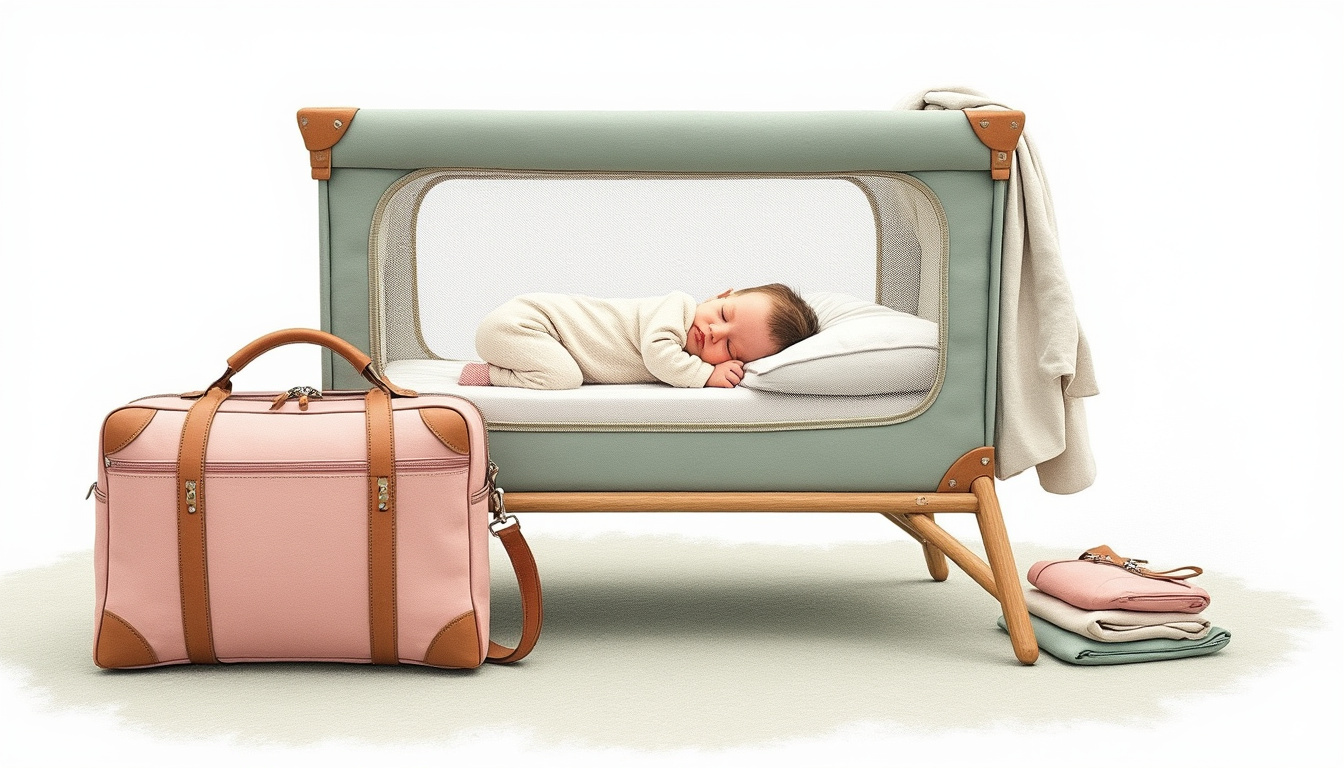
Must-have models: criteria that avoid bad surprises (weight, folding, options)
A travel cot comparison becomes useful when it reflects reality. Reality is catching a train, a trunk already loaded, a narrow stairway, or a late check-in after a baby trip. In those moments, the most protective criterion for your balance is not “design” but ease of transport and ease of assembly without contortions.
Weight is a simple marker. A lighter model is easier to carry, especially when the other hand manages a diaper bag or a car seat. Folded volume matters just as much. Two beds of similar weight can differ greatly in compactness and bag quality. A too-soft bag deforms, catches zippers, and eventually makes every storage irritating. A structured bag with a smooth zipper and a sturdy handle changes life in the long run.
Options are tempting, and some are truly relevant. A second sleeping height can relieve parents’ backs during the first months when the baby is light and not yet sitting up. A playpen function can be useful during awake phases when child mobility explodes and the environment is not perfectly safe. An integrated changing table helps out in poorly equipped rentals. The downside, very concrete, is that these elements often increase weight and bulk, complicating transport by train or plane.
The budget is often between 80 and 300 euros, depending on material quality and accessories. A price increase is not automatically a gain in child safety. It can correspond to options, better fabric, or smoother mechanics. A good guideline is to ask if the extra cost improves a real constraint. A portable baby bed bought for two weekends a year does not have the same requirements as a bed used weekly at grandparents’.
Another subtle but decisive point concerns ventilation. Mesh (net) sides allow better air circulation and reassuring visibility. They also enable observation without turning on bright lights. When a baby falls asleep, their micro-movements are frequent, and parents benefit from being able to check a position, clothing, or pacifier without intrusive intervention.
A chart to choose according to your real use, not a promise
| Mobility situation | Concrete priority | Recommended configuration | Child safety watchpoints |
|---|---|---|---|
| Frequent train/plane trips | Weight and compactness for ease of transport | Light travel cot, sturdy bag, quick folding | Clear bar locking, no play in corners |
| Car travel, regular weekends | Simple assembly and stability | Reliable standard model, original mattress well fitted | Do not add a topper not provided by the manufacturer |
| Vacation home or at grandparents’ | Sleep comfort and long use | Robust folding bed, breathable fabric, possible second height option | Height adapted to age, stop second height as soon as baby sits up |
| Poorly equipped housing, long stays | Daily practicality | Changing table option if truly used, integrated storage | Floor stability and no hanging accessories in sleep space |
This type of reading avoids a common trap. Buying a too-equipped portable furniture and then leaving it at home because it’s too heavy means losing both practicality and budget. The next challenge lies in the precise folding gesture because a neglected mechanism eventually becomes less safe.
Ease of folding and storage: the precise gesture that protects the mechanism and safety
When a travel cot is new, it sometimes seems “resistant.” This feeling leads some parents to force a bit, especially under pressure. The mechanism doesn’t like to be rushed. Proper folding limits wear, reduces blockage risks, and contributes to child safety by ensuring complete locking at the next assembly.
The gesture always starts with what prevents accidental folding. Many models use hook-and-loop fasteners, like Velcro or Scratch, located on the lower outer part. They stabilize the structure. They must be detached before trying to close the bed. Next, the mattress provided is removed. It often serves as a cover or protection around the folded bed, reducing friction inside the bag and preventing fabric damage.
The most common mistake concerns the sequence order. Not all models fold exactly the same way. Some require unlocking the side bars before activating the center. Others require the opposite. Following the manual, even if it seems repetitive, reduces “intuitive” manipulations that eventually deform a joint. When a bar starts to catch, the parent compensates by pulling harder, and the cycle sets in. Practicality disappears, and a structure that “resists” becomes a source of doubt when putting the child to sleep.
In practice, the good method is to train at home. Two or three assemblies and foldings are often enough for the hands to learn the sequence. This gestural memory becomes precious during baby trips, especially when bedtime is already fragile. A baby senses adult tension, and falling asleep becomes complicated when the atmosphere is charged. It’s not a matter of tantrum. The young child’s nervous system co-regulates with the environment. A smooth gesture, a low voice, soft light support the transition to sleep.
Storage also has a safety dimension. A poorly folded and compressed bed can twist part of the frame. On the next assembly, the bar may seem locked without being fully so. It’s rare but real. A simple check is to verify, once the bed is open, that all four sides are firmly “locked,” without flexing when moderate pressure is applied by hand. The base must be taut, and the original mattress must lie flat, without sagging.
A short checklist before putting the baby to sleep
- The side bars are locked and do not fold when moderate pressure is applied.
- The provided mattress lies flat, with no visible lateral gap between the mattress and the wall.
- The bed rests on a stable surface, with no rocking when a hand presses on a corner.
- No soft objects are added in the sleeping space, even to “calm” or “prop”.
These actions seem simple. Their value is in becoming automatic, especially when fatigue sets in. Once the mechanism is mastered, the next question arises quickly among parents. Until what age is this portable baby bed suitable, and how to adjust use as the child grows?
Until what age to use a portable baby bed: age guidelines, motor skills, and occasional uses
Age is not the only criterion, but it provides a first compass. For a newborn, a small bassinet or folding cradle may suffice for a weekend, especially if the accommodation is quiet and space is limited. At this age, the main need is a flat, stable, compliant sleeping surface with simple installation. Most parents also seek reassuring proximity because the baby sleeps in segments, with frequent awakenings linked to immature cycles.
The “real” travel cot makes full sense when trips become regular or when the child often sleeps away from home. In many families, it is used up to 3 years. This limit often reflects a combination of the child’s size, climbing ability, and manufacturer height or weight recommendations. A tall and very active child may feel cramped sooner. Another, smaller or more cautious, may sleep comfortably longer.
The useful question concerns child safety related to motor skills. Around 6-9 months, many babies learn to sit up, then to straighten with support. At this stage, a bed whose walls are high enough and structure stable is protective. Must-have models in this context are those that remain rigid when the child grabs on. A bed that wobbles or deforms encourages internal falls and startled awakenings.
Use at grandparents’ or friends’ homes deserves particular attention. The folding bed is often assembled and left in place for several days. This is comfortable for adults but increases the chance that an accessory is slipped in “to help.” A pillow, a rolled blanket, a crib bumper taken from another bedding. For the baby, these additions increase risks of rebreathing, overheating, or entrapment, especially before 12 months. Nomadic comfort is better built with a sleeping bag adapted to temperature and a clear environment.
Sleep while traveling also varies according to temperament. Some babies fall asleep anywhere. Others need a more gradual transition, especially between 4 and 8 months, when attention sharpens and the environment draws more focus. In these cases, setting the portable baby bed in a stable corner with dimmer light helps the brain understand that activity is decreasing. White noise can be useful but only if kept at a low and constant volume.
Consultation box: when to seek advice rather than multiply adjustments
Consultation with a pediatrician, midwife, or childcare nurse is advisable if the child shows any of these signs during or after a stay with the travel cot, especially if it persists beyond 48 to 72 hours despite a return to the usual routine.
- Unusual noisy breathing, chest retractions (hollowing between ribs), grayish complexion or bluish lips.
- Refusal to eat, repeated vomiting, fewer wet diapers than usual.
- Inconsolable crying with atypical posture, excessive drowsiness, or on the contrary extreme agitation that does not ease.
- Fall or shock during installation, even if the child “seems fine,” with secondary vomiting or decreased tone appearing later.
These indicators are not meant to alarm. They mainly prevent attributing a clinical sign to a “bad bed” when it deserves professional attention. When health is good, it remains to choose the right model according to your travel style and distinguish what belongs to practicality from marketing.
Top travel cots in 2026: selecting according to child mobility and type of baby trip
A useful “top” is not about stacking product names but identifying profiles of must-have models. Families do not all travel the same way. Some take long car trips. Others alternate train, plane, and temporary accommodations. Child mobility also imposes evolving constraints because a 2-month-old baby does not have the same needs as a 2-year-old child who walks, climbs, and tests limits.
The first profile is the ultra-compact travel cot. It targets ease of transport. It stores easily, carries without excessive effort, and sets up quickly. This format is particularly suitable when the bed is handled frequently. The compromise sometimes lies in the thickness of the original mattress, which can be more minimalist. In that case, the answer is not to add a “universal” topper but to choose from the start a model whose mattress is considered satisfactory or a model offering a mattress option approved by the brand.
The second profile is the “enhanced comfort” nomadic bed. It is somewhat heavier but offers better suspended bedding, more breathable textiles, and a structure that moves little. It often becomes the spare bed at grandparents’. Its robustness is appreciated over time. After several foldings, a good model remains smooth. Closures keep sliding, joints do not develop play, and the bag does not tear.
The third profile groups practicality-oriented models. Second height, storage, changing table. These are real benefits when the environment is poorly equipped. They can reduce mental load, especially in the first months. The nuance is simple. The more accessories, the more parts to install, clean, check. For some parents, this is a gain. For others, it turns every departure into a checklist. The right choice is the one that aligns with your real energy.
The fourth profile is the travel cot convertible into a playpen. For very active babies, this dual use can be valuable. The secured space during awake times prevents having to “baby-proof” an entire rental apartment urgently. Child safety then relies on stability and the absence of small accessible elements. A playpen-bed must not be cluttered with objects in the sleeping area. Separation of time, awake versus sleeping, also helps the child understand the context change.
To anchor a choice, a useful guideline is your frequency estimate. Two stays a year do not justify the same expense as weekly use. The price between 80 and 300 euros then becomes clear. The most expensive models are not “better” by principle. They are sometimes more suited to specific constraints like flying, frequent moves, or intensive use.
A successful portable baby bed is one you assemble without raising your heart rate, even in an unfamiliar room, even after a long day. This is often the sign that the mechanics, weight, and setup logic are truly compatible with your daily life.
Is the mattress always included with a travel cot?
In the vast majority of cases, yes. The mattress provided is designed to work with the bed base and its dimensions. If a model is sold without a mattress or with a separate option, it is preferable to stick to the accessories offered by the manufacturer to maintain a precise fit and a tested configuration.
Can you add a topper to improve nomadic comfort?
It is safer not to add a topper not specifically planned for this model. This can create lateral gaps, modify the useful height of the sides, and increase the risk of overheating. If comfort seems insufficient, the best lever is to choose a travel cot with a higher-quality original mattress or a mattress option approved by the same brand.
Up to what age can a child sleep in a travel cot?
Many folding beds are used until about 3 years of age, but the limit depends on the child’s size, motor skills, and manufacturer recommendations (size/weight). A child who climbs or tries to climb earlier may require a different solution before this age.
What signs indicate the bed is not installed safely?
A bar that does not lock firmly, a structure that rocks when pressure is applied on a corner, a bottom that is not well stretched, or a mattress that leaves a visible gap on the sides. In these cases, it is better to disassemble and start again calmly following the manual, rather than adjusting “halfway.”
Which option is most useful for regular baby travel: second height, playpen, or changing table?
It depends on your usage. The second height mainly helps the first months to save the back. The playpen mode becomes very practical when child mobility increases and the accommodation is not secure. The integrated changing table helps in poorly equipped rentals but often adds weight. The right criterion is to choose the option that responds to a constraint experienced at each stay, not an occasional situation.