In brief
- Halloween can remain a joyful celebration even with some chills, provided the level of light horror is adjusted to the child’s age and temperament.
- A film that “is just scary enough” often stimulates the alert system then calmness, especially if an adult stays available and the story offers clear landmarks.
- The most comfortable Halloween youth films alternate tension and humor, with ghosts, pumpkins, costumes, and scary adventures where the danger is contained.
- Winning choices for a family evening mix suspense and laughter, with a gentle aesthetic or a clear irony.
- A simple setting reduces nightmares, even after a somewhat intense movie, by protecting the falling asleep process and allowing space for talking.
Choosing Halloween youth films according to age, temperament, and sensitivity to chills
At Halloween, the same film can trigger bursts of laughter in one child and a restless night awakening in another. This difference is not surprising. Between 3 and 12 years old, the brain is still learning to distinguish between what is “for real” and what is staged, especially when the image is dark, the music rises, or a monster suddenly appears. The most reliable reference often remains observing your child in daily life. A child who already tenses at the sound of the vacuum cleaner or avoids overly realistic costumes doesn’t have the same margin as a child who loves inventing costumes and playing at being scared in the hallway corner.
Between 3 and 5 years old, imagination is very vivid and the day/night separation remains fragile for some. Typical Halloween figures—translucent ghosts, witches, creaking pumpkins—can be perceived as intrusive. At this age, the films that work best have lots of light, readable faces, and explicit humor. Casper often ticks these boxes because the “ghost” is more a companion than a threat. Children also pick up safety signals in the narrative, like a haunted house becoming a playground rather than a trap.
Between 6 and 8 years old, story comprehension sharpens. The child better tolerates suspense, provided there is a clear return to calm and reassuring adults in the film. Scary adventures then become emotional training ground. The body feels the adrenaline rise, then learns to come down, resembling a mini rehearsal for stress management. Animated films with stylized visual codes, like Monsters, Inc. or Hotel Transylvania, often allow this experience without overload.
Between 9 and 12 years old, some children seek a more direct dose of tension. The danger is not fear itself but isolation in the face of fear. When a child watches a more intense film, they might “hold on” at the moment and collapse later, at bedtime, when the brain releases vigilance. Choices around Coraline, Monster House, or The Prophecy of the Clock can be very appreciated, but benefit from accompaniment, especially if the child is prone to ruminations. A slamming door or a frozen stare scene can replay repeatedly in the head, even if the child says everything is fine.
A simple reference helps a lot: if the child already has nightmares more than twice a week, or persistent difficulties falling asleep, a very image-heavy dark Halloween evening often increases the likelihood of a disrupted night. In most cases, it’s not “serious,” it’s a nervous system still learning. The theme that follows matters as much as intensity. Stories of loss and separation, even poetic ones, sometimes touch more deeply than a funny monster.
Choosing a film is not done solely “by age.” It’s done by dose, form, and context, and that’s when the evening can become an enjoyable moment, even with chills, without turning Halloween into a bedtime battle.
Creating a Halloween evening without nightmares, even with light horror and suspense
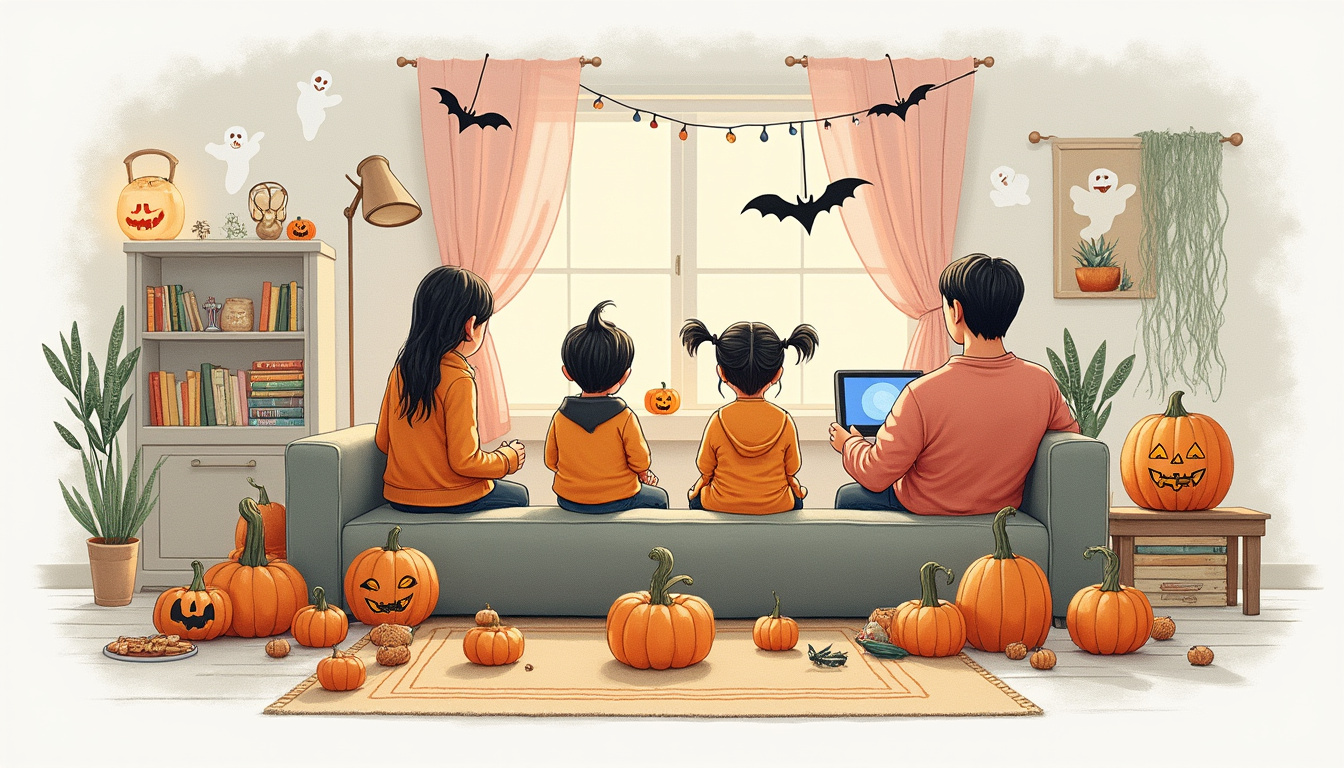
An evening of youth films for Halloween often hinges on details. The film matters, but the environment matters almost as much. A child’s brain quickly associates elements together. An overly dark room, accumulated fatigue, a meal that is too sweet or too late, then a film with suspense, all this can amplify emotional reactivity. The objective is not to avoid any tension surge, but to organize a smooth descent.
The first adjustment is the schedule. For many children aged 3 to 8, falling asleep becomes more fragile after 8:30–9 pm because fatigue reduces the ability to self-regulate. For a Halloween evening, an earlier start to the film allows time to return to calm. This “decompression” time is often what makes the difference between a pleasant chill and a scene that lingers when closing the eyes.
The second adjustment is co-viewing. Watching together is not only a presence. It is a safety signal. When an adult stays nearby, the child’s alert system activates less intensely and quickly calms down. Children also watch your face. A parent who laughs, simply comments on a scene, puts words on what’s happening, helps the child categorize the emotion. A short sentence suffices. “Here, the music is purposely rising to scare.” “The monster is ridiculous, look at its steps.” It’s not a lesson; it’s guidance.
The third adjustment is choosing the “style of fear.” A light horror based on comedy and irony works better for many families than fear founded on discomfort. Ghostbusters or Hotel Transylvania often make people laugh because the threat is instantly defused by jokes, music, or caricature. Conversely, some highly successful artistic works, like Coraline, can leave a more lasting impression as the strangeness is subtle, and the brain likes to fill in the blurry areas.
A post-film ritual reduces awakenings. It doesn’t need to be long. A warm drink suited to the age, a bathroom visit, then a very short and bright story. The goal is to change the sensory register. Many children regulate through the body. A gentle pressure on the shoulders, a wrapping hug, or simply sitting on the edge of the bed for two minutes can be enough to “switch the system to nighttime mode.” The concrete gesture to aim for is to avoid the direct shift screen dark → dark room.
When to wonder if the film was too strong? Observable signs help. Inconsolable crying, intense agitation with trembling, strong refusal to go to the bathroom alone when it was previously okay, or re-experiencing scenes the following day with withdrawal or irritability. If it lasts more than 48 to 72 hours, a simple discussion and a break from scary content are often more useful than minimizing. If massive fears set in, with somatization (frequent stomach aches before school, worsening sleep disorders), consulting a doctor, nurse, or psychologist can help understand what’s going on without dramatizing.
A successful Halloween evening rarely looks like a performance. It looks like a frame where the child can have fun, shiver, laugh, then sleep feeling the world remains predictable.
To prolong the atmosphere without overloading, some families like to play a very short trailer or a song associated with the film, then return to a calm space. Selected video content can also help you gauge the tone of a film before playing it.
Understanding what the child “works on” by watching Halloween films: fear, attachment, humor, and mastery
Watching youth films at Halloween is not just entertainment. It is often a form of emotional learning. The child’s brain trains to feel internal activation—heart acceleration, shoulder tension, very focused attention—then to return to a calmer state. This alternation resembles what happens in real life when the child must handle a conflict at school, a novelty, or separation at bedtime at someone’s house.
The mechanism is simple to observe. During a suspense scene, the alert system activates. The child might laugh loudly, talk a lot, or conversely freeze. These are three versions of the same regulation attempt. Laughter is not always a sign that “everything is fine,” sometimes it is a release valve. Silence is not necessarily a sign of distress; sometimes it is intense concentration. What matters is the ability to return to calm after the scene and how the child talks about it afterward.
Films that trigger bursts of laughter against a backdrop of monsters are often more reassuring because they give the brain a way out. Hotel Transylvania or Monsters, Inc. play with a very useful reversal. The monster, supposed to be scary, is himself overwhelmed, clumsy, endearing. The child reads an implicit message: what seems threatening can be understood, tamed, discussed. This reading is very different from purely anxiety-inducing fear, where danger remains vague.
The theme of death and ghosts, common at Halloween, deserves a precise word. Ghosts in cinema are often a metaphor for separation. For a child going through a period of questions about absence, grief, or simply family change, a film like Coco can have a deep impact. The film depicts a colorful world of the dead but also talks about memory, transmission, and place in the family. In most cases, this opens conversation. A simple sentence after the film helps. “What made you sad?” “What reassured you?” The goal is not to have a long discussion. One or two sentences are enough for the emotion to flow.
Highly stylized films, stop-motion or gothic universes, like The Corpse Bride or The Nightmare Before Christmas, have a paradoxical effect. They can be more acceptable than realistic images because the brain clearly identifies the fabrication. The textures, slightly jerky movements, colors create distance. This distance protects some children. Others, on the contrary, are very sensitive to strangeness and frozen faces. Again, temperament guides more than the “for children” label.
When the film is too intense, the reaction may come at bedtime, not during the session. The brain discharges late when the child has no more distraction. A child who asks for light, wants the door open, or asks to check a closet is not “testing.” They seek a sensory reference that helps them feel the environment is stable. A small adjustment often works. A soft nightlight, the door ajar, a transitional object, then a consistent, identical sentence each night calmly said. Repetition is soothing because it makes the end of the day predictable.
If fear becomes invasive, with refusal to go to school, repeated stomach pains, panic attacks, or insomnia lasting more than two weeks, a consultation is relevant. A pediatrician can check there is no associated somatic factor. A child psychologist can help decode what the fear tells, without forcing the child to “talk about everything.” In the vast majority of Halloween evenings, a good adjustment of content and setting is enough. Cinema remains what it should be: an emotional playground with an adult hand nearby.
The next step is to link each age group to concrete gestures and a way to present the film, so the evening’s pleasure stays compatible with sleep and daily life.
Concrete rituals before and after the film: costumes, pumpkins, and emotional regulation
Rituals around Halloween are not gimmicks. For a child, they serve as borders. When the evening is structured, emotion flows better. Costumes, pumpkins, and little routines transform sometimes overwhelming content into manageable experience. The brain likes sequences: beginning, middle, end. This also applies to a film evening.
Before the film, a playful activation time often helps. Carving a pumpkin, making paper decorations, or preparing a simple snack tray. Movement and handling reduce anticipatory tension. Fear rises more when the child waits doing nothing, already in a dark atmosphere. Conversely, a short activity channels energy and prepares the body to sit afterward.
The choice of costume can also be a tool. A worried child better tolerates a costume that remains soft to the touch, doesn’t hinder breathing, and does not deform the face. Rigid masks sometimes increase anxiety because they blur expressions and create a feeling of strangeness. Simple makeup, done in front of a mirror, allows the child to see the transformation gradually. This gradualness reassures. It gives a sense of control.
During the film, managing volume and light changes the experience. Too loud a sound triggers a startle reaction that can stay in the body. A small side lamp, placed behind the couch, avoids complete darkness without breaking the Halloween atmosphere. Children aged 3 to 7 often enjoy more when the adult comments very little but remains present. Talking all the time breaks immersion, and some children get annoyed. Staying available, answering if the child asks, and offering a break if tension rises, is generally enough.
After the film, the return to calm is built through the sensory. A quick shower, a face wash to remove makeup, putting on soft pajamas, then a room not too warm. Body signals tell the brain we are changing registers. The film discussion can be brief. A 6-year-old might say “I was scared when the door slammed.” A 10-year-old might comment on the plot and humor. In both cases, listening without long analysis is often the best calming method.
When a child wants to see a scene again “to be sure,” it sometimes surprises. Yet it is a frequent strategy. The brain seeks to regain control of a striking image. Watching a scene again in daylight, without loud sound, can help some children defuse it. Others will be more impressed the opposite way. Again, observing the reaction guides the decision. If the revisit increases activation, it’s better to offer something else, a funny clip, a happy ending scene, or bright content.
Clear framing also helps siblings. Older ones sometimes like to prove they can handle a more intense film. Younger ones imitate and “hold on,” then crack later. Separating sessions is no luxury. It’s a family adjustment. A short film for the little ones, then a more intense film for the older ones, can transform the evening into a smooth moment rather than a frustrating compromise.
The simple gesture that protects sleep is to end with a familiar and reassuring scene. A well-known episode, soft music, or a repeated short reading. Halloween then remains a celebration where emotions are allowed to exist without overflowing into the night.
At what age can a Halloween film with ghosts be considered?
Between 3 and 5 years, ghosts usually go better when they are clearly friendly and drawn, like in Casper. Around 6–8 years old, the mystery can be more present if the story resolves reassuringly. The most reliable reference remains the child’s reaction to dark images and sound surprises, more than the age listed on a platform.
What to do if the child laughs a lot during the film but then has a nightmare?
Laughter can be a way to regulate tension. After the film, a calm-down period often helps, with soft light, bathroom visit, then a short and stable routine. If nightmares repeat for several nights, reducing the suspense intensity, avoiding films right before bed, and favoring fantasy comedies with more frequent laughter generally improves the situation.
Are films like Coraline or Monster House too scary for primary school?
They can be suitable from 9–10 years old in children who tolerate strangeness well and are not prone to ruminations at bedtime. Some 8-year-olds will handle them very well, others at 11 will be impressed by the atmosphere. Co-viewing and the possibility to stop after 10–15 minutes if tension rises remain simple and effective safeguards.
How to keep the Halloween atmosphere with pumpkins and costumes without exciting the child before night?
Plan an activity time early in the evening, then a gradual calming down after the film. Comfortable costumes without rigid masks limit agitation and strange sensations. After the session, remove makeup, change into pajamas, and keep soft lighting so the body understands the party is ending and the night is beginning.