
In brief
- Guided exploration of the 12 countries and their capitals to better navigate an interactive map of South America, without confusing political borders and large natural regions.
- Clear reading of South American geography through two major structures, the Andes mountain range and the Amazon basin, to connect relief and climate.
- Useful topography landmarks, with simple ways to “read” a map as one learns to read a toddler’s signals, without getting lost in details.
- Concrete navigation tips on maps (zoom, layers, scales, points of interest) to prepare realistic itineraries, from travel to geography lessons.
- A clear chart of South American countries and their capitals, to anchor names in a comprehensible and memorable cartography.
Interactive map of South America: stable landmarks to locate yourself without getting lost
In a family, there are moments when the mind looks for a fixed point. When nights are short, when attention is fragmented, the brain appreciates what structures. An interactive map of South America can play this role of a landmark, because it transforms a mass of information into simple gestures. Zooming in, moving, displaying a layer, then returning to the general level, like adjusting a baby’s environment to help them organize.
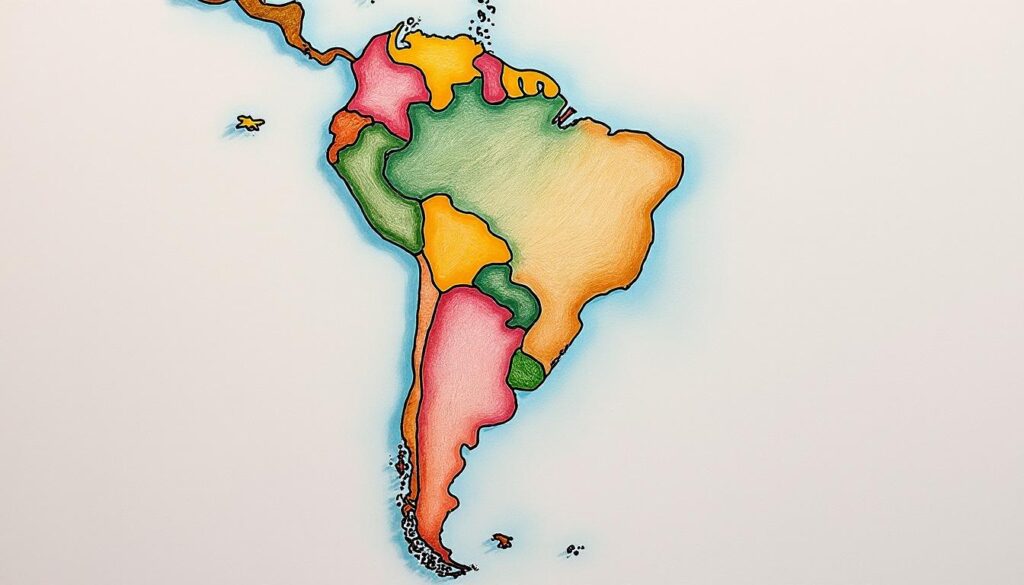
The first useful anchor concerns the composition of the subcontinent. South America includes 12 countries when referring to sovereign states. French Guiana is not counted, since it is an overseas French territory, even if it is on the continent. This distinction avoids frequent confusion during a school exploration, a trip preparation, or a geography quiz.
A well-designed interactive map highlights political borders while allowing natural elements to be displayed. This is where the tool gains value. A static map shows. An interactive map explains, because it allows comparison. Parents know the difference between “seeing” and “understanding.” Seeing a baby fuss is not yet understanding whether it is a Moro reflex, tiredness, or digestive discomfort. On a map, seeing a mountain range is not yet understanding its impact on roads, climates, and population densities.
Another often cited anchor to locate the region on a world scale is the size of Latin America, around 17,840,000 km² in some geographic summaries. This magnitude helps to understand the vast distances and diversity of environments. When an itinerary “seems close” on screen, the scale reminds that a journey can take hours or even days. The human brain easily underestimates distances when it lacks solid reference, especially on mobile devices.
To work with a child, printing a blank map remains an effective strategy. The interactive version is used to verify, adjust, enrich. The paper version is for memorizing, appropriating, tracing. This alternation saves time and reduces mental load. Some parents use the same principle for the bedtime routine. The screen to understand an instruction, then the simple gesture to integrate it.
This “landmarks first” approach also applies to other contents that structure family curiosity. A detour through a map of Corsica between sea and mountains often helps to compare a European island to a South American continent, and to concretely feel the notion of scale.
South American countries and capitals: political cartography that becomes memorable
A map is not just a drawing. It is an organization. For political cartography to become memorable, the brain needs stable associations. The South American countries are Argentina, Bolivia, Brazil, Colombia, Chile, Ecuador, Guyana, Uruguay, Peru, Venezuela, Suriname, and Paraguay. When an interactive map allows clicking on each country, learning happens in short loops. Information, verification, repetition.
Capital landmarks help consolidate. Some capitals are easy to remember because they frequently appear in the media or culture. Others require a bit more practice. The important point lies in accuracy. Brazil’s capital is Brasília since 1960. Many keep “Rio” in mind because the city is better known. An interactive map highlighting the capital avoids this mistake without blaming. Confusion is not a failure; it signals that the association was not yet stable.
Bolivia also requires nuance. La Paz is often given as the capital because it hosts the government seat. In many references, Sucre remains the constitutional capital. An interactive map can indicate this dual status depending on sources. When a tool shows only one name, it is better to check the legend or explanatory note. This ability to verify information is a skill to pass on early and serves well beyond geography.
| Country | Capital | Quick reference for map navigation |
|---|---|---|
| Argentina | Buenos Aires | Southern cone, Atlantic coast |
| Bolivia | La Paz | Altiplano, near the Andes |
| Brazil | Brasília | Center-east, visible urban planning |
| Colombia | Bogotá | Northwest, access to Caribbean and Pacific |
| Chile | Santiago | Long coastal ribbon, Andes to the east |
| Ecuador | Quito | Near the equator, marked Andean relief |
| Guyana | Cayenne | Northern coast, forest and coastal territory |
| Uruguay | Montevideo | Small Atlantic coast, south of Brazil |
| Peru | Lima | Pacific coast, Andes in the background |
| Venezuela | Caracas | North, Caribbean arc |
| Suriname | Paramaribo | Northeast, coastal and inland forest |
| Paraguay | Asunción | Inland, major structuring rivers |
To help a child remember, the interactive map can be used as a short game without turning the house into a classroom. Three minutes are enough if regular. Click on a country, say the name, find the capital, then close. The brain consolidates better with a brief repetition than with a long session at the end of the day.
This “small doses, clear landmarks” logic resembles what works with a toddler. A baby learns through repeated micro-experiences. Parents notice when a simple, repeated gesture becomes a learned skill. On a map, it’s the same. Learning stabilizes when navigation is predictable.
Relief, Andes and Amazon: understanding topography to give meaning to landscapes
A map becomes truly expressive when it connects topography and everyday life. South America is often read through two natural structures that organize the continent. The Andes mountain range, a long backbone to the west, and the Amazon basin, a vast forest and river system in the north and center. An interactive map that overlays these layers makes the information almost tactile. Relief is no longer an abstraction; it becomes a constraint and a resource.
The Andes explain many things. Altitude variations influence temperature, oxygenation, agriculture, and even how cities develop. When a map displays altitude as the cursor passes, the link is immediate. A high-altitude city does not have the same climate as a coastal city at the same latitude. This kind of understanding protects from “too simple” ideas that waste time, such as thinking Ecuador is always hot because it is near the equator.
The Amazon basin, on the other hand, reminds of the importance of rivers and plains. On an interactive map, displaying waterways helps understand itineraries that are not only by road. In some areas, the river remains a main axis. Careful exploration also shows why some regions are less densely populated, without falling into a single explanation. Access, relief, ecosystems, history, economic choices all play together.
A physical map (relief, hydrography) and a political map (borders, capitals) do not tell the same story. Confusing them leads to misreading. A simple example lies in borders that do not always follow natural barriers. Lines are sometimes inherited from colonial periods or diplomatic compromises. An interactive map allows switching between them and noticing these differences within seconds.
In a family, this observation can become a calm conversation about the complexity of the world. Children quickly sense when an explanation is too rigid. A nuanced discourse reassures them because it leaves room for reality. Parents already practice this flexibility. When a baby has variable rhythms, the response is not to force a norm, but to observe, adjust, and consult if concrete signs appear.
In the context of a trip, a map showing the relief avoids unrealistic routes. A “straight” road on screen may cross mountains, protected areas, or slower sections. For a school project, relief becomes a guiding thread. The Andes explain climates, agricultural cultures, urban densities. The Amazon explains ecosystems, environmental issues, and transportation methods.
A simple reference helps to avoid exhaustion. When a map offers too many options, it’s better to start with three layers maximum. Borders and capitals, relief, hydrography. The rest comes later. This gradual approach reduces cognitive overload and makes Exploration more pleasant, even after a busy day.
Navigation on an interactive map: precise gestures to prepare reliable itineraries
Navigation on an interactive map is a skill. It seems intuitive, then tires if not structured. On mobile, the most frequent mistake comes from zooming. Too close, the user loses the big picture. Too far, information mixes together. A simple strategy is to set a “comfort level.” At that level, countries remain readable and capitals appear. Then, zoom only on a targeted area.
The choice of scale changes perception of distances. For itineraries, the scale must be coherent with the means of transport. A flight route is thought of as wider lines. A land route requires looking at relief, axes, sometimes border crossings. An interactive map showing estimated travel time and main roads helps anticipate, but may underestimate local variability. It is better to complement with field sources when the project is concrete.
Some parents use the map as a dialogue tool with a child. The rule that works is the same as with a baby. One instruction at a time. Find a country. Then its capital. Then a relief feature. Only then build a story. This progression avoids dispersion. It gives a sense of achievement, which fuels the desire to continue.
Layers, legends and colors: avoiding the most common confusions
The colors of a political map do not represent soil type. They serve to distinguish administrative entities. Confusion arises quickly when a child thinks “green” is a forest, whereas it is only a graphic code. An interactive map allows verification by changing modes. Political, then physical, then satellite. Understanding builds by switching from one to the other.
The legend is not a detail. It is the translation tool. When a map offers symbols for capitals, roads, parks, relief zones, spending thirty seconds on the legend avoids ten minutes of mistakes. This short time is rarely lost, especially when fatigue makes attention fragile.
Print a blank map: a simple gesture that consolidates cartography
Printing a blank map of South America serves to anchor. The child places countries, then capitals, then major topography regions. The interactive map serves as a reference, the paper map as training ground. Memory strengthens when the hand participates. Writing “Lima,” tracing the Andes line, coloring the Amazon basin, these are gestures that stabilize knowledge.
This screen-paper alternation recalls a development principle. The brains of young children, and sometimes exhausted adults, incorporate better what passes through multiple channels. Seeing, saying, touching, writing. Geography then becomes an experience, not just information.
In a home seeking suitable cultural resources, some readings serve as a bridge. A text on rebellion in “Vipère au poing” can open a broader discussion on history, borders, and how societies build themselves, without turning the conversation into a lesson.
When navigation becomes smooth, the next step naturally unfolds. Linking points on the map to living places, cultures, real realities, so exploration does not remain virtual.
Explore to understand: landscapes, cultures, and concrete uses of an interactive map in the family
A successful geographical exploration is not limited to locating. It connects the map to concrete choices. Preparing a trip, choosing a documentary, understanding news, enriching a lesson. An interactive map becomes a sorting tool. It helps decide what deserves time and what can wait.
For a trip, the tool serves to calibrate. Distances, relief, crossings from one country to another, climates according to altitude. A family planning to cross several countries in a short time benefits from visualizing constraints. The Andes can lengthen land routes. Forest zones sometimes require detours. The Pacific coast does not offer the same axes as the Atlantic coast.
For a child, the map gives space to details that capture attention. Capitals, large rivers, mountain ranges, neighbors. These details become “hooks” for memory. A child often remembers better when information is linked to a specific image. A capital near a marked relief. A long and narrow country. A huge river basin. The interactive map provides these images in a stable way.
In the early years of parenting, mental time is limited. An activity that brings both information and calm is precious. Opening a map, choosing a country, looking at its location, then closing, can create a structuring pause. This pause does not need to be long. It needs to be simple and repeatable.
A short list of guided activities to avoid dispersion
- “Country-capital” mode in 3 minutes with three random countries, then stop before saturation.
- “Relief” mode displaying only the Andes and locating capitals near the range.
- “Itineraries” mode comparing a land journey and a flight between two capitals, to feel the scale.
- “Paper” mode by printing a blank map and first placing the 12 countries, then the capitals in a second session.
These short formats reduce tension. A child who loses focus is not “bad.” They have reached their attention limit at the moment. The interactive map allows resuming later without starting from scratch. This gentle continuity counts a lot in motivation.
If curiosity turns to first names, often related to otherness and travel, a detour through male first names starting with the letter L can extend the activity, because names and places are anchored together in memory.
The map then becomes a gateway to a living general culture. It respects the child’s rhythm and the parents’ fatigue. It offers structure without rigidity, and that is often what makes learning lasting.
How many countries does South America count on an interactive map?
Most interactive maps show 12 sovereign countries in South America. French Guiana often appears on the map, but it is not an independent country, which explains variations depending on sources and legends.
Why do a political map and a physical map give such different impressions?
The political map emphasizes borders, capitals, and administrative entities. The physical map shows topography, relief, rivers, and basins. Switching between the two helps link human boundaries to natural constraints, especially for understanding itineraries.
What is a simple method to memorize South American capitals and countries without spending an hour?
Work in very short sessions. Choose three countries, click, say the name, locate the capital, then close the map. Repeat several days in a row. Brief repetition consolidates better than a long session when attention is fatigued.
Why is Brasilia the capital of Brazil and not Rio de Janeiro?
Brasília has been Brazil’s capital since 1960. Rio de Janeiro is a major and well-known city, which causes frequent confusion. An interactive map that displays capitals quickly corrects this association.
When is an interactive map not enough to prepare itineraries in South America?
When a trip is concrete and imminent, especially in areas with marked relief or variable access, the interactive map must be complemented by field information. Travel times, local conditions, and certain routes can change. Checking with local sources or updated transport tools makes the itinerary more reliable.