
In brief
- Grandfathers’ Day takes place on the first Sunday of October and has existed since 2008, a simple occasion to highlight the everyday heroes.
- For young children, the celebration often involves short and concrete gestures that provide reassurance, such as a reading ritual or a repeated walk.
- The intergenerational bond nourishes the family on two levels at once, emotional and developmental, supporting emotional security and language.
- A successful gift does not need to be expensive; it benefits from carrying a trace of the child, a phrase, a photo, a drawing, a recounted memory.
- With MOMES, it becomes easier to exchange activity ideas and create memories that respect the child’s age and the adults’ energy.
Let’s celebrate grandfathers: understanding the origin and meaning of a family celebration with MOMES
In many households, the holiday calendar circulates on the fridge, then ends up imposing itself at the pace of laundry, naps, and school returns. Grandfathers’ Day fits into this reality quietly, but with a strong emotional significance when thought of as a meeting rather than a performance. Since 2008, grandfathers have their dedicated day in France, set on the first Sunday of October. This stable marker helps children anticipate and visualize time, which matters a lot between ages 2 and 6, when the notion of “later” remains very concrete.
Grandmothers’ Day, older, has long been the sole occupant of this symbolic ground. To place Grandfathers’ Day within a family and societal history logic, it can be useful to look at the roots of these celebrations. A detour through the history of Grandfathers’ Day illuminates how a recent tradition can become a solid emotional appointment, provided it is connected to simple, regular gestures.
The question is not about “doing the right thing,” but about building an experience the child can understand and remember. In the preschool age, autobiographical memory consolidates in fragments. It fixes better when an event is linked to a tangible object or routine, like a printed photo, a recipe made again together, or a phrase repeated year after year. What touches a child is not originality; it is coherence. Presence, voice, the scent of a scarf, the way of holding hands, the tenderness in a predictable gesture.
The role of grandparents, especially grandfathers, also takes a particular place in development. Between 0 and 3 years, the child needs stable figures who help regulate stress. A calm, available adult who adjusts to the toddler’s pace becomes a safety base. A baby does not “benefit” from an adult. They organize themselves thanks to them. Emotional regulation is first external before becoming internal, and it is learned in those arms, in those voices, in those presences.
This perspective changes the way of viewing the celebration. It is no longer a social obligation but a moment making visible a form of discreet generosity, that of the everyday heroes who care, repair, tell stories, wait, come back. With MOMES, the celebration often unfolds in accessible ideas, thought for children and realistic for adults. A practical support is also found in MOMES proposals for Grandfathers’ Day, allowing one to choose an activity appropriate to the age without overloading the day.
The rest becomes clearer when leaving history for the concrete, that of interactions and gestures that build a solid attachment over weeks.
Grandfathers, everyday heroes: what their presence brings to child development
A grandfather does not need to be outgoing or “very playful” to matter. In the young child’s brain, what imprints is reassuring repetition. A familiar face, a stable way of speaking, a recognizable body posture. Before 12 months, the child orients mainly by voice, smell, and rhythm of gestures. Between 12 and 24 months, they better recognize routines and begin to anticipate. These are expected neurodevelopmental skills, with variations depending on temperament.
When a grandfather arrives and always greets the same way, he contributes to building predictability. This predictability is not rigid; it soothes. It reduces the alert load on the nervous system. A child who feels safe explores more. They go away, come back, go away again. This is exactly what secure attachment seeks. This security is built in ordinary moments, not in demonstrations.
Language is nourished by intergenerational exchanges
The speech addressed to the child has a direct effect on language development. Grandfathers often have a different tempo, slower, less rushed by immediate organization. This slowness can become an advantage. A child from 18 to 30 months particularly benefits from an adult who leaves silences, waits for a response, rephrases without harshly correcting. Comprehension precedes expression. A child can understand dozens of words before saying them, then make a vocabulary leap in a few weeks.
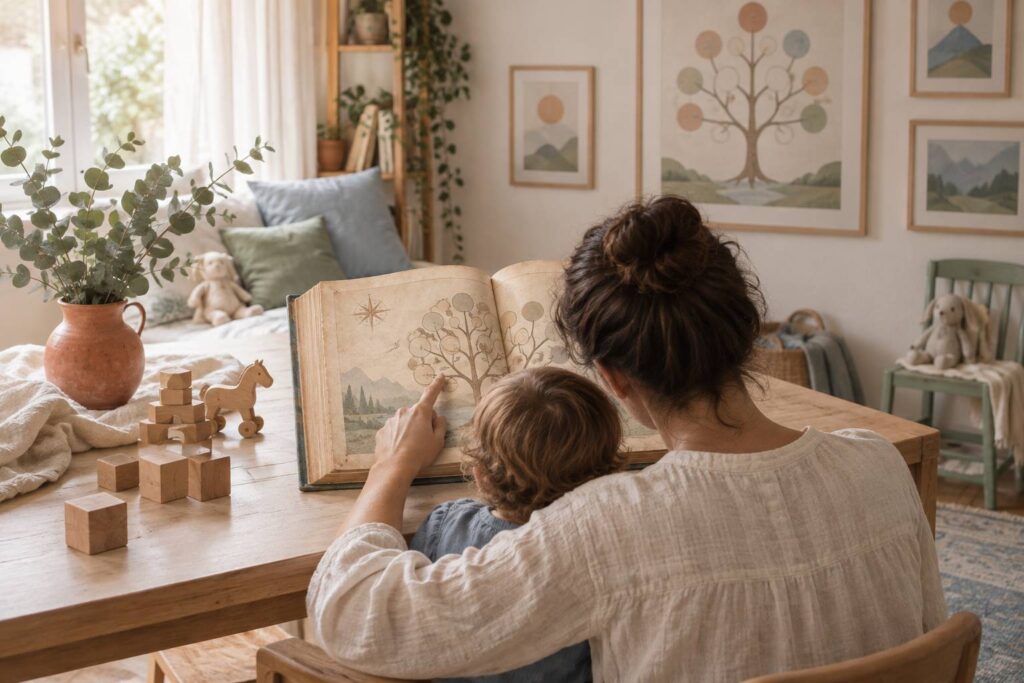
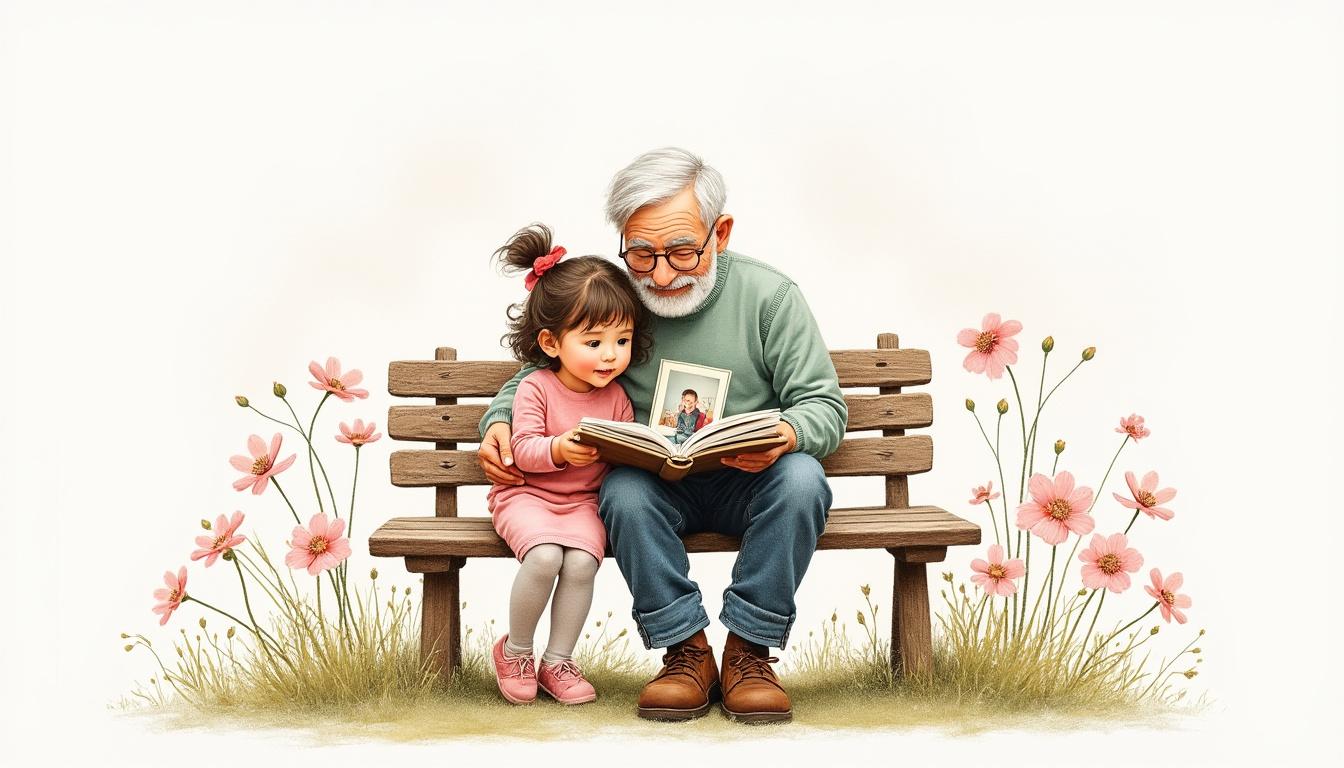
Memories told out loud also play a role. When an adult describes a photo, locates a place, names people, they give the child a narrative structure. This ability to tell “what happened” then supports school skills. An album flipped through together is not just an emotional object. It is a tool for language and mental organization.
Motor skills and confidence develop through well-calibrated challenges
Grandfathers often propose very concrete activities: tinkering, gardening, carrying a small plank, watering, pushing a miniature wheelbarrow. The interest is not performance but the calibration of the challenge. A 2-3-year-old child needs short tasks with a visible beginning and end. A 4-6-year-old likes missions, provided they remain within reach. When the adult adjusts the instruction, they implicitly teach self-efficacy, this inner feeling that says “it’s difficult but doable.”
This logic also applies to toddlers. Holding a baby in a sling, walking gently, showing a tree, speaking softly, are moderate sensory stimulations. They help the baby integrate information without overload. An overstimulated baby looks away, gets agitated, sometimes cries. It is not opposition; it is a nervous system saying “too much.” A grandfather who spots these signals and slows down becomes a powerful regulator without needing words.
The next step is to transform this understanding into realistic celebration ideas that respect the child’s age and the family’s energy, while putting love into circulation.
To vary ideas and see visual proposals, a video search can also inspire activities suitable for multiple ages.
Grandfathers’ Day: MOMES activities and rituals that create memories without overloading the day
A successful celebration, with young children, often takes place over time rather than a “big moment.” The first Sunday of October can be the climax, but the child mainly needs concrete cues in the preceding days. Preparing a card in two ten-minute sessions is often more effective than an hour-long workshop. Attention capacity builds gradually. Around 3 years, it remains short and fluctuates. Around 5-6 years, it becomes more stable, especially if the child understands the goal.
Activities that adapt to age, not the other way around
For a baby from 0 to 9 months, the celebration can remain entirely sensory. Skin-to-skin time with the parent, then a calm meeting with the grandfather, a gentle voice, hand-to-hand contact, a photographed moment. That baby will not “know,” but their body records safety. For a child from 10 to 18 months, an activity consists in sticking two stickers on a sheet and making a handprint with edible or very diluted paint, while watching the tendency to mouth.
From 2 years, drawing becomes more intentional. Fine motor skills remain immature. The gesture comes from the shoulder as much as the wrist. Offering thick crayons, washable markers, and only one instruction at a time avoids frustration. At 4-6 years, a child can dictate a sentence, then try to copy it. Letters are sometimes reversed, which is common until early school. The value of the message lies in the intention, not the form.
A list of simple ideas with strong emotional impact
- The “three details” card with a drawing, a print, and a phrase dictated by the child, then copied by an adult without “correcting” it.
- The small memory album with a maximum of 5 printed photos and two lines under each image, read aloud together.
- The transmitted recipe with a gesture the child can do, pour, mix, sprinkle, then offer a wrapped portion.
- The recounted walk by taking a photo of a single detail, a leaf, a door, a bench, then sending it later with a sentence.
- The photo frame decorated with paper collage, limiting glue and workshop time to 15-20 minutes depending on age.
These formats work because they are finished. A child needs to see that “it’s done.” This supports mental organization and reduces overflow at the end of an activity, common when fatigue rises.
When excitement overflows, regulation comes before success
Before a celebration, some children become more restless, oppositional, or clingy. This gap sometimes surprises. The immature brain poorly manages anticipation. Emotion takes up space; control capacity decreases. A shorter meal, a protected nap, and a progressive arrival at grandparents limit these overflows. A child who starts crying upon arrival is not “ungrateful.” They are moving from one context to another and need a transition.
This thread naturally leads to gifts. Not “what to buy,” but how to offer something bearing the trace of the child and the relationship, with simple reference points to choose without pressure.
For more concrete inspirations, video demonstrations can help adjust crafting difficulty levels.
Grandfathers’ Day gifts: choosing with tenderness, generosity, and accuracy according to the child’s age
A gift for a grandfather gains value when it tells a bond. The child does not need to understand the notion of money to give. They understand the gesture of love and the joy of giving. Between 18 months and 3 years, giving resembles “placing” and “watching the reaction.” Between 4 and 7 years, the child begins to anticipate the other’s pleasure. It is an important step of empathy, which then refines with the maturation of the prefrontal cortex.
In families, the desire to “mark the occasion” can clash with everyday reality: budget, fatigue, travel, naps. A reasonable choice is often the most bearable. A material gift can be very touching if accompanied by a message dictated by the child or a small associated ritual. The gift then becomes a support of relationship, not an isolated object.
A table to associate age, abilities, and realistic ideas
| Child’s age | What the child can really do | Gift idea | How to enhance the memory |
|---|---|---|---|
| 0-9 months | Look, listen, briefly grasp, smile, calm down in familiar arms | Printed photo + small footprint made with an adult | Repeat the same lullaby during the meeting, then listen to it again while looking at the photo |
| 10-18 months | Stick a sticker, tap the paint, turn thick pages | Very simple card with 2-3 stickers and a handprint | Say the same short phrase at the time of giving, to create a verbal reference |
| 2-3 years | Draw intentionally, choose a color, participate in a small recipe | Small decorated jar with a label and cookies made together | Photograph a single step and send it later, to extend the event |
| 4-6 years | Cut with help, dictate a text, make a more structured collage | Decorated photo frame + dictated, copied, signed phrase | Create a “memory page” in a shared notebook and reread it every year |
| 7-10 years | Write a few sentences, lead a mini-project, interview an adult | Small book of collected memories, anecdotes, photos, drawings | Record an audio of the child reading a passage, then listen together |
When the grandfather’s health requires a different pace
Some grandfathers live with chronic fatigue, illness, or hearing loss. Adapting the celebration protects everyone. A 3-year-old child can be noisy unintentionally. Reducing visit time, favoring a seated and short activity, avoiding the end of the day, are effective adjustments. When hearing is reduced, facing the adult and speaking more slowly helps more than speaking louder.
These situations sometimes require explaining to the child, with simple words, why things are done differently. Clarity reassures. A child understands better “Grandpa tires quickly, we stay for half an hour and will come back” than vague messages that might make them think they did something wrong.
To further nourish the bond, the celebration can also become a pretext to exchange family stories. These narratives build the child’s identity and help them feel belonging, which is then worked on daily.
Exchanging memories within the family: strengthening the intergenerational bond with MOMES without pressure
Memories are not only pictures. For the child, they are structured through narration, associated emotions, and repetition. A grandfather who tells “how it was when…” offers precious material, provided it is adapted to the age. Before 6 years, the child needs short stories anchored in concrete, an object, a place, a gesture. After 6-7 years, they can follow a longer story, especially if sensory details make it vivid.
In a family, these stories play a protective role. They give the child continuity. They help the child understand they come from somewhere, that there are resemblances, transmissions, choices. This sense of belonging becomes a foundation during periods of transition, school entry, arrival of a little brother, moving.
Exchange formats that really work with children
An effective format is to choose an object and make it talk. An old watch, a military service photo, a recipe book, a sports medal. The object avoids abstract stories. It also allows the child to touch, look, ask a question. If the child does not ask, the adult can propose a short phrase, then wait. The silence leaves room. It is often there that the child comes back with an unexpected remark.
MOMES often helps transform these exchanges into small creations, a scrapbook page, a labeled drawing, a homemade postcard. The benefit is not aesthetic; it is relational. When a child proudly shows what they made, they seek validation. A simple and precise response works well. “You chose this color for grandpa, you can tell” speaks more to the child than a vague compliment.
A consultation box when family relationships are strained
The intergenerational bond is not always simple. Family histories can be heavy, separations, bereavements, conflicts. A child picks up these tensions. Their body sometimes speaks for them: sleep disorders, stomach aches, opposition during visits. These signals are not proof but deserve calm and structured reading.
A consultation with a professional can help when the child shows persistent, observable signs related to family meetings.
- Marked sadness or irritability persisting more than two weeks after a family change.
- Durable regression, return to younger behaviors for several weeks, with visible distress.
- Significant sleep disorders, multiple awakenings, frequent night terrors, associated with daytime anxiety.
- Repeated somatic pains, stomach, head, without medical cause found, especially if they appear before visits.
A midwife, a pediatric nurse, a doctor, then if necessary a developmental psychologist, can help distinguish normal adaptation from developing relational stress. The goal is not to accuse anyone. The goal is to give the child reference points and a feeling of security again.
To extend this reflection on family traditions, a detour through the origins of Grandmothers’ Day provides useful insight into how families appropriate celebrations over generations, which end up telling their own story.
When Grandfathers’ Day becomes a simple love appointment, it often opens the door to a more serene organization of family daily life because it refocuses on what really matters: a regular and adjusted presence.
When is Grandfathers’ Day in France?
It is celebrated on the first Sunday of October. The date thus changes every year, but the marker of the first Sunday remains stable and easy to anticipate within the family.
From what age does a child “understand” the celebration and the gift?
Before 2 years, the child mainly understands the gesture of giving and the adult’s reaction. Between 3 and 6 years, the child begins to anticipate the other’s pleasure and to visualize the event. A very simple gift, accompanied by a ritual (photo, repeated phrase, reading moment), then becomes particularly meaningful.
What to do if the child cries or refuses to say hello to their grandfather?
In toddlers, it is often a transition difficulty rather than rejection. A transition phase helps a lot: staying in the parent’s arms, allowing time to observe, proposing a side-by-side activity rather than face-to-face. If these reactions are intense and repeated for several weeks, professional advice can help understand what’s happening.
What gift works well when time is short?
A printed photo and a very short card with a print or phrase dictated by the child are quick to prepare and very emotionally rich. Adding a shared moment the same day, ten minutes of reading, a walk, a simple recipe, anchors the memory more surely than a complex object.
How to use MOMES to find age-appropriate ideas?
MOMES offers accessible activities and creations, often achievable in short sessions. The most comfortable approach consists of choosing a single idea, adjusting the duration to the age (10-20 minutes for the youngest), then valuing the trace left by the child rather than the finish.