
In brief
- Summer games with water guns develop aiming, coordination, and cooperation when based on simple rules.
- A refill basin, a slip-free zone, and known instructions before the game greatly reduce conflicts and minor accidents.
- Children aged 2 to 8 can participate with variations adapted to their strength, rule comprehension, and tolerance for excitement.
- Targets, water-propelled races, and washable paint offer longer-lasting entertainment than an improvised battle.
Summer games with water guns and rules that protect the fun
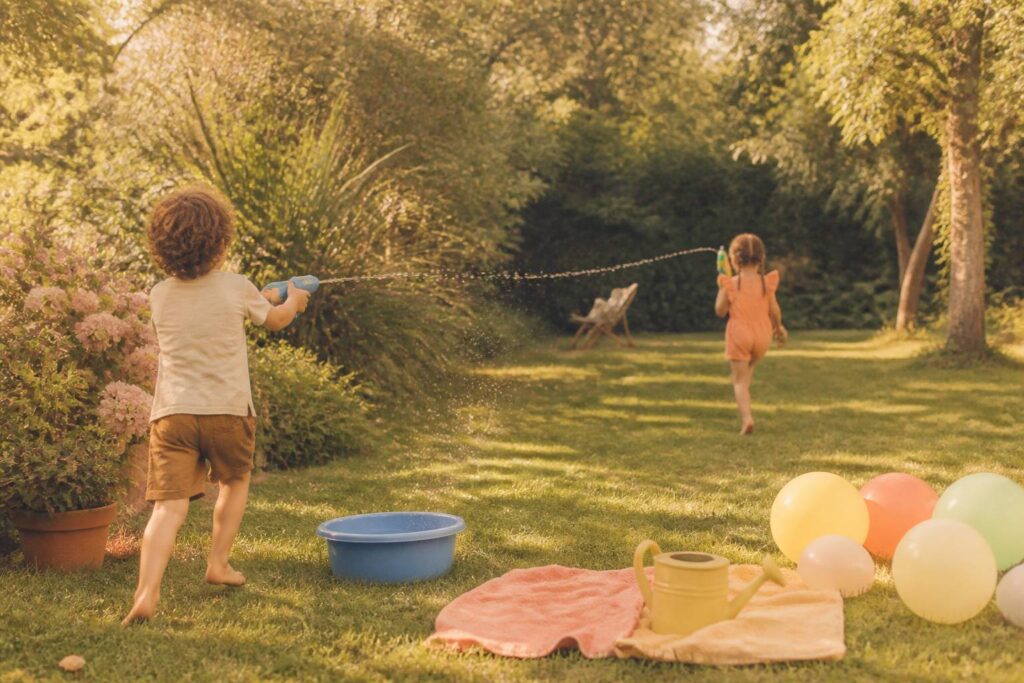
Water guns attract children as soon as the heat sets in. The jet, the pump noise, and the cool sensation on the arms create immediate excitement. This surge of energy is expected. In a child between 2 and 8 years old, the emotional regulation system is still developing. A highly stimulating activity can therefore quickly shift from laughter to annoyance, especially when fatigue, hunger, or high temperature add up.
A framework set before filling the first reservoir makes water games more enjoyable for the whole group. The rules are not meant to cool down the mood. They give children predictable landmarks, which limits impulsive reactions. Younger children do not yet know how to modulate their gesture strength alone or stop immediately when a peer says they don’t like being sprayed.
A water jet should be directed neither at the face, nor the ears, nor at a child who clearly asked for a break. This sentence can be calmly spoken, then concretely demonstrated before outdoor activities begin. Children understand a rule better when it is translated into visible action. A demonstration on a target at belly or leg height is more expressive than a long explanation.
Prepare a simple refill station. A large stable basin, filled with clean water and placed on grass or on non-slip terrace, is sufficient in most gardens. Keep reservoirs and caps nearby to avoid rushed trips to a tap. If children under 3 years old are present, access to the basin requires close adult supervision. Even a small amount of water represents a risk for a toddler who falls and cannot quickly get back up.
Choosing the equipment also deserves a few minutes. Low-pressure models are better suited before 5 or 6 years old. They are easier to handle and the jet is less abrupt. Large blasters or water rifles require more hand strength but also a wider distance between players. A toy that is too heavy can frustrate the child, who compensates by getting too close to others.
| Approximate age | Suitable game format | Safety guideline |
|---|---|---|
| 2 to 3 years | Spray a fixed target, a washable wall, or a ball placed on the ground | Adult within arm’s reach, jet directed downward |
| 4 to 5 years | Fill a container, aim at cups, move a small car | Instruction repeated before each round, obstacle-free ground |
| 6 to 8 years | Races, relays, team missions, and supervised battles | Rest area, immediate stop if a player refuses to be sprayed |
| From 9 years | Precision challenges and longer cooperative scenarios | Defined shooting distance and regularly checked equipment |
Clothing plays a concrete role in comfort. A swimsuit, a lightweight anti-UV t-shirt, and shoes that stay on the feet limit slips. Flip-flops become unstable as soon as children start running. An accessible towel and dry clothes prevent a child from staying wet for long when the wind rises or the day ends.
Heat can mask fatigue until the child collapses in tears or becomes irritable. Offer a break in the shade every 20 to 30 minutes during a hot afternoon, with a few sips of water. Cooling the skin does not replace hydration. A dry mouth, very dark or infrequent urine, unusual drowsiness, headaches, or vomiting require stopping the game and seeking medical advice without delay if the general condition does not improve quickly.
A pair of sunglasses does not allow shots to the face. Glasses protect from light, not from a jet received at very close range. If a child complains of persistent eye pain, keeps the eye closed, shows marked redness, or sees blurry after an impact, contact a doctor or emergency services depending on symptom intensity.
Rules benefit from being formulated in positive and precise terms. Children can aim at targets, legs when the game allows it, and stop as soon as a raised hand signals a pause. This raised hand works particularly well from 4 years old because it remains visible even amid noise and splashes. The rest can then be built around challenges that value skill rather than confrontation.
Creative ideas for shooting and precision with water guns
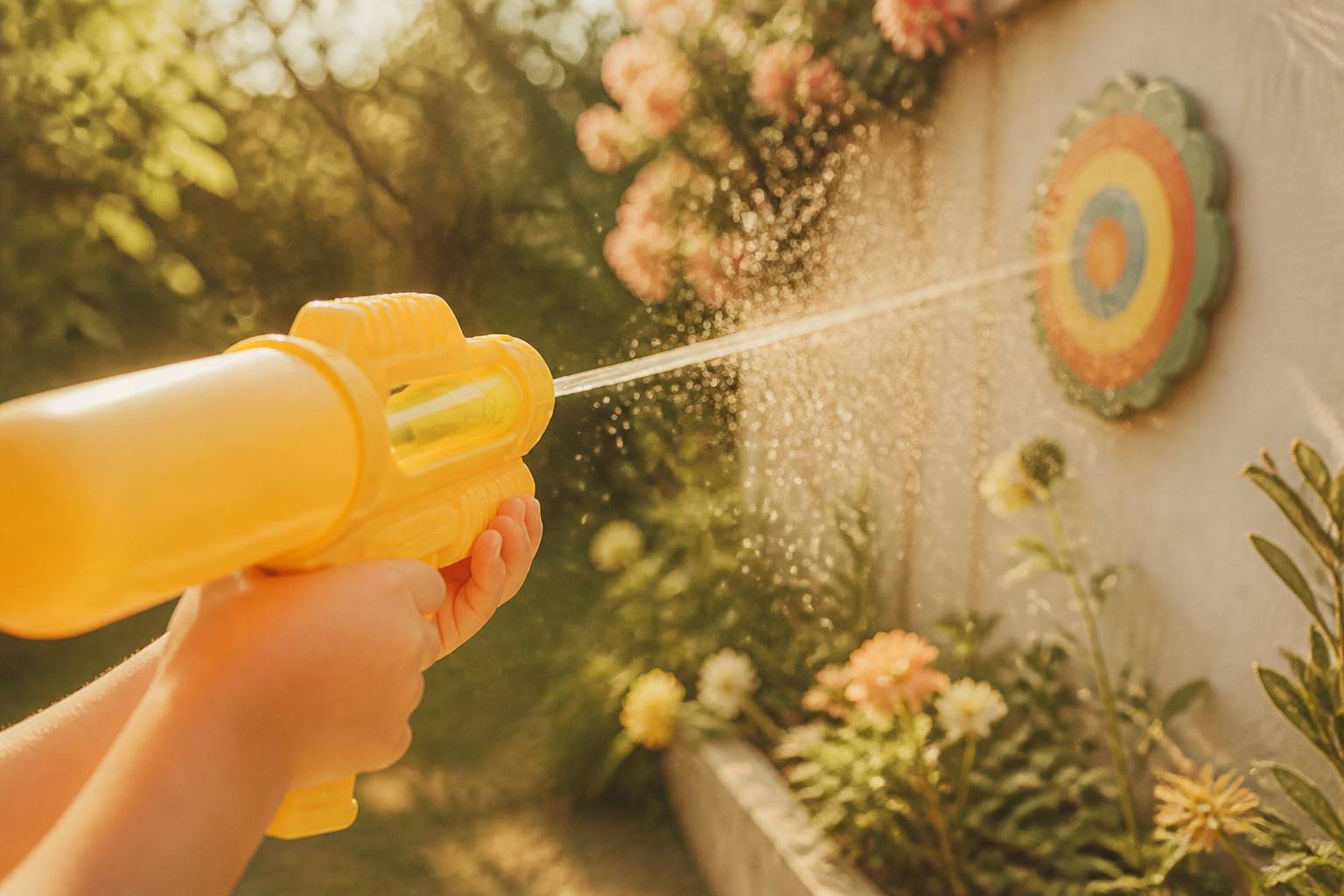
Fun precision games transform the jet’s energy into sustained attention. Aiming requires adjusting distance, controlling the wrist, and observing the result. Between 3 and 6 years, these experiences support eye-hand coordination. The child is not only trying to win. They gradually learn that changing their body position, moving closer, or pressing less quickly can change the effect.
The shooting range with cups, balls, and figurines
Arrange reusable plastic cups on a low table or on the ground. Ping-pong balls placed on stable bottles also make light targets. Small figurines can serve as decoration, provided solid and washable toys are chosen. Avoid metal objects, glass elements, and heavy targets that could fall on feet.
Mark a shooting line with a rope, chalk, or two small cones. For children aged 3 to 4 years, a distance of 1 to 1.5 meters is sufficient. Between 5 and 8 years, the line can gradually move back up to 2 or 3 meters depending on the equipment’s power. The goal is to achieve regular successes. A target constantly out of reach causes more frustration than it stimulates perseverance.
Rules can vary without multiplying instructions. Each child has three shots to topple a cup. Another round requires moving a ball to a line drawn on the ground. A third challenge is to aim at a colored zone on laminated cardboard. This progression keeps the activity lively while giving the brain time to internalize the same motor gesture.
The score does not need to dominate the game. Counting targets hit can suit children who enjoy competition. Others will stay more available if they try together to knock down ten cups before the refill bucket is empty. Cooperation is often more suitable when ages differ. A 7-year-old child and a 3-year-old child neither have the same precision nor the same endurance.
Filling the cup without rushing
This game suits small water guns with a gentle jet. Place a cup on a plastic plate, then hold the set with a pebble placed next to or under the support without blocking the opening. The jet hits the plate and flows into the container. This intermediate surface forgives still imprecise gestures, which is precious for preschool children.
Mark a line at half the cup’s height rather than waiting for overflow. The visible mark allows everyone to notice their progress. Games where the result appears gradually are easier to understand for young children than those where nothing happens until the very last second. The rising water makes the effort concrete and often calms children who might tend to empty their reservoir in a few presses.
This challenge can become sensory. Add a drop of food coloring to the cup’s water without putting any into the water guns. The clear water arriving in the container then changes shade slightly. The equipment stays clean and the game retains a pleasant visual dimension. Paints, even washable, should not be used in reservoirs if the manufacturer does not allow it, as they may clog the mechanism or irritate skin and eyes.
Children also learn to wait their turn in this type of activity. Waiting is not an automatic skill. Before 4 years, a few seconds can already seem long. Give a role to the one who isn’t shooting. They can watch the water line, count the jets, or hold the small sign indicating the round. This participation reduces the feeling of being excluded from the game.
A child who gets upset because they miss their target is not lacking willpower. Their emotional control is momentarily overwhelmed by disappointment. Then reduce the distance or enlarge the target. Good adjustment doesn’t mean letting them fail a long time so they “toughen up,” but maintaining an achievable challenge. Skills are built at the border between what is already acquired and what still requires effort.
These shooting games become a good transition before races and collective scenarios. They engage attention in a calmer atmosphere, then prepare the body to move with more control.
Water races to move, cooperate, and channel excitement
Outdoor activities that move water rather than players limit rough contacts. They are well suited when several children want to play together but not all tolerate being wet. They also give a visible goal to the action. The ball moves forward, the car crosses a line, the cup slides on its string. This direct relation between the gesture and the result feeds practical reasoning.
Water-propelled cup race
Pierce a small side hole in the bottom of a reusable cup. Thread a sturdy string through this hole, then stretch the string between two stable points at low height. The cup must be able to slide without children being under its trajectory. The jet is aimed at the bottom of the cup to push it along the string.
Two parallel lanes allow a two-player race. A single lane also works very well for a collective mission. Children can try to make the cup reach the end of the track in less than ten shots or by taking turns pressing. The cooperative version prevents a less skilled child from being eliminated too early. It also trains the ability to observe the other and adapt one’s own rhythm.
For children under 5, the string can be short, between 1 and 1.5 meters. Older children appreciate a track of 2 to 3 meters with some colored markers. A cup that gets stuck is not a disaster. It’s a simple opportunity to find the cause. The string might be too loose, the hole too tight, or the jet directed sideways.
Small cars and balls without using feet
A small plastic car on a slightly inclined or very smooth surface can be pushed with a water jet. Set up a start and finish line spaced a few meters apart. Children shoot from the side of the track, never face to face. This position reduces splashes toward the body and allows everyone to watch the trajectory.
The very light beach ball creates a different challenge. Each player tries to push their ball to the finish line with their water gun’s water. Feet stay behind a line. The rule seems simple but involves inhibiting movement. From about 5 years old, the child can better restrain an impulse when the framework is repeated and consistent. Younger ones will need calm reminders each round.
Prefer a grassy or non-slip surface. Wet tiles quickly turn a joyful race into a fall risk. Children do not spontaneously gauge the impact of their speed on a slippery surface. This risk estimation develops gradually during childhood and also depends on momentary excitement. An adult available watches rhythm changes without intervening every second.
- Mark a wide lane with flexible cones so players have a clear direction without bumping into each other.
- Fill reservoirs before each round, as a water outage during a challenge often triggers unnecessary disputes.
- Plan a short round of two to five minutes, then switch roles or change the distance.
- Keep a dry corner in the shade for children who want to watch before joining.
Playtime benefits from remaining adjustable. A series of three rounds often suffices between 3 and 5 years. After 6 years, some children maintain their attention longer, up to 15 or 20 minutes, if rules evolve slightly. Signs of saturation are easy to recognize. Children no longer respect limits, throw equipment, argue over a spot, or move away without listening.
A break should not be perceived as a punishment. It can take the form of a change of activity, a passage to the shade, or time to refill the guns together. Regulation comes back more easily when the body receives water to drink, a bit of calm, and reduced stimulation. Following games can then allow more room for creative expression.
Additional inspirations for organizing an afternoon can be found in this selection of summer games with water guns, always keeping the most age-appropriate variant for the real age of participants.
Water painting and creative missions for children in summer
Water guns are not only for spraying or running. They can become creative tools. This approach suits particularly children who withdraw from a water fight but love observing, mixing colors, or inventing a story. There is no single right way to participate. Some children seek movement intensity. Others need to start with a more predictable activity before joining the group.
Create a mural with suitable paint
Set up a large white support on a washable exterior wall, an easel, or a protected fence. Use very diluted, non-toxic paint suited for children, only in sprayers or containers intended for this use. Classic water guns remain reserved for clear water if their instructions do not confirm they support paint. Residues can block the pump and make cleaning difficult.
Thick paper, fixed with moisture-resistant tape, receives light splashes very well. Children can aim at large pre-drawn shapes. A sun, waves, leaves, or colored circles suffice. The interest lies in movement and observing the mark, not a perfect result. At 2 or 3 years, the child mostly discovers that their gesture produces a mark. Around 5 or 6 years, they can choose an area, compare colors, and develop a more precise intention.
Projection painting requires dedicated clothing. An old long-sleeve shirt or a washable apron protects the skin and avoids turning washing into a tension at the day’s end. Rinse hands, arms, and toys after the activity. Even paint labeled washable deserves to be removed from the skin before meals or bedtime.
This proposal encourages creativity without imposing a theme. Children can create a giant treasure map, spray only pencil-drawn zones, or leave droplet marks. A clear limit remains useful. Paint targets the support, never a person. Children who want to be splashed can use clear water in a different zone.
Invent missions rather than endless battles
Missions give imagination a direction. Hide three laminated cardboard targets in the garden and ask the group to reach them in a given order. One target may represent a flower to “wake up,” another a cloud to “fill,” a third a boat to “push.” Phrasing stays simple for the youngest. Too many steps overload working memory, which is still limited before 6 years.
Children aged 6 to 8 can draw their own course. They choose a target, set a reasonable distance, then explain the rule to others. This organizer role develops anticipation and language. The adult simply checks that the mission respects the face rule and that movements remain safe.
A child who suddenly refuses to play is not necessarily trying to upset the group. Noise, wet clothes, or unpredictable jets can be unpleasant depending on their sensory profile. Offer them a peripheral role. They can announce the start, hold targets, choose the next color, or refill supplies with a small cup. Inclusion does not require everyone to receive the same stimulation level.
The activity’s end can become a soothing gesture. Children empty guns into the basin, put away cups, and rinse the paint surface with clear water. This gradual return to calm helps the nervous system settle after an exciting activity. Shared tidying is not a chore added to the fun. It extends the experience by giving a last concrete mission to accomplish together.
Supervised water battles and respect for consent
Water battles remain a summer entertainment classic. They work when each child knows they can enter, leave, and ask for a break. Without these landmarks, it easily becomes overwhelming for a more cautious, younger, or simply less enthusiastic child. Fun is not measured by the number of soaked participants. It is seen in each person’s ability to keep a chosen place within the game.
Before starting, gather children near the play area. Show the field boundary and the refill spot. Designate a no-spray space near towels or under a parasol. This space must be truly respected. If a child enters and continues to be sprayed, they quickly lose trust in the rule and may begin crying or reacting by pushing.
In a successful water battle, the right to say no continues to exist after the first yes. A child may want to play for five minutes then want to stop. Adults sometimes tend to interpret this change as a lack of fair play. At this age, identifying an unpleasant bodily sensation and verbalizing it is already a valuable skill. Respecting it helps the child listen to their own limits.
The freeze game with a single water gun
The freeze game, sometimes called “hands up,” requires only one gun. A child holds the toy and tries to gently touch others on the legs or back, at a reasonable distance. Tagged players freeze with arms raised or hands on the head. A peer can free them by gently tapping their hand rather than passing between their legs. This variant avoids uncomfortable positions and suits better for groups of varied ages.
The tagger role should change often. A two-minute round suffices. Tagging games strongly solicit excitement and can create a sense of injustice if the same person keeps spraying power for too long. Alternating roles makes the activity more stable. Children also more easily understand the position of the one avoiding the jet when they have themselves experienced it.
For a birthday party or fair, avoid the everyone-for-themselves principle without time limit. The group quickly becomes hard to regulate, especially when not all children know each other. Instead, organize two teams with a common mission. Each team must wet three large hanging sponges, fill a bucket, or hit five targets. Competition is then oriented towards an object, not other bodies.
Adults can accompany without arbitrating every disagreement. A short sentence often suffices. “The rule was to aim below the shoulders, try again by stepping back one step.” This kind of feedback describes the expected behavior without labeling the child. Long explanations during the game are rarely heard, as attention is already captured by noise, movement, and eagerness to restart.
Watch for signs of overflow. A child who continues to spray someone crying, who refuses several reminders, who grips the toy very tightly or seems unable to slow down needs the game to stop for them for a few minutes. This does not mean they are aggressive. Their control system is overwhelmed. An accompanied break, with a towel and a calm task like filling the basin, often allows resuming later under better conditions.
An adult must stay particularly alert if a child receives a jet very close to the face, falls on a hard surface, or appears disoriented after a collision. Persistent pain, a significant bump, vomiting, unusual drowsiness, difficulty walking, or behavior change justify a rapid medical evaluation. Water games keep their lightness when bodily signals are taken seriously.
As the sun goes down, the game can slow down without disappointment. The last minutes serve to fill a collective target or make a fine rain over plants, with children’s agreement. This progressive exit avoids the sudden stop that sometimes triggers opposition, especially after very intense activity.
At what age can a child use a water gun?
From 2 or 3 years old, a child can handle a small low-pressure model under close supervision. The most suitable games at this age involve aiming at the ground, a ball, or a large fixed target. Rules remain very brief and the adult retains control of refilling.
How to avoid disputes during a water battle?
Define before starting a play zone, a dry zone, and a clear rule about the face. Short rounds, alternating roles, and target missions reduce tensions. A child may leave the game as soon as they wish.
Can paint be put in water guns?
It’s better not to do this with a classic water gun unless explicitly allowed by the manufacturer. Paint can damage the mechanism and leave residues. Use dedicated paint sprayers or spray colored water on a surface with easily cleaned equipment instead.
What duration to plan for aquatic games in full sun?
An active activity of 20 to 30 minutes may suit before a break in the shade and a drink offer. Duration varies according to temperature, age, fatigue, and excitement level. Signs like marked thirst, headaches, unusual fatigue, or rare urination require immediate stop.