
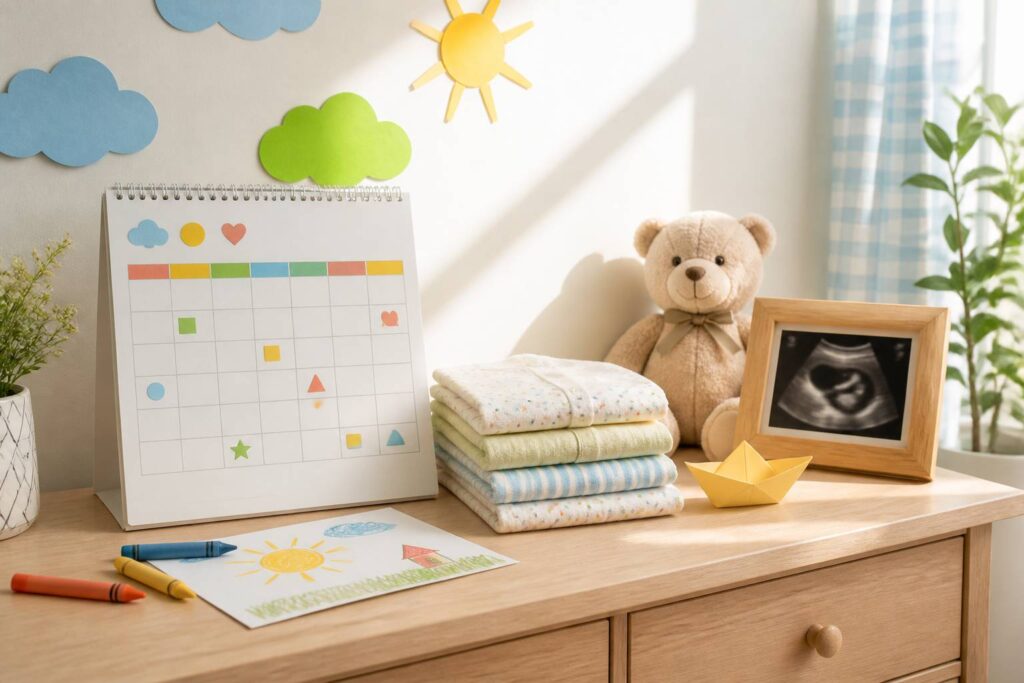
- The Chinese calendar is based on the intersection of the mother’s lunar age and the lunar month of conception. It belongs to a cultural tradition, not a medical tool.
- The promises of 90% success rates are not based on any scientific validity demonstrated by rigorous studies.
- The chromosomal sex is determined at fertilization by the sperm carrying an X or Y chromosome.
- The morphological ultrasound, usually performed around 22 weeks of amenorrhea, provides very reliable information about the anatomical sex of the fetus.
- Calendars, tests, and timing methods can remain pregnancy games, provided they are not entrusted with a reproductive decision or a source of worry.
Chinese calendar and baby sex prediction, a tradition that spans generations
The Chinese calendar often attracts attention from the very first weeks of pregnancy when the wait for the ultrasound seems long. Between ovulation date calculations, tracking apps, and family conversations, this chart promises a simple answer to a very human curiosity. It associates the age of the future mother at the time of conception to predict a girl or a boy.
This Chinese tradition is regularly presented as very ancient. Some stories link it to the imperial court under the Qing dynasty, between the 17th century and the early 20th century. A lunar calendar was then reportedly reserved for the imperial family to favor the birth of male heirs. This story is appealing because it gives the tool an appearance of transmitted and preserved knowledge.
However, the details of this origin remain difficult to document with solid historical sources. The claim that the original document was stolen during the Boxer Rebellion and then kept in Beijing circulates widely on the internet. It does not prove that the chart used today corresponds to an authenticated ancient document, nor that it was validated by the astrologers of the time.
In families, this practice mainly survives because it creates a small ritual. Results are compared with a grandmother, an aunt, an online calendar, or a printed version in a magazine. The prognosis sometimes changes from one chart to another, which already shows that the method is not standardized. Two sites can use different rules to convert the same date into the lunar calendar.
The Chinese calendar can fuel curiosity during pregnancy, but it cannot reliably predict the baby’s sex. This distinction protects against unnecessary disappointment. A fun result can become burdensome if the prognosis is taken as a promise, especially when parents are already imagining a name, a room, or a very precise image of their child.
Why lunar age and lunar month complicate the calculation
The chart does not directly take the mother’s civil age into account. It uses a lunar age, often calculated by adding one year, but this simplification does not work in all situations. In the traditional system, the age can depend on the Chinese New Year and the birth date. A person born just before or just after this period may get a different result depending on the conversion method chosen.
The lunar month also does not exactly correspond to the month of the Gregorian calendar. It is based on the lunar cycle, about 29.5 days. Some years have an intercalary month to maintain alignment with the seasons. A conception located at the boundary of two new moons can therefore be placed in different boxes depending on the chart consulted.
The conception date itself remains an estimate. Professionals usually calculate the start of pregnancy from the first day of the last menstrual period, then adjust if necessary with early ultrasound. Ovulation does not always occur on the fourteenth day of the cycle. It can vary depending on cycle length, stress, recent contraceptive discontinuation, breastfeeding, or certain medical conditions.
A 28-day cycle may have ovulation around the 14th day, but a range between the 11th and 16th day is frequently cited in regular cycles. Sperm can remain fertilizing for up to five days in the genital tract, while the ovocyte is fertilizable for a much shorter period, around 12 to 24 hours. Determining an exact day of fertilization several weeks later is therefore often an approximation.
These inaccuracies do not prevent the Chinese calendar from being used as a game. They simply explain why it is impossible to make a reliable sex selection method out of it. A tool whose input data vary depending on the version consulted cannot produce a stable prediction, even before considering what biology actually allows.

The scientific reality of sex selection at fertilization
The scientific reality is much more straightforward than astrological calculations. The chromosomal sex is set at the moment a sperm fertilizes the ovocyte. The ovocyte always carries an X chromosome. The sperm provides either an X chromosome or a Y chromosome. An XX combination is usually associated with the development of a female sex, while an XY combination is usually associated with the development of a male sex.
This step occurs before implantation in the uterus, before the first signs of pregnancy, and well before the ultrasound. The mother’s age, the lunar phase, or the month of conception do not alter the chromosome transmitted by the sperm that reaches the ovocyte. In spontaneous conception, the chances are generally near equilibrium, with a slight biological predominance of male births observed in many populations.
A method based on the calendar cannot influence the X or Y chromosome carried by the sperm at fertilization. This fact puts commercial promises in their proper perspective. Announcements of 90%, 95%, or 97% success face a simple problem. A method that announces one of two results already has about a one in two chance of being correct by chance.
A sex prediction should be evaluated over a large number of pregnancies, with a predefined method, reproducible calculations, and a comparison against what chance would predict. Saying the calendar “worked” for a girl or a boy after birth proves nothing. Correct results are more often told than mistakes, creating an impression of reliability far greater than reality.
Why announced success rates give a false impression of accuracy
A chart that assigns a pink or blue box to each combination of age and month gives an illusion of precision. The numbers, rows, and colors suggest an objective measurement. Yet, it measures no biological phenomenon. It does not take into account sperm quality, the actual fertile period, the meeting of gametes, or embryonic development.
Calendar methods operate on a binary logic. When the prognosis is correct, it is perceived as confirmation. When it is wrong, explanations multiply. The lunar age may have been miscalculated, the conception month uncertain, conception might have occurred later, or the wrong chart used. This ability to explain every error precisely prevents any serious verification.
Timing methods sometimes claim to favor X or Y sperm by choosing intercourse more or less close to ovulation. These theories are mainly based on the idea that Y sperm are faster but less resilient. Robust data do not confirm reliable sex control through this process. Sperm mobility and survival are influenced by many factors, without allowing controllable domestic selection.
Tracking ovulation can, however, help identify a fertility window when planning pregnancy. Urine tests detecting the LH surge and observation of cervical mucus can guide intercourse around the fertile period. This serves to favor conception, not to choose the future child’s sex. Pregnancy does not occur every cycle, even when intercourse is well-timed.
After 12 months of regular intercourse without contraception with no pregnancy, an assessment can be discussed with a doctor or midwife. This delay is often shortened to 6 months from age 35, or earlier in cases of very irregular cycles, gynecological history, pelvic surgery, known endometriosis, or an already identified male factor. The priority remains fertility and health, not a calendar’s prognosis.
A natural method presented as a gentle way to choose a boy or a girl can seem reassuring. It becomes problematic when it imposes scheduled intercourse, causes guilt after a different result, or delays consultation for conception difficulties. The child project deserves more than pressure built around a result that spontaneous biology does not guarantee.
Using the Chinese calendar without confusing family fun and sex selection
The Chinese calendar can remain present in a pregnancy without becoming a rule. Its interest lies in the game, transmission, and conversation. Many relatives like to compare its result with belly shape, food cravings, or frequency of nausea. These signs do not allow knowing the sex either, but they are part of the stories around waiting for a baby.
This lightness sometimes requires a clear framework. Some parents do not want to know the sex before birth. Others are expecting a girl after several boys or a boy after several girls. When desire is intense, a simple prediction can take a disproportionate place. Words used by those around matter. A repeated joke about “the expected heir” or “the little princess” can reinforce already present pressure.
The best use of the Chinese calendar is to treat it as a playful forecast, never as information on which to organize emotional expectations. It is possible to note the result in a pregnancy journal, then compare it later with the ultrasound. This approach keeps curiosity alive without turning belief into verdict.
Concrete benchmarks to preserve the place of the game
A simple attitude helps avoid misunderstandings. The calendar can be consulted once, with an estimated conception date, then set aside. Recalculating on several sites until the desired result is obtained feeds anxiety instead of soothing it. Pregnancy already carries enough medical and emotional uncertainties not to add imaginary control.
- Use the same chart and the same conversion method if you want to do the calculation, to avoid contradictory results that reflect no medical data.
- Present the result to relatives as a Chinese tradition game and not as an announcement of the child’s sex.
- Reserve highly gendered purchases for after reliable medical information, or choose clothes and items you like regardless of the prognosis.
- Welcome any possible disappointment without shame if the medical result does not correspond to an already constructed image.
Disappointment related to the expected sex exists and is not a lack of love for the child. It can arise after an ultrasound, sometimes briefly, sometimes with more intensity when family history, previous losses, or particular projections are involved. It is not corrected by forcing oneself to be enthusiastic. It is recognized, then can be put into words in a safe space.
A midwife, a doctor, a perinatal psychologist, or a maternal and child protection professional can support this experience if sadness persists, invades days, or makes connection to the pregnancy difficult. A consultation is also advised if the subject causes significant tension in the couple. Talking early prevents silence from turning a common emotion into isolation.
Material preparation can also be separated from the sex question. Planning an appropriate car seat, safe sleeping space, some easily openable clothes, and useful contacts for postpartum addresses real needs. Follow-up month by month helps more to orient oneself in exams, bodily changes, and procedures. The month-by-month pregnancy guide helps situate these steps without reducing them to a color or category.
Family culture can thus keep its place, provided the child to come is not confined to a scenario. The sex announced at the ultrasound does not indicate temperament, tastes, or ways of relating to you. A baby arrives with their biological history and their own pace, much broader than a box in a chart.
Reliably knowing the baby’s sex thanks to pregnancy monitoring
Medical follow-up provides benchmarks much more solid than the Chinese calendar. During the first trimester, dating and screening ultrasound can sometimes give a first impression. Observation of the genital tubercle is possible under certain conditions, but depends heavily on the fetus’s position, image quality, and exact gestational age.
Before 16 weeks of amenorrhea, this estimation may remain fragile. External genital structures still resemble each other a lot and the fetus may be in a less favorable position for observation. A cautious professional will speak of hypothesis or probability, without turning an uncertain image into a definitive announcement. This caution is not a lack of skill. It respects the actual level of precision available at this stage.
The morphological ultrasound performed around 22 weeks of amenorrhea generally provides very reliable information about the fetus’s anatomical sex. At this stage, structures are better visible and the exam also allows checking many elements of development. Sex determination is never the primary medical goal of this ultrasound, but it can be communicated if the parents want to know and if observation conditions allow.
Distinguishing medical information from legitimate curiosity
The choice to know or not know the sex belongs to the parents. Some ask the sonographer to announce it during the exam. Others prefer to receive the information in an envelope, to discover it together, or to wait for birth. None of these choices is more right than another. The most comfortable is often the one that respects how you want to experience the wait, without pressure from those around you.
Non-invasive prenatal tests performed on maternal blood can sometimes detect the Y chromosome from an early stage, depending on indication and the laboratory. In France, their use is primarily within the screening of certain chromosomal anomalies and follows a precise medical framework. They are not a convenience tool intended to organize sex selection.
| Method | Possible timing | Reliability level | What it actually measures |
|---|---|---|---|
| Chinese calendar | After estimation of conception | Close to chance | A traditional crossing between lunar age and month |
| First ultrasound | First trimester | Variable depending on term and position | An early observation of the genital tubercle |
| Morphological ultrasound | Around 22 weeks of amenorrhea | Very high if visibility is good | The external genital organs observable on ultrasound |
| Medically supervised chromosomal analysis | Depending on the proposed exam | Very high for chromosomes searched | Genetic information, in a screening or diagnostic context |
The observed anatomical sex, chromosomal sex, and gender identity do not designate the same reality. During pregnancy, exams inform on biological characteristics. They do not predict the child’s character, future interests, or identity. This nuance prevents loading the announcement with expectations that a prenatal exam cannot say.
An ultrasound must also remain a follow-up time, not a validation test. The inability to see the sex because the fetus has crossed legs is common and harmless. The sonographer may suggest shifting slightly, walking for a few minutes, or waiting for a later check depending on the context. Lack of immediate answer on this point does not indicate a medical problem.
A question about the result, the term, or the test’s reliability deserves to be addressed directly to the professional following the pregnancy. They know the quality of images, dating data, and your file’s particularities. This conversation is more useful than comparing with a prediction obtained on an online chart.
The weeks of waiting can be accompanied by concrete information about pregnancy changes, fetal development, and postpartum preparation. They provide more reassuring footholds than looking for a hidden sign in a lunar phase or an ovulation date.
Myth or scientific reality, choosing respectful benchmarks to welcome your child
The question of a child’s sex sometimes touches on expectations that go beyond simple curiosity. In some family stories, it links to passing down a name, sibling composition, religious traditions, or very ancient representations of female and male roles. The Chinese calendar then becomes the visible support of a deeper desire.
This emotional load deserves to be heard without judgment. Hoping for a specific sex does not negate the love for the baby. The discomfort begins when this preference becomes a condition of joy, a subject of dispute, or pressure on the pregnant person’s body. Domestic techniques advertised as capable of guiding fertilization sometimes nurture the idea that failure would be the couple’s responsibility.
No date, sexual position, diet, or lunar phase offers reliable sex selection in spontaneous conception. This statement may liberate rather than disappoint. It removes from parents the obligation to control what does not depend on them. It also protects intimate life, which does not have to be organized around a calendar claiming to distinguish days favorable to girls and days favorable to boys.
When to seek support regarding sex-related expectations
A passing emotion after the sex announcement often resolves as pregnancy advances and the child becomes more concrete. Movements felt, appointments, preparation of the living space, and exchanges with the baby gradually modify projections. There is no imposed deadline to feel ready. Some people need to talk about it repeatedly before regaining emotional availability.
Professional support becomes relevant if disappointment is accompanied by frequent tears, intense guilt, lasting insomnia, generalized loss of pleasure, or repetitive thoughts hard to soothe. During pregnancy, a midwife or doctor can refer to a psychologist trained in perinatality. After birth, sadness that lasts beyond two weeks, dark thoughts, or fear of being alone with the baby call for prompt help.
Relatives can help by avoiding comments that confine. Saying a boy “will inevitably be rowdy” or a girl “will be easier” already assigns a role to a child not yet born. Temperament differences appear very early, but they are not deduced from sex. Some babies need a lot of closeness, others tolerate transitions more easily. These variations relate to their individuality and neurological maturation.
The choice of words also matters when speaking about the child. Saying “the baby” during the first months can leave room if the sex is unknown or if parents prefer to keep the surprise. Using the chosen name can create connection if that suits you. There is no universal ritual. The useful benchmark is the one that reduces pressure and increases the feeling of presence alongside this real pregnancy.
The Chinese calendar can even become a fun memory if kept honestly. It tells the story of a pregnancy phase where clues were sought, a clearer image was awaited, and the circle formulated hypotheses. It does not need to be ridiculed to be put in its place. Tradition can be respected without being confused with evidence.
To deepen the understanding of this belief’s functioning and compare different ways of calculating it, this page dedicated to the Chinese calendar and baby sex provides additional benchmarks. Light activities shared with elders, like jokes and riddles for children, can also shift family conversations toward a more relaxed wait.
The bond with a child does not begin with the certainty of having a girl or a boy. It is built through repeated gestures, kept appointments, questions asked when worries appear, and space left for meeting. The expected baby will never simply confirm a colored box in a calendar.
Is the Chinese calendar reliable for knowing the baby’s sex?
No. There is no scientific proof showing that crossing the lunar age and the lunar month of conception predicts sex with accuracy better than chance. The high success rates announced online are not validated by rigorous studies.
When can one reliably know the baby’s sex?
A first estimate can sometimes be offered in the first trimester, but it remains uncertain before 16 weeks of amenorrhea. The morphological ultrasound around 22 weeks of amenorrhea usually allows a very reliable determination if the fetus’s position is favorable.
Does ovulation allow choosing a girl or a boy?
Detecting ovulation can help target the fertile period and increase conception chances. However, scheduling intercourse before or after ovulation does not reliably allow choosing the chromosome carried by the sperm.
What to do if the sex announced at ultrasound causes disappointment?
This emotion can be expressed without shame. If it persists, invades days, weakens the couple, or makes connection to pregnancy difficult, a midwife, doctor, or perinatal psychologist can offer appropriate support.