
In brief
- Chloé comes from ancient Greek Khlóê and evokes a young shoot, a new green growth, a beginning sprouting.
- Its meaning speaks of vitality and renewal, an image often sought when a first name accompanies the arrival of a girl.
- In France, its popularity peaked very strongly around the 2000s, then gradually declined, while still maintaining a solid presence in culture and collective memory.
- Its spelling varies and sometimes changes the sound or visual perception of the name, without altering its fundamental etymology.
- The first name Chloé fits well with current fashion trends, which appreciate short, soft, clear names, but its history makes it less “fleeting” than a mere trend effect.
- The concrete markers to consider are the birth frequency by period, coherence with the last name, and ease of daily use, starting from daycare.
Origin of the first name Chloé and Greek etymology: where does this “young shoot” come from
In the days following a birth, many parents test the first name out loud, sometimes in the calm of a room still a bit too bright in the early morning. The name must “hold” in the mouth, sound right when whispered, but also when pronounced quickly, between two diaper changes. Chloé is one of those names that pass these everyday tests well, because it is short and rhythmic, while carrying a strong image.
The origin of Chloé is in ancient Greek, with the term Χλόη (Khlóê). The etymology refers to greenery, emerging grass, a new sprout of light green. The word was not created to be “pretty”. It describes a very concrete state of the living, that of the beginning of growth. This precision matters, because a name is not just a sound, it is also a representation.
In Greek culture, Khlóê was associated with images of fertility and renewal, and it was also used as an epithet linked to Demeter, goddess of the harvest. This cultural layer obliges nothing, but it gives a depth. Many parents feel reassured when a name choice is not only a matter of fashion, but is rooted in a longer history.
Spellings of Chloé and their practical effects in daily life
The name is most often spelled Chloé in French, with either a diaeresis or an accent depending on typographic variants, but you also encounter Cloé, Chloë, or Khloé. These forms may seem close, yet they create very concrete consequences.
A variant with “Kh” catches the eye and can recall recent Anglo-Saxon uses, which can appeal if the family has an international connection. Conversely, a more classic form sometimes facilitates spontaneous spelling by others, especially at school. This detail becomes real when you have to correct a health record, daycare file, or the first library card.
A simple rule helps decide. If the name must be spelled often, the most expected version reduces daily friction. If the family embraces a distinctive choice that makes sense, the variant becomes an identity mark, provided it is managed serenely, without ongoing battles over spelling.
This reflection naturally leads to how a name crosses time. The next question is not “is Chloé beautiful”, but how its presence evolves, and what its frequency tells about an era.
Meaning of the first name Chloé: symbolism of growth, temperament, and educational benchmarks
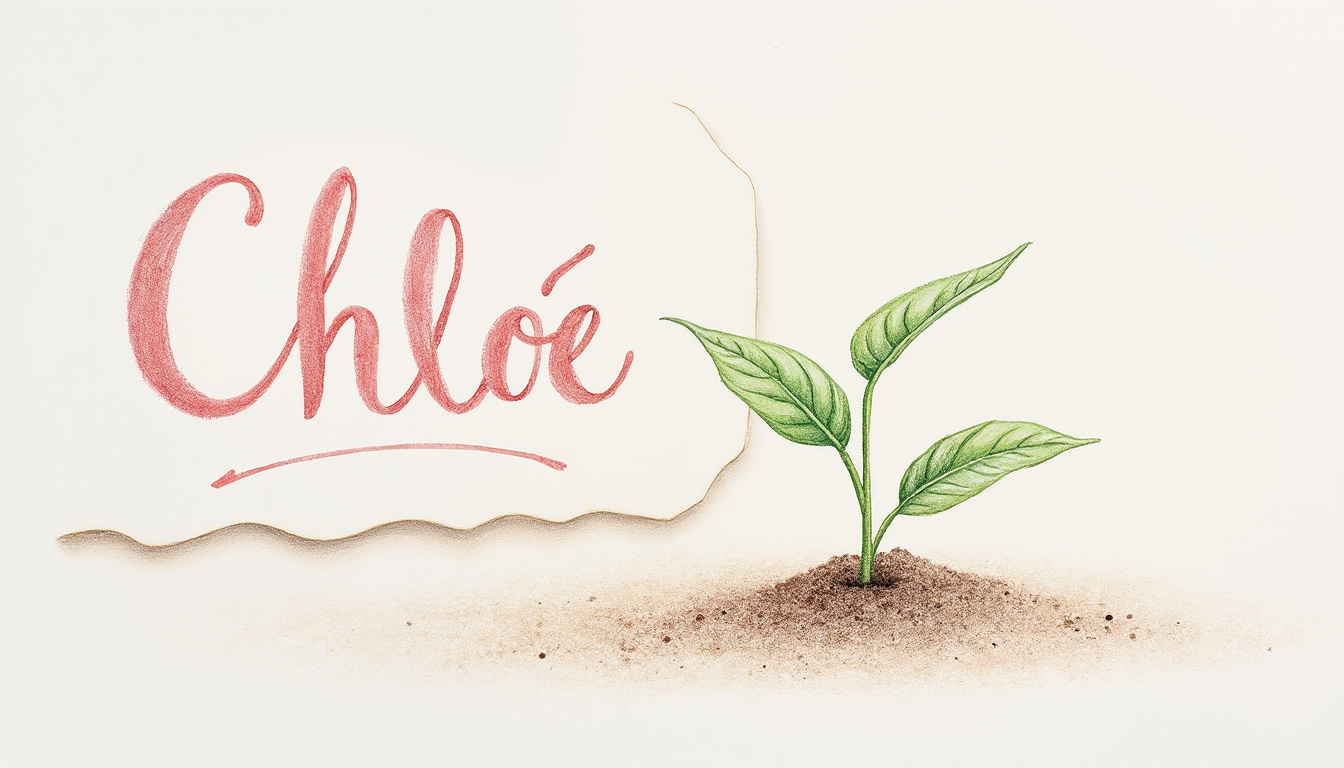
The meaning of Chloé, “young shoot” or “new greenery”, speaks spontaneously to parents because it fits what a baby shows in the first weeks. An infant grows quickly but mainly builds themselves by micro-steps. One day may seem identical to the previous one, then a detail changes, a glance catches, a sleep shifts, a way of nursing becomes more effective. The idea of growth by small pushes corresponds well to this movement.
The name also carries a symbolism of vitality. This vitality is not a promise of an “easy character”. It rather evokes a drive, an ability to move towards, to develop. In reality, this drive expresses itself differently depending on temperament. Some babies are very lively, demanding, others seem observant, cautious, slower to open up. The name does not predict a profile, but sometimes colors the way the surroundings talk to the child.
Character attributed to Chloé: independence, acuity, critical sense
In traditions around first names, Chloé is often associated with intellectual acuity and independence of spirit. This association can be a resource if kept as a flexible interpretation. A child described as lively and autonomous benefits from support in their need to explore, but also needs stable benchmarks so as not to exhaust themselves fighting everything.
One point deserves to be named clearly. Early independence can become a strength but also a “double-edged sword” when criticism takes up all the space. Some little girls, from preschool age, very quickly spot inconsistencies, flaws, injustices. They ask direct questions. They test limits. This is not a moral flaw, it is a way to seek security by understanding the environment.
When a child “steps out of line,” it is not gratuitous provocation in most cases, it is an attempt to keep control over what eludes them. Responding with harsh rigidity often worsens tensions. Responding with a lack of structure also worsens them. Balance is found in a short, coherent, repeated framework, with a real space for autonomy.
Concrete steps to support a strong temperament without extinguishing it
Three simple steps often help, beginning at 3-4 years, when the child has sufficient language to negotiate without endless back-and-forth. They remain valid later, in primary school.
- State the waiting time rather than the emotion. Saying “in five minutes” and showing a visual timer reduces the struggle, because the child’s brain better locates time than “be patient”.
- Offer a real but limited choice. “The green sweater or the beige sweater” works better than “get dressed”, because autonomy is respected without opening an endless debate.
- Validate the intention, frame the action. “You want to decide, that’s normal. Here, the adult decides because it’s safety” helps avoid humiliating the child while maintaining adult responsibility.
In some situations, the child closes off “like a shield” when the environment does not suit them. This withdrawal is not necessarily worrying if it is temporary, linked to a change, and if the child regains flexibility in a familiar framework. However, if social withdrawal persists several weeks, if the school signals a clear drop in participation, or if sleep and appetite deteriorate durably, a discussion with the attending physician, a pediatric nurse, or a developmental psychologist may help clarify things.
This reading of temperament naturally leads to another very parental question. Such a well-known, often pronounced name: how is it situated today in popularity and birth frequency?
Name trends are better identified when put into numbers and placed back in their social context. The same sounds come back in waves, then calm down. Chloé experienced this movement very visibly in France.
Popularity of the first name Chloé in France: trends, frequency and generational effect
The popularity of a name is experienced very concretely. In daycare, it is measured by the probability of hearing the same name in the hallway. At school, it is measured by how often the teacher has to add an initial. A very common name is not a “bad choice”. It often brings a feeling of generational belonging. A rare name can give space but also require more explanations. The right choice is the one that fits the family’s project.
In France, Chloé was particularly in fashion in the late 1990s and especially in the 2000s. In many families, a grown Chloé in 2026 refers to that very period. This temporal association is a useful marker. It means the name can be perceived as very familiar but also somewhat “marked” by a generation, depending on regions and environments.
After this peak, the birth frequency declined progressively. This movement is typical. Names rise, saturate social space, then decline. This drop does not erase the name. It sets it differently, with fewer duplicates in a given class, while maintaining immediate recognition.
Markers for reading statistics without being misled
Looking at a national ranking is not enough. Two families may live two opposite realities with the same name, depending on the city, neighborhood, cultural environment. A name can be “in decline” nationally and still very present locally. The opposite also exists.
A simple benchmark is to cross three levels. The national level gives a general trend. The regional or departmental level refines it. The “field” level is read by asking daycare, early childhood centers, or local nursery schools which names often recur. This is not superstition; it is a way to project oneself into daily life.
| What you observe | What this often means | Concrete consequence |
|---|---|---|
| Chloé is very present among adults around you | Name strongly borne by a generation born around the 1990-2000 period | Name immediately recognized, little risk of mispronunciation |
| Few babies are named Chloé around you | Current frequency is lower in your area | Fewer duplicates at daycare, while keeping a familiar name |
| The name appears in lists of “recent classics” | Stabilization after a fashion peak | A choice seen as safe, but not impersonal |
Culture, media, and social perception of Chloé
Culture plays a discreet but real role. A name circulates in books, songs, fictional characters, the media. This does not compel a choice or avoidance, but it influences the mental image. Chloé has a regular presence in Francophone and international culture, which maintains its familiarity.
This familiarity is an asset as the child grows. In adolescence, some very rare names can become burdensome if the teenager must always explain. Conversely, a very common name may trigger a desire for differentiation. With Chloé, the experience is often in between, especially since its frequency has calmed down.
The choice of a first name is rarely decided on numbers alone. The next step is to see how Chloé fits into a complete identity, with a surname, siblings, and daily usage.
A name does not live in a statistical table. It lives on tired lips calling the child to bath, on a coat label, on the first cafeteria card. It is this passage from “beautiful on paper” to “easy to live with” that makes the difference.
Choosing Chloé for a girl: harmony with the last name, pronunciation, identity, and daily life
When a first name is already well established in the language, the main question is not its legitimacy. It concerns its adjustment to your family history. Chloé has a short structure, two syllables, a marked consonant attack, then an open ending. This architecture makes it easy to call, and quite “musical” to remain soft even when the voice rises a bit, which happens to everyone in a busy day.
Harmony with the last name is tested concretely. Say the first name + last name aloud, at normal speed. Say it as you would at the school gate. Listen if the sounds clash, if endings repeat, if an involuntary liaison creates another word. This simple test avoids surprises.
Chloé and anticipated sound associations
Some last names start with a vowel. “Chloé” ends with an “é” sound. The transition can be very smooth, but sometimes a bit “slippery” depending on regional accents. When the last name also starts with a sound close to “é” or “è”, the whole can be compressed. In this case, adding a second, more consonant-heavy middle name can give more breathing room, without changing the usual first name.
International pronunciation also matters. Chloé is generally understood in many languages, even if the accent shifts. In a world where mobility is frequent, this is a concrete comfort. This is not mandatory, but some parents are sensitive to it.
When past popularity becomes an educational advantage
A very well-known name sometimes offers an implicit framework. In daycare, it is well pronounced. Children remember it quickly. The child does not have to “carry” the weight of strangeness when learning to enter the group. For a little girl with a temperament very sensitive to the environment, this can be a discreet advantage. A child who feels confident opens up. A child who perceives too much uncertainty can protect themselves.
This dynamic matches a frequent observation. Lively, autonomous, sometimes critical children give their best when the framework is clear and stable. The name is not the cause, but participates in the atmosphere. A name that is easy to say, without permanent spelling struggles, leaves more energy for learning real daily skills.
Consultation box: when withdrawal deserves professional advice
A child may go through phases of withdrawal, especially when beginning social care, moving, or after a sibling’s birth. Most of the time, adjustment occurs with time and a steady rhythm. Some signs justify seeking advice without waiting for the situation to stabilize.
- Persistent social withdrawal beyond 4 to 6 weeks with loss of interest in previously enjoyed activities.
- Marked and lasting sleep disorders, with very long falling asleep or repeated awakenings, associated with daily irritability.
- Clear and prolonged appetite changes, weight loss or unusual stagnation in a young child.
- Multiple regressions accumulating, with visible suffering and difficulty calming despite stable routines.
In these cases, a first discussion with the doctor, a pediatric nurse, or a developmental psychologist helps distinguish normal adaptation from a need for more targeted support. An early, calm opinion often prevents difficulties from becoming entrenched.
After sound harmony and daily life, there remains one last very concrete angle. The name does not live alone; it lives in a symbolic story, sometimes spiritual, sometimes simply familial. This is where feast days, references, and stories take their place.
Cultural references around Chloé: feasts, traditions, and place in the imagination
References associated with a first name often serve as a support point for families. Some like to pass on a feast day, a story, a discreet link with a value. Others prefer to keep the first name as a chosen sound, without additional symbolic layer. Both approaches are valid. What matters is coherence with your way of telling your child’s story.
Chloé is sometimes linked, according to some name sources, to a celebration around October 5th, connected with Saint Fleur. This association is not universal but exists in popular usages. The floral and plant symbolism naturally connects with the Greek meaning of young greenery. For parents who like to mark a date, this can become a simple ritual, without compulsory dimension.
In some families, another date circulates, more seasonal, like the spring equinox. Again, this is not a prescription. It is a transmission gesture, a way to connect the name to a rhythm of the year. For a child, these benchmarks mainly become memories. A cake, a walk, a card. Nothing grandiose, but a regular trace.
When a name becomes a reassuring story for the child
A child also builds themselves in the stories offered about themselves. Telling a little girl that her name evokes a “new shoot” may be a delicate way to speak about learning. Growing up is not done in a straight line. A child can progress, stumble, go backward, restart. The name here serves as a useful metaphor because it remains simple and concrete.
A shoot does not grow because it is pulled upwards; it grows because the conditions are sufficiently stable. This sentence relates as much to sleep, nutrition, as to emotional security. Without doing psychology on every topic, it helps remind that a child learns better when they feel expected as they are, not constantly judged.
The place of Chloé in contemporary culture
Chloé regularly appears in literary and audiovisual works, in France and elsewhere. This ongoing presence maintains the impression that the name crosses decades. For parents, this is often reassuring. The name does not depend on a micro-phenomenon; it fits within a broader cultural background.
This stability does not prevent evolution. Short names often come back because they fit well with current usages. They slip into messages, forms, signatures. Again, fashion is not the sole driver, but it accompanies. Chloé is situated in an interesting place. It was very popular, then it calmed down, which today gives it a balance between recognition and relative uniqueness.
When the choice becomes clearer, parents benefit from checking one last practical point. How the child will live with spelling, accents, documents, and social perception of the name over the years. These are details, but they are repeated details.
Is Chloé still a very common first name today?
Frequency decreased after a very marked peak in the 2000s, which means Chloé is often less present among babies than in the generation of young adults. The name remains known and well accepted, with a generally lower risk of duplicates than fifteen to twenty years ago, depending on regions.
What is the exact meaning of Chloé according to its etymology?
Its Greek etymology (Khlóê) refers to new greenery, emerging grass, a young shoot. The image is of a living being that starts and grows in stages, which often resonates with parents when naming a girl.
Chloé, Cloé, Chloë, Khloé: how to choose the spelling?
The most common version in French simplifies daily use, especially for documents and school. A variant may make sense if it fits a family or cultural story, provided one accepts it will be spelled or corrected more often.
Does the first name Chloé have an associated feast day?
According to naming traditions, Chloé is sometimes associated with October 5th, linked to Saint Fleur, and some also symbolically connect it to spring. These markers are not mandatory, but they can support a small family ritual if it resonates with you.
Should the character attributed to the first name Chloé influence education?
Character traits associated with names are representations, not diagnoses. What truly helps is observing your child’s temperament and adjusting the framework. If your daughter is very lively, autonomous, or critical, a coherent framework, limited choices, and concrete temporal markers often support her balance without stifling her drive.