
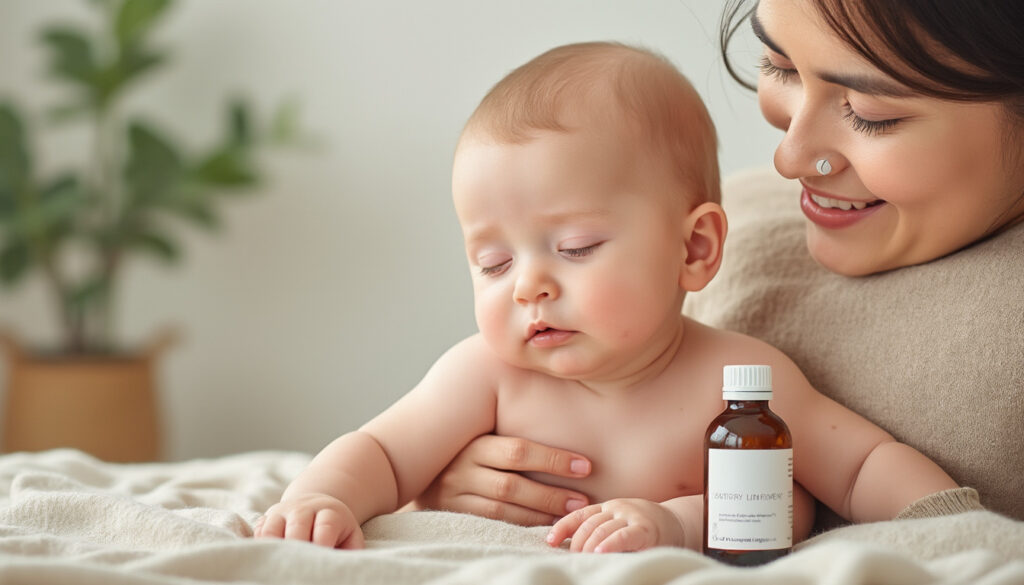
In short
- Liniment oleo-calcareous is a rich emulsion mainly used for the skin protection of the diaper area, more than for cleaning.
- Its classic formula combines olive oil and <stronglimewater, which helps buffer the acidity of urine and stools and supports irritation prevention.
- Proper use is based on a simple sequence during diaper change, starting with a gentle cleansing, then a thin layer of liniment left unwashed.
- The choice of a product matters, as baby cosmetics can contain perfumes, preservatives, or ingredients that are not very useful for fragile skin.
- Liniment can occasionally be used to soften cradle cap, and sometimes for massage, with precautions regarding temperature and contact.
Understanding oleo-calcareous liniment in baby care
In the first few weeks, the skin of the diaper area experiences a succession of micro-aggressions. Moisture is almost continuous under the diaper. Friction is repeated, sometimes with every hip movement. Urine and stools cause local pH changes, and an infant’s skin barrier is still developing.
Liniment, also called oleo-calcareous liniment, fits within this reality. It is not considered a washing gel. It is understood as a skin protective product that leaves a thin lipid film, capable of limiting direct contact between the epidermis and irritants.
The traditional formula relies on a simple balance. In practice, you often find 50% olive oil and 50% limewater. The oil provides lipids that support skin suppleness. The limewater, with its alkaline pH, helps buffer the acidity deposited by urine and stools. This mechanism is interesting because irritated skin inflames more easily when its environment becomes too acidic and too moist.
This logic explains a frequent confusion. Liniment can loosen some residues by a “greasy” effect, which gives the impression of washing. However, it does not include, in its classic version, a cleansing agent designed to carry away matter. On stools, especially if abundant or sticky, the product alone often leaves traces. The skin looks clean, but the next diaper change reactivates an irritation already underway.
Brands have enriched many formulas, sometimes with relevance, sometimes as pure marketing. A protective wax can strengthen the barrier effect. A calendula extract is often appreciated for its comfort on sensitized areas. The idea is not to pile up actives, but to choose a coherent composition for fragile skin, without fragrance, with tested tolerance.
The expected benefits are not limited to “softening.” For many babies, the right product at the right time reduces the frequency of diffuse redness. It decreases irritations linked to friction. It improves recovery between diaper changes, noticeable especially when stools are more acidic, for example during teething or a period of accelerated transit.
When the goal is clear, the action becomes simple. The next section details how to use it so that irritation prevention is real, not just hoped for.
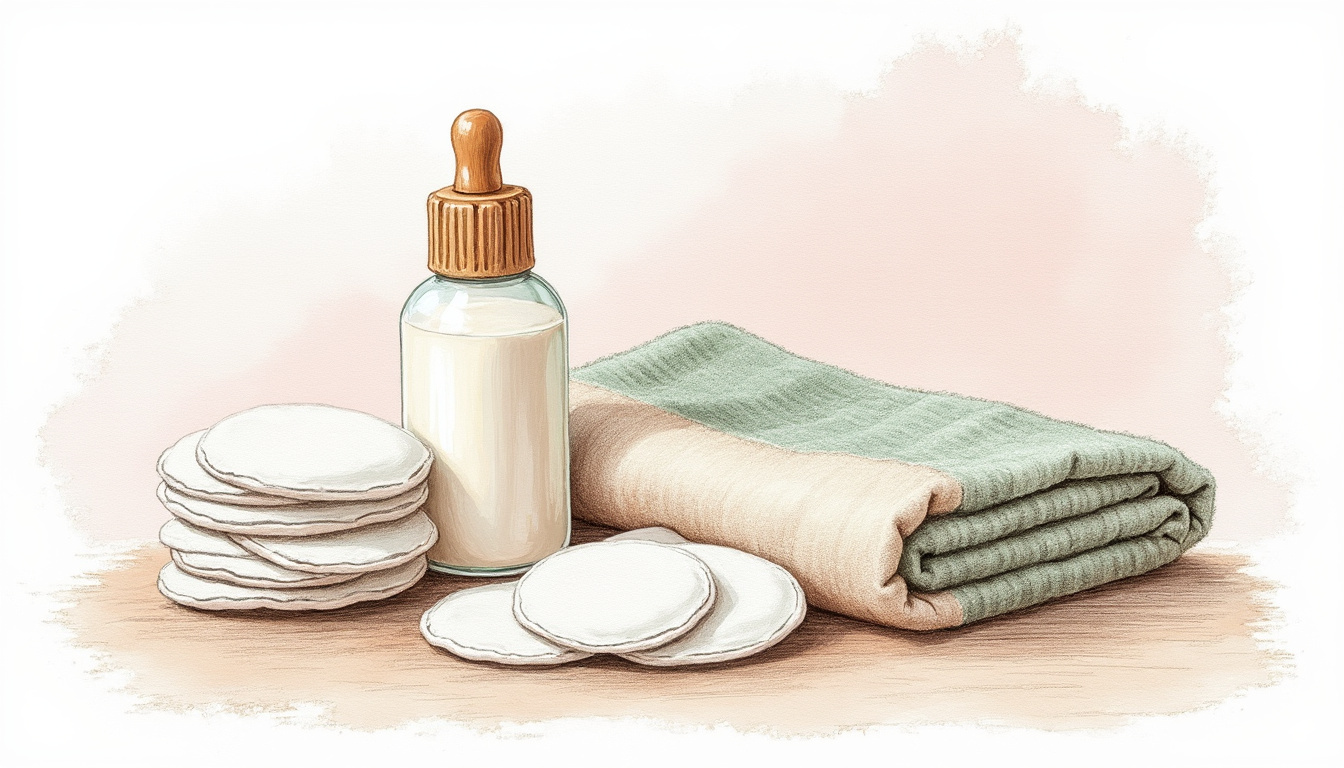
Liniment and diaper change for infants: precise gestures for irritation prevention
During diaper change, an effective routine resembles a small choreography. It targets two distinct objectives. The first is a real gentle cleansing, that is, removing urine and especially stools. The second is setting up a protective barrier that limits maceration and friction until the next change.
Liniment is mostly involved in the second stage. It is applied on clean, well-dried skin. A thin layer is enough. Too much product leaves a “wet greasy” feeling that can maintain maceration in some babies, especially if the diaper is very close-fitting or if the room is warm.
A realistic diaper change sequence, even when the night is interrupted
When the diaper contains only urine, a cotton pad lightly moistened with warm water or a clean cloth is often enough to remove moisture, then dry. Liniment can then be applied as a protective film, without rinsing. The skin remains supple, and the diaper slides more easily instead of sticking.
When stools are present, the priority is to remove them completely. Liniment alone can “spread” residues if they are thick. The gentlest option remains washing with warm water using a cloth, or well-tolerated wipes, followed by thorough patting dry. The difference appears on the crease redness in the groin, often due to persistent moisture.
Why not rinse liniment after application
The lipid film is precisely what provides the skin protection effect. If the skin is rinsed, the benefit diminishes greatly. The product loses its barrier function, and the epidermis comes into direct contact again with irritants in the diaper.
A useful guideline is to aim for matte, supple skin, not shiny. A small amount warmed between the hands, then applied in a very thin layer, is enough in most cases.
Table of concrete daily guidelines
| Diaper change situation | What happens on the skin | Most appropriate response | What helps prevent diaper rash |
|---|---|---|---|
| Urine only | Moisture + pH that can irritate if repetitive | Cloth/warm water, dry, then thin layer of unwashed liniment | Limit maceration and maintain a stable lipid barrier |
| Light stools | Enzymatic irritants + friction | Clean with water/cloth, dry, liniment for protection | Avoid residue in folds and reduce diaper friction |
| Sticky or frequent stools | Rapid inflammation possible, fragile skin | Complete cleaning, long pat dry, thin layer of liniment, air if possible | Change sooner, allow to breathe for a few minutes, reduce friction |
| Diffuse redness without sore | Irritated but still intact skin barrier | Stable ritual, protective liniment, avoid perfumed products | Reduce pH fluctuations and mechanical abrasion |
| Lesions, oozing, red “satellite” spots | Suspected severe dermatitis or fungal infection | Medical advice, avoid self-medication | Treat the cause rather than layering products |
Changing diapers is also a time for observation. If redness persists beyond 48 to 72 hours despite a stable routine, if the skin oozes, bleeds, or small red spots appear around a patch, evaluation by a pediatrician or midwife is preferable. Diaper candidiasis is not resolved by applying more liniment.
When the routine is mastered, the next question quickly arises. Which product to choose among the offering of natural products and pharmacy references, and how to read a label without getting lost.
To visualize a skin-friendly diaper change, a video demonstration often helps adjust the pressure of the gesture and drying.
Choosing a liniment in 2026: reading the label and avoiding false friends in baby cosmetics
The baby cosmetics market has become more transparent, but the abundance of claims remains confusing. “Organic,” “gentle,” “hypoallergenic,” or “sensitive skin” do not always describe the composition. Reading the INCI list remains the most reliable tool because it imposes a precise order. Ingredients appear in descending quantity, from most to least present.
For a liniment intended for the diaper area, parents benefit from looking for a short formula without fragrance. Fragrance adds nothing to the skin and increases the risk of sensitization, especially on an occluded area under the diaper. A simple composition also helps identify the cause if redness appears.
What the ingredient list really tells
When an oil is at the very beginning of the list, the texture is often richer. When water or a solvent comes first, the product may be more fluid, sometimes less “barrier.” There is no universal rule, as comfort varies depending on season, stool frequency, and type of diaper used.
Some commercial “liniment” bottles are actually cleansing lotions enriched with lipids. They may be suitable but they don’t play quite the same role. If the goal is a durable protective barrier, a well-oily emulsion is often more logical. If the goal is quick cleaning on urine, a lotion may suffice, provided it does not irritate.
A short and useful list, without overload
- Fragrance-free, because the diaper area is occluded and more reactive.
- Tested under dermatological control, especially if your baby has had eczema or recurrent redness.
- Stable formula with practical packaging, because a leaking or oxidizing bottle often ends up being overdosed during changes.
- Relevant enrichments in small number, like a protective wax or soothing extract, rather than a long list of actives.
Homemade liniment: apparent simplicity, real risks
Making it yourself may seem reassuring, because the traditional recipe is well-known. The sensitive point is limewater. In case of overdose, its alkaline character becomes irritating, sometimes corrosive. The diaper skin, already exposed to moisture, can weaken quickly.
Another common pitfall is the addition of essential oils. They are discouraged for infants. They penetrate more easily the immature skin barrier, and the risk is not only cutaneous. A “homemade” highly fragranced product may give the illusion of a premium care while increasing the likelihood of reaction.
A simple criterion is to prefer the safety of a controlled formula when the skin is already red or the baby is less than three months old. Parental comfort also matters, as a too complex routine is rarely maintained over time.
Once the right product is chosen, liniment can sometimes go beyond diaper changes. Massage, dry areas, cradle cap: each use requires a precise framework to remain beneficial.
Texture and format differences are better understood by seeing the gestures, the amount deposited, and the way to warm the product between the hands.
Beyond the diaper area: liniment, massage and cradle cap with fragile skin
Liniment is best known for baby care during diaper changes. However, its rich texture and ability to “stick” to the skin open other uses, provided the infant’s skin function is respected. A newborn’s skin does not have the same thickness as adult skin. The stratum corneum is thinner, and thermoregulation is less stable. Each gesture must therefore remain measured.
Liniment as a massage medium, when the day has been too full
Massage is not a decorative “plus.” It influences tone and alertness. A slow, steady touch stimulates skin receptors that interact with the autonomic nervous system. For some babies, this promotes calm at the end of the day, especially when the environment has been noisy or rich in stimuli.
Liniment can serve as a medium because it limits hand-skin friction. The gesture remains simple. A small amount is warmed between the hands, then placed on legs, belly, or back without pressing. Removing rings and bracelets avoids micro-scratches, often invisible at the moment but irritating afterward.
This approach also protects parents. A 3 to 5 minute massage is enough. Beyond that, a baby may become agitated, not because he “refuses,” but because his sensory threshold is reached. Signs are clear. The gaze turns away, hands open then clench, legs stiffen. In this case, stopping and dressing calmly is more appropriate than insisting.
Cradle cap: soften before bath, without stripping
Cradle caps often appear on the scalp, sometimes on eyebrows or forehead. They are benign. They are linked to excess sebum and a scaling that clumps together. The main risk comes mainly from attempts to pull them off, which irritate the skin and can cause small wounds.
Liniment can help, as it softens these patches. A very gentle massage application a few hours before the bath is often enough. At bath time, a light rub with a damp cloth or a very soft brush allows detaching what is ready to come off. This pace respects the skin. It avoids the “scratching to finish” reflex, which reactivates redness.
Face and sensitive areas: caution and observation
On the face, use is not systematic. Some skins tolerate a touch on a dry area very well. Others react with small pimples because the greasy film occludes. A test on a small area, once a day, provides more reliable information than a sudden routine change.
Consultation is justified if cradle caps become oozing, if an odor appears, or if red patches spread beyond the scalp with marked itching. Significant seborrheic dermatitis or infant eczema sometimes require specific care, and multiplying products then delays improvement.
Liniment, well chosen and well used, finds its place as a comfort ally. The final step is to dispel frequent doubts, those that come back at 3 a.m. when the skin reddens or the routine falters.
Does liniment replace a washing product for diaper changes?
No, not in most cases. Liniment is mainly a skin protection and moisturizing care. It can help loosen residues but generally does not contain a cleansing agent. In case of stools, gentle cleaning with warm water (or a well-tolerated cleansing solution) followed by careful drying gives better results before applying liniment in a thin, unwashed layer.
Should liniment be rinsed after application?
No. The lipid film left on the skin contributes to the desired benefits, notably preventing irritations caused by friction and repeated contact with urine and stools. Excess, however, can maintain maceration. The right amount leaves the skin supple and comfortable without a shiny aspect.
Which signs should prompt consulting for diaper rash?
Consultation with a pediatrician, midwife, or pediatric nurse is appropriate if redness persists beyond 48 to 72 hours despite a stable routine, if there is oozing, cracks, bleeding, marked pain to touch, fever, or small red spots around a patch (suggestive of a fungal infection). In these cases, adding layers of products does not replace professional advice.
Can liniment be used for cradle cap?
Yes, often with good results. A small amount gently massaged on the patches a few hours before the bath softens the cradle cap. They then detach more easily during washing, without scratching. If patches become oozing, very red, or spread, medical advice helps verify if it is not eczema or more severe dermatitis.
How to choose liniment adapted to fragile skin?
A short formula, fragrance-free, dermatologically tested is a good starting point, especially for fragile skin. Reading the label helps, as ingredients are ranked from most to least present. Marketing claims are not enough. Natural products can be very good, provided unnecessary additives are avoided and a clear and stable composition is prioritized.