

In brief
- Cervical mucus is produced by the cervix and changes in appearance throughout the menstrual cycle under the effect of a hormonal variation.
- In the follicular phase, it often shifts from a dry or creamy sensation to a wetter texture, then becomes transparent and stretchy approaching ovulation.
- After ovulation, in the luteal phase, it generally becomes thicker, opaque, and less abundant.
- Its role goes beyond fertility: it also contributes to the protection of the uterus against certain germs and acts as a filter for sperm.
- Cycle monitoring by observing mucus, combined with temperature, is a pillar of the symptothermal method and can support a pregnancy plan or natural birth control.
Cervical mucus and menstrual cycle: understanding a reliable “body signal”
Between diaper changes, a bottle, a meeting, or a school run, the body keeps communicating. Cervical mucus is one of those discreet, sometimes confusing signals that provide information about the menstrual cycle dynamics. It is not “an intimate detail” reserved for insiders. It is a secretion from the cervix, with a clear hormonal logic, and observable daily markers.
Confusion often comes from imprecise vocabulary. “White discharge” describes what is visible on underwear or toilet paper. Cervical mucus, however, is produced higher up at the cervix. When it flows and mixes with vaginal secretions, it becomes part of these discharges. Observing the mucus is tracing back to the source of biological information, not just describing a sensation of wetness.
Physiologically, this viscous substance combines water, mucus, mineral salts, and proteins. Its structure is not fixed. It is literally “shaped” by hormonal variation throughout the cycle. When estrogen rises, the mucus thins, becomes more abundant and more welcoming to sperm. When progesterone takes over after ovulation, it thickens and tends to limit passage.
This mechanism fulfills several overlapping functions. First, protection. The cervix and uterus are not open spaces all the time. Thick mucus forms a mechanical barrier, also with an immunological dimension, which slows the ascent of certain pathogens. Next, fertility. At certain times, the mucus becomes a true “corridor” facilitating sperm progression. At other times, it becomes an obstacle. Finally, selection. Mucus acts as a filter, favoring the passage of the most mobile sperm and limiting those less mobile or presenting abnormalities.
One little-known point deserves clear mention. Passing through mucus participates in the functional maturation of sperm, a process called capacitation. Without entering unnecessary jargon, the idea is simple. Sperm are not immediately “ready” to fertilize upon exiting. They go through stages, and contact with a favorable environment, like a good quality mucus, helps to clear one of these final steps.
In real life, observation does not resemble a lab demonstration. Some people mainly perceive sensations. “Dry,” “slippery,” “wet,” “sticky.” Others notice appearance on paper. Both approaches complement each other. And when the situation is unclear, one marker helps. Generally, the wetter and more slippery the sensation and the more transparent and stretchy the appearance, the closer the fertile window. This does not give a date engraved in stone, but situates a cycle moment with often useful precision.
The next logical step is to link this signal to the body’s internal calendar, clearly distinguishing follicular phase, ovulation, and luteal phase. That’s when observation becomes really useful, without turning life into an Excel sheet.
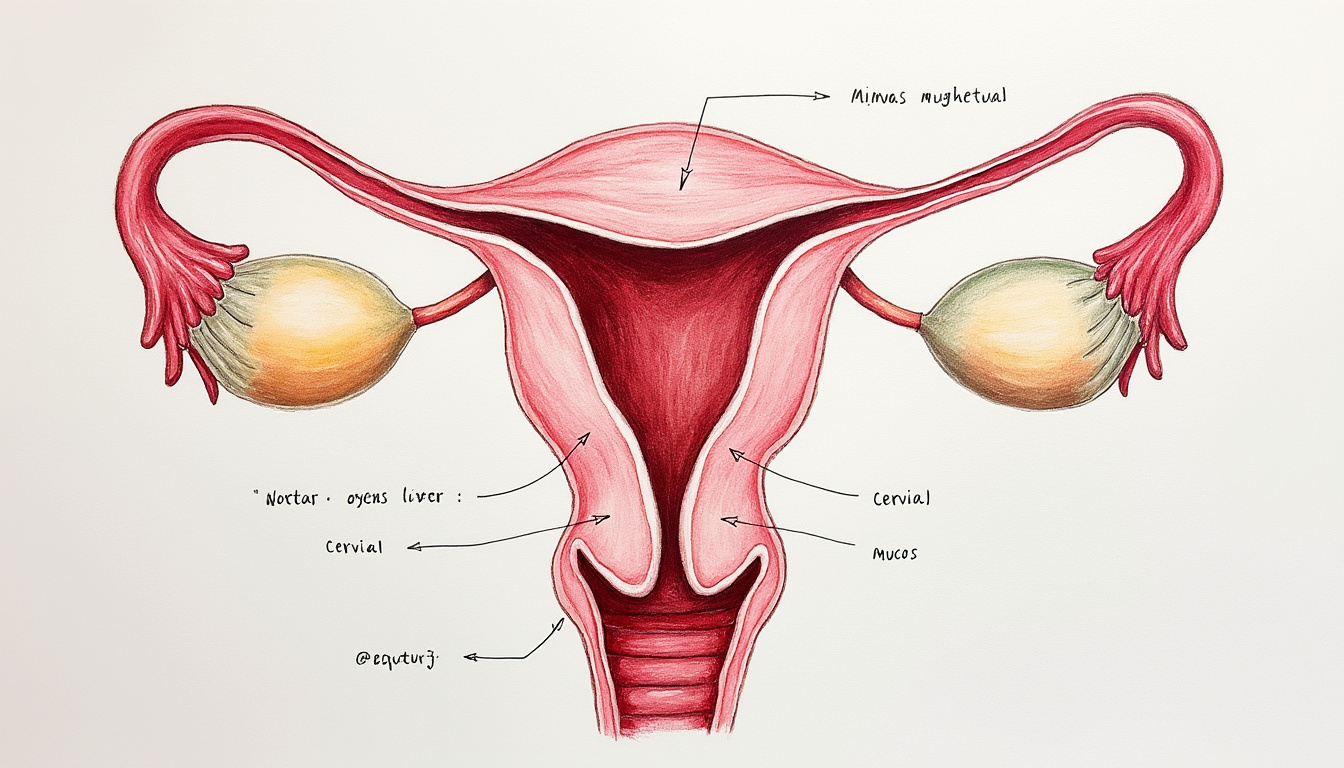
From follicular phase to ovulation: recognizing “fertile” mucus without misreading signs
The follicular phase begins on the first day of menstruation and continues until ovulation. Its duration varies widely from person to person. A 26-day, 30-day, or 35-day cycle can be perfectly compatible with good health, and this mechanically changes the ovulation date. This explains why the “day 14” markers can sometimes be misleading. They really only apply to very regular cycles around 28 days.
In the days following menstruation, cervical mucus is often discreet. The sensation may be rather dry, or the discharge modest, white, thick, with a creamy appearance. If mucus is taken between two fingers, it stretches little or not at all. This type of secretion frequently corresponds to a period of low permeability for sperm.
When estrogen rises during the follicular phase, the cervix produces a different mucus. The sensation becomes wetter. The appearance tends toward translucent. Then, approaching ovulation, a typical secretion appears, often described as “egg white.” The image helps because it describes three useful characteristics simultaneously. The mucus is transparent, abundant, and very elastic. It can stretch in a thread between two fingers over several centimeters. This stretchy mucus generally corresponds to the highest fertility window.
For many couples wanting to conceive, this marker changes how they schedule intercourse. Focusing solely on day counts can miss the actual window, especially if ovulation advances or delays. Observing mucus is following the body’s signal, cycle after cycle. In most cases, after a few months of observation, the personal profile becomes more readable. Some people have stretchy mucus for 1 to 2 days. Others for 3 to 5 days. Both can be compatible with ovulation.
A concrete marker can help structure observation without rigidity. The best information is not the “average” appearance of the day, but the most fertile moment observed, when mucus is most slippery and stretchable. In observation methods, this is sometimes called the “mucus peak.” This peak often locates ovulation within about 24 hours, with individual variability.
When “fertile” mucus is absent or very sparse, several explanations are possible. Estrogen deficiency may be a cause, but it’s not the only one. Intense stress, postpartum, breastfeeding, certain treatments, marked dehydration, or recent hormonal contraception may alter secretion quality. And one point must be stated bluntly. Under the pill, mucus is deliberately made unfavorable to sperm. This is one of the expected contraceptive mechanisms, besides ovulation inhibition depending on the pill.
When trying for a baby and the absence of fertile mucus repeats over cycles, consultation is useful without waiting months of doubt. A midwife, gynecologist, or general practitioner can evaluate hormonal context and suggest appropriate tests. The next step, when ovulation seems to occur but fertilization does not, is to observe the following phase, the luteal phase, and understand what the mucus tells.
To deepen understanding of ovulation signs and common confusions between discharges and mucus, this video resource is often more telling than a long technical explanation.
After ovulation: luteal phase, thick mucus, and markers for implantation
Once ovulation has passed, the cycle enters the luteal phase. The follicle that released the ovum transforms into the corpus luteum and mainly secretes progesterone. This hormone modifies the endometrium to make it receptive to potential implantation, and it also modifies cervical mucus. The environment becomes less favorable to sperm passage. Mucus tends to become opaque, pasty, sticky again. It often decreases in quantity as days pass.
This change has a direct biological utility. After ovulation, the body “locks” access to the uterus more strongly. This limits ascending infections and reduces chances of late fertilization, less consistent with the real viability window of the ovum. Thick mucus in the luteal phase is thus often a coherent sign, not an anomaly.
Some people observe an alternation that worries unnecessarily. A few dry days, then a return of moisture, sometimes a slight more liquid secretion. Several causes are possible. Vaginal irritation, recent sexual intercourse, certain gels or lubricants, minor microbiota variation. The logic is to look at context and repetition. An isolated episode does not have the same value as a pattern repeating identically over several cycles.
The question of implantation often arises toward the end of the luteal phase. If implantation occurs, the corpus luteum is maintained and continues producing progesterone. In this case, instead of becoming scarce before menstruation, mucus may remain more abundant and thick. Some people also note very slight brownish or pinkish discharge in the days following implantation. This spotting may correspond to small mucosal bleedings at the moment the egg implants. It is not systematic and alone is not a certain sign of pregnancy.
It is useful to set a clear hierarchy of tools. Observing mucus 12 to 14 days after ovulation can provide a clue. It does not replace a urine test, let alone a blood test if doubt persists. When the cycle is irregular or ovulation undated, symptoms quickly become ambiguous. A test done at the right time avoids much emotional waiting.
The same progestative mechanism explains a well-known phenomenon in obstetrics. Early in pregnancy, thick mucus gradually contributes to forming the mucus plug. It seals the cervix and protects the uterine cavity during pregnancy. Understanding this continuum helps not to see mucus as a simple “body waste.” It is living tissue, an interface, an active protective system.
When the luteal phase seems very short, with menstruation returning 9 to 10 days after ovulation across several cycles, or when bleeding occurs repeatedly before the expected date, consultation is relevant. A short luteal phase may exist occasionally, notably postpartum or during significant stress, but if the pattern settles, an assessment helps clarify. The next logical step then is moving from “curious” observation to structured monitoring, useful for fertility or natural birth control.
To understand how basal temperature and cervical signs complement each other, this video content can help visualize the reasoning, especially at the start.
Daily cycle monitoring: simple gestures, symptothermal method and natural birth control
Cycle monitoring is not an exam. It’s a short, repeated routine that becomes easier over time. The trap is wanting to “do everything perfectly” from the first month. The body does not need perfection, it needs consistency. Observing under similar conditions, noting without judging, then reviewing over multiple cycles provides more reliable information than long irregular observations.
To collect cervical mucus, many people keep it simple. Observation on toilet paper before urinating, and evaluation of sensation. When the signal is unclear, a finger collection can be more precise, by reaching mucus near the cervix, with washed hands. The position can be sitting, squatting, or with one foot raised, like when inserting a tampon. Once mucus is on the fingers, stretching between two fingers allows assessing the stretchy nature.
The symptothermal method combines several indicators. Most often, it combines cervical mucus and basal temperature, sometimes observing cervix position. Temperature is taken in the morning, upon waking, before getting up, at the most stable time possible. After ovulation, the thermogenic effect of progesterone raises temperature by a few tenths of a degree, in a lasting way until menstruation. Mucus helps identify the fertile window in advance, temperature confirms ovulation afterward. This duo explains why the method is often more robust than either sign alone.
In a natural birth control context, the rigor of learning is crucial. Observation methods can be effective when well learned and applied, but their potential failure rate is higher than medical contraception, especially with irregular cycles, lack of sleep, or half-understood instructions. And in real life, lack of sleep exists, especially postpartum. This does not mean these methods are “bad.” It means context matters.
One way to make this approach practical is to have a light protocol, repeated daily, without spending ten minutes on it.
- Note the dominant vulvar sensation once a day, choosing a simple scale like dry, wet, slippery.
- Observe appearance on toilet paper, then, if needed, check elasticity between two fingers to distinguish creamy from stretchy.
- Take basal temperature upon waking at least 5 days a week, noting exceptions, especially with night awakenings.
- Review the cycle at month-end with a factual outlook, looking for the most “stretchy” day and thermal rise.
A simple chart often helps clarify what is expected, especially when the goal is twofold, understanding fertility and avoiding unwanted pregnancy.
| Cycle period | Dominant hormonal profile | Common cervical mucus appearance | Fertility interpretation | Marker in symptothermal method |
|---|---|---|---|---|
| Start of follicular phase (after menstruation) | Low estrogen then progressively rising | Scanty, white, thick, creamy, barely stretchable | Low to moderate fertility depending on return of moisture | Start of observation, beware short cycles |
| End of follicular phase (pre-ovulatory) | High estrogen | Clearer, wet, then transparent, slippery, stretchy | High fertility, fertile window open | Risk days if natural birth control |
| Ovulation (around the “mucus peak”) | Estrogen peak then drop | Very abundant, very elastic, egg white type | Maximum fertility | Peak marker, then wait for thermal confirmation |
| Luteal phase | Progesterone dominant | Opaque, pasty, sticky, then sometimes almost absent | Low fertility after ovulation confirmation | Stable thermal rise over several days |
Two nuances protect against misinterpretations. Lubricants can mimic fertile mucus, while some are unfavorable to sperm. And discharges linked to vaginosis, yeast infection, or irritation do not follow cycle logic. Strong odor, itching, burning, pain during intercourse, or greenish or grey discharge justify consultation. It is not a “minor annoyance” to endure. It is often simple to treat, and it prevents cycle observation from becoming anxiety-inducing.
When cycle monitoring is well established, another question often arises. What if mucus seems fine, but pregnancy does not occur, or infertility suspicion appears? Mucus then can become a medical evaluation tool, with targeted tests.
When cervical mucus becomes a medical tool: fertility, Hühner test, and signs justifying consultation
Along a fertility journey, cervical mucus is not only an ovulation marker. It becomes a compatibility factor between two physiologies. Too scarce mucus, too thick at the wrong time, or with unsuitable pH may hinder sperm progression, especially if the spermogram already shows reduced mobility or low count. Conception difficulties are rarely “a single cause.” They often add up, and mucus can be part of the combination.
A classic exam, sometimes offered during an assessment, is the Hühner test, also called post-coital test. The principle is simple. A mucus sample is taken within hours following unprotected intercourse, at a cycle moment when mucus is supposed favorable. The lab observes quantity, appearance, pH, and sperm mobility inside the mucus. A positive test shows a sufficient number of mobile sperm progressing in quality mucus. This does not guarantee pregnancy but removes a possible barrier.
An unfavorable result is not a verdict. It may reflect imperfect timing, an atypical cycle that month, temporarily less favorable mucus, or a more lasting problem. The value of a well-conducted assessment is to place this test among other elements, like ovulation, ovarian reserve by age, status of fallopian tubes, and spermogram. In 2026, journeys are better structured than twenty years ago, but the excess of online information paradoxically increases anxiety. Having clear markers, established with a professional, prevents getting lost in contradictory interpretations.
Mucus can also alert on another level, infections and inflammations. Mucus associated with pelvic pain, fever, bleeding outside menstruation, or sharp pain during intercourse requires medical advice. Similarly, total absence of secretions with severe dryness, burning, and microfissures may need evaluation, especially after childbirth, during breastfeeding, or perimenopause. The body changes, and this change deserves tailored support, not standard solutions.
A simple box helps sort situations where quiet observation is possible from those requiring more cautious advice.
When to consult without delay
- Discharge with strong odor, itching, burning, pain, or sudden color change with discomfort.
- Bleeding after intercourse or between periods repeatedly, especially if accompanied by pain.
- Severe pelvic pain, fever, malaise, or pain on cervix movement during exam.
- Persistent absence of “fertile” mucus over several cycles with desire for pregnancy, especially if cycles are irregular.
When the goal is to optimize fertility, mucus observation fits well within a global follow-up. Sleep, mental load, intercourse rhythm, and consideration of postpartum or breastfeeding are part of reality. Physiology is not an “on/off switch.” It responds to a whole. This understanding makes cycle monitoring more useful, gentler, and often more effective over time.
Can cervical mucus alone confirm ovulation?
Cervical mucus mainly indicates the opening of the fertile window and the time when estrogens make the cervix more permeable. The slipperiest and most stretchy day usually locates ovulation within about 24 hours, but the most reliable confirmation is done retrospectively with a sustained rise in basal temperature. Combining both signs, as in the symptothermal method, reduces interpretation errors.
What is the difference between white discharge and cervical mucus?
White discharge describes what flows and is seen vaginally. Cervical mucus is produced by glands in the cervix. When it descends and mixes with vaginal secretions, it becomes part of the discharge. To observe the mucus closest to its source, some people gently collect it near the cervix with washed hands, then assess elasticity and appearance.
Why does mucus become “egg white” around ovulation?
Around ovulation, estrogens are high. They modify mucus composition by increasing fluidity and elasticity. This transparent and stretchy texture facilitates sperm progression and protects them from a more acidic vaginal environment. This change is a physiological marker of high fertility.
Can cervical mucus help with natural birth control?
Yes, but only with serious learning and regular cycle monitoring. Observing mucus identifies potentially fertile days, and basal temperature helps confirm ovulation has passed. These methods can be effective for some, but they are more sensitive to errors, irregular cycles, lack of sleep, and hasty interpretations than medical contraceptions.
What about abundant and thick mucus before menstruation: a sign of pregnancy?
After implantation, progesterone remains high and mucus may stay more abundant and thick instead of decreasing. This can be a clue, but is not a reliable sign on its own. A urine test at the right time, and then a blood test if needed, remain the safest way to confirm pregnancy, especially if ovulation was not precisely dated.