
In brief
- Safe duration in a baby bouncer for an awake and supervised baby: usually 20 to 30 minutes, with a practical ceiling of about 1 hour at a stretch depending on the model and the child’s tolerance.
- Total daily usage time: aim for 2 to 3 hours maximum, alternating with floor time and being held.
- A bouncer supports but limits mobility and can increase certain risks if used for prolonged periods: discomfort, stiffness, and flattening of the skull in some babies.
- The bouncer is not a bed: for sleep, the reference remains flat on the back, in a dedicated sleeping area, without a harness and without inclination.
- Safety depends as much on time spent as on the context: close supervision, stable surface, harness if recommended by the manufacturer, and immediate stopping if visible breathing difficulty occurs.
Safe duration of a baby bouncer: understanding what the body really tolerates
In the first weeks, many parents look for a place to put their baby without “losing sight” of them, especially during a meal, a quick shower, or a conversation with an older sibling. The bouncer gives this feeling of a frame, support, sometimes immediate comfort. This feeling is real, but it can be misleading: what seems restful is not necessarily a favorable baby position when it lasts.
The clinical guidelines used in consultations converge towards a simple idea. The bouncer is for short sequences. For an awake, calm baby under supervision, a window of 20 to 30 minutes often corresponds to a well-tolerated duration. One hour can remain acceptable occasionally, but the goal is to avoid “long immobile blocks.”
Why this time limit? An infant develops through micro-movements. Leg extensions, head rotations, arm movements that go and come back—all of this nurtures the development of muscle tone. In a semi-reclined seat, the pelvis is fixed, the shoulders are often “pulled in,” and the head can stay resting in the same spot. In small doses, this is not a problem. Repeated for a long time, it affects the freedom to explore the body.
The bouncer is also a position that can tire some babies faster than one might imagine. The signs are concrete: a baby who arches their back, who fusses without finding support, who reddens, who “pushes” with the legs as if to get out, or who ends up collapsing forward under the chin. This last point matters for safety: an overly flexed chin can obstruct airflow, especially in very young babies whose airways are narrow.
Duration guidelines remain averages. Depending on temperament, age, reflux, or muscle tone, a baby may need a posture change after 10 minutes, or conversely tolerate 30 minutes without apparent discomfort. In practice, a good indicator is the quality of alertness. A settled and attentive baby looks around, follows with their eyes, vocalizes. A “stuck” baby freezes, gets frustrated, braces themselves, or suddenly falls asleep from exhaustion.
To deepen understanding of age and use according to manufacturers and developmental stages, the resource age and use guidelines for the bouncer helps adjust based on facts rather than impressions.
Short, repeated, and alternated durations better protect development than long continuous use, even if the baby seems “quiet.”
Baby position in a bouncer: what changes for breathing, muscle tone, and the skull
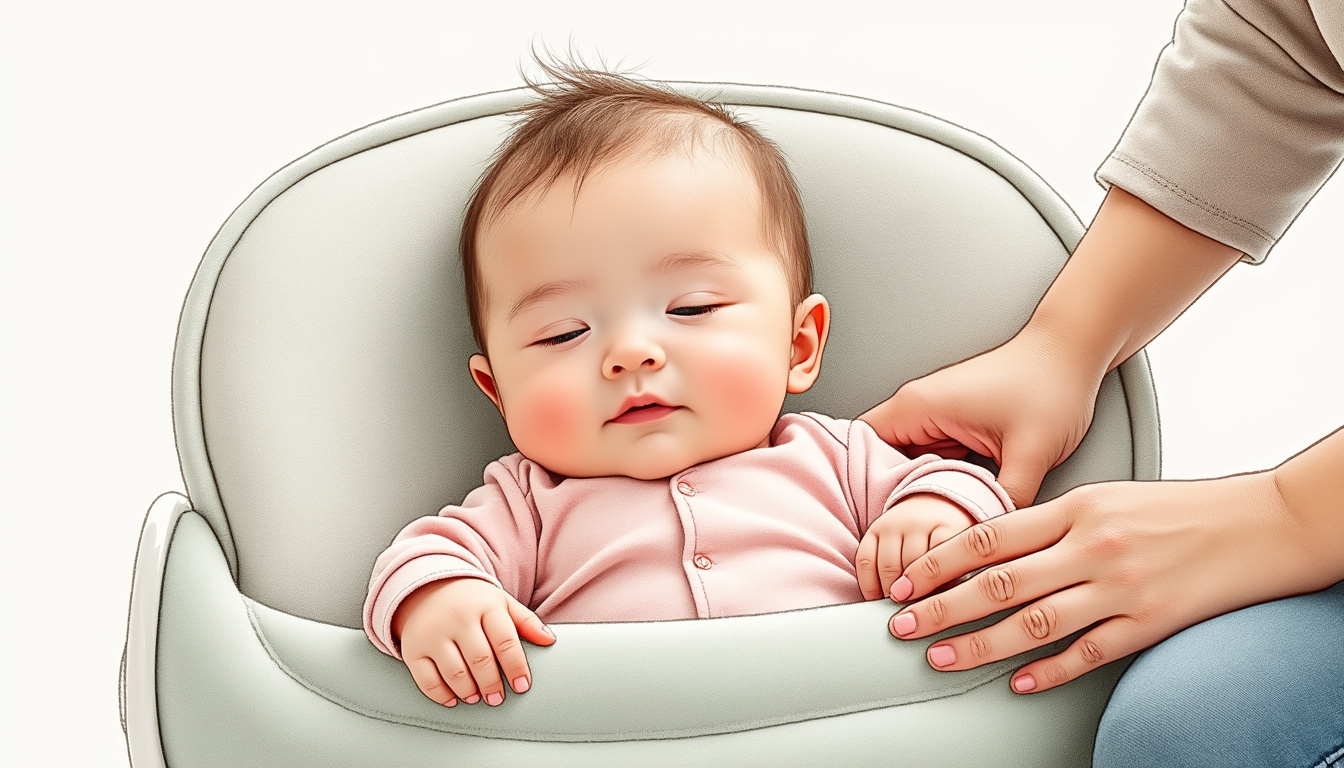
The question of usage time becomes clearer when the mechanics of the body are understood. A bouncer places the baby in semi-inclination. The weight of the torso shifts backward, the head rests on a support point, and gravity “organizes” the body instead of the child. On the floor, it’s the opposite: gravity becomes a partner encouraging the baby to adjust tone, turn, move, find support points.
On the respiratory level, an inclined position can be neutral in an older baby who holds their head well. In a newborn or small infant, neck flexion can happen quickly. The sign to watch is simple: the chin moves closer to the sternum, the mouth opens slightly, breathing becomes noisier, or the face seems to “go out.” This doesn’t mean a serious problem is happening. It means the position is no longer suitable, and supervision should lead to immediate action: take the baby out, lay them flat, or hold them.
Muscle tone is another concern. Neck and back muscles strengthen through frequent and short phases. Between 0 and 3 months, a few minutes on the tummy several times a day is already enough to train head control, provided the baby is awake and accompanied. In a bouncer, this work is more passive. The baby looks around, yes, but does not “carry” their head in the same way.
The skull deserves attention without anxiety. Positional flattening occurs when the same area on the back of the head remains in contact with a surface for a long time. The bouncer is not the sole cause, but it can contribute if the baby spends long stretches there, in addition to sleeping on the back. The idea is not to chase every asymmetry but to vary positions. The best habit is to alternate visual orientations. Place the object of interest to the left for a while, then to the right. Change the direction in the bouncer if the environment allows. Reduce the duration if a zone clearly flattens.
Risks increase especially when the bouncer becomes a fixed “parking spot” throughout the day. In a living room, it can turn into a central point, and the baby stays there during meals, calls, or tidying up. The baby is present, but their body no longer explores. Motor development is written with thousands of tiny attempts.
The best protection is not a perfect bouncer adjustment, but variety of postures throughout the day.
Two videos can help visualize postures and calm alertness markers without replacing professional advice if doubt remains.
Another useful angle concerns prevention of skull flattening and alternation of pressure points, especially in the first months.
Daily safety: how to install a bouncer without creating avoidable risks
Safety of a bouncer relies on three pillars. The first is stability. A bouncer is placed on the floor, on a flat surface. Sofas, tables, countertops, or beds create a risk of falling, even if the baby “does not move yet.” Rolling over can happen sooner than expected, and a simple kick can disrupt balance.
The second pillar is the harness, used as the manufacturer intends. Some babies gradually slide down, especially as they grow and become more active. Sliding changes the baby’s position, flexes the neck, and can make breathing less easy. A well-adjusted harness limits this sliding. It must not compress. Two fingers should fit under, and the straps must not move up toward the neck.
The third pillar is supervision. Here it does not mean “presence in the house.” It means attentive watching. A bouncer allows preparing a bottle, folding laundry nearby, reading a story to an elder sibling. It does not allow stepping away for long or cooking while turned away for a prolonged period. The baby’s state changes quickly, and the bouncer does not correct a chin that falls forward.
One point must remain very clear. A bouncer does not replace a bed. Letting a baby sleep in a bouncer exposes them to unfavorable neck postures, sliding, and less free breathing. Safe sleep is on the back, flat, in a dedicated sleeping place, without pillows or loose blankets. When falling asleep occurs in the bouncer, the simple rule is to transfer as soon as possible, even if it sometimes takes several tries.
A realistic use often happens in “small missions”: the time for a quick shower, changing an elder sibling, warming a meal. The bouncer then serves as a parenthesis, not as the main place. Many families gain peace of mind by setting a gentle timer. Not as a constraint but as a guide when fatigue makes time awareness slip.
Concrete usage time guidelines according to the objective
The bouncer is particularly suited for calm alertness. A baby who observes, listens to a voice, follows a contrast, enjoys a moment without excessive stimulation. To maintain balance between comfort and movement, these guidelines work well in most homes, adapting to the age.
| Situation | Recommended Duration | Why | When to stop immediately |
|---|---|---|---|
| Calm alertness after a diaper change, baby with good tone | 20 to 30 minutes | Limited but tolerable movement in small doses, parent available | Stiffness, persistent agitation, sliding, falling chin |
| “Logistics” time (preparing a meal, bottle, quick shower) | 10 to 20 minutes | Short duration, specific objective, close supervision | Inconsolable crying, noisy breathing, grayish or very pale complexion |
| Sleepy baby | As short as possible, transfer as soon as feasible | The bouncer is not a safe sleeping place | Deep sleep, bent head, poorly placed harness |
| Total daily duration | 2 to 3 hours maximum | Allowing time on the floor, in arms, spontaneous mobility | Clearly flattening skull, baby “stuck” several times a day |
When the setup is safe, duration remains short, and supervision is real, the bouncer becomes a useful tool without taking the place of movement.
Alternatives to the bouncer for comfort and motor development without turning the house into a gym
Reducing the usage time of the bouncer does not mean constantly “occupying” the baby. An infant does not need sophisticated toys to work on their motor skills. They need a stable place, an available body, and an environment that does not overwhelm their attempts.
The floor is often the best ally, provided it is prepared. A firm mat, a thin, well-stretched blanket, and a space where nothing falls. At first, the baby may protest. This is not a refusal to learn. It is a frequent reaction when the posture requires effort. With very short, repeated sequences, the body adapts.
Carrying is another powerful alternative for comfort. A baby carried against an adult regulates temperature, heart rate, and often crying better. The immature nervous system calms with contact, movement, and familiar smell. Carrying does not prevent motor development. It supports it, provided floor time is kept during the day.
The bouncer can also be occasionally replaced by a simple “nest” on the floor. The baby lies on their back, with identical supervision and light stimulation. The difference is important: the neck is not blocked backward in an inclined position, and arms and legs have more amplitude.
A realistic alternating routine over half a day
The goal is to create a rhythm that respects parental fatigue. The day with a baby consists of short windows. A simple alternation limits the risks related to immobility, without imposing a “method.”
-
After a meal, offer a moment of gentle uprightness in arms or by carrying, especially if the baby has reflux.
-
When alertness becomes calm, lay the baby on their back on the floor, with close presence, 5 to 15 minutes depending on age.
-
Use the bouncer for a short task, then return to the floor or arms as soon as the task is done.
-
Slide 2 to 5 minutes on the tummy when the baby is fully awake, several times a day, staying at face level.
The bouncer keeps its place, but it becomes one tool among others. Parents often observe that by reducing long semi-seated periods, falling asleep is smoother and end-of-day agitation decreases in some babies. The body has “done its day.”
Alternating postures builds a more available baby, without requiring perfect organization.
Recommendations by age, and signs that justify medical advice without delay
Recommendations especially change with head control and the baby’s ability to adjust posture. Between 0 and 2 months, the margin is small. The head is heavy, the neck has little tone, and flexion comes quickly. Bouncer times should remain very short, with an adult very close by. Between 3 and 5 months, the baby holds their head better, but the need to move explodes. This is often the period when irritation in the bouncer is seen because the baby wants to grab, roll, push.
From about 6 months, depending on sitting ability and motor skills, the bouncer often becomes less interesting. Some babies prefer the floor, crawling, or brief periods in a high chair suited for meals. The bouncer can remain occasionally useful, but it no longer holds the same functional place.
Some situations require more caution. A baby with significant reflux, prematurity, hypotonia, or recent respiratory issues deserves individualized guidelines. The bouncer can sometimes be used for comfort, but duration and inclination must be adjusted with a professional who knows the child.
When to consult, without dramatizing
Some signs do not concern a “baby who doesn’t like the bouncer.” They justify rapid advice from a pediatrician, midwife, or health professional trained with infants.
A clear box helps decide without getting lost in forums.
| What can wait and be watched | What merits professional advice |
|---|---|
| Crying stops as soon as the baby is picked up | Persistent noisy breathing, visible respiratory pauses, bluish lip coloring |
| Agitation after 15-20 minutes, need to change posture | Unusual drowsiness, difficulty waking the baby, prolonged “absent” gaze |
| Mild skull asymmetry improving with position changes | Flattening worsening despite variation, head always turned to the same side |
| Modest reflux, baby gaining weight | Projectile vomiting, marked pain, weight stagnation, blood in stool |
To refine age and usage markers, a helpful supplement is found on this detailed guide on bouncer use, with vigilance points according to stages.
When a respiratory sign or unusual drowsiness appears, the safe duration becomes “zero” until the posture is corrected and advice is sought if necessary.
Can a baby nap in a bouncer if the nap is short?
The bouncer is not designed as a sleeping place. Even for a short nap, neck flexion and sliding can occur silently. If falling asleep happens, the safest guideline is to transfer the baby flat on their back in their crib as soon as possible.
How to tell if the baby’s position in the bouncer hinders breathing?
A chin falling toward the chest, noisier breathing, a pale face, an open mouth with an “off” expression are signals to immediately remove the baby from the bouncer. Breathing should remain silent or slightly audible, with a free neck and well-aligned head.
Does the bouncer increase the risk of flat head?
The risk mainly depends on cumulative pressure on the back of the skull. A bouncer used often and for long periods can contribute to flattening, especially combined with back sleeping. Varying positions, reducing long semi-seated periods, and increasing awake floor time greatly reduce this risk.
What total usage time should be targeted in a day?
A reasonable target is to limit the bouncer to around 2 to 3 hours total per day in short sequences. The most useful guideline remains alternating with floor time, carrying, and time in arms, which support motor skills and baby regulation.