
In brief
- Shoulder dislocation corresponds to the displacement of the head of the humerus out of the glenoid of the scapula, with sharp pain and functional impairment.
- In the young child, instability is often multidirectional and linked to hyperlaxity. In the adolescent, the most frequent form is anterior after a shoulder trauma during sports.
- The dislocation diagnosis is based on clinical examination and medical imaging, first to rule out an associated fracture.
- Dislocation reduction is an emergency procedure, performed in a medical setting, after pain relief and sometimes nitrous oxide to relax the muscles.
- Shoulder dislocation care combines immobilization for about 3 weeks, then regular shoulder rehabilitation for several weeks, with supervised return to sport.
- Surgery is mainly discussed in case of recurrences in the sporting adolescent, while it remains very exceptional in the hyperlax child.
- Dislocation prevention involves targeted muscle strengthening, adjusted sports technique and identification of hyperlaxity tendencies.
Understanding shoulder dislocation in children and adolescents, without confusing two realities
When a shoulder dislocates, the body sends an unmistakable signal. The pain is sudden, often immediate, and the arm becomes “unusable” at the time. For a parent, it is a shock. The mind quickly fears the worst. Calm information helps regain control over what is really happening.
A shoulder dislocation corresponds to the displacement of the head of the humerus out of the glenoid, the small “cup” of the scapula. The shoulder is the most mobile joint in the body. This freedom of movement comes at a price. Stability depends on a delicate set composed of the capsule, ligaments, labrum, and the rotator cuff muscles. When this balance breaks, the bone comes out of its axis.
In the child and adolescent, the same word, however, covers very different mechanisms. Before adolescence, a shoulder that “goes out” may correspond to multidirectional instability, often favored by hyperlaxity. The connective tissue is more flexible, the capsule allows more play, and the humerus can slip in several directions. The context is sometimes less dramatic than an accident, with repeated episodes during effort or even ordinary movements.
From mid-adolescence onwards, the scenario is more often traumatic. A fall, a blow, a throwing movement or the famous “cocked arm” in shoulder sports can cause an anterior dislocation. In this case, the humeral head most often moves forward. The clinical picture is clear, with marked disability, visible deformation, and understandable anxiety linked to the intensity of the pain.
This distinction changes everything. The hyperlax child does not have the same care trajectory as the adolescent who dislocated during a match, a tennis serve, a handball reception, a ski fall or an explosive basketball movement. The strategy, the pace of return, the possible surgical discussion all depend on this.
Vocabulary matters too. A subluxation corresponds to a partial displacement, with a sensation of “dislocation” that sometimes spontaneously reduces. This is not trivial. Repeated subluxations can wear the tissues, maintain apprehension of movement and install pain that lasts over time. It deserves evaluation, even if the shoulder seems “put back”.
A simple guideline helps parents. The more violent the scene and the more intense the pain with deformation, the more likely it is an emergency. The more fluctuating, repetitive the complaint, associated with general hyperlaxity, the more the care will often focus on strengthening and motor control. The logical next step is to know how to recognize what requires a rapid consultation.

Recognizing the signs and knowing when it is a traumatic emergency
A dislocated shoulder does not present like a simple bruise. The most telling sign remains the very sharp pain that arises at the moment of dislocation, then worsens with the slightest attempt to move the arm. The child or adolescent often spontaneously seeks a pain-relieving position, elbow slightly away from the body, hand supporting the forearm. This is not acting. It is mechanics failing.
A deformity may be visible. A “bump” may appear in front or on the side, corresponding to the displaced head of the humerus, with flattening of the normal shoulder contour. This observation impresses, but it also helps to understand that the joint is no longer in its axis. Another common sign is functional impairment. Grabbing a bottle, putting on a jacket, lifting the arm becomes impossible.
In some sporting adolescents, a sensation of “out and back” may be described. This suggests a subluxation or spontaneous reduction. In this case, the pain may decrease, but instability persists. The shoulder becomes wary. The young person avoids certain movements, especially those placing the arm in abduction and external rotation, such as cocking a throw. This apprehension is a real signal to continue evaluation, even if the crisis has passed.
The notion of emergency rests on two very concrete goals. The first is to rule out an associated fracture, especially after a fall or violent blow. The second is to relieve and reposition the shoulder in good conditions, to limit suffering and reduce the risk of neurovascular complications. An unreduced dislocation exposes to prolonged intense pain and increasing difficulty relaxing the muscles, which can complicate reduction.
Some signs justify immediate consultation. A cold hand, persistent tingling, loss of sensation, sudden finger weakness, or unusual paleness must be taken seriously. After trauma, pain that “pierces” despite usual analgesics or total inability to move the arm also requires rapid medical advice.
At home, the priority is not to “put it back”. The priority is to protect. Immobilizing the arm against the chest with an improvised sling can reduce unwanted movements. Applying cold wrapped in a cloth for 10 to 15 minutes sometimes helps reduce pain and swelling. Food and drink may be limited if anesthesia is subsequently needed, but a professional will guide according to the context.
Shoulder trauma often causes an adrenaline rush, then an energy drop. In an adolescent, the worry of “not being able to play sports anymore” appears quickly. Clear words reassure. In the majority of cases, rapid care and well-conducted rehabilitation allow a return to movement, with progressive and supervised resumption. The rest depends on diagnosis and imaging.
To understand what happens in the emergency room, the most useful is to anticipate the process of dislocation diagnosis and the exact role of medical imaging.
Diagnosis of shoulder dislocation and medical imaging, with practical guidelines for parents
Dislocation diagnosis begins with clinical examination. The professional observes posture, shoulder shape, possible mobility, then checks sensitivity and circulation in the hand. This neurovascular check is a reassuring step when all is normal and quickly guides when a nerve or blood vessel seems compressed.
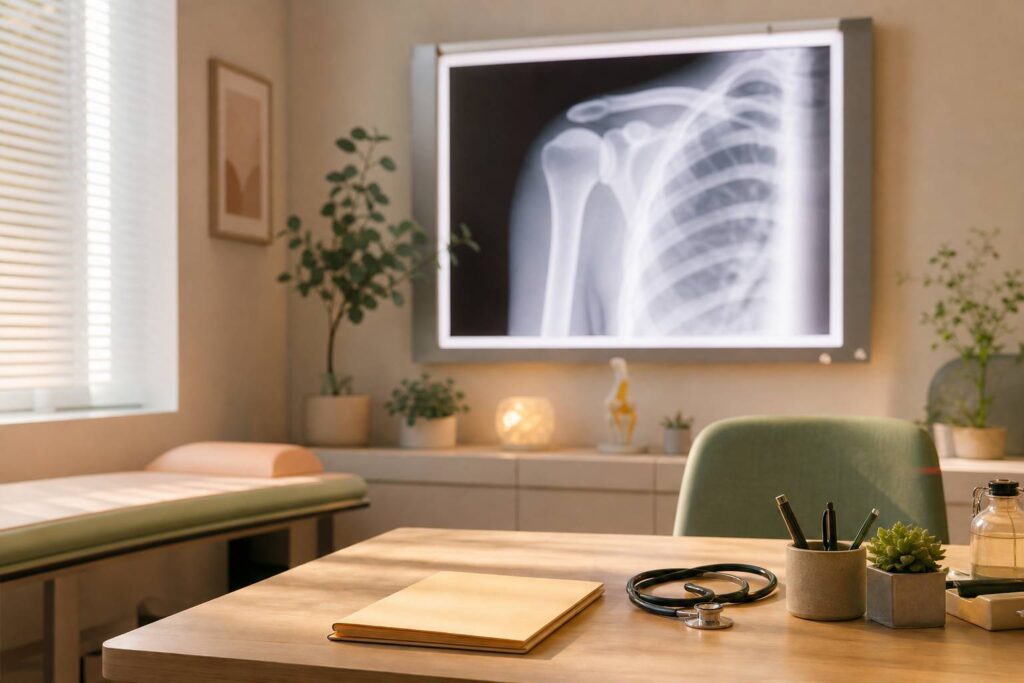
Medical imaging is almost systematic before reduction, especially when it is a clear shoulder trauma. X-rays confirm the dislocation and, above all, rule out an associated fracture. In adolescents, the growth area is not always fully consolidated depending on age and maturation, which requires caution and precision. In the youngest, some bone lesions can be more discreet, and interpretation is done with an eye accustomed to pediatrics.
After reduction, a new X-ray is often performed to verify that the joint has correctly returned to place. This double check is not an excess. It secures the procedure. It also allows detection of lesions that may influence following care, notably if the shoulder dislocated forward with labral tear or impaction of the humeral head.
Subsequently, depending on symptoms and risk of recurrence, other exams may be proposed. Ultrasound can help evaluate certain soft tissues, even if the shoulder is complex. MRI, sometimes MR-arthrography, becomes useful when precise mapping of lesions of the capsule, labrum, or rotator cuff is needed, especially in adolescents with repeated episodes or persistent instability. CT may be indicated to analyze bone when suspected glenoid bone loss exists or before surgery such as bone block.
The notion “depending on age, two different pathologies” takes full meaning here. In the hyperlax child, imaging does not always explain the feeling. The shoulder can seem “normal” on an X-ray between episodes, although the capsule is too loose and muscle control insufficient. In these cases, diagnosis is often clinical, supported by laxity tests and precise analysis of movements triggering instability.
A table helps distinguish the most frequent scenarios, without boxing your child. It serves to prepare questions to ask and understand the care logic.
| Profile | Most frequent mechanism | Usual direction | Exams often done | Most common treatment | Point of vigilance |
|---|---|---|---|---|---|
| Child (often 8-12 years) with hyperlaxity | Progressive instability, repeated episodes during effort or daily gestures | Multidirectional | Clinical exam + X-rays if acute painful episode | Shoulder rehabilitation focused on strengthening and motor control, rare surgery | Possible chronic pain, need for comprehensive management |
| Sporting adolescent (often ≥ 15 years) | Shoulder trauma from fall, contact, throw, “cocked arm” | Anterior | X-rays before/after dislocation reduction, then MRI if instability | Reduction + sling about 3 weeks + physiotherapy | Risk of recurrence depending on sport, laxity, associated lesions |
| Adolescent with repeated episodes | Recurrent dislocations, movement apprehension | Often anterior | MRI/MR arthrography, sometimes preoperative CT scan | Surgical discussion such as capsulorrhaphy or bone block + rehabilitation | Protection of cartilage and bone in the long term |
This reading level avoids two pitfalls. The first would be to trivialize a shoulder that “goes out often” in a hyperlax child, while pain and functional limitation can become long-lasting. The second would be to minimize a first traumatic dislocation in an adolescent thinking “it will pass”. The immediate next step is reduction and emergency care, with adapted immobilization.
Immediate care, reduction of dislocation and immobilization, with reassuring and precise process
Shoulder dislocation care in the acute phase has a clear objective. Put the joint back in place, relieve pain, then protect tissues while they heal. When the shoulder is quickly reduced, pain often drops dramatically. This improvement does not cancel tissue damage, but changes the experienced sensation.
Dislocation reduction is done in a medical environment. It requires a relaxed patient because muscles contract in response to pain and lock the joint. It is a protective reflex. Teams use analgesics, sometimes light sedation, and in some adolescents nitrous oxide, known to the public as “laughing gas”. The goal is not deep sedation but to relax, reduce anxiety, and allow gentle manipulation.
Reduction is not a brutal gesture. It is performed progressively with adapted techniques. This detail reassures many parents. When the professional looks for the right direction, he respects the physiology of the joint. The goal is to put the humeral head back into the glenoid without forcing, using muscle relaxation and controlled traction rather than constraint. After the maneuver, the neurovascular exam is repeated.
Immobilization almost always follows. An elbow-to-body splint or a specific sling keeps the shoulder rested, often for about three weeks after a first traumatic episode, with adaptations according to age, pain and stability. This period makes sense. The capsule and ligaments need time to heal. Moving too much too soon, even if pain decreases, favors instability.
At home, residual pain is common. Relief is not the same as complete disappearance. Prescribed analgesics allow sleeping and minimum movement. A useful guideline is to observe daily life. Pain decreasing over a few days is expected. Increasing pain, fever, marked redness or increasing inability to move fingers should prompt contact with a professional.
Comfort also depends on practical details. Sleeping half-sitting can help the first nights. Slipping a cushion under the forearm prevents the arm’s weight pulling on the shoulder. For hygiene, loose clothing and front-opening tops ease dressing. These are simple adjustments but they avoid a succession of micro-pains that exhaust.
When the event was impressive, fear of moving settles quickly. It is not “in the head”. It is learning by the nervous system after acute pain. The logical next step is to regain control with structured rehabilitation, to restore stability and movement confidence.
Shoulder rehabilitation, return to sport and recurrence prevention according to age
Shoulder rehabilitation is not a bonus. It becomes the key component to regain a stable shoulder, especially in the sporting adolescent and hyperlax child. The physiotherapist does not “just build a little muscle”. He relearns the shoulder to center itself, activate the right muscles at the right time, and protect the joint within risky ranges of motion.
After a traumatic dislocation that was reduced and immobilized, rehabilitation often starts with gentle mobilizations, then progresses to strengthening. The frequency often proposed is two to three sessions per week, over a duration that may go up to three months, with variations according to stability and sports practice. Between sessions, short daily exercises are generally prescribed. They are brief. They must be regular. It is this repetition that reprograms motor control.
In the adolescent, the return to sport is discussed in stages. Returning too early to a throwing movement exposes to recurrence. Returning too late without progression feeds fear and muscular maladaptation. A classic progression includes return to running without shoulder impact, then specific strengthening, then reintroduction of technical gestures. Contact or throwing sports require extra caution because they combine speed, range of motion, and unpredictability.
Dislocation prevention is based on simple but demanding principles. Shoulder stability depends a lot on scapula muscles, rotator cuff, and overall core strength. A strong but poorly centered shoulder remains vulnerable. Conversely, a less powerful but well-controlled shoulder withstands better. Coaches trained in shoulder injury prevention know this. Technique matters as much as strength.
In the hyperlax child, the strategy changes. The goal is not to “lock” by surgery, as results are often disappointing and may shift the problem in another direction. The work focuses on strengthening, proprioception, coordination, sometimes with more regular physio sessions, or even management in a center with balneotherapy and more intensive strengthening. Some aquatic activities may help but not all. Breaststroke is sometimes better tolerated, while back crawl can provoke risky shoulder positions depending on profile.
When episodes repeat despite well-conducted rehabilitation, it is useful to widen the view. Hyperlaxity may be part of a constitutional profile, sometimes isolated, sometimes associated with collagen involvement. A specialized opinion may be proposed, exceptionally a genetic evaluation, especially if there are other signs of tissue fragility. These situations remain rare but they change management, notably on pain and fatigue.
Chronic pain deserves particular attention. A child who repeatedly dislocates may develop persistent pain, with impact on school, sleep, mood. A consultation in a pediatric pain center, with a pain specialist, may open resources. Psychocorporal approaches such as sophrology, pain-focused psychotherapy, sometimes guided meditation, can complement drug treatment. This does not replace rehabilitation. It helps the nervous system lower the alarm volume.
Surgical discussion mainly exists for the recurring adolescent. Two main types of techniques are often mentioned. The bone block aims to prevent the humeral head from going forward. Capsulorrhaphy tightens the capsule and ligaments. The choice depends on lesions seen on imaging, sports level, and risk of recurrence. After surgery, the sling, sport cessation for three to six months, and rehabilitation remain necessary. The repaired tissues need protection before being stressed.
A shoulder that has dislocated once can become reliable again. It requires time, steps, and clear collaboration between the young person, parents, physiotherapist, and sports doctor or orthopedist. The next useful angle is to know which questions to ask in consultation and which signs to watch for remotely, without living in constant alert.
What is the difference between dislocation and subluxation of the shoulder in a child?
Dislocation corresponds to a complete displacement, with the humeral head out of the glenoid and often clear functional impairment. Subluxation is a partial displacement, sometimes with spontaneous reduction. Even if the crisis seems “over”, repeated episodes can maintain instability and pain, which justifies evaluation and often adapted rehabilitation.
Should one go to the emergency room at each suspicion of shoulder dislocation?
In case of very sharp pain, visible deformity, inability to move the arm after shoulder trauma, urgent consultation is the rule, notably to rule out a fracture and perform safe dislocation reduction. If the shoulder seems back in place but significant pain, marked apprehension, or tingling persist, medical advice is also indicated.
How long does immobilization last and when does shoulder rehabilitation start?
After reduction, immobilization by elbow-to-body splint is often proposed around three weeks, with adaptation according to age and stability. Shoulder rehabilitation then starts progressively, first with gentle mobility and control, then strengthening, often two to three sessions per week for several weeks, sometimes up to three months.
When is surgery discussed for the adolescent?
After a first traumatic dislocation, treatment is most often non-surgical, combining reduction, immobilization and rehabilitation. Surgery is discussed mainly if dislocations repeat, if medical imaging identifies lesions favoring recurrence, or if sports level exposes to high stresses. Possible techniques include bone block or capsulorrhaphy, chosen according to lesions and profile.
Which dislocation prevention measures can be implemented after a first episode?
Dislocation prevention relies on targeted strengthening of the rotator cuff and scapula muscles, proprioception work and progressive sports resumption. Risky movements, notably arm in abduction-external rotation in throwing sports, are reintroduced with technique and control. In the hyperlax child, regular rehabilitation and adaptation of activities are often more decisive than seeking a surgical solution.