In brief
- Recommended age for Jurassic World: Dominion in cinemas: often 10 to 12 years old for a calm screening, with some margin depending on sensitivity.
- Some cinemas mention from 8 years for the “comprehensible” aspect but warn of loud sound, screaming, impressive images, and a long duration (2h13).
- Classification and age guidelines are just guides, not verdicts. The child’s temperament, their experience with suspense, and tolerance to noise weigh heavily.
- A “successful” screening is prepared like a family outing with a young child: scouting, seating, break strategy, and a plan if intensity overflows.
- When fear overflows after the film, it’s not “a tantrum.” It is often a brain continuing to process too strong images. Simple gestures exist to restore emotional safety.
Recommended age for Jurassic World: Dominion in the cinema, beyond the number
A stated age reassures because it gives the impression of quick decision-making. Yet, the experience of a film like Jurassic World: Dominion depends less on “dinosaur” curiosity than on the child’s sensory and emotional maturity. Between 8 and 12 years old, tolerance to suspense can vary greatly, even among children the same age.
Feedback from cinemas and parental reviews converge towards a cautious range. The recommended age is often between 10 and 12 years to limit crying, rushed departures, and restless nights. Some cinemas mention 8 years as “possible,” because the story remains understandable and the creature enjoyment works very early. This nuance should be heard but must not erase the context. A big screen, enveloping sound, realistic images, and chase scenes activate the alarm system much more strongly than at home.
Classification is a structuring reference because it translates an average intensity level. It cannot know your child’s personal history, nightmares, reaction to screams, or ability to tell themselves “it’s just a movie.” When a film is rated “parental guidance recommended” in some countries, it does not mean “forbidden,” but “adult presence useful to contain and explain.” The presence is not only physical. It serves to observe, suggest a break, put words to it, and prevent fear from turning into shame.
A concrete indicator helps decide without getting lost. A child who already tolerates a cartoon with explicit threat, tense music, and chase scenes, without collapsing or brooding for days, tolerates this kind of adventure better. A child who freezes at a “friendly” character shouting, or who wakes up at night after a chase scene, often needs time. The chronological age does not tell everything, but the reaction to stimuli does.
The subject of Jurassic World: Dominion adds an element. The story is about a risky mission on an island linked to the original park’s research center, with a worrying discovery hidden for decades. This “survival” setting does not rely only on monsters. It plays on anticipation, the invisible threat, rising music. A child’s brain can remain stuck on this suspense even if they “liked it” at the moment. The next theme, that of sensory intensity in the cinema, clarifies what really weighs on the balance.
What really impresses in the cinema, and why some children check out from 8-9 years old
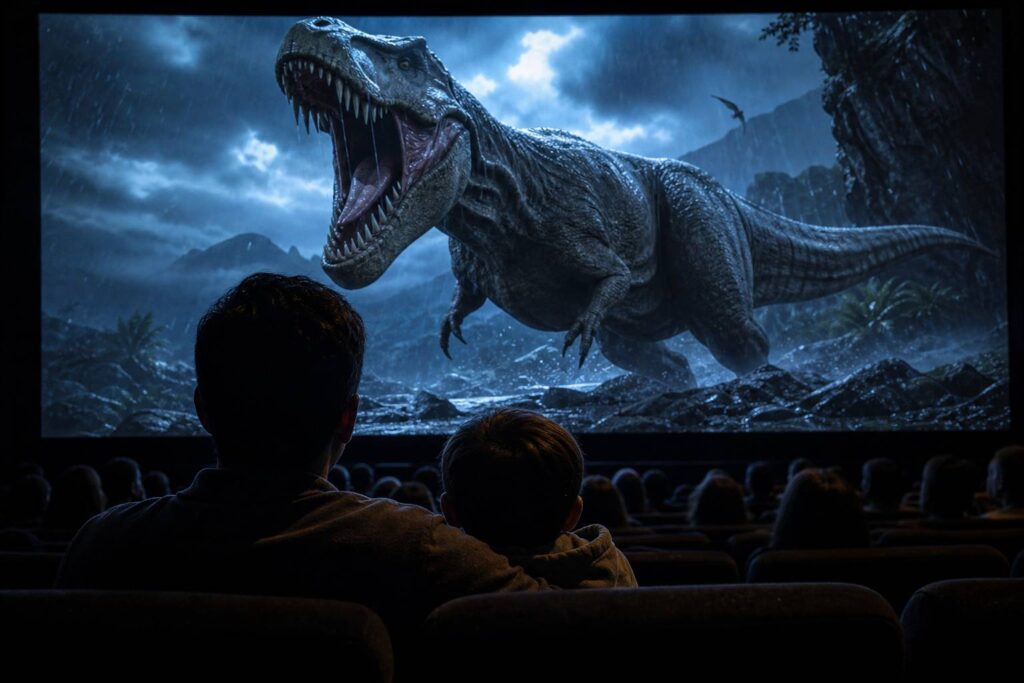
In cinemas, intensity does not come only from “violent” images. It comes from the whole sensory experience. A loud sound makes the chest vibrate. Unexpected screams trigger a jump. Flickering lights tire more quickly. A child can understand the story and still be overwhelmed because their nervous system processes an avalanche of information continuously.
Between 7 and 10 years old, many children already know how to tell what is “fake” in a movie. This cognitive skill is not always enough to calm the body. The emotional brain reacts quickly. The amygdala detects the threat before the rational part has time to say “it’s just a movie.” This lag explains a frequent scene. The child says they want to stay, then suddenly asks to leave, becomes irritable, or clings to the adult’s arm. This is not opposition. It is a threshold being crossed.
Staff in some cinemas have a very pragmatic observation. Even without official warning, they mention a minimum around 8 years, specifying that the sound is quite loud, images can be impressive, and screams mark certain young viewers. This field insight is valuable because it speaks of the in-theater experience. It also mentions a point often minimized. The duration (2h13) is long for a young child. Even if fear is manageable, attention and physical comfort can give out before the end.
Length counts double. First because it increases fatigue and thus emotional vulnerability. Then because intense scenes repeat. A child who manages the first stress spike can be “full” at the third. In a dark room, without the possibility to move easily, helplessness increases panic. Seating near an aisle and a clear permission to leave without scolding change the situation.
Some simple adjustments protect sensory safety. Child-appropriate earplugs or a light noise-cancelling headset can reduce the risk of overflow. A discreet snack and water prevent irritability linked to hunger, often confused with fear. A bathroom visit just before limits emergency departures, which amplify anxiety. One detail also matters. A child who does not like darkness benefits from settling during trailers to get used to the room before the movie really starts.
This preparation also serves the relationship. It sends a simple message. The adult is a support point, not a judge. This stance becomes even more useful when relying on the classification and the film’s content to decide, which opens the next theme.
To feel what a full theater represents, the reactions to sound and staging, a trailer or excerpt sometimes helps. A video search on visual and sound elements can offer a first “test” at home, keeping the volume low and the lights on.
Classification, film content and understanding the plot, three criteria to separate
Parents often confuse three questions. Can the child understand the story? Can they tolerate fear? Does the classification allow it? The three do not overlap. An 8-year-old can follow a mission on an island and understand the quest for dinosaur DNA “to save human lives” while being overwhelmed by the staging of danger. Conversely, a 10-year-old very sensitive to noise can check out, even if not afraid of dinosaurs.
The synopsis of Jurassic World: Dominion sets the mood. A team led by Zora Bennett goes to a dangerous place linked to the original park’s research center to retrieve genetic material. The story shifts when the mission becomes increasingly risky and a shocking discovery resurfaces after being hidden for decades. This type of scenario feeds anticipation. Children who like dinosaurs “as animals” can be surprised by the “survival” and “secret” dimension.
The film’s reception in theaters in 2025 gives a clue about its appeal. Released Friday, July 4, 2025, it surpassed 673,000 entries in three days. This figure reflects family anticipation and strong curiosity around this new installment, directed by Gareth Edwards with a renewed cast. Scarlett Johansson, Jonathan Bailey and Mahershala Ali bring another tone, less “habitual” for some children who followed previous episodes’ faces. This novelty can stimulate but can also disorient a young viewer attached to known signposts.
To decide precisely, a table helps separate the criteria. The idea is not to fix a rule but to observe where your child stands today.
| Reference | What it measures | Favorable signs | Warning signs |
|---|---|---|---|
| Age and emotional maturity | Ability to stay regulated during a fear spike | The child verbalizes, allows covering eyes, breathes then returns | Blocking, silent crying, agitation, need to leave immediately |
| Sensory tolerance | Reaction to sound, darkness, startle responses | Tolerates loud volume at a concert or party without distress | Covers ears, migraines, noise hypersensitivity |
| Plot comprehension | Narrative tracking over 2h13 | Follows a long movie at home without losing the thread | Checks out after 45-60 minutes, often asks “who is this?” |
| Prior Jurassic World experience | Familiarity with saga codes | Has seen a previous installment and talks about it without nightmares | Ruminations, avoidance, nightmares after similar content |
A method point helps. When the child insists on going, the request may hide two different needs. The need to feel “grown-up” like others, or the real need to see the story. In the first case, alternatives exist without humiliation. An earlier screening in the afternoon, strategic seating, or another less intense adventure movie can satisfy the need to belong. The next section details concrete, practical gestures so that the outing remains a family experience and not a test.
Behind the scenes of production and the director’s tone are sometimes more telling than scattered reviews. Researching interviews and staging helps sense if the film plays more on horror or adventure.
Preparing the family screening with simple gestures that protect safety
A cinema screening with a child is like a little expedition. The goal is not to control everything. The goal is to reduce “avoidable surprises” that turn a normal emotion into panic. In a family, a clear plan also relieves the adult, who no longer has to improvise in the middle of the room.
The most protective rule is to give an explicit permission to leave. It must be said before entering, calmly, without threat. A child who knows they can take a break does not need to hold their silence. This permission lowers tension, sometimes to the point that it won’t be needed.
Choosing the screening counts. A daytime show tires less. The room is often less full, which facilitates a discreet exit. Seating near an aisle reduces the feeling of being “trapped.” For sensitive children, a seat slightly further from speakers lowers sound pressure. This logic applies especially to Jurassic World: Dominion, which combines action and powerful sound effects.
A short and concrete list helps not to forget anything, without turning the outing into a military operation.
- Provide hearing protection if the child often complains about noise, even at home, and do a trial beforehand.
- Eat and drink beforehand, then keep a small bottle of water, because hunger and thirst lower stress tolerance.
- Choose a seat by the aisle and settle during trailers to familiarize the child with the room.
- Fix a discreet signal for asking for a break, a hand gesture or a squeeze on the arm.
After the screening, regulation continues. Many children seem “fine” on the sidewalk, then wake up at night with recurring images. The brain sorts and consolidates memory during sleep. When images are too intense, they appear in dreams. A calming return helps. Soft light, warm drink, two or three sentences putting the scene back into fiction, without mocking. Some children need to move a little before sleeping to lower bodily activation.
The notion of safety concerns not only emotion. It also concerns sleep, especially if the child ends up in the parental bed after a night fear. This happens even in “older” children after a striking film. The most important is not to create a battlefield at 2 AM. Shared sleep references and adjustments to keep it safe are detailed here, with simple and concrete criteria co-sleeping and safe sleep.
When the outing hits the mark, the child returns proud, not drained. This difference often depends on adults’ ability to recognize the tolerance threshold, then accompany the aftermath. The next theme addresses precisely the signs that indicate the film was “a bit too much,” and when to ask for professional advice without dramatizing.
Recognizing signals after the film, and knowing when to ask for parental or professional advice
A child may love Jurassic World: Dominion yet show overload signals in the following days. Parents often notice them in details. Refusal to go alone to the bathroom. Unusual request for light at night. Irritability at bedtime. Replaying the film in drawing or game, focusing on the most intense scene. These do not mean the outing was “a mistake.” They indicate the nervous system is still digesting.
There is a useful distinction. Replaying is often a mastery mechanism. The child reenacts to regain power over a fear. The warning sign is invasive repetition. Nightmares several nights in a row. Fear extending to other contexts, such as fear of the dark that did not exist. Somatization, stomach aches before school, or marked appetite drop. When these signs persist beyond 7 to 10 days, consulting a childhood professional often brings quick relief, because they make sense and offer adapted strategies.
The way of talking about the film matters. A minimizing parent closes the door. A dramatizing parent locks in fear. An effective approach is based on facts. What scared the child. When. Where it is felt in the body. Tight throat, racing heart, sweaty hands. Naming the body helps the brain classify the experience, instead of letting it loop. A child who can say “it was too strong when they shouted” recovers better than a child who keeps “I’m scared” as a lump.
Some children also have occasional vulnerabilities. Fatigue, school change, separation, recent illness. A convalescing period can lower stimulation tolerance. For younger children, a viral infection or oral discomfort can already disrupt sleep, and fear attaches itself. When a child is going through a fragile period, it is better to avoid adding a very intense film. Guides on symptoms requiring medical caution also exist in very different topics, like hand-foot-mouth disease symptoms, because fatigue and pain directly influence emotional regulation.
A clear box helps knowing when to consult without turning parental worry into constant alert.
When to ask for advice
- Sleep is disturbed more than a week with repeated nightmares or panicked awakenings.
- The child shows a new and persistent fear, such as refusing to go to school or stay alone in a room.
- Physical signs appear and last, such as daily stomach aches, anxiety-related vomiting, marked appetite loss.
- The child recently experienced a stressful event and the cinema outing seems to have “overloaded” an already present vulnerability.
In most cases, a few days suffice for everything to settle, especially if the adult remains available, offers a night light temporarily, and agrees to re-explain the fiction. This calm gaze also prepares future outings because the child learns that fear is overcome, with support, and that it doesn’t define who they are. The last section answers the practical questions parents most often ask before buying tickets.
What is the recommended age to take a child to see Jurassic World: Dominion in the cinema?
The most comfortable range is often between 10 and 12 years old, because the sound intensity, suspense, and 2h13 duration strongly demand emotional regulation. Some cinemas mention 8 years as a possible minimum, especially if the child tolerates impressive scenes and noise well. The decision is better made by observing sensitivity to sound, reaction to suspense, and ability to ask for a break.
Is classification enough to decide?
Classification gives a content reference but does not know your child’s temperament. A child can understand the plot and be overwhelmed by screams, startles, or darkness. The most reliable tool remains observation of reactions to comparable adventure films, then preparing the screening with aisle seats and the possibility to exit.
How to prevent the film from triggering nightmares?
Reducing stimulation helps from the start, with hearing protection if necessary, and a daytime screening. After the film, returning to calm facilitates sorting images before night, with soft light, stable routine, and putting into words the marked scene. If nightmares persist beyond 7 to 10 days, consulting a childhood professional can help defuse quickly.
What to do if the child wants to leave mid-screening?
Leaving without arguing at the moment protects emotional safety and prevents the child from associating fear with humiliation. Once in the lobby, suggest breathing, drinking some water, then decide together whether to return or stop. A child who feels respected in their limit recovers faster and will try again more calmly.