

In brief
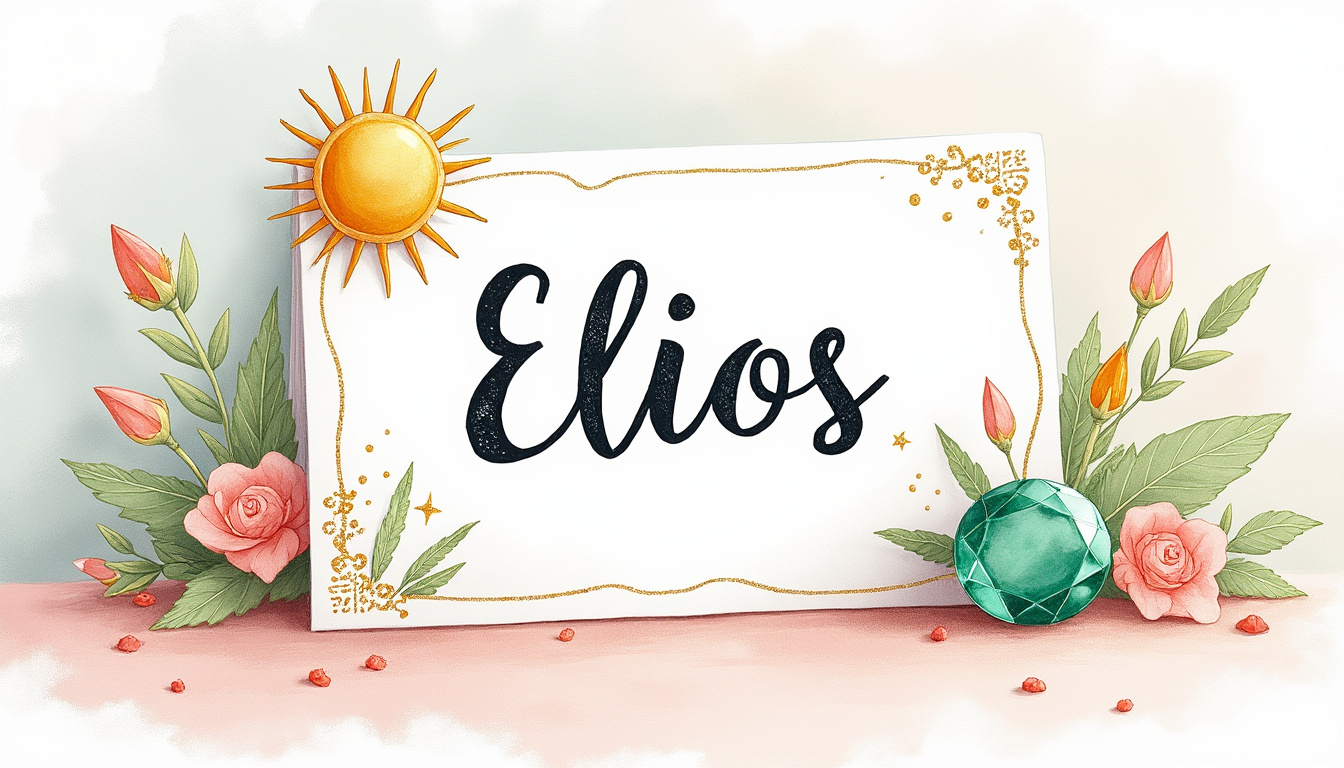
- Elios is a first name of Greek origin, borne by a rich cultural history and an etymology associated with the sun.
- Its meaning evokes light, warmth, and energy—images that often resonate with parents when envisioning life with their baby.
- In France, Elios remains discreet yet real in popularity, with a noticeable resurgence around 2020, while maintaining an impression of rarity.
- The personality traditionally associated with Elios highlights loyalty, empathy, and a taste for social bonds, along with a useful caution regarding sometimes too spontaneous trust.
- Concrete reference points help to confidently choose an atypical first name, to anticipate its reception within the family culture, and to place it in a meaningful tradition.
History, origin and etymology of the first name Elios, between Greek mythology and European culture
In the first days following birth, fatigue sometimes makes everything feel very dense, including the choice of words that will accompany a child throughout their life. A first name is not just a pleasant sound. It is woven into a history, a culture, a lineage, and sometimes a very intimate projection of what the parents wish to pass on.
Elios is rooted in a Greek origin, closely related to the name Helios, a major figure in ancient mythology. Helios personifies the sun, the one who crosses the sky, illuminates, and marks the rhythm of days. Although a first name does not “program” a destiny, its collective imagery exists and shapes the way it is perceived.
The meaning associated with Elios therefore refers to the solar body. The etymology leads to the idea of light, warmth, and vital impulse. Many parents find a reassuring, almost tactile symbolism in it, because the sun evokes a simple bodily sensation. After childbirth, when the body recuperates and sleep is fragmented, this kind of image can matter, without it becoming a command to “radiate” or to succeed.
The circulation of Greek first names in Europe follows waves. There are periods when mythology inspires literature and the arts, then times when there is a return to shorter, more international forms. Elios is a spelling that retains a gentle musicality, with an “-os” ending that evokes Antiquity, while remaining pronounceable in several languages. This “cross-border” dimension explains part of its contemporary appeal.
The way a first name takes hold also depends on religious registers and calendars. Some sources associate the celebration of Elios with July 20, which creates a possible tradition for families who like to mark a date. A name day is never an obligation. For some parents, it is simply a straightforward annual reference, an opportunity to later tell the child why the choice was made.
On a linguistic level, Elios is close to other forms such as Elio. Variants matter because they influence spontaneous spelling at school, how relatives write a card, or how an administration records a file. A rare but readable choice eases daily life, especially when parents are already managing a thousand concrete details in the first weeks.
To situate Elios among other first names with a strong cultural flavor, it can be useful to see how origin and imagery evolve according to eras and regions. A detour through the history and meaning of Olympe helps understand how a mythological first name can remain modern without disguising itself.
Once meaning, sound, and cultural anchoring are established, the next question naturally arises for many parents: How is this first name living in today’s society, and what do recent trends say?
Meaning of the first name Elios and symbolism of the sun, with concrete reference points for parents
The meaning of a first name acts like a small narrative compass. Parents often tell the story of the name choice during the early months, when those around ask “why that one?”. Having simple and accurate words avoids feeling obliged to justify oneself, especially in a period when sensitivity is strong.
Elios evokes the sun. This symbolism is rich because it is not limited to an idea of performance or extroversion. The sun is also rhythm. There is a sunrise, a zenith, a sunset. This image matches something very concrete in a newborn, whose biological clock gradually develops. A baby is not born with a mature day-night rhythm. The circadian rhythm usually calibrates between 6 and 12 weeks, with wide variation depending on the child.
This “sun-rhythm” association can become a simple family anchor. Some parents like to link the name to small, realistic habits, without forced folklore. Saying “hello to the day” when opening the shutters, taking a short walk in the morning when possible, exposing the baby to indirect natural light during the day. These gestures sometimes help consolidate the differentiation between day and night, without promising complete nights.
The sun as metaphor for regulation, not as a command to be well
A bright name can be badly experienced if the surroundings expect a child to fit an image. Yet a baby does not “choose” their temperament. Some infants are very alert, others more observant, some cry a lot in the evening, others less. The name is not a program. It becomes a narrative, and this narrative can remain flexible.
In everyday life, an anchor helps. When the baby goes through a crying period at the end of the day, common in the first weeks, it does not mean they are “unwell” or something is lacking in the parents. The nervous system is immature. Regulation of wake states passes through the body, through carrying, sucking, reduced stimulation. Associating Elios with the sun can remind that the end of the day is often a moment of physiological tipping, not an educational challenge.
Associated symbols, precious stone, and family imagery
The symbolism also assigns to Elios a stone, the emerald. This association appeals to families who like souvenir objects. An emerald does not need to be a “real” stone given to a baby. It can become a reference color in the room, a small motif on a comfort toy, a piece of jewelry passed down later. The interest is to create continuity, a trace, not to overload daily life.
To go further in how symbols attach to first names and become a family story, the article around Rose Blanche and first name symbols offers subtle insights on what parents project and how to bring it to life without pressure.
A first name that “shines” in the imagination can also face social reality. How is it received at daycare, at school, in forms, and above all, what place does it hold in trends?
Popularity of the first name Elios in France, recent trends and social perception
The popularity of a first name is a sensitive topic. Some parents want to avoid a too common name to limit classmates who share the same name. Others mainly look for a sound that suits them, even if it becomes trendy. The right question is not “will this name be in fashion?”, but “will it remain comfortable to wear in ten years?”.
In France, Elios appears in birth records during the 20th century, with confirmed presence as early as 1939 according to some compilations. It remains discreet for a long time, then gains visibility with the rise of short, vowel-rich first names, easy to pronounce. Peaks exist. A commonly cited benchmark places a maximum around 2020, with about twenty male births recorded that year in some public databases. This figure reflects a reality. The name circulates but does not become widespread.
In 2026, the general impression remains that of a rare name. Rare does not mean “difficult”. Elios is readable, spelled as it is pronounced by most French speakers, and does not require endless explanation. The most common point concerns accentuation. Some write Élios, others Elios. In administrative life, the absence of the accent sometimes simplifies matters, but the choice belongs to the parents and their relationship with the language.
What the trend tells, and what it does not
Name trends often reflect cultural movements. The return of mythology, the taste for “travelling” first names, the desire for a clear meaning. Social networks amplify these waves, but are not their sole origin. Many families discover Elios through a book, a film, an artistic reference, or a meeting.
The risk, when looking only at fashion, is to forget the family context. A rare name can be perceived as original in one family, and very common in another region. The ear gets used to it quickly. What matters more is coherence with the surname, and ease in daily life. A first name must be pronounceable in a whisper at 3 a.m., when the baby wakes up. This seems anecdotal, but it is a real test.
Parents who like Elios often appreciate this middle ground. It is neither “unfindable” nor “everywhere already.” To explore other options in this register, the selection of unique boy names allows comparing styles and feeling what resonates best.
Reference table to situate Elios among close choices
A visual anchor helps clarify what attracts in a name. Sound, length, cultural reference, likelihood of spelling errors. The table below does not seek to rank, but to make the choice more concrete.
| Criterion | Elios | Close variant | What this changes in daily life |
|---|---|---|---|
| Origin and culture | Ancient Greece, solar mythology | Elio | Similar reference, somewhat more “international” perception for Elio |
| Length and rhythm | 5 letters, 2 syllables | Eliott | Eliott is more common, risk of more frequent homonyms |
| Spelling | Simple, sometimes confused with “Helios” | Élios | The accent can be forgotten on some documents, not serious but to anticipate |
| Imagery | Sun, light, energy | Solal | Close imagery, but more literary connotation for Solal |
Once popularity is established with references, one point often fascinates parents: the personality associated with the name, what it tells, and how to use it without confining the child.
Personality associated with the first name Elios and affective needs, with developmental reference points
Many parents read personality descriptions of first names like reading a weather forecast. It is not a diagnosis, nor a verdict. It can become a language to talk about human qualities that matter within a family. Interest increases when these qualities connect to real affective needs of the child, observable and modifiable according to their temperament.
The profile most often associated with Elios highlights loyalty and empathy. This suggests a child attentive to others, sensitive to relational climates, with a capacity to take on challenges. This type of “relational” profile feeds on security. An empathic child quickly spots tensions. They need adults who calmly name what is happening, without asking them to carry the household mood.
Descriptions also mention a need for attention and an appreciated social life. For a toddler, this may express as a need for closeness. A baby who frequently demands to be held in the first weeks is not “manipulating.” Their regulation system depends on the adult. The frequency of crying and waking varies greatly, but consistent parental responses build attachment security, which then makes exploration easier as the child grows.
When “sociable” resembles “tiring” for a baby
One point often surprises. A very alert baby, who seems to “love” faces, can also tire quickly. The sensory system overloads. Signs are concrete: gaze aversion, yawning, fingers spreading, arm agitation, sudden crying. Reducing stimulation at that moment helps more than adding a toy or interaction.
A simple anchor helps in most cases: short and repeated wake windows suit newborns better than long activity periods. These windows increase with age. An infant 2 to 6 weeks old often stays awake 45 to 60 minutes before showing signs of tiredness, sometimes less. Around 3 months, the window often extends to about 1 hour 15 minutes to 1 hour 45 minutes, with large variations.
The taste for collective and trust, two forces to support
Descriptions of Elios often mention an attraction to team sports, hence group energy. In children, this dimension is prepared through socio-emotional skills. Free play, simple turn-taking, ability to accept mild frustration mostly develop between ages 2 and 6. The name does not change this. Adult presence, stable, does.
A useful watchfulness concerns sometimes too spontaneous trust. This does not mean general mistrust. Rather, it points to learning limits and social signals. The child may need an adult to help decode. Saying “stop” when play gets out of hand, spotting when the other no longer wants to, learning to ask before taking. These micro-learnings happen daily, without endless talk.
A symbol such as the emerald can become an emotional reference, a “courage-color.” Some children bond to an object or a hue for security. When this remains flexible and not imposed, it is often a good support for regulation.
The name lives in a family story, but also in a social environment, with relatives, teachers, forms, calls in a playground. The choice remains to anchor it in a tradition that resembles your family, without rigidity.
Choosing Elios in a family tradition, pronunciation, variants, and practical reference points
A first name is chosen with the heart, but it is carried with the body and the voice. Parents repeat it hundreds of times a week, sometimes whispering, sometimes calling it in a room, sometimes pronouncing it in a doctor’s office. Elios has a clear and short sound. This helps in moments when sleep is lacking.
Regarding pronunciation, the most common form in French leans toward “é-li-os,” in three light beats, though some pronounce it in two syllables depending on their region. The proximity with Helios can cause hesitation among mythology enthusiasts among relatives. This hesitation is resolved by a simple sentence. Parents can say “Elios, without H.” That suffices, without needing to argue.
The question of the accent arises often. Élios attracts some parents because the accent immediately marks the correct intonation. Elios, without an accent, circulates better in certain digital tools and in an international context. No choice is superior. What matters is coherence on official documents and flexibility in daily life when someone forgets the accent.
A short list to test a name before registration
When maternity is still recent, parents sometimes need a concrete, quick test that decides without dramatizing. This list serves to evaluate the name in ordinary situations.
-
Say “Elios” in a whisper, as during a night waking, and check if the sound remains soft in the mouth.
-
Say “Elios, here we go” in a louder voice, as on a sidewalk, and check if the name carries without being harsh.
-
Write “Elios” by hand three times, then reread it the next day when attention is lower.
-
Combine first and last name, imagining a future school registration, to check the sound balance.
-
Observe the emotional reaction when the other parent pronounces the name, because the ear sometimes hears differently depending on the voice.
Within a family tradition, Elios can also be combined with a second more classic first name, passed down from a grandparent, or conversely with a rare second first name. Middle names often give the child more flexibility in adolescence, as they assert their preferences.
For parents who like to compare first names of very different styles before deciding, viewing a structured analysis of a more “heritage” name like the meaning of the name Maxime helps sense the gap between Latin tradition and Greek imagery, without hierarchy.
There remains a last practical point. A rare name, even if readable, can raise questions from relatives. Preparing a short sentence about the origin, etymology, and meaning avoids feeling caught off guard, especially postpartum when the energy to explain may be lacking.
A parent can say “Elios comes from Greek, it evokes the sun.” It is simple, factual, and leaves room for the rest. Choosing a name does not need to be defended; it just needs to be calmly assumed.
Elios and Helios, is it the same thing?
They are close in origin and imagery. Helios is the better-known mythological form with an H, whereas Elios is a first name spelling used as such. In everyday life, a simple clarification like “Elios, without H” avoids confusion without complicating exchanges.
What is the meaning of the first name Elios?
The most commonly associated meaning refers to the sun, hence to light and energy. This symbolism can become a sober and warm family narrative, without expecting the child to correspond to a particular temperament image.
Is the first name Elios common in France?
Its popularity remains moderate. Public data indicates an old presence and a resurgence around 2020, without tipping into a very frequent name. This often makes it a choice perceived as rare while being easy to pronounce.
What personality is often associated with Elios?
Descriptions commonly attribute to Elios traits of loyalty, empathy, and reliability, with social ease. Useful caution concerns sometimes very spontaneous trust, which is well regulated with simple anchors about limits and respect for others’ rhythms.