
In brief
- The bed bumper appeals by its “cocoon” aspect, but it adds baby bedding in an area where the air must remain free around the face.
- The most discussed risks in infant health are suffocation, burial, overheating, and accidents related to ties or a fastening that loosens.
- A safe sleep environment is built with few objects in the bed, a firm mattress, a suitable sleeping bag, and a stable temperature.
- The “baby who bumps” worries, but the priority remains baby respiratory safety, especially before 12 months, a period of increased vulnerability.
- Prevention also involves organizing the room and being vigilant about domestic accidents (cords, pacifiers with clips, curtains, auxiliary heating).
Bed bumper for baby and baby safety: understanding what truly happens during sleep
In the first weeks, many parents try to “soften” the crib. The bars seem cold, sometimes even anxiety-inducing, especially when the baby moves from a cradle attached to the parents’ bed to a larger sleeping space. The bed bumper often comes in at that point, as an intuitive response to a feeling of emptiness around the little one.
Infant sleep is not miniature adult sleep. The cycles are shorter, awakenings are more frequent, and motor control remains immature. Before 4-5 months, the Moro reflex can cause sudden movements, and even a baby who “turns the head” does not have the stable ability to free their face from a soft surface if pressed against it.
The notion of safe sleep is based on a simple principle to remember when fatigue makes everything more confusing. Air must circulate freely around the nose and mouth. The more padded textile or soft material in the breathing zone, the smaller the safety margin, especially if the baby moves closer to the sides while sleeping.
One point creates a lot of confusion. “Baby protection” against bumps does not carry the same weight as respiratory protection. An arm stuck between bars can scare upon waking, leave a red mark, trigger crying, and yet remain a minor incident in most cases. Conversely, a face buried in fabric, even for a few minutes, can become problematic if the baby can’t free themselves and rebreathes their own oxygen-depleted air.
Bed bumpers come in quilted panels, modular versions, or thick braids very seen on social networks. The shape changes, but the risk logic remains similar. Any element creating a soft support surface near the face increases the risk of burial, and any fastening system adds a mechanical risk if a tie comes undone or forms an accessible loop.
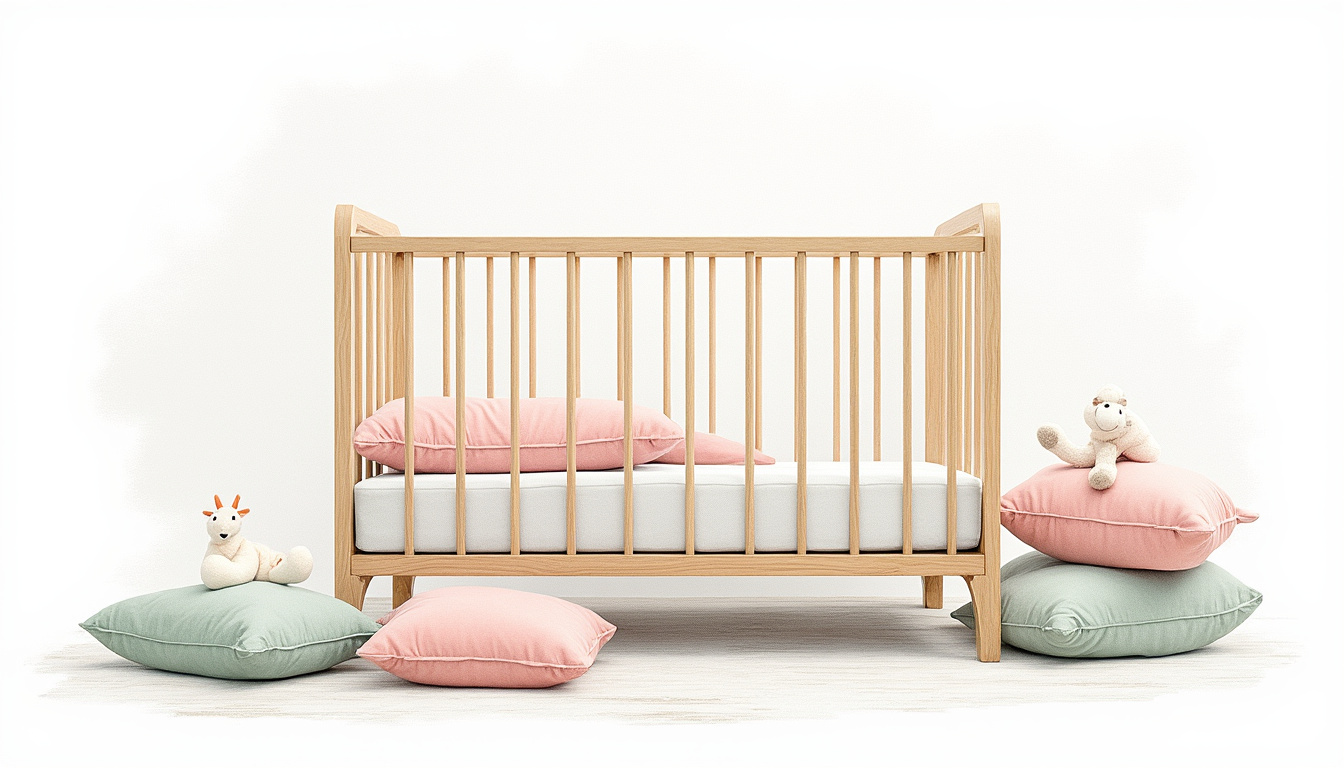
A calm reference helps to sort things out. In a baby’s bed, the safest baby bedding is minimal: a firm mattress exactly sized for the bed, a fitted sheet stretched tight, a sleeping bag suited to size and season. The rest is thought of outside the bed, in the room, without decoration taking the place of physiology.
To choose a sleeping area consistent with these markers, the guide how to choose the baby bed helps check dimensions, ventilation, and height adjustments, without getting lost in marketing options. The logical next step is to look, object by object, at what goes into the bed and what can stay around it.
When parents try to soothe a baby sensitive to noise, the environment is built differently than by adding textile in the bed. Soft lighting, a stable routine, and sometimes occasional hearing protection during noisy events can be more relevant. A dedicated article exists on baby noise-cancelling headphones, useful in certain situations, without interfering with breathing during the night.
Risks of the bed bumper: suffocation, overheating, and domestic accidents related to fastenings
The word risks can be scary, while it mainly serves to prioritize. In the bed, problematic scenarios are those that combine a baby still immature motor-wise, a textile that deforms, and a position where the face remains in prolonged contact. This is why the bed bumper, just like pillows, duvets, and large stuffed animals, is often discouraged in infant prevention recommendations.
Suffocation is the most intuitive risk, yet it is often underestimated when the bumper is presented as “soft.” Padding can hug the face and reduce air intake, especially if the baby’s nose is buried and they rebreathe already exhaled air. The problem isn’t the baby’s “fragility,” but the immaturity of their automatic adjustments to a partial obstruction.
The second risk is overheating. Infants still imperfectly regulate their temperature. A thick bumper can reduce air circulation, especially in an already warm room or with auxiliary heating. An overdressed baby can sweat, become agitated, and have multiple micro-awakenings, which gives the illusion of discomfort to be “fixed” with even more textile. A cycle sets in, whereas the expected adjustment is often to remove, not add.
The third risk concerns the fastenings. Models with ribbons, Velcro, or knots must remain tight over time, despite washings and pulls. A tie that loosens, a piece that slips, a panel that folds down, and sleep is no longer a neutral zone. Domestic accidents do not only come from the kitchen or bathroom. In a room, they also come from things hanging, catching, or untying.
The temptation to opt for a “breathable” mesh model exists. The mesh reduces part of the obstruction risk but doesn’t eliminate it. It does not prevent escalation as the child grows and does not remove the risk related to attachments if the fastening fails. The term “anti-suffocation” is often more a commercial promise than a guarantee, especially if the mesh is doubled or stiffened in places.
Another scenario appears around 8-10 months, when the baby starts to sit up, kneel, then stand. A bumper, especially thick or braided, can serve as a stepping stool. Falls are not systematic, but the possibility increases. Prevention is then thought of by bed height, supervision, and withdrawal of anything that might facilitate climbing.
A concrete reference helps to arbitrate without guilt. The more the bed looks like a “bare and firm” space, the stronger the respiratory safety. If an object is there “just in case,” it is often a sign it bothers more than it protects. The next theme arises naturally: if the bed bumper is not the right tool, how to address the needs that led to buying it?
Why the bed bumper reassures: needs for a cocoon, perception of danger, and baby bedding markers
The bed bumper rarely sells as a “health” object. It sells as a promise of atmosphere. The room looks more finished, the bed seems less “bare,” and the idea of a cocoon echoes intrauterine life. This search for continuity is understandable. In the first weeks, a baby is still very sensitive to changes in light, temperature, sounds, and the feeling of space around them.
The parental need is often twofold. There is the desire to protect the baby from hitting the bars, and the wish to reassure oneself when the baby finally sleeps. Fatigue makes the mind more vigilant, sometimes hypervigilant. When a baby moves a lot, small rubbing noises against the bed can be enough to give the impression of imminent danger, even if the real risk is low.
A simple reference helps put the discomfort in perspective. Babies do bump sometimes, especially when they start to turn and explore their support points. Significant bruises remain rare in a bed that meets standards because the fall height is almost zero. The real challenge is to limit anything that endangers breathing or thermoregulation, two functions still immature in the first year.
Baby bedding has its own rules, stricter than those for older children. A firm mattress prevents burial. A well-fitted sheet avoids creases that ride up. A sleeping bag replaces a blanket because it follows the body instead of moving towards the face. A padded bumper goes in the opposite direction: it adds mobile or compressible material where a stable contour is sought.
When parents say the bumper “protects from drafts,” the most reliable adjustment is often elsewhere. The room temperature is more effective to adjust than the bed. Between 18 and 20°C, with suitable clothing, most babies sleep without getting cold. If the room is hard to stabilize, it’s better to act on insulation, curtains, or positioning the bed away from a drafty window rather than adding a textile barrier near the face.
The psychological dimension also deserves a place, without dramatizing. A complete bumper can reduce the visual field of a baby starting to orient in space. Around 2-3 months, vision sharpens, the baby follows contrasts better, then faces. Seeing the door open, perceiving movement, spotting a sound source contributes to a feeling of security. An environment too “closed” can make some babies more sensitive to noises they cannot identify.
To meet the need for a cocoon without adding objects to the bed, solutions exist. A very soft night light, a mobile placed out of reach, a sleeping bag with an appropriate TOG, and a stable ritual often work better than padding. The next point then becomes very concrete: how to arrange a bed that remains beautiful, practical, and truly protective?
Prevention and alternatives to the bed bumper: creating safe sleep without compromising decoration
Prevention is not a list of bans. It is a way to shift parental energy toward what has the most impact. The bed can be aesthetic without being filled. Walls, room textiles, and space organization allow a warm look while preserving safe sleep.
A first, often underused lever is to work on the decor outside the bed. A soft wallpaper on a single wall, a high shelf with selected objects, a frame, or a string of lights placed far from the bed create a universe without interfering with breathing. The bed remains a resting zone, not a storage zone.
A second lever concerns managing the small “troubles” motivating the bumper. A pacifier that falls wakes some babies and tires parents. Before adding a barrier, it can be more effective to observe whether the pacifier is truly necessary for falling asleep or imposed by habit. When used, a model suited to age and offered at the right moment limits losses. Pacifier clips, however, do not go in the bed at night, as they add a cord, hence a risk.
A third lever is targeted protection rather than full wrapping. Localized “bar protection” or sleeves on some bars can limit bumps without creating a large soft panel against which the face can stick. This option remains to be evaluated case by case, prioritizing breathability and stable fastening, and being attentive to the age when the baby starts to stand up.
Some parents also consider a bed reducer out of a desire for a cocoon. The subject deserves precise reading since a reducer also adds material around the baby. The point is developed here: at what age to use a bed reducer. When the goal is sleep, the main criterion remains breathing and free space around the face.
Concrete arrangement of the room to limit domestic accidents around the bed
The room seems calm, yet it concentrates typical dangers of domestic accidents. Curtain cords, baby monitor cables, chargers, poorly placed humidifiers, and small decorations that can fall into the bed are points of vigilance. These risks are not headlines but accumulate when parental exhaustion sets in.
A simple gesture changes the balance. Placing the bed away from windows, grouping cables in conduits, fixing the baby monitor out of reach, and keeping the changing table out of the sleeping area prevent “traveling” objects toward the bed. When a bumper is bought to “protect,” these adjustments often protect more.
Heat management is also adjusted daily. A well-chosen pajamas is part of safety. Breathable fabrics, the right size, and the proper heat level reduce the temptation to add layers in the bed. A useful guide exists on baby clothes for sleep, especially when seasons change or heating is irregular.
| Observed situation | What the bed bumper promises | Potential risk | Safer alternative |
|---|---|---|---|
| Baby rubs head against the bars | Soften small bumps | Suffocation if face buried against padding | Standard-compliant bed, firm mattress, monitoring sleeping bag size |
| Arm or leg stuck between bars | Prevent sticking | Panel detaching, accessible ties, climbing later | Adjust bed height, check bar spacing, localized sleeves away from the face area |
| Cool room, fear of drafts | Create a cocoon | Overheating, less circulating air | Temperature 18-20°C, suitable clothing, bed placement away from windows |
| Bed deemed “empty” and minimally decorative | Make bed pretty | Addition of unnecessary baby bedding | Wall decoration, mobile out of reach, room textiles rather than bed textiles |
An empty bed is not a sad bed. It is a bed that gives the baby the physiological space needed to breathe, move, and go through sleep cycles with as few obstacles as possible.
Parent advice: age markers, equipment choices, and signs warranting consultation
The most useful parent advice relies on age markers because the baby’s abilities change quickly. Before 6 months, the baby gains tone but remains inconsistent in their ability to free themselves from uncomfortable positions. Between 6 and 12 months, motor skills accelerate with rolling, crawling, then standing. After 12 months, the child may still find themselves in uncomfortable positions but generally has more resources to move and push away what bothers them. This doesn’t make all objects “risk-free,” but the nature of risks changes.
In many families, the question arises around 2-3 months, when the baby leaves a smaller cradle. The volume change is real. Some babies seem “lost” in a large bed, wake more, or stick to the walls. A simple response is to work on falling asleep and rhythm stability rather than closing the space with textile. A short, repeated ritual and a constant environment often reduce awakenings related to sensory surprise.
Equipment choice must remain consistent. A firm mattress of exact bed dimensions avoids side gaps. The sheet must be snug, without folds. The sleeping bag must be the right size, with a neckline that does not allow the baby to slip inside. These details seem “small,” but they make up the framework of baby safety at night.
Some sleep-adjacent objects also create confusion. The bouncer, for example, can soothe during the day but is not a night sleeping place as its incline changes the head and airway position. If this question resurfaces at home, markers are detailed here: baby bouncers, comfort and safety. Distinguishing supervised day rest from night sleep greatly changes prevention.
A short checklist to verify the bed in two minutes before night
- Only in the bed firm mattress + stretched fitted sheet + suitable sleeping bag, without bed bumper, pillow, duvet, bulky stuffed animal.
- The baby is laid on their back at bedtime, then free to move according to development.
- The room is around 18-20°C, and clothing is adjusted to avoid overheating.
- Nothing hangs near the bed, and no cable is within reach, even if the baby kneels.
When to seek medical advice without delay
Particular vigilance is required if the baby shows respiratory signs or malaise, as these should not be discussed on the basis of an accessory. A rapid consultation with the pediatrician, midwife, or emergency service is justified if you observe abnormally difficult breathing, unusual respiratory pauses, bluish lips, unusual extreme drowsiness, or repeated vomiting with deterioration of general state.
The bed bumper should not become the center of anxiety. It serves as a revealing factor. When nighttime fear increases, talking to a professional often helps set concrete markers adapted to the baby’s age, temperament, and the real room configuration. A parent reassured by specific facts makes better decisions, even when tired.
Is a “breathable” mesh bed bumper enough to ensure safe sleep?
Mesh can reduce part of the obstruction risk, but it does not eliminate all risks. It does not annul the danger related to fastenings (ties, Velcro), nor overheating in an overly warm room, nor the climbing risk as the baby grows. The most robust criterion remains a bed with very few objects, a firm mattress, and a suitable sleeping bag.
At what age does a bed bumper become less problematic?
The risk of suffocation and sudden infant death decreases significantly after the first year, but caution remains as long as the child sleeps in a barred bed and can use the bumper as support to climb. Many professionals prefer to avoid any bumper during the first two years, then consider decorative or comfort use when the child is older and reliably mobile.
How to protect a baby if they often get an arm or leg stuck between bars?
First check that the bed meets standards and that the mattress fits perfectly, without gaps on the sides. Most stuck limbs are scary but benign. If the problem is frequent, targeted and breathable protection on some bars can be discussed, avoiding large padded panels and monitoring the age when the baby stands up to limit any support that would facilitate climbing.
Can a bed bumper increase separation anxiety?
For some babies, a complete bumper can limit the room’s visual field. A baby who hears sounds without identifying the source can become more agitated, depending on temperament. A more “open” bed, with a stable visual reference in the room (soft night light, fixed decorative object on a wall), often helps more than a barrier that closes the space.