In brief
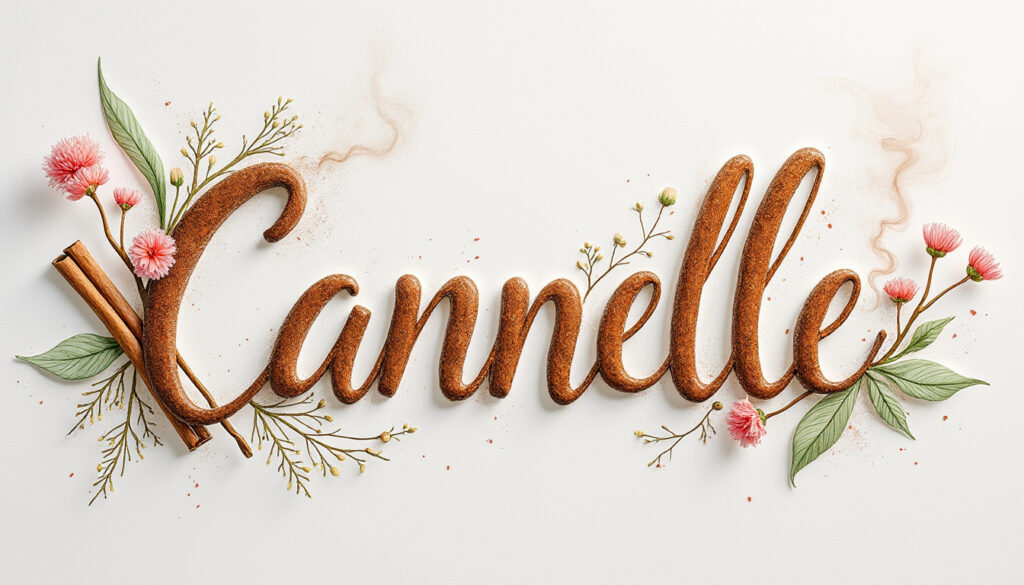
- Canelle is a modern, secular first name, directly inspired by cinnamon, with an immediate sensory meaning.
- Its origin is rooted in the word for the spice and, by extension, in the history of trade and aromatic routes that shaped cultures.
- Its “magic” lies less in a mystical promise than in a concrete effect on family imagination, voice, memory, and the attention given to the baby.
- The etymology, sound, and symbolism of Canelle evoke warmth, softness, protection, and presence, without locking a child into a fixed character.
- The spirituality surrounding this first name can remain simple and everyday, through discreet rituals and reassuring markers in the first years.
Origin of the first name Canelle and etymology related to cinnamon
In the first days with a newborn, parents find themselves pronouncing the name in a low voice, almost like a sound marker. A first name can become a fixed point amid a still unstable rhythm, marked by frequent feedings and fragmented sleep phases. It is often at this moment that the question of origin takes on particular importance. With Canelle, this origin is readable, concrete, and immediately sensory.
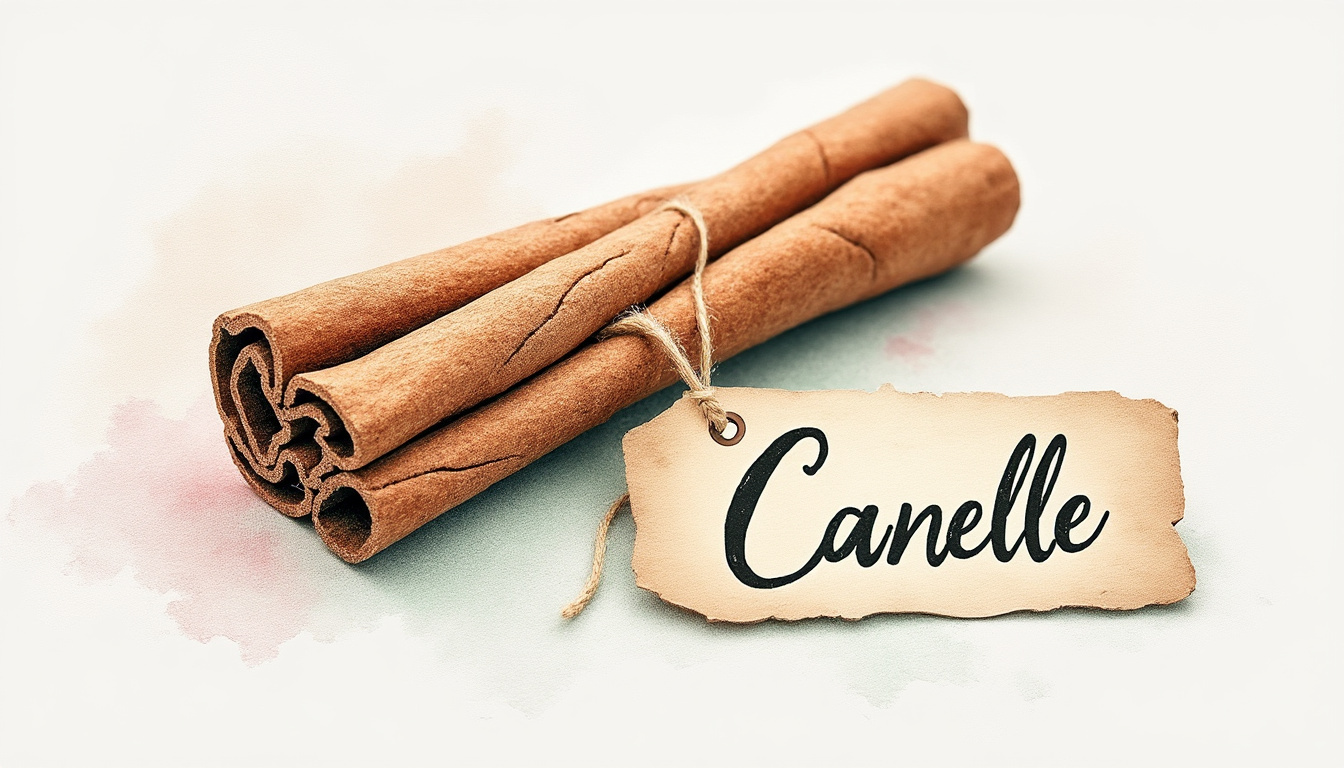
The first name Canelle is directly inspired by cinnamon, the spice. Its etymology refers to a word that has circulated through languages and centuries, carried by the trade of aromatics, culinary uses, and domestic rituals. This linguistic lineage does not need to be perfect to be meaningful. What matters in the experience of families is the stable association between a word, a scent, a color, and an impression of warmth.
Choosing a first name derived from a common noun is not a modern whim. Cultures have often drawn from nature, plants, stones, or stars to name children. It offers a simple, shareable image that does not require lengthy explanation at every introduction. In everyday interactions, “Canelle” is easy to remember, pronounced smoothly, and retains a softness at the end of the word that facilitates calling, singing, whispering.
The “magic” sometimes attributed to this type of name also comes from a very human mechanism. The brain quickly associates a sound with an emotional state. When the name is spoken during prolonged skin-to-skin contact, rocking, a calm feeding, it embeds itself in the emotional memory of the parents. This conditioning has nothing mystical about it. It relies on repetition and on the coincidence between a sound stimulus and a drop in tension. A baby recognizes prosody, rhythm, and melody of the voice long before understanding words, and a name like Canelle, with soft consonants, suits well these enveloping intonations.
This dimension extends into the extended family. Grandparents, friends, healthcare professionals pronounce the name and contribute to the coherence of the environment. When parents experience a period of doubt, hearing the name spoken with respect and stability acts as a reminder. The child is not a problem to solve; they are a person to accompany.
Tradition may seem absent because Canelle is not an old name in the religious or hagiographic sense. The absence of an assigned patron saint makes it a secular name, often chosen for its sound and image. This does not diminish its substance. Tradition also builds itself in everyday gestures, in how the story of the name is told to the child, then passed on when they ask one day why this choice was made.
Meaning of the first name Canelle and everyday sensory magic
A first name carries a meaning that is not reduced to a definition. It acts as a bridge between the inner world of the parents and the reality of the child. With Canelle, the meaning is first sensory. It calls forth warmth, softness, a familiar scent. This “magic” is very concrete because smell and memory are intimately linked. A single scent can reactivate a bodily memory, a kitchen, a presence, a moment of security.
In the first weeks, sensoriality is a major language. The newborn does not yet regulate their states alone. Their nervous system is immature, and they rely on the adult to move from agitation to calm. The voice is part of these supports. When a name is short, rhythmic, easy to repeat, it becomes a relational tool. A parent can use it along with slow rocking, movement carrying, or a hand firmly placed on the baby’s back. It is not a formula. It is synchronization.
The magic, in this context, comes from a reproducible sequence. A baby who startles at the slightest noise, with a Moro reflex very present until 4-5 months, is not “afraid of everything.” Their body reacts quickly. A stable and predictable response reduces the load. Saying “Canelle” in a low voice, on an exhale, holding the baby’s pelvis and shoulders against oneself, often helps restore more flexible tone. What soothes is not the word, it is the coherence between voice, posture, and rhythm.
The meaning of the first name can also support parents when fatigue sets in. A broken night, waking every 2 to 4 hours, an effective feeding lasting 10 to 20 minutes per breast in a breastfed newborn, or split bottles reduce mental availability. In this reality, a name evoking simple warmth can serve as an anchor. It reminds that the bond builds through micro-gestures, not performances.
The meaning also manifests in how the child is presented to the world. Some first names open conversation. Canelle, because it evokes the spice, prompts associations. Parents can decide to welcome or redirect them. If a comment becomes intrusive, one sentence suffices. “Canelle was chosen for its soft sound and warm image.” The child does not have to carry others’ projections. Parents can set this boundary early, calmly.
For complementary markers on the logic of first names and their roots, reading very different journeys helps put pressure into perspective. Articles on the origins and meaning of Zoé or on the origin of the first name Chloé show how a name’s story can be old, symbolic, or conversely recent and figurative, without impacting the quality of the parental bond.
The next section goes further into the symbolism and spirituality associated with Canelle, with concrete gestures that respect each family’s uniqueness.
Videos can also help hear how a first name’s sound fits into a voice addressed to the baby, with slow and containing prosody.
Symbolism of the first name Canelle, spirituality, and family traditions
The symbolism of a first name does not dictate a destiny. It rather serves as a common language to tell an intention. In many families, spirituality is not a strict religious framework. It resembles a way of inhabiting the first months with attention. Canelle suits this approach well because the spice evokes warmth, protection, conviviality. It can become a “tradition” in the family sense, built by simple, repeated, and chosen habits.
Spirituality around a first name can also remain very discreet. A parent can write the name on a card, slip it into the health record, or pronounce it in a calm moment of gratitude. This type of ritual need not be long. It can last 30 seconds. The brain needs short markers, especially when mental load is high.
The first name Canelle often invites an imagination of softness. This softness does not mean fragility. A child mainly needs a predictable environment, adults who respond to signals consistently, and limits that come early but without harshness. A baby does not manipulate. They express tension, hunger, discomfort, sensory overload. The symbolism of the name can help parents maintain a posture: Welcome, contain, then restart exploration when the child is ready.
To make this symbolism applicable, a few simple gestures are enough, and they remain adjustable according to the child’s temperament and household reality.
- Evening vocal ritual: say “Canelle” in a deeper, slower voice for 20 to 30 seconds, keeping the hand on the baby’s chest, without tapping. Stable pressure often aids regulation.
- Marker object: keep a dedicated cloth diaper, always the same one, used during calm times. The family scent becomes a security signal, especially between 0 and 4 months.
- Transmission phrase: prepare a short explanation on the origin of the name, to avoid lengthy justification. The child will hear it later as a coherent story.
- Relational framework: when the atmosphere rises, reduce stimulations before “talking discipline.” A toddler poorly understands a command when their alert system is activated.
Family traditions are also built with the wider circle. A secular name like Canelle can coexist with a family attached to a religious calendar. In this case, tradition can shift. A day of the year can be dedicated not to a saint but to a gesture. Reviewing birth photos. Rereading a few lines from the pregnancy journal. Seeing how the child has grown. Tradition becomes a story, not an obligation.
Some parents like linking names to broader symbols, such as flowers, colors, stones. This type of association does not need to be “scientifically true” to be affectively useful, provided it does not confine the child. The article on the symbolism of the white rose in first names shows how a symbol can serve as a family guiding thread without turning into a label.
When a family goes through a more fragile period, spirituality can also be a way to spot a signal to monitor. A parent who no longer feels pleasure, who cries every day beyond two weeks after birth, who has frightening intrusive thoughts, deserves professional support. This does not say anything about the love for the baby. It says something about exhaustion, hormonal chemistry, and sometimes postpartum depression. A soft name does not replace a need for care. At best, it can remind that asking for help is a form of protection.
The next part addresses a frequently asked point in consultations, the “personality” associated with a first name, with what can reasonably be expected and how to use it without projecting.
To deepen the links between symbols, family stories, and development, some audiovisual resources provide simple and respectful markers.
Personality associated with the first name Canelle and educational markers without labels
Many descriptions of first names assign a typical personality. Canelle is often described as tender, romantic, seeking affection, with an aversion to conflicts and a great capacity for commitment. This portrait resonates with many parents because it resembles what they want to protect. However, it deserves a clear nuance. A first name does not explain temperament. Temperament is built on a neurobiological basis, then refined through environmental contact.
This framework is reassuring. A very noise-sensitive baby is not “fragile.” They have a more reactive alert system. A baby who seeks more contact is not “clingy.” They regulate their tension better in proximity. The future personality cannot be read in the first weeks. What can be read, however, is how the adult responds to signals and how this response shapes attachment security.
Responding to a newborn’s cries does not create dependence; it builds a secure base. The mechanism is simple. When the baby cries and the adult responds predictably, the stress axis activates less long. Over months, the child internalizes this regulation. This does not prevent autonomy. It prepares for it. Parents who choose the name Canelle because they love softness can rely on this idea without judgment. Softness is not the absence of boundaries. It is the presence of a stable adult.
As the child grows, the question of conflict emerges. A little girl or boy may avoid conflict by temperament, or on the contrary seek it because frustration is hard to tolerate. In both cases, the adult can remain legible. A short sentence, a clear limit, and a supporting gesture. “Stop, I don’t let you hit. You can hit the cushion.” The child learns a distinction. The feeling is allowed; the act is framed. This method is not ideological. It works because it is repeated and provides a concrete outlet.
When descriptions of names speak of “easygoing” children, this can translate into a tendency to follow, let themselves be guided, give in to keep peace. This trait, if it exists, can become a social strength later. It can also expose to difficulties in self-assertion. Parents can support assertion very early without dramatizing. Offer two real choices. Allow time to respond. Validate preference. This applies from the first years.
A table often helps distinguish projection related to the first name and observable markers in the child to keep a flexible view.
| What the first name Canelle often evokes | What is actually observed in a young child | Concrete and realistic parental gesture |
|---|---|---|
| Softness, need for affection | Variable proximity needs according to age and temperament, often more pronounced between 0 and 9 months | Calm carrying 10-20 minutes during tension peaks, then put down when the baby is relaxed |
| Little taste for conflict | Avoidance or agitation in the face of frustration, especially between 18 months and 3 years | Limit with one sentence, suggest a motor alternative, stay physically close |
| Commitment, perseverance | Short attention span initially, increasing in stages, with great variability | Break an activity into sequences of 3-5 minutes and stop before saturation |
| Sensitivity to relational climate | Reactivity to loud voices and tense atmospheres, common among babies | Lower the volume, move the noise source away, speak on exhale to slow the pace |
When a parent feels the child remains inconsolable, that cries last several hours a day beyond 3-4 months, or that feeding becomes difficult with insufficient weight gain, advice from a midwife, pediatrician, or lactation consultant is recommended. Criteria to watch are concrete. Fewer wet diapers, unusual drowsiness, difficulty breathing, persistent refusal to eat. The goal is not to worry but not to trivialize a signal.
The last part opens on the social place of the first name, its rarity, the question of “famous Canelles,” and how to carry a unique name without feeling obliged to justify it.
Popularity of the first name Canelle, social identity, and absence of famous Canelles
The popularity of a first name influences the child’s daily experience. A very common first name reduces questions but can dilute the sense of uniqueness. A rarer first name attracts attention, sometimes for the better, sometimes with awkward comments. Canelle often falls into this zone. It is known as a word, rarer as a name. This setup is interesting. The ear recognizes it, society is not unsettled, and the child can keep a quiet singularity.
At school, the rarity of a first name sometimes becomes a strength. The child is noticed more quickly. Their name is memorable. This can help children who like to exist stably in the group. It can also weigh if the child prefers to blend in. Parents can remain attentive to the feelings without overinterpreting. A child may go through a phase wanting “a name like the others,” then later regain pride. This oscillation is normal.
The question of “famous Canelles” often comes up. To date, there is no widely known figure bearing this first name to the point of being an immediate reference. This absence is not a lack. It leaves space. In the family imagination, it can turn into a subtle message. The child does not have to be someone’s copy. She or he can be the first remarkable Canelle in their circle, simply by way of being.
Parents sometimes appreciate linking their choice to names with a comparable path. Some names, once rare, spread because of a historical figure, a work, a public personality. Others have remained confidential while being perfectly accepted. To explore these dynamics, reading about the history and meaning of Olympe shows how a name can gain visibility through culture and time without losing its bearing.
Carrying a name like Canelle sometimes invites explanation. The explanation can remain short. Parents can choose a “social” version and an “intimate” version. The social version states the origin and meaning without entering the family history. The intimate version is reserved for the child when they are old enough to hear it. This distinction protects the family from overexposure and respects the child.
Another concrete point concerns spelling and pronunciation. Canelle is generally stable. Possible confusions are more around “Cannelle” with two n’s. Parents can decide whether to correct systematically or accept occasional errors. Calm correction, without irritation, models a valuable skill: naming oneself and being named correctly. A child observes this posture long before reproducing it.
The link between name and identity also builds at home. The child hears their name in varied contexts. Joyful calling. Reprimand. Consolation. It is useful to keep a simple marker in mind. If the name is only said to scold, it charges negatively. If the name is only said in enthusiasm, it sometimes becomes less effective to attract attention in danger. A balance is easily created. Say the name also in neutral moments. “Canelle, we’re changing the diaper.” “Canelle, we’re putting on the pajamas.” Neutrality is part of security.
The next section offers targeted answers to the most frequent questions so parents can move forward without getting lost in interpretations.
Does the first name Canelle have a religious origin or an associated saint?
Canelle is generally considered a modern secular name, without an assigned patron saint. Tradition can therefore be built differently, through a family story or a simple ritual, without imposed religious reference.
What is the strict meaning of the first name Canelle?
The most direct meaning refers to cinnamon, the spice. In usage, it mostly evokes warmth, softness, and a sensory dimension. It does not confine the child in a character but gives parents a stable image to convey.
How to talk about the etymology of Canelle to a child later?
A short sentence with simple words suffices. For example, explaining that the name comes from the name of a spice known for its fragrance, and that this choice was made for its soft sound. The child can then appropriate their name in their own way.
Can the ‘magic’ of a name like Canelle really soothe a baby?
A name does not soothe by itself. The soothing comes mainly from prosody, rhythm, and contact. Pronouncing Canelle in a low and steady voice, at the same time as stable carrying or a hand placed on the chest, can help the baby regulate their tension, especially in the first months.
When should you consult if a baby cries a lot, regardless of their name?
Consultation is indicated if crying accompanies feeding difficulties, insufficient weight gain, fewer wet diapers, unusual drowsiness, significant vomiting, fever, or respiratory signs. Without these signs, frequent crying can stem from difficult nervous system regulation, and support from a midwife or early childhood professional can already provide concrete adjustments.