

In brief
- The Defense and Citizenship Day takes place after the citizen registration and is aimed at young French people between 16 and 25 years old, with a summons most often before the age of 18.
- The procedure alternates workshops, information sessions, and evaluations, with a focus on citizenship, national defense, and possible forms of engagement.
- Attention is given to citizen knowledge, safety, and collective responsibilities, including gender equality and violence prevention.
- The certificate of participation given at the end of the day serves as proof for certain procedures and exams between 17 and 24 years old.
- Arrangements exist for transportation, absence from the company, and procedures for exemption or deferral in case of disability or temporary unfitness.
Citizen registration and summons to the Defense and Citizenship Day: understanding the first step
In many families, the registration occurs in the middle of an already busy period. Between career choices, first administrative procedures independently carried out, sometimes a training program starting, the calendar fills up quickly. Citizen registration fits into this precise moment when the teenager gradually becomes an adult in the State’s registers. It is not a decorative formality. It is the gateway to the process leading to the Defense and Citizenship Day, with very concrete consequences going forward.
The basic reference is simple. Citizen registration must be completed between the 16th birthday and the end of the third month following. In practice, this can be done at the town hall or via online services when offered locally. The key point that changes everything daily is that the declared address must remain reliable. A summons sent to a former address does not trigger an immediate alert, but creates a chain of complications, often at the moment when an exam or an administrative registration occurs.
After registration, a written summons is sent, indicating the date and location. A delay is frequently observed around 45 days before the session, which allows reasonable time for organization, provided the mail is properly received. The day is generally scheduled between the registration date and the 18th birthday. There is some leeway, and some young people attend later, but the idea remains not to wait until the last minute, especially if a project like a driving license or an exam is upcoming.
Transportation is a frequent concern, especially when the reception center is not in the town. Costs are not supposed to become an obstacle. Depending on the area, the young person may benefit from a round-trip transport voucher on a local network (bus, coach, metro, tram) or a fixed allowance often between 10 and 20 euros, adjusted according to the distance and local arrangements. The useful reference is to check these details upon receiving the summons, rather than the day before, when everything seems more urgent.
Another situation is common. A young person is an employee, apprentice, or in a long internship and fears “losing” a day. The summons entitles them to exceptional leave authorization. The employer cannot deduct this absence from leave nor reduce pay, provided the summons is presented. This may seem like a cold rule, but the effect is reassuring when anticipated, because the exchange with the company becomes factual, without extended justification.
For a more detailed reading of documents and procedures around the certificate, a clear reference can be found in this guide about the JDC certificate. This administrative detail may seem far from the emotional daily routine of a family, but it plays the same role as a well-kept health record. When the document is requested, having it on hand changes the experience.
The logical next step, once the summons is in hand, is to envision the day itself. Knowing what to expect transforms apprehension into preparation.
Conduct of the JDC: workshops, evaluations, and rhythm of a structuring day
The procedure of a JDC is designed as a structured day, often starting in the morning. In most cases, reception begins around 8:30 am. The time can vary by site, but the principle remains the same. Punctuality matters because workshops follow one another. When a young person arrives late, it is not just a question of “rule.” It is a collective schedule that becomes fragile, with activities requiring continuous presence to be validated.
The workshops address the issues and goals of national defense. The term may seem abstract, but it covers concrete realities. Protection of the territory, crisis management, cybersecurity, resilience in the face of disasters, and the role of citizens in a rule-of-law state. The content evolves with the times. In 2026, the question of safety no longer only concerns physical borders. Personal information, online manipulation, misinformation risks are part of the threats discussed because they directly affect social cohesion.
A significant part concerns practical citizenship. Rights are not recited like a lesson. They are connected to duties and responsibilities. Understanding what it means to participate in democratic life, respect the law, and contribute to living together in a pluralistic country. This citizen knowledge is not a luxury. It is a tool to decide, debate, and not endure.
The day also includes information sessions on equality between women and men, fighting sexist prejudices, and preventing violence within couples, whether physical, psychological, or sexual. This section sometimes touches a sensitive area because many young people have already been exposed, directly or indirectly, to problematic situations. The collective framework can offer first verbalization. When a subject unsettles, a simple guideline helps. Turning to a trusted adult, a professional, or a dedicated helpline is not “making a fuss.” It is recognizing a signal that deserves protection and support.
Fundamental tests and learning in the French language are conducted. The goal is not to stigmatize. It aims to detect difficulties that may hinder access to training, employment, or administrative procedures. In a developmental approach, it resembles screening. Screening does not label. It opens a door to concrete solutions, often more effective when started early.
To get through the day without tension, a few simple actions help. A real breakfast, a bottle of water, a pen, identity papers ready. These details weigh little but avoid cognitive fatigue. A young person who has not eaten learns less well, reacts more quickly, and shuts down more easily. Body and attention work together.
When the day ends, the next question becomes central. The certificate given has administrative value. Again, it is better to understand exactly what it proves and in which situations it is required.
Certificate of participation, bac, driving license: what the certificate proves and when it is requested
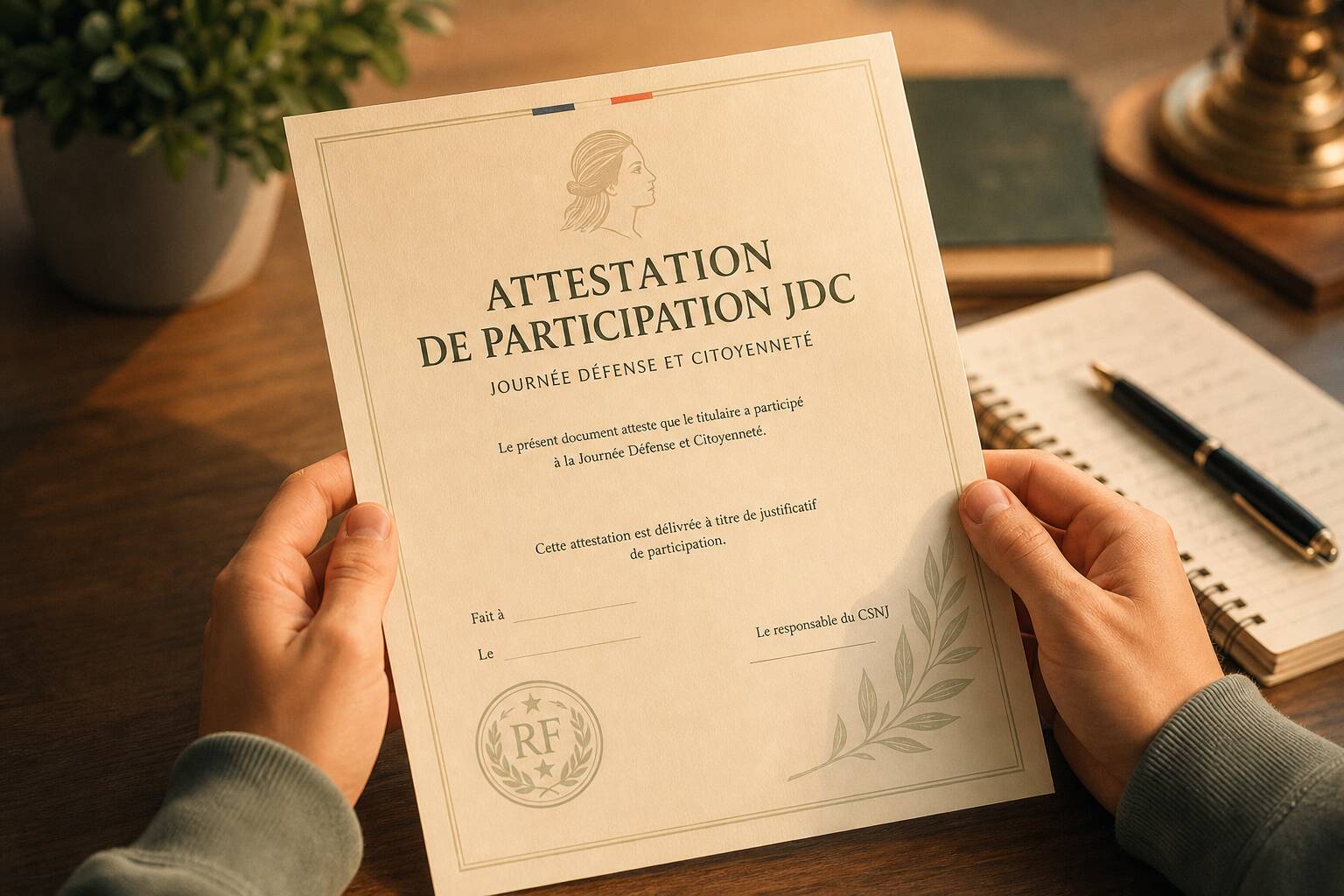
At the end of the day, the individual certificate of participation is given to each young person present who completed all workshops. This document is proof. Like a piece of an administrative puzzle, it fits into files at the precise moment when a registration is blocked without it. Much family stress comes from this. A parent discovers the need for the paper when enrolling for the driving license, finalizing an application, or validating an exam file. Knowing the rule beforehand changes the moment’s tension.
Requests vary by age. Before 17 years, the certificate is generally not required for registration to an exam or competition. Between 17 and 24 years, a JDC-related document may be requested for procedures like the driving license, a CAP, the baccalaureate, or French authorities’ competitions. From 25 years, no certificate is required. These thresholds, simple on paper, become a scheduling mechanism. A young person preparing registration at 17 years and 3 months benefits from knowing their situation.
In the 17-24 age range, several documents may be accepted depending on the case. The certificate of participation is the most common. An exemption certificate exists for exempted young people. An administrative status certificate can be issued in case of loss, damage, or theft of the certificate. A provisional summons “instance” certificate can cover the period while the young person is still awaiting their JDC date. This diversity avoids deadlock but requires identifying the right document at the right time.
| Age | JDC proof required for exams/competitions | Document(s) generally accepted |
|---|---|---|
| Under 17 years | Usually no | No applicable |
| From 17 to 24 years | Often yes | Certificate of participation, exemption certificate, administrative status certificate, provisional summons instance certificate |
| From 25 years | No | No applicable |
The sensitive point in families is not the rule. It is the keeping of the paper. A document lost at the wrong time may give the impression that “everything is falling apart,” whereas the situation is resolved with the correct procedure. The most realistic organization is to keep a paper copy filed with identity documents and a digital copy stored in an accessible space. A young person in an apprenticeship or mobile environment changes surroundings quickly. Stability often comes from a simple well-named file.
This administrative dynamic reminds one of something well known in postpartum. When a health record is missing, anxiety rises even though the child is fine. An overwhelmed brain looks for an anchor, and the absence of paper becomes a perceived “danger.” The mechanism is the same here. The document is cognitive security, not moral value.
For better orientation in certificate recovery and use procedures, the detailed explanations in the JDC participation certificate provide actionable references without jargon.
Another question then arises, sometimes more personal. What to do if participation is difficult, impossible, or medically contraindicated? The law provides for measures. Knowing them avoids feeling trapped.
Exemption, deferral, disability: arrangements provided without exposing your private life
Some young people cannot participate in the JDC under standard conditions. Motor disabilities, sensory disorders, significant limitations, chronic fatigue, progressive pathologies. The issue is not to “prove” a civic value by performance. The issue is to guarantee equal access, with attention to dignity and confidentiality.
An exemption can be granted, notably if the young person has a mobility inclusion card bearing the mention “disability,” or a disability card. The request is made after registration, with the nearest National Service and Youth Center (CSNJ). If accepted, an individual exemption certificate is sent. This document then has the same administrative use as the certificate of participation in situations where proof is required.
Another path exists. A person with a disability can submit a recent medical certificate, dated less than three months, specifying the situation. Administrative forms may also be requested depending on the context. Confidentiality is protected by an envelope procedure, with the mention “medical confidentiality.” This detail matters. The young person does not have to expose their privacy to non-medical interlocutors. The procedure aims to transmit useful information, not to tell their life story.
There are also cases of temporary unfitness. There, a deferral can be proposed, with a provisional certificate. This option helps young people undergoing a period of care or rehabilitation. The practical guideline is not to wait until the session date to act. When the administration receives a clear, documented request well in advance, adjustment becomes much easier.
In families, these procedures sometimes revive an old anxiety. Being “different” has often been a school, social, sometimes medical struggle. The administrative process can reactivate fatigue. Support helps. A parent, a guardian, a school reference, a social worker. Asking for help with a file does not reduce the young person’s autonomy. It makes it possible, at the right pace.
This subject touches on a broader dimension of the issues of the JDC. Citizenship is not about uniformity. It is about organizing a community that protects, includes, and makes itself accessible, including when the body or health impose limits. This is also why accessibility and non-discrimination issues have a growing place in institutions in 2026.
After these very concrete aspects, a stage emerges. Understanding what the JDC tries to convey beyond papers, and how that can open forms of engagement adapted to each temperament and capacity.
Issues of citizenship and engagement: what the JDC changes in the way of positioning oneself in society
The issues of the JDC go beyond the day itself. Part of the benefit is invisible at the moment and then reveals itself later. A young person hears words previously thought reserved for adults. Democracy, defense, crises, institutions, respect for the law, social cohesion. When these notions are unclear, they leave room for shortcuts. When explained with examples, they become reference points. The JDC seeks this tipping point.
An idea often returns in workshops on national defense. Defense is not limited to military operations. It includes the protection of the population, continuity of services, response to disasters, vigilance against digital threats. It ties into daily life. Protecting personal data, reporting illegal content, adopting responsible behaviors on the road, respecting safety rules in school or work environments. Safety is a fabric of repeated actions, not an abstraction.
The theme of engagement is presented in several forms. Some project themselves into uniformed professions, others not. The goal is not to convert but to show a range. Defense, civil security, intelligence, cybersecurity professions, but also reserves, associations, and general interest schemes. This plurality is useful because a young person who does not identify with a single model quickly feels excluded from the “good citizens.” Yet engagement takes varied paths.
Civic service often fits into this reflection. It is a way to contribute to a mission of general interest, with a framework and support. For a young person looking for meaning or a transition between studies and employment, it is sometimes a breathing and structuring space. The helpful signpost is to look at the real content of the mission. A good indicator is the presence of identified tutoring, clear objectives, and a rhythm compatible with health, family constraints, or concurrent training.
A link is also made with violence prevention and the notion of consent. This touches on protecting individuals, individual responsibility, and how a society defines itself. This part is sometimes received with distance, then comes to the forefront when couple situations, outings, or social pressure arise. The adolescent brain is under construction, notably in planning and inhibition areas. That does not excuse. It explains why explicit guidelines are useful, and why the adult should not just say “you know well.” Clearly stating what is forbidden, dangerous, or requires help strengthens the ability to protect oneself.
This work of reference points, many parents already do in another domain. Feeding a newborn, for example, requires precise information, a framework, and translation into achievable actions. The parallel is not a comparison of seriousness but of method. A complex subject becomes bearable when broken down, explained, and linked to concrete actions. For this logic of references, reading this guide on colostrum and its benefits clearly illustrates how rigorous information can reassure without oversimplifying.
The JDC, when well understood, fits this same idea. One day does not transform a trajectory by itself. It can, however, deposit a clearer understanding of everyone’s place, with actions and documents that secure what comes next.