

In brief
- Unforgettable memories are not born from a rare event, but from a repetition of short, clear, and emotionally secure moments.
- In kids, memory is first built through the body and senses, then through storytelling. A simple, repeated gesture becomes an imprint.
- Creation (drawing, cooking, DIY, music) anchors emotions because it mobilizes attention, fine motor skills, and pride in acting.
- Sharing with siblings, grandparents, or school gives social value to the memory and helps the child tell their story.
- A few concrete landmarks are enough to ritualize without rigidifying, even when fatigue and lack of time weigh on everyday life.
Kids and unforgettable memories: understanding how memory is made in childhood
In the early years, kids’ memory does not work like that of adults. Part of the memories is built in blurred images, sensations of security, smells, and textures. The precise scene will sometimes be forgotten, but the emotional imprint remains. This is often what parents notice with surprise. A 3-year-old can remember the softness of a wool sweater, the smell of a soup, or the song always sung in the same tone, without being able to recount the event around it.
This discrepancy has a neurodevelopmental explanation. Before about 3 to 4 years old, the hippocampus, a key structure for organizing autobiographical memories, is still maturing. Memory traces exist, but they are more fragmented, sensory, context-linked. Language, meanwhile, progresses quickly between 2 and 5 years, becoming a “net” to catch the experience and transform it into a story. When a parent puts simple words on what happened, the child learns to classify their emotions and to give continuity to their story.
Memory is not an object; it is a mechanism
A lasting memory is fixed when three ingredients meet. There is attention, often caught by novelty or surprise. There is emotion, not necessarily intense, but identifiable. There is repetition, which stabilizes. An exceptional outing can mark, but a ten-minute ritual, repeated weekly, leaves a more solid trace.
Repetition is not boring for a young child. It reassures, anticipates, and provides a framework. A child who knows what comes next uses less energy to protect themselves and more energy to explore. This internal availability increases the capacity to register what is happening around, thus to create memories.
When emotions overflow, memory becomes blurred
One point needs to be said clearly. Too high emotional intensity can alter memory. The child then remembers mainly the tension, noise, fatigue, not the expected joy. A birthday that lasts too long, an outing without a break, a late show can produce the opposite effect of what was intended. The moments that remain are those where the child could stay regulated, with understandable transitions.
A simple landmark helps a lot. For a child aged 2 to 4 years, aiming for a main activity of 60 to 90 minutes, then a recovery phase, avoids overflow. Between 4 and 7 years, tolerance increases, usually around 2 to 3 hours depending on temperament. When overload signals appear—sudden movements, irritability, refusal of contact, or conversely agitation—the adult has more impact by reducing stimulation than by adding explanations.
The role of shared storytelling in turning experience into memory
The “hot” story is not always effective. After a busy day, a child gets annoyed if asked insistently for a report. The “cold” story works better. The next day, at breakfast, in the car, in the bath, a few sentences suffice. “Yesterday, you saw very big fish. How was your body when you were impressed?” The child learns to link sensation, emotion, and event.
This way of telling also creates family continuity. The memory becomes a common language. It is a precious foundation for the future, including when the child passes through opposition phases around 2-3 years or social concerns entering school.
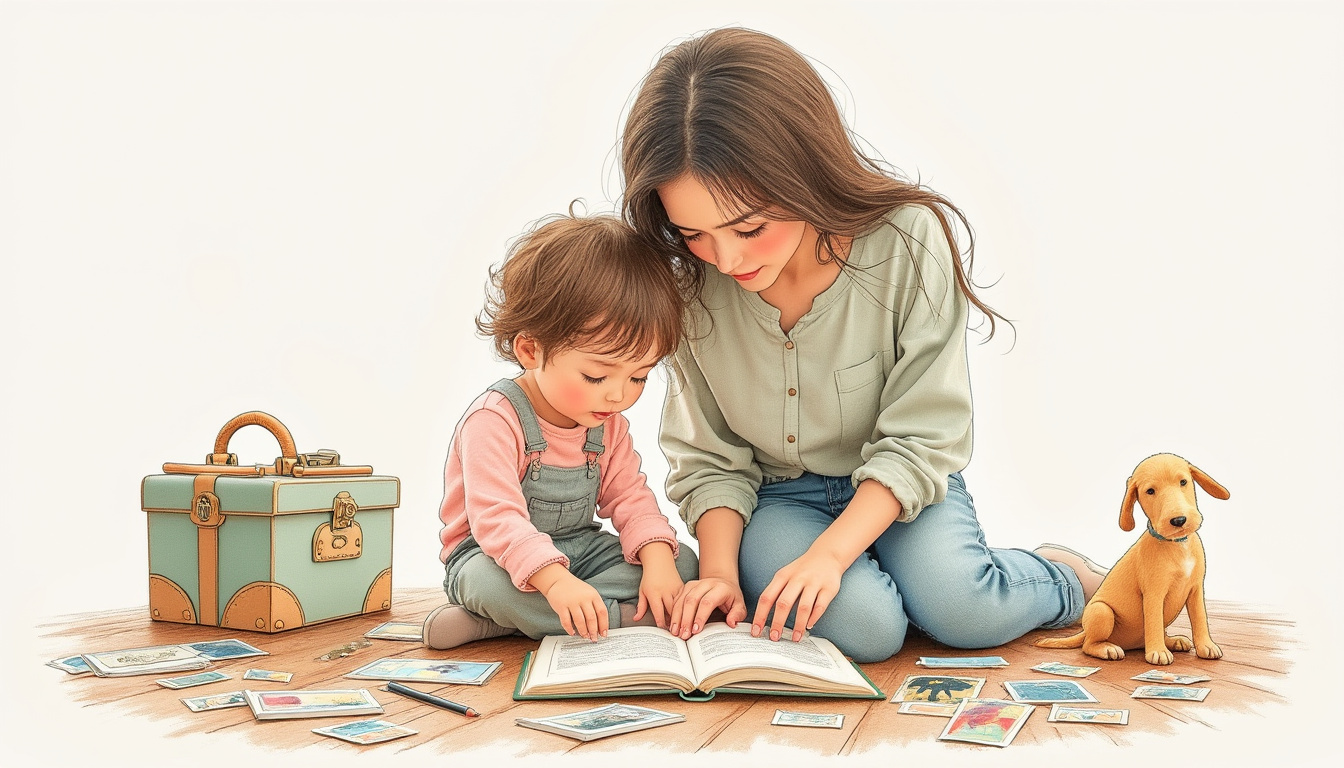
Kids: the art of daily creation for unforgettable moments (without overloading the schedule)
Creation has a special strength in childhood. It engages the body, thought, choice, error, and redoing. All this strengthens memory. The result matters less than the process. A collage slightly crooked can become an emotional landmark because it contains pride, cooperation, and joint attention. Creativity is not a “talent,” it is a skill that develops gradually.
In real life, the question often comes up: How to create unforgettable memories when fatigue is present, when a baby demands attention, when homework takes space, when work overflows? Everyday life can become a discreet workshop. The best rituals are short, repeatable, and tolerate variations. A family that misses a week has not “broken” the ritual. It just paused it.
Short formats that leave a stronger mark than a big project
A 10 to 20 minutes format works very well from 3 to 8 years old. The child stays engaged; the adult does not feel trapped in an endless activity. A concrete example often happens around a table, with little material, and a clear end. This reassures the child and preserves the parent.
A simple option is to make a “little victories notebook.” One page per week. A drawing, a dictated sentence, a printed photo. The notebook becomes an object of memories without pressure to perform. Regularity is enough to create the imprint.
A sensory DIY to regulate and memorize
Activities involving touch, weight, rhythm help the child regulate their nervous system. This regulation improves attention, thus memorization. “Squishy” homemade anti-stress balls, for example, can be made with a sponge, a balloon, and some patience. The child then keeps the object. They not only keep a creation but an experience of competence.
A step-by-step video can support the adult who lacks the energy to invent. Pedagogical resources and tutorials, when kept simple, are a real help daily. The concrete gesture—cutting, filling, tying—becomes a shared sequence. The child then associates imagination with security.
A short list of “memory” activities by age
Age markers prevent disappointments. An activity that is too complex causes frustration; too simple, the child loses interest. The proposals below keep a realistic level, with possible adaptations according to temperament.
- 18-36 months: watercolor painting with a brush on a slate or thick cardboard, with a 5 to 10 minutes time and a announced end.
- 3-5 years: a walking treasure box, maximum three objects, then glue and a dictated sentence about “what the body liked best.”
- 6-8 years: mini outing journal, a photo + a sentence + one thing learned, to reinforce narration.
- 9-11 years: “signature cooking” workshop, the child chooses a simple recipe, notes a personal variation, and files it in a binder.
The detail that changes everything is the space left to the child. A real choice, even tiny—paper color, order of steps, project name—increases motivation. The memory does not come from an imposed event. It comes from an experience lived as active.
Unforgettable memories in the family: intergenerational sharing as an emotional anchor
Sharing with grandparents and family figures creates a particular depth. The child perceives that they belong to a story larger than their daily life. This belonging supports self-esteem and helps to go through stages when the child compares themselves, questions themselves, feels “small” facing the world. A photo, a recipe, a transmitted gesture have a strong symbolic value, and very concrete for the child.
The intergenerational relationship also has an effect of an “emotional buffer.” An additional adult, stable, available, gives the child another way to be seen. This can be a precious support during transition periods: starting school, arrival of a little brother, moving house. Unforgettable memory is not always joyful. It can be a moment when the child felt understood, and when the adult maintained security.
Creating moments that don’t require large logistics
Intergenerational meetings do not need to be spectacular. A short, regular walk, a “family history” workshop choosing an old photo, a ten-minute video call with a ritual of greeting, a song, a guessing game, are enough. Repetition creates an emotional framework. The child anticipates, rejoices, and prepares.
To give form to these memories, a material support helps. A “box of roots” can contain a postcard, a museum ticket, a little drawing. The object makes memory tangible. The child opens, touches, puts away, and the story returns.
Inspirational landmarks around grandfathers and transmissions
When a family wants to make space for grandfathers, ideas for concrete gestures, far from standardized gifts, are often more appropriate. An outing for two, a DIY workshop, a letter dictated by the child, a photo album with comments. Proposals around Grandfathers’ Day can be an entry point without reducing the relationship to a fixed date.
To nurture these ideas, the articles ideas for Grandfathers’ Day with Kids and grandfathers, these discreet daily heroes provide concrete angles to create shared memories, even when the child is small.
When the child resists the bond, without forcing
Some children take time to open up. This is common between 18 months and 4 years, when separation anxiety is more marked. A child may refuse arms, hide, cry at arrivals. This does not mean “they don’t love.” It means “their alarm system activates.” The best strategy is to ritualize short, predictable reunions, with a transitional object if needed: a comforter, scarf, or small book.
A consultation is worth considering if the child has intense, lasting distress during separations, with repeated vomiting, major sleep disorders, or systematic refusal of any person outside the parental core beyond 4-5 years old. A pediatrician or developmental psychologist can then help distinguish a temperament phase from a more structured anxiety.
Outings and shows: turning an experience into lasting memories without exhausting the kids
Family outings have an advantage. They create a sharp contrast with routine. This contrast attracts attention, thus facilitates encoding. But the outing can also overwhelm the child, especially before 6 years old. Noisy places, lights, crowds, late schedules heavily tax the sensory system. An unforgettable memory is not made against a child’s physiology. It is made with it.
An effective approach is to think of the outing as a three-step sequence. Before: prepare and describe. During: observe and adjust. After: tell and keep a record. The parent does not need to constantly entertain. They serve as a landmark, regulator, and translator of the world.
Choose a format adapted to age and wake-sleep rhythm
Before 3 years, a zoo, animal park, or short 30 to 45 minutes show is often better suited than a large event. Between 3 and 6 years, an immersive experience works if it stays early in the day and a break is possible. After 6 years, the child tolerates better, but accumulation remains a trap. A day with “museum + restaurant + show” may be too dense even for a calm child.
Sleep plays a direct role in memory. A tired child encodes less well, irritates faster, and the memory is tinged with tension. A nap or quiet time before the outing improves presence quality. When naps disappear, usually between 3 and 5 years depending on the child, a 20-minute break at mid-morning or early afternoon may substitute.
Two concrete landmarks to prepare and secure
The first landmark is predictability. Announcing steps with simple words reduces stress. “We arrive, look at two things, take a break, go home.” The second is a transitional object. A small toy, scarf, photo, a familiar snack help tolerate novelty. This does not harm autonomy. It supports it.
A striking cultural experience can also become a discussion support at home. Immersive exhibitions, magic shows, themed events like immersion in Japanese culture in Paris, provide material for storytelling. Older children like learning a few words, comparing rituals, observing costumes. The memory then becomes a bridge to curiosity.
Reference table for a “memory” outing by age
| Child’s age | Often well-tolerated outing duration | Frequent overload signals | Helpful adjustment |
|---|---|---|---|
| 18-36 months | 45 to 90 minutes | Sudden crying, refusal to walk, agitation, need to be carried | Reduce noise and crowds, offer carrying or stroller, 10-minute sensory break |
| 3-5 years | 1.5 to 2.5 hours | Irritability, opposition, dispersion, repeated requests to “go home” | Snack break in a quiet place, rephrase the schedule in 2-3 steps |
| 6-8 years | 2 to 4 hours | Fatigue, somatic complaints, decreased attention, quarrels with siblings | Alternate activity and rest, give the child a simple mission to involve them |
| 9-11 years | 3 to 5 hours | Verbal boredom, criticism, screen withdrawal if available | Co-build a goal, photo to take, detail to spot, memory to choose |
When the parent notices early signals, the child keeps a memory of safety. It is not a “perfect outing.” It is an outing where their limits were heard.
Learn and grow: turning kids’ curiosity into memories that structure
The most structuring memories are not only emotional. They can also be intellectual, social, ethical. A child remembers for a long time the moment they understood an idea, discovered a rule of the world, or felt they could act. Topics like sustainable development, school bullying, morning nutrition, or how to approach reproduction by age become anchor points when treated with simplicity and respect.
A child does not retain a speech. They retain a learning experience. Sorting waste together, planting and observing a seed, a short discussion about teasing and its effects, a breakfast built with the child, are moments that give shape to thought. This shape becomes a memory, then a value.
Sustainable development: making concrete what seems abstract
For a child, the planet is first a sensation. Rain on the skin, dirt under the nails, the smell of a forest. An effective approach is to start from what is close. Tap water, turning off the light, snack packaging, the trip to school. The word “environment” then takes shape. The emotions associated are often pride and responsibility, when the adult leaves real space for action.
A very practical example is to choose a single gesture for two weeks. Replace a plastic bottle with a reusable bottle, do a 15-minute “picking up” walk, or sort waste with a color code. The child sees the effect, so remembers. The imprint is stronger than a long explanation.
School bullying: a difficult memory can become a protective landmark
Talking about bullying is not about frightening. It is about giving words to recognize, and strategies to ask for help. A child needs to distinguish a one-time dispute, frequent at school, from a repeated process where a child is targeted, isolated, humiliated. Repetition and power imbalance are markers.
The protective memory here can be a scene where the adult listened without minimizing. The child then remembers that their word has weight. To anchor this, a short sentence can be repeated. “When something repeats and scares you, an adult must know.” This does not prevent autonomy. It secures it.
A consultation with the educational team or a professional should be requested if the child suddenly changes behavior, persistently refuses school, presents recurrent pains without clear medical cause, or isolates themselves while previously sociable. The landmark is a clear gap from usual functioning.
The role of emotional support so the child dares to speak
Many children protect their parents. They sense fatigue, worry, mental load. They remain silent not to add more. Clear emotional support from the adult changes the dynamic. Ten minutes of availability, without phone, with steady eye contact, has a real impact on the child’s ability to share what they are experiencing.
To deepen this dimension, the article the importance of emotional support helps understand how affective security builds in ordinary interactions, and why it facilitates learning as much as relationships.
A final touch to link knowledge and imagination
Learning is better retained when it meets creativity. A map of Europe where you write “hello” in several languages, a breakfast recipe where the child chooses a variation, a small scientific experiment filmed in 20 seconds become memory supports. Kids don’t need performance. They need an embodied, shareable experience, simple enough to be repeated.
The next thread, after outings and learning, is often in how to keep and transmit these traces without turning the house into an archive and without rigidifying spontaneity.
At what age does a child really start to remember their early childhood?
Memory traces exist from early childhood, but organized autobiographical memories appear more clearly around 3 to 4 years old, with great variability. Before this age, the child mostly retains sensations, routines, emotions, and image fragments. Putting simple words after an event, the next day or a few days later, helps transform the experience into a tellable memory.
How to create unforgettable memories when the parent lacks time?
A short and repeatable format leaves more mark than a rare big project. Aim for 10 to 20 minutes once a week, that is enough. A notebook, a walking treasure box, or a “signature” recipe build memories without overload. The key is to keep a clear end and a real choice left to the child, even minimal.
Can an outing that ends in a crisis still become a positive memory?
Yes, if the child feels regulated and understood afterwards. When sensory overload is recognized, the adult reduces stimuli and proposes recovery, the child also remembers safety. A cold story the next day helps sort what was difficult and what was pleasant, without denying either.
What signs should prompt asking a professional about the child’s emotional experience?
A consultation can help if distress persists and clearly alters the child’s usual functioning. Observable examples: persistent refusal to go to school, significant established sleep disorders, unusual isolation, repeated somatic complaints without found medical causes, very intense separation crises beyond 4-5 years, or recurrent fear linked to a social situation. The pediatrician, nurse, or developmental psychologist can guide and distinguish an expected phase from a difficulty requiring support.