

- Cradle cap often appears from the second week of life and most commonly corresponds to seborrheic dermatitis, similar to scalp eczema, linked to excess sebum and the proliferation of a yeast of the Malassezia type.
- Its appearance is typical, with yellowish, greasy, and scaly patches on the scalp, sometimes the eyebrows and more rarely other areas, without this indicating poor baby hygiene.
- The right approach is based on progressive, gentle, and repeated baby care, rather than an aggressive “solution,” as scratching dry increases irritation and the risk of superinfection.
- A well-managed natural treatment can be sufficient in most cases, combining an emollient (vegetable oil or liniment), gentle brushing, and spaced mild shampooing.
- Certain signs justify a consultation, notably oozing, odor, rapid spread, inflammatory bumps, or marked discomfort, to adapt care and rule out infection.
- Cradle cap prevention lies in routine, with washing generally every 2 to 3 days, attention to rubbing, and hydrating the scalp when it is dry or irritated.
In the first weeks, parents sometimes discover a rough area on the skull by touch, like a thin stuck layer. Cradle cap is striking because it appears quickly and is visible in bright light, while the baby seems to remain calm. In the vast majority of cases, it is a benign phenomenon that is mainly treated with regularity and delicacy.
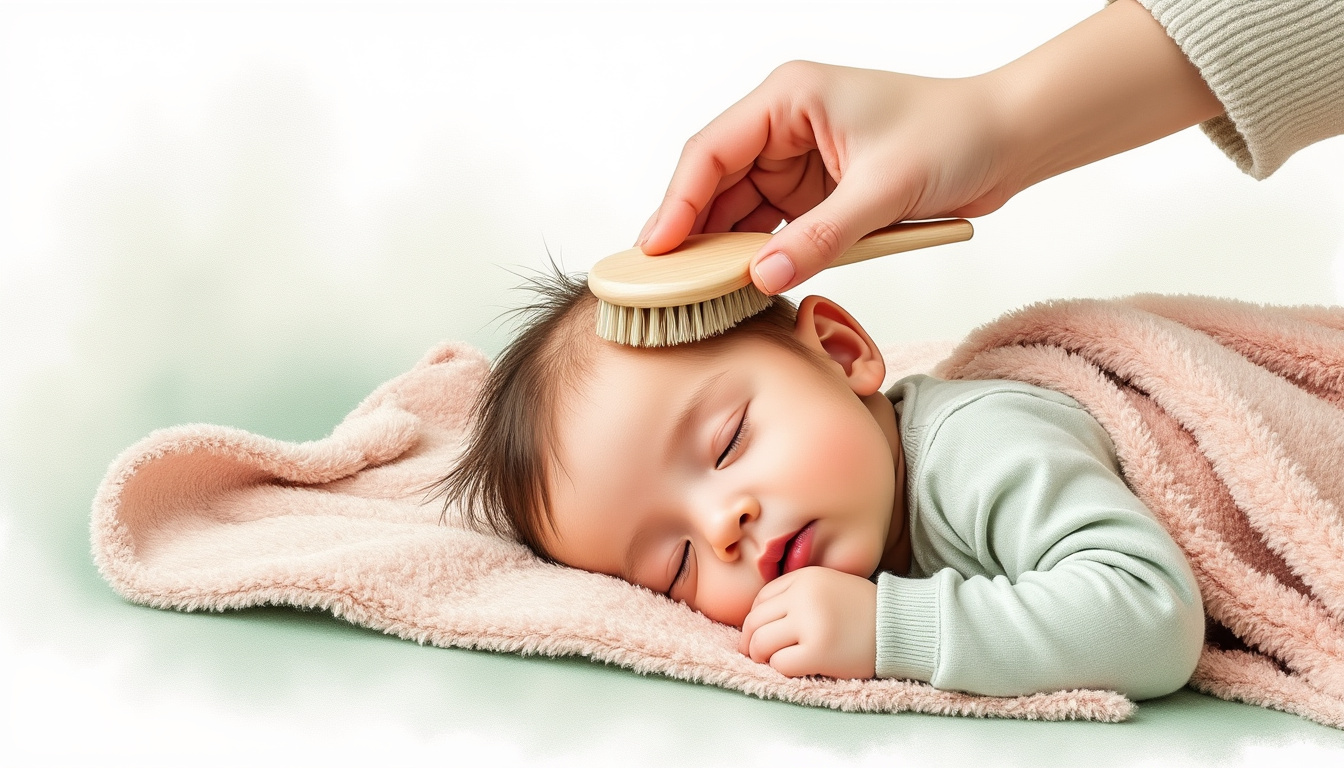
Understanding cradle cap in babies and scalp eczema
Cradle cap is often compared to adult dandruff, with a major difference. The infant’s scalp sometimes produces too much sebum, this greasy film supposed to protect the skin. When this sebum is abundant, it creates a favorable environment for a common microscopic yeast on the skin from the Malassezia family. This combination can trigger a superficial inflammation called seborrheic dermatitis. The word sounds scary, but it describes a common skin reaction at the beginning of life.
This mechanism explains the characteristic appearance of the patches, often yellowish, somewhat greasy, sometimes thick, that stick to the hair or skin. The location is very typical, with the scalp, eyebrows, ear contours, and sometimes folds. It is also sometimes seen on the fontanelles. This area may seem fragile, yet gentle skin massage above it is possible. The brain is not “exposed” under the fontanelle, it is protected by membranes and tissues, and the pressure of a gentle treatment is nothing like trauma.
Two forms are classically encountered. The so-called dry form corresponds to patches that are somewhat flaky, with generally greasy skin. The wet form is accompanied by oozing, sometimes with more vivid redness. The difference is not trivial, because persistent oozing opens the door to more significant irritation and bacterial colonization, especially if the baby sweats a lot from the head or if the patches are handled too vigorously.
In terms of timing, cradle cap often appears from the second or third week. It flares up in bursts. Many disappear spontaneously before 12 months, and most before 2 to 3 years. Later reappearance remains possible, including in adolescence, especially if the skin becomes greasy. The zigzag evolution does not mean that baby care “does not work”, but that the skin follows its own hormonal and sebaceous schedule.
Frequent confusion occurs with other infant rashes. Infant acne gives rather small red or white bumps, especially on the cheeks, and follows a different logic. A dedicated content helps distinguish these patterns, without mixing care gestures, as in this guide on infant acne. The idea is not to diagnose everything at home, but to spot signs that orient towards a simple routine or a medical opinion.
The next step is to observe, without hunting. Baby skin is a maturing organ, permeable, reactive. Understanding the “why” helps choose gentle gestures, especially when the urge to remove the patches quickly is strong.
When the mechanism is clear, care becomes more concrete. The next step is to act without aggression, with a short, realistic routine, repeatable even during tiredness.
Daily baby care to loosen patches without irritation
Cradle cap does not need to be “picked off” to disappear. The scalp mainly needs the patch softened, then accompanied towards progressive detachment. Scratching dry with a nail, even “just a little,” creates microlesions. These small entry points are enough to maintain inflammation, and sometimes allow a superinfection to establish. Irritated skin defends itself by producing more sebum, which paradoxically can feed the patch cycle.
A simple routine is done in two steps, around bath or washing. First, applying an oily product to soften. A neutral vegetable oil may be suitable, such as olive or calendula oil. Liniment is also used by many parents because it combines an oily phase and an aqueous phase. A dedicated article helps choose and use this type of product appropriately, according to age and skin, as in this overview of liniment and skin care. Then, after a setting time, comes the gentle washing.
The setting time matters. One to two hours before the bath often gives good results. The massage is done with fingertips, in circular motions, without trying to lift immediately. If the baby has a lot of hair, some parents use a thin layer of petroleum jelly on the area, as it stays in place and softens effectively. Removal is then done with a wide-toothed comb or a very soft brush. The sensation must remain comfortable. If the baby stiffens, turns the head, or cries, the pressure is too strong or the skin is already too inflamed.
Shampooing should be thought of as active rinsing, not stripping. A mild product for infants, without harsh fragrance, applied in small amounts, is enough. The gesture consists of foaming in the hands, then placing the foam on the scalp and massaging lightly. A long rinse is more useful than vigorous rubbing. Rinsing reduces sebum and yeast load without damaging the skin barrier.
Frequency is an often underestimated lever. Daily shampooing sometimes dries the skin, which increases reactivity. In routine, washing every two or three days is enough. In periods of strong heat, if the baby sweats a lot on the head or often wears a hat, slightly more frequent washing can be considered. The goal remains skin stability, not “ideal” cleanliness. Baby hygiene is measured by gentleness and consistency, not the number of washes.
Brushing can be done on damp hair after the bath, when the patch is already softened. A brush with very soft bristles, always passing in the direction of hair growth, gradually removes the detached fragments. The hardest part is tolerating that not everything comes off at once. Baby’s skin responds better to repeated, light gestures than to occasional strong interventions. The next step is to specify what falls under natural home treatment and what requires a prescribed specific cream.
When the routine is established, the next question is often about products. Some parents want to stick to minimalism, others look for targeted care. Both approaches can coexist if the skin is closely monitored.
Natural treatment, breastfeeding and cradle cap, and product choices
A natural treatment does not mean “putting everything” or multiplying recipes. It means using simple, tolerated products that respect the skin barrier. Cradle cap responds well to this logic, as the main problem is patch adherence and greasy terrain, not deep infection. The challenge is to soften, gradually remove, then let the skin rebalance.
Vegetable oils are often the first proposed. Calendula oil is appreciated when the skin is reactive. Olive oil is accessible, stable, and works well on thick patches. Sweet almond oil is also used, but a nuance is useful. In babies with a known allergic background in the family, or already marked atopy signs, it is sometimes avoided out of caution. In others, the risk of contact allergy remains low. When skin reacts, it is not a “failure,” it is information. Redness that spreads, warmth, clear discomfort after application lead to stopping the product and discussing it with the professional following the child.
Liniment, when well tolerated, can act as a softener. Its texture allows gentle massage without sticky sensation. It is used in small amounts on clean skin and then rinsed off with shampoo. The common mistake is applying too much, which leaves a thick film and can trap heat. A scalp that stews, especially under a hat, easily becomes re-irritated.
The topic of breastfeeding and cradle cap comes up regularly. Breast milk contains lipids and immune compounds. Some families observe that applying a few drops on the patches, then brushing very gently, makes the patch detach more easily. This practice can be tried if the skin is not oozing and the gesture remains clean. It is not a medication but a possible softening method. The benefit is mainly mechanical, linked to moistening and lubricating before gentle removal.
“Special cradle cap” products sold in pharmacies exist, often as shampoos or emollients. They can help, especially when patches recur quickly. The idea is to check tolerance, avoid strong perfumes, and maintain a stable routine at least two weeks before judging. In some cases, a doctor may prescribe an antifungal or anti-inflammatory cream for a short course, especially if the skin is red and irritated. This step is not uncommon and is not excessive when signs justify it.
Cradle cap may coexist with other small infant rashes. “Heat bumps,” fold redness, or patches on the face. Distinguishing lesion types avoids over-treating one area and neglecting another. A useful reference is found in this overview of different baby bumps, which helps observe without panicking or minimizing.
The last point concerns the idea of hydrating the scalp. Hydrating does not mean leaving a greasy film permanently. It means supporting the skin barrier, sometimes with a light emulsion after the bath when the skin is dry, and especially avoiding harsh soaps. Well-protected skin inflames less. The next step is to sort what is normal variation and what should lead to medical advice, with simple signs to spot.
Baby hygiene, cradle cap prevention and markers to avoid relapses
Cradle cap prevention often rests on daily details. Patches develop when sebum accumulates and the skin remains in a warm, sometimes humid environment. A hat worn indoors for long, marked sweating on the neck, or repeated rubbing on rough fabric can be enough to maintain the area. The goal is not to avoid all heat but to observe what triggers a flare in this specific baby.
Washing frequency is a balance point. Washing every two to three days suits many infants. If the baby sweats, rinsing the scalp with lukewarm water between shampoos can already improve the situation without removing too many protective lipids. A very mild shampoo after a baby swimming session, for example, is logical because chlorine dries. Conversely, multiplying “purifying” products sometimes maintains scalp eczema by damaging the barrier.
Choice of textiles and gestures matters. A soft towel, patting rather than rubbing, limits irritation. A soft cotton fitted sheet, washed with low-scent detergent, reduces rubbing and irritating residues. Scalp skin is often more sensitive than imagined, as it is thin and highly vascularized. Skin that heats and reddens easily calls for a gentleness strategy, not an intensity strategy.
Useful baby advice also includes hair management. When the baby has dense hair, patches can hide then thicken. Very light daily brushing, even without visible crusts, can help distribute sebum and prevent it from accumulating in patches. The gesture remains superficial, without scratching. Some parents prefer a very soft comb, others a natural bristle brush. The marker is simple. If the skin reddens after brushing, the pressure is too strong or the frequency too high.
| What is common with cradle cap | What should prompt medical advice | First practical step at home |
|---|---|---|
| Yellowish, slightly greasy patches, without apparent pain | Intense spreading redness, warm skin, very distressed baby | Soften with an emollient 1 to 2 hours before bath then gentle washing |
| Location on the scalp and sometimes eyebrows | Persistent oozing, odor, thick “honey”-looking crusts | Stop scratching, gently clean, make an appointment |
| Flare-ups with slow improvement | Rapid spread over the whole body with inflammatory patches | Photograph evolution over 48h to describe precisely to professional |
| Small areas returning when baby sweats | Fever, altered general condition, unusually drowsy baby | Consult without delay to rule out infectious cause |
When bumps appear around patches, the issue is not only aesthetic. It may be irritation, folliculitis, or a superficial infection. In these cases, a doctor may propose a targeted local treatment, sometimes antifungal, sometimes anti-inflammatory for a short duration. This fits a protective logic, not excessive medicalization. Parents save time when arriving with precise observations about location, appearance, and evolution after bath.
Family habits also play a role. A “greasy” scalp is sometimes found in several family members without it being a disease. This helps understand why one baby develops patches early, while another never does. Heredity does not condemn, it explains a terrain. In this context, prevention often passes through stable baby care rather than seeking the perfect product.
When prevention is in place, parents often ask a last very practical question. When does the situation go beyond simple daily care and warrant specialist advice, without waiting for the skin to worsen.
When to consult for cradle cap in babies and how to prepare the appointment
A consultation is not reserved for “serious” situations. It serves to confirm it really is cradle cap, to distinguish seborrheic dermatitis from drier atopic eczema, or from a skin infection. The right time is when gentle routine no longer suffices, or when the appearance changes. A change in odor, oozing, vivid redness, or inflammatory bumps are simple and observable signals justifying advice.
The most suitable professional depends on context. The pediatrician or general practitioner can confirm diagnosis and prescribe a cream if needed. A dermatologist is useful if flares are significant, if the skin is very reactive, or if several body areas are affected. A midwife or pediatric nurse can also help adjust routine, check brushing pressure, product choice, and support care organization when daily life is already busy. The request need not be dramatic to be legitimate.
Preparing the appointment allows obtaining a more precise answer. Note since when patches have been present, shampooing frequency, applied products, and skin reaction after. Two or three photos taken in the same light over a few days provide a reliable visual reference. This precision avoids successive trials and speeds up care adjustment, especially if the baby has mixed skin with greasy and very dry areas.
Parents sometimes fear the doctor will immediately propose a “strong” cream. In fact, treatments are often graded. An emollient and stable routine remain the base. If a prescription is made, it usually targets a short period to calm inflammation or reduce yeast proliferation. The goal is then to return to simple care. A well-targeted treatment, used for the indicated duration, often avoids the daily persistence that ends up irritating more.
One point deserves to be said clearly. Cradle cap is not a sign of neglect. It can appear in babies washed carefully, carried, massaged, and surrounded. They mainly indicate the skin rebalancing. The most effective baby advice is sometimes the most discreet. A warm bath, a setting time, a soft brush, then a pause. The scalp does the rest.
When the skin becomes smooth in places, the temptation is great to accelerate to “finish.” It is often the moment when it is better to slow down and maintain gentleness, as skin under repair reacts strongly to rubbing. This patience, daily, avoids many relapses.
Do cradle cap patches hurt the baby?
In most cases, no. The patches are often mainly visible and slightly greasy to the touch, without pain. Discomfort appears rather when the skin is very red, warm, oozing, or when the patches have been scratched dry, which irritates. If the baby scratches, cries when touched, or seems uncomfortable, medical advice helps verify that it is not a more marked inflammation.
Can the fontanelle be massaged if cradle cap patches are present?
A gentle massage of the skin above the fontanelle is possible. The area is protected by membranes and tissues, and delicate care does not expose the brain. The marker is pressure. Movements remain light, with fingertips, without trying to detach at all costs. If the skin reddens strongly or oozes, better have the diagnosis confirmed by a professional.
What shampooing rhythm is best for good baby hygiene when there is cradle cap?
A mild shampoo every two or three days often suits. Daily washing can dry out and maintain irritation. If the baby sweats a lot on the head or during hot periods, rinsing with lukewarm water between shampoos may suffice. The goal is stable skin, not a stripped scalp.
Breastfeeding and cradle cap, can breast milk help?
Some families find that a small amount of breast milk applied on the patches can help soften them before very gentle brushing. The benefit is mainly mechanical, like a light emollient. This does not replace prescribed treatment if the skin is very inflammatory, oozing, or if bumps appear.
When to consider superinfection and consult quickly?
Superinfection is suspected if the skin oozes, smells bad, becomes very red or painful, if thick crusts with a “honey” appearance appear, or if the baby has fever or notable behavior change. In these situations, consultation allows evaluation and, if needed, prescribing adapted local treatment.