
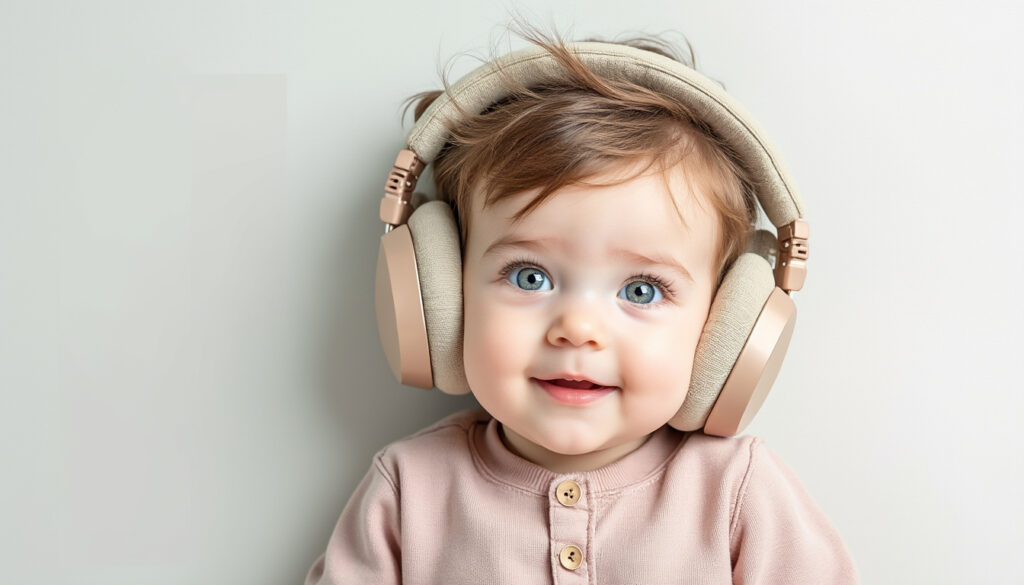
In brief
- A baby noise-cancelling headset reduces the sound level but does not make a noisy environment “acceptable”: the primary hearing protection remains avoiding very intense sources.
- Simple guideline: below a few months, noise tolerance is low and the nervous system quickly saturates, even if the baby does not “show it” except through signs of discomfort.
- The useful noise reduction is often around 20 to 25 dB for noisy environments, provided the headset is properly fitted.
- Comfort and safety take precedence over looks: soft pads, moderate pressure, stable headband, light weight, and adjustable size.
- Hypoallergenic materials and easy-to-clean surfaces: infant skin reacts quickly to heat, friction, and sweat.
- Safety standards (CE marking, sometimes NF depending on the ranges) and purchase from a seller offering trial or return: a poorly fitting headset loses much of its effectiveness.
Understanding a baby’s hearing sensitivity before choosing a noise-cancelling headset
In the first weeks, the baby goes from a filtered and muffled world to a highly contrasted sound environment. The auditory system already functions, but the way the brain processes sounds remains immature. A sudden loud noise is not just “heard”: it can trigger a startle reaction, affect heart rate, tense the body, and disrupt sleep organization.
The Moro reflex, often present until 4-5 months, illustrates this vulnerability. A clap, a train station announcement, or a banging door can provoke a sudden extension of the arms, followed by flexion, sometimes with crying. This is neither a tantrum nor a “bad habit.” It is a nervous system protecting itself as best as it can.
The notion of hearing protection then takes on a concrete meaning. The issue is not just to avoid discomfort. Repeated exposure to high sound levels increases the risk of fatigue, irritability, difficulty falling asleep, and, in cases of marked intensity, hearing damage. The eardrums of very young children are more fragile and the baby does not know how to move away, plug their ears, or ask for a break.
A useful guideline circulates in many parental guides: avoid exposing a child to sounds exceeding 80 dB. In practice, this corresponds to certain concerts, fireworks, DIY tools, stadiums, or very noisy areas of an airport. A noise-cancelling headset offers noise reduction, not total cancellation. If the environment is extreme, the risk remains real, even with a good model.
The right approach is to think in two steps. First, assess if the situation is suitable for the baby’s age. Then, if exposure is occasional and hard to avoid, use appropriate protection, well adjusted, and for a limited duration. This hierarchy avoids a common trap: believing the headset “authorizes” an ambiance which in reality remains aggressive.
Some parents also notice a side effect: a baby may seem calmer with a headset, not because they “isolate themselves,” but because the sensory load decreases. The infant’s brain poorly sorts information. When everything comes in strong and fast, the organism shifts into alert mode. Lowering ambient volume sometimes helps regain a window of availability to nurse, fall asleep, or simply look around.
The logical next step is to understand which technical criteria turn a headset into a real help, and which are mostly marketing. This is where the balance between performance, comfort, and safety is played out.
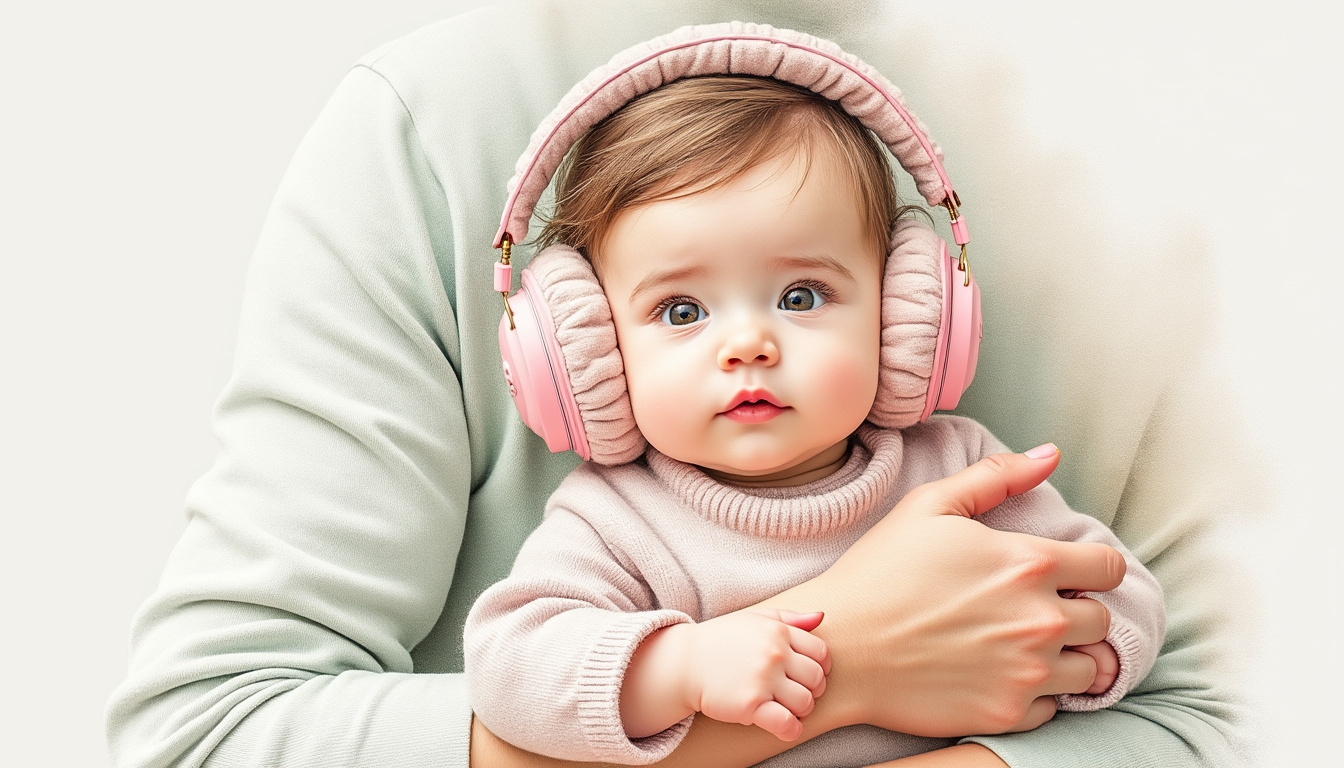
Noise reduction, SNR and decibels: how to read a product sheet without mistakes
A noise-cancelling headset does not “cut” sound like a switch. It attenuates the sound energy reaching the ear. Performance is often indicated by an overall value like SNR (Single Number Rating), or by attenuation by frequency. For a parent, the key idea remains simple: the better the headset fits, the closer the announced noise reduction is likely to be to reality.
In truly noisy environments, attenuation of about 20 to 25 dB is often cited as a relevant threshold for protection to be tangible. This does not mean everything becomes “soft.” It means a very loud noise can become less aggressive, provided exposure remains brief and the child shows no signs of discomfort.
The difficulty comes from a concrete point. A headset that is too large lets air—and thus sound—pass through. A headset that is too tight creates unpleasant pressure on the skull and soft tissues around the ear, with risk of crying, redness, or outright refusal. Noise reduction is therefore not judged only on packaging but on the “seal,” the uniform contact of the pads.
What changes everything: the actual fit on a baby’s head
An infant’s morphology is nothing like that of a 5-year-old child. The skull is smaller, facial proportions differ, and ears are often closer to the scalp. A “child” model placed on a baby may seem to hold but remain off-center and lose much of its effectiveness.
A headset adapted for very young children relies on a headband that stabilizes without crushing. The mention adjustable size has value if the adjustment is fine, symmetrical, and does not slip. Some models intended for the youngest use an elastic textile headband rather than a rigid arc. This limits pressure points and improves tolerance, especially before 12 months.
Decibels in daily life: concrete guidelines without dramatizing
Daily life can be surprising. A busy street, a subway, a hairdryer, a drill, or a family party in a reverberant room can quickly increase noise. The 80 dB guideline helps decide, but the baby’s behavior also matters. A baby who turns their head away, fusses, clenches fists, becomes hypervigilant, or cries whenever a noise occurs expresses overload.
In these situations, the headset can serve as a sensory “buffer,” but the fit and duration of use make the difference. The goal is not to wear hearing protection for hours, but to get through a risky moment then remove the headset as soon as the ambiance becomes moderate again. The next challenge then becomes comfort, because an uncomfortable baby does not keep a headset on, even a very high-performing one.
Visual demonstrations of fitting and adjustment can be found in videos, often helping identify what is “normal” and what is not.
Comfort, hypoallergenic materials and adjustable size: what the baby really tolerates
Comfort is not a cosmetic detail. In a baby, discomfort quickly becomes global disorganization. A headset that heats up, slips, or is too tight can trigger crying, interrupt nursing, or prevent falling asleep. Tolerance depends on age, temperament, and current state. A tired baby often accepts constraints less well.
A noise-cancelling headset usually consists of shells, pads, inner foam, and a headband. Elements in contact with the skin must be chosen carefully. Infant skin marks quickly. A red mark that disappears in a few minutes is not necessarily worrying. Persistent redness, irritation, or small bumps after wearing indicate a problem of material, friction, or heat.
Hypoallergenic materials: especially useful on fragile skin
The mention of hypoallergenic materials reassures but deserves concrete verification. A soft, odorless material, easy to wipe, and lint-free is a good sign. In cases of atopic tendency, eczema, or very reactive skin, a washable textile surface or foam covered with soft material limits irritation. Sweating also plays a role. At a station in summer or in a heated airplane, the area around the ears can become damp within minutes.
A simple gesture protects the skin. Remove the headset regularly, gently wipe the area if needed, then put it back only if sound exposure continues. This alternation also helps verify that the baby remains available, breathes calmly, and that the head is not compressed.
Weight and pressure: two often underestimated parameters
A heavy headset tips forward and pulls on the headband. A headset too tight presses on the temples. In infants, the fontanelles and skull bone flexibility require calm caution. The right feeling is stable support, without deep marks, and no slipping when the baby turns the head.
The adjustable size must allow centering the shells on the ears without crushing. If the pads rest on the auricle instead of surrounding it, the headset becomes less effective and more irritating.
A fitting process that respects the baby’s rhythm
The way of putting on the headset changes everything. A quick gesture without pulling the ears, supporting the neck, avoids turning the accessory into a constraint. In the very young, acceptance often increases if the headset is put on in a calm moment, before entering the noisy environment. Waiting until the noise is already present is asking an already saturated baby to accept something on their head.
If the baby cries intensely, arches, becomes very red, or shows signs of distress, the headset is not “to be imposed.” Better to move away, reduce exposure, then try again later if it makes sense. The following section will help decide when baby use is relevant and when it is not.
Some video user feedback also shows how to spot excessive pressure and adjust without forcing.
When and how to use a noise-cancelling headset with a baby: plane, fireworks, parties, DIY
The noise-cancelling headset is a situational tool. It is not intended for daily home use, nor to “accustom” the baby to aggressive environments. The most frequent uses are transport (plane, train), occasional events (wedding, family party), or unpredictable urban moments. In these contexts, the goal is to reduce a sound load the baby cannot control.
On a plane, the noise issue sometimes mixes with that of pressure. A noise-cancelling headset does not equalize pressure in the middle ear. For discomfort linked to ascent and descent, nursing, a bottle, or sucking often helps, as swallowing mobilizes the Eustachian tube. The headset can reduce ambient sound level but does not replace these actions.
For fireworks, caution is even clearer. Sound peaks can be very high. Hearing protection helps, but distance remains decisive. A baby in a stroller in the middle of a crowd, close to explosions, remains exposed. In most cases, an infant benefits from being moved away or even not attending the event. This position is not a moral prohibition. It is a physiological reading.
Installation: three concrete guidelines that make all the difference
A poorly positioned headset is a false security. To support tired parents, here is a short list focused on the gesture.
- Place the shells well centered on the ears, without bending the auricle, then check with a finger that the pad contacts all around.
- Adjust the adjustable size so the headset stays when the baby turns their head, without creating tension on the temples.
- Take a break every 20 to 30 minutes if exposure lasts, to air the skin, check alertness, and adjust if necessary.
The tolerable duration varies. A 2-3 month-old baby may refuse after 2 minutes. A 10-month-old baby may accept longer, especially if carried and comforted. Carrying sometimes reduces the reaction to noise because it stabilizes tone and offers vestibular cues. The headset then becomes a complement, not a sole strategy.
Age and recommendations: respect manufacturer indications
Many models are not recommended before 1 month, sometimes more. The reason lies in head size, skin fragility, and difficulty obtaining correct fitting. Putting a model designed for 2 years on a 6-month-old baby often yields ineffective protection and discomfort as a bonus.
Conversely, a “baby” headset on a 3-year-old child may be too small, too tight, and create unnecessary pressure. Safety therefore depends on respecting indicated ages and head circumferences when this information is available.
Consultation box: when to seek professional advice
Consultation with a pediatrician, midwife, or ENT is discussed if one of these signs appears after sound exposure, with or without a noise-cancelling headset. Suspected hearing loss with absence of reaction to usual sounds, inconsolable crying associated with persistent ear rubbing, marked sleep disturbances lasting several days, or onset of tinnitus reported in an older child. Without these signs, occasional discomfort after a noisy event may be simple sensory fatigue, especially in sensitive babies.
Once the “when” is clarified, the “what” to choose at purchase remains. The next section sets safety criteria, standards, and useful comparison guidelines.
Safety standards, maintenance, purchase: choosing a reliable and durable baby noise-cancelling headset
A noise-cancelling headset is a safety product. Safety standards do not guarantee everything but set a framework. The CE mark indicates the product meets applicable European requirements for its category. Some brands also highlight additional certifications or tests. The idea is not to collect logos but to avoid products without traceability, whose foam compresses quickly and whose noise reduction becomes unpredictable.
Purchasing in baby gear stores sometimes allows trials. This is valuable because the baby’s tolerance is immediate. If buying online, the return policy matters as much as the technical sheet. A headset that does not fit properly is a bad investment, even if “highly rated.”
Comparison table: practical guidelines by age and use
| Age / situation | Hearing protection goal | Features to prioritize | Watch points |
|---|---|---|---|
| 1 to 6 months, occasional outings (station, family party) | Limit sensory overload and sound peaks | Soft headband, light weight, soft pads, fine adjustable size | Watch for redness and heat, frequent breaks |
| 6 to 18 months, transport (train/plane) | Reduce background noise and aid sleep | Noise reduction stated around 20-25 dB, good stability, easy-to-clean materials | Do not confuse noise and pain related to pressure on planes |
| 18 months to 4 years, occasional events (wedding, crowd) | Protect from unpredictable environments | Enveloping pads, robust adjustment, hypoallergenic materials if sensitive skin | A headset does not make fireworks “risk-free” |
| From 5 years, adapted shows, sports | Protection in noisy places, autonomy | Adjustable arc, robustness, easy storage/transport | Ensure the child puts it on correctly and accepts breaks |
Examples of known ranges and choice logic
Several brands offer models by age range. “Baby” lines often target under 36 months, while other references start around 18 months, then “kids” models from 5 years. Indicative prices often range between 20 and 35 euros depending on brand, materials, and accessories. The best logic remains to first choose the age group, then compare comfort, stability, and ease of maintenance.
Maintenance matters more than imagined. Pads accumulate heat and sweat. Simple cleaning with a soft, slightly damp cloth, then complete drying, prolongs lifespan. If the headset smells strong, sticks, or the foam deforms, it loses effectiveness and becomes less pleasant. Safety also involves this regularity.
One last point protects skin and hearing. A headset should not be used to “tolerate” decibels at home, like loud music or DIY tools in the same room. Putting distance, closing a door, postponing drilling—these are simple and often more effective actions than any accessory. When the environment is controlled, the headset goes back to what it should remain: an occasional aid, chosen with care.
At what age can a noise-cancelling headset be used for a baby?
Many models are not recommended before 1 month, sometimes more depending on design. The age indicated by the manufacturer must be respected because adjustment and pressure on the head vary greatly between a newborn and a baby a few months old. If noisy exposure is planned very early, the best lever remains avoiding the situation or moving away from sound sources rather than relying solely on the headset.
What noise reduction should be aimed for for hearing protection to be useful?
For noisy environments, an attenuation around 20 to 25 dB is often a relevant guideline, provided the headset is well centered and well fitted. A poorly positioned headset may show a good value on the packaging but protect little in practice. Noise reduction does not make a very intense context risk-free; it mainly reduces sound aggression.
How to tell if the headset is too tight or poorly fitted?
Simple clues help. Persistent redness, immediate crying upon placing, deep marks on the temples, headset slipping toward the eyes, or pads crushing the auricle instead of surrounding it. A good headset holds without pain, and the baby can move their head without the shells shifting. When in doubt, prefer a model with finer adjustable size or a softer headband.
Does the noise-cancelling headset help with ear pain on a plane?
It can make the flight more bearable by reducing background noise, but it does not resolve discomfort linked to pressure changes. For this sensation, sucking and swallowing during ascent and descent are often more effective. If marked pain, intense crying, or persistent troubles appear after the flight, pediatric advice should be considered, especially in case of cold or repeated ear infections.