

Discovering a positive test, waiting for a blood test, or choosing to keep this secret to yourself for a few hours can provoke a very vivid mix of joy, dizziness, and emotion. Revealing the pregnancy to the future dad does not need to be spectacular to have a lasting impact: it especially benefits from respecting your story, your pace, and the real place you want to give it from the very first days.
- The right moment is when you feel ready to share the news, even if the announcement happens just minutes after the test.
- A gift, a meal, a letter, or a game are useful when they reflect your couple and leave space for the reaction.
- The surprise can be tender, funny, or very simple without reducing the depth of this special moment.
- A silent, practical, or worried reaction does not necessarily translate a lack of joy: the future dad may need time to absorb this change.
Choosing the right moment to announce a pregnancy to the future dad
The result sometimes appears in the bathroom, just as the day is barely starting. The body can be crossed by very concrete sensations: the heart races, hands become cold, thought blurs for a few seconds. This first perception of pregnancy fully belongs to the person taking the test. Some want to call their partner immediately. Others prefer to check the instructions, retake a test the next day, or make an appointment for a blood test before sharing the news.
There is no correct emotional timeframe for announcing a pregnancy to the future dad. Sharing the news quickly allows going through the processes, doubts, and first projections together. Waiting a few hours or a few days can also help welcome the information before confiding it. This choice is not a distancing. It can simply respond to a need for stability after months of attempts, a previous miscarriage, a medical termination of pregnancy, or the unexpected arrival of a positive test.
Medically speaking, a urine test detects the hCG hormone in the urine. This hormone is produced after the embryo implants. A positive result is usually very reliable when the test is used from the first day of missed period, but a consultation can organize follow-up and date the pregnancy. Intense pain on one side of the lower abdomen, heavy bleeding, fainting, or shoulder pain justify contacting a healthcare professional or emergency services without delay. Slight spotting can have various causes and deserves to be reported during a discussion with a midwife or doctor, especially if it persists or is accompanied by pain.
Preparing an announcement without staging it at all costs
The desire to create a surprise often comes from a very healthy wish: to make visible the discreet transition from two people to a family-to-be. However, an announcement that is too complex can become a source of tension. Organizing ten clues, reserving a location, and controlling every detail does not guarantee more emotion. The memory often remains attached to a phrase, a look, or a silence rather than the setting.
It can be helpful to first choose the intention. Do you want to share a calm moment, provoke laughter, offer an object to keep, or create a visual trace? This response guides creativity without locking you into a scenario. A couple who talks a lot over coffee may appreciate a cup revealing “you’re going to be a dad” at the bottom. A couple used to games may prefer a riddle. A relationship marked by a long fertility journey may prefer a short letter, read in private, to give full space to contradictory emotions.
If you already have a medical appointment scheduled, you can wait for biological confirmation or the first ultrasound. If waiting isolates or worries you, informing your partner quickly can on the contrary support you. Early pregnancy is not necessarily experienced better in secret as a principle. It is experienced in the way that helps you most to feel supported and respected.
To broaden your ideas beyond personalized objects, ideas for an original pregnancy announcement can help you sort out what really suits you. Leave room for the unexpected. The future dad may understand immediately, reread the message twice, laugh nervously, or remain still. None of these reactions diminish the value of your announcement.
Planning a moment without urgency just after the revelation often changes the experience. Avoid, if possible, slipping the news between two departures, before a difficult professional appointment, or in a noisy room where talking would be impossible. About twenty calm minutes are enough. The goal is not to create a perfect scene but to allow everyone to receive the information at their own pace.
Creating a pregnancy announcement for dad that truly reflects your couple
A successful announcement is not measured by the price of the gift nor the speed of the reaction. It draws its strength from shared habits. The Friday meal, the novel placed on a bedside table, the Sunday board game session, or the first hot drink in the morning are emotional landmarks. Slipping the news into these gives the gesture immediate coherence, without requiring heavy staging.
Creativity becomes touching when it uses a ritual already present in your daily life. A personalized plate hidden under a beloved dish may suit a cooking enthusiast. A scratch card can work for a person who enjoys short games and surprises. A bookmark bearing a few words, or an ultrasound inserted into a book, gives the revelation an intimate dimension if reading holds an important place in the relationship.
Simple ideas that leave room for emotion
A message on a mirror can be prepared with a erasable marker rather than a hard-to-clean product. “1 + 1 = 3” remains a concise formula, but a more personal message avoids the impression of reproducing an image seen online. A phrase like “our family is growing” or “see you in a few months” may be more fitting if it corresponds to your usual words.
Dinner for two also offers a very accessible setting. Reserving a table for three is a tender idea, provided you check that the place allows this request without attracting attention if you prefer discretion. A plate with a word written in chocolate can create a surprise, but leave time after dessert. The announcement can open conversations about medical appointments, daily organization, or first concerns. It is not just a surprise effect.
Gourmet attentions require some precautions from the beginning of pregnancy. A personalized bottle can serve as decor, but choose a non-alcoholic drink for yourself. Current recommendations remain clear: no amount of alcohol is considered safe during pregnancy. A decorated cake, a box of cookies with a small note, or a pizza bearing an inscription are easy-to-share and unambiguous alternatives.
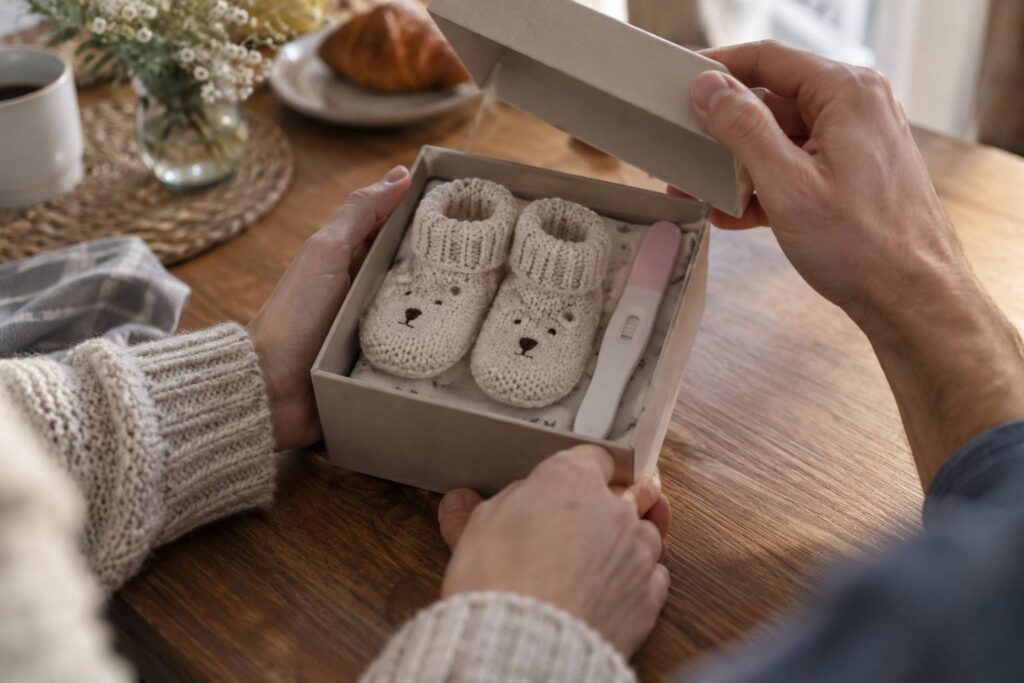
- Slip a simple bodysuit bearing “future dad” into a box with a handwritten note, without multiplying objects that could distract from the news.
- Prepare four scratch cards forming a short phrase, then stay close to him when the message appears to welcome his reaction.
- Place a personalized bookmark into a book he actually reads, making sure he can discover it in a calm moment.
- Write a letter one page maximum, with what you feel today and the phrase announcing the baby’s arrival.
The letter is often a valuable option when words get stuck orally. It doesn’t need to be literary. A few sentences are enough to express joy, possible fears, and the wish to journey together. The medium also allows the future dad to reread the message later, when reality begins to take shape.
A digital surprise may please a computer or video game enthusiast, but it deserves special attention to privacy. Changing a wallpaper with an image of the test or ultrasound can be touching if the computer is strictly personal. On a professional or shared device, it is better to choose a USB key, a discreetly named file, or a game prepared at home. The first ultrasound contains health data not meant to circulate without your explicit consent.
A small device is worth more than a complicated production if it opens up a genuine exchange. Emotion cannot be commanded, but the setting can make its place more comfortable. A sofa, a meal without phones, a walk, and a discreet object can convey this news with great delicacy.
Welcoming the future dad’s reaction with kindness and realism
The first reaction is not a verdict on the quality of the couple nor on the future attachment to the baby. Many people associate a pregnancy announcement with immediate tears or joyful exclamations because family stories and social networks emphasize these scenes. In reality, the brain sometimes has to integrate several pieces of information at once: a child to come, material change, the pregnant person’s health, upcoming exams, and a new parental identity.
The future dad can feel joy and worry at the same time, without contradiction. A very practical response, like talking about housing, budget, or appointments, can be a way to reduce uncertainty. Silence can signal surprise. Laughter can relieve tension. These emotional regulation mechanisms are common when the event abruptly changes the representation of the future.
Making room for feelings that don’t resemble a movie scene
Future fathers may fear not being ready, losing their freedom, no longer seeing their friends, or failing to maintain some activities. Financial worry is also common, even in a stable household. It deserves a concrete conversation, without being brushed off by too quick reassuring phrases. Establishing a provisional budget later, discussing leave, and checking the benefits you may be entitled to often make this worry more manageable.
Sexuality may also change from the announcement. Some people fear hurting the baby during intercourse. In an uncomplicated pregnancy, sexual relations cannot reach the baby, who is protected in the uterus by the amniotic sac and the cervix. A midwife or doctor may recommend temporary abstinence in certain precise situations, notably in case of heavy bleeding, threat of premature birth, placenta praevia depending on term, or membrane rupture. This indication must come from medical follow-up, not isolated fear.
A very detached reaction at first deserves being observed over time, without hasty interpretation. Attachment to the baby builds at different rhythms. The pregnant person gradually feels bodily signs, then fetal movements, often between 16 and 22 weeks in a first pregnancy, with wide variations. The second parent accesses pregnancy more through stories, ultrasounds, placing a hand on the belly, or shared appointments. They may need concrete landmarks to project themselves.
| Observed reaction | What it may translate | Helpful response in the couple |
|---|---|---|
| Silence or blank face | Surprise, need to process information, emotion difficult to verbalize | Suggest a calm moment and revisit the topic later in the day |
| Questions about money or housing | Need for security and control in the face of major change | Note questions and schedule a specific time to review them together |
| Laughter, jokes, or restlessness | Tension release and attempt at emotional regulation | Simply say what you feel, then let the discussion settle |
| Intense sadness, persistent panic, or prolonged withdrawal | Possible psychological distress, personal conflict, or overwhelming fear | Discuss with a midwife, treating physician, or perinatal psychologist |
Dialogue benefits from remaining direct. Saying “I need to know what’s going on for you” opens more than asking for a specific reaction. On the other hand, naming a fear without blaming protects the couple’s alliance. Pregnancy does not demand being happy every minute. It demands that emotions can circulate without becoming a forbidden topic.
When anxiety takes over, sleep is strongly disturbed for several weeks, dark thoughts appear, or exchanges become explosive, support is recommended. A midwife can direct to a psychologist trained in perinatal care. Consulting early does not dramatize the situation. It prevents loneliness from settling around news that should be shareable.
Imagining a creative revelation without exposing your intimacy
A pregnancy announcement can become public very quickly, sometimes before the couple has had time to understand what is happening to them. A photo, a video, or a message sent to a family group can trigger dozens of responses within minutes. This buzz brings joy, but it can also deprive you of the necessary time to get through the first appointments, medical uncertainties, or first trimester fatigue.
A surprise intended for the future dad can remain entirely private as long as you decide. Filming his reaction is possible, but only if you know he appreciates being filmed in a vulnerable moment. Consent should not be presumed because the result seems happy. The phone can remain placed out of reach. This decision sometimes protects emotion better than any editing.
Games, objects, and keepsakes to announce the arrival of a baby
A treasure hunt suits couples who enjoy searching, solving, and playing together. It stays pleasant when it lasts three or four steps. Each clue can evoke a facet of the upcoming daily life, without becoming cryptic enough to create frustration. A first word near where you have breakfast, a second in a book, then a box containing a pair of booties or the pregnancy test may suffice.
A board game prepared for the occasion allows a progressive revelation. In Scrabble, a few words linked to parenthood can awaken suspicion before the final phrase appears. In a charades or riddle game, the chosen terms should remain light. If the pregnancy was preceded by a difficult period, a more direct approach may be preferable. Creativity should never require masking a more complex emotional reality.
Baby accessories have immediate symbolic power. A bodysuit, a pacifier, or booties give a material form to an event still invisible. However, it is useful not to invest these objects with excessive certainty in the very first days if it makes you anxious. A test, a handwritten card, or a positive blood test can be equally expressive supports, with an emotional charge sometimes better adapted to the stage of pregnancy.
Announcements related to a passion also deserve to stay simple. A USB drive with an audio file, a wallpaper prepared on a personal tablet, or a message slipped into a game controller can work for a technology enthusiast. For a book lover, the bookmark remains a delicate option. For a person who likes to cook, a cookie with a message or a recipe annotated “for three” may suffice.
It is better not to use alcohol as the centerpiece of the celebration. A personalized beer or wine label can seem fun, but it blurs a useful benchmark from the beginning of pregnancy. Rather prepare a toast with a sparkling non-alcoholic drink, grape juice, or a non-alcoholic cocktail. This allows celebrating the news together and makes visible, without awkward explanation, the change that begins.
A creative approach may also fit into a family story. Keeping the letter, later framing the scratch card, or storing the booties in a keepsake box builds a transmission object. This trace does not need to be shown to anyone. It can remain in the private space of the couple and take on a new meaning after birth.
The same care applies when you consider sharing the news later with relatives. The moment of the family announcement can be different from that experienced as a couple. Sharing the news of a pregnancy with family often requires thinking about boundaries, possible confidences, and the support you will need if the first weeks are tough.
Announcing a second pregnancy to dad while including the family with sensitivity
When a child is already present, revealing a new pregnancy also transforms the family balance. The eldest can participate in the announcement to the future dad, but their role must be thought through according to their age and temperament. A 2-year-old child may wear a t-shirt indicating they will be a big brother or sister without really understanding what that means. Between 4 and 6 years, the child better grasps the idea of a baby to come, but may alternate enthusiasm and fear of losing some parental attention.
Making the eldest participate is a joyful proposal, not a responsibility to entrust them with. They do not have to keep a heavy secret, produce a touching reaction, or reassure the adults. A brief participation works better: handing over a box, showing a drawing, wearing prepared clothing, or being present for a photo. If the child refuses, changes their mind, or becomes restless, this behavior remains typical. Pregnancy is not yet a concrete reality for them.
Preserving the couple while opening the door to siblings
Some parents want the future dad to discover the news through the eldest. This idea can be very moving, but the child risks revealing the message sooner than planned or losing interest at the chosen moment. Prepare a simple version, without pressure. A drawing representing three or four silhouettes, an envelope given during snack time, or a family photo where a small sign announces the enlargement can create a warm memory.
A professional photo shoot preserves the moment, provided you inform the photographer of your project and frame what may be displayed. The future dad’s consent also matters here. Some people like to keep these images to themselves until the first ultrasound, while others want to send them quickly to the grandparents. No social timetable is imposed.
After the announcement, dialogue with the eldest continues little by little. For children under 3 years, short and repeated phrases are easier to understand. “A baby is growing in the belly. He will arrive when it gets cooler” is often more meaningful than a precise date. From age 4, you can use seasons, show belly growth, and simply answer questions about birth. Age-appropriate books can support these exchanges without replacing them.
Anticipated jealousy should not be treated as a fault. It often corresponds to the difficulty of sharing an attachment relationship. The child’s brain looks for signs of continuity. Maintaining some predictable appointments, such as the bedtime story or weekend walk, helps them imagine the relationship will remain available after birth. These moments can be short. Their regularity matters more than their duration.
Revealing to the extended family also requires a joint decision. Some want to wait for the first trimester ultrasound, often done around 11 to 13 weeks of amenorrhea depending on follow-up organization. Others prefer to speak early to receive support, notably if nausea, fatigue, or anxiety become hard to bear. You can choose a close circle of people able to respect your confidentiality.
If you inform relatives early, say clearly what you expect from them. You can ask that the news not be spread, that no one comments on your body, or that advice remain measured. This precision prevents many awkward moments. Family joy is more soothing when it does not confiscate the couple’s experience.
A sober announcement may sometimes be the most appropriate. Placing the test on the table, taking your partner’s hand, and saying “we are going to have a baby” is neither lacking in creativity nor depth when these words correspond to your bond. The memory builds less around a performance than the availability offered to what really happens between you.
When to announce your pregnancy to the future dad?
You can announce it as soon as the positive test, after a blood test, or after a first medical appointment. The right marker is your sense of security and your desire not to go through the first emotions alone.
How to react if the future dad stays silent after the announcement?
Give him a few minutes or hours to integrate the news, then open a simple exchange about what he feels. Silence often reflects surprise or worry, not absence of joy.
Does a pregnancy announcement have to be a surprise?
No. Discovering the test together can be just as powerful as a gift or staging. Intimacy, availability, and the possibility to talk matter more than the effect produced.
Can an eldest child be included in the announcement to the future dad?
Yes, if the participation remains light and adapted to their age. The child can hand over a box, show a drawing, or wear a t-shirt, without having to keep a secret or respond to an emotional expectation.