

Cradle cap often appears during the first weeks, sometimes as early as the second week of life. These yellowish patches on the scalp can be surprising, but they most often correspond to a benign seborrheic dermatitis and do not indicate either a lack of care or poor hygiene of the baby.
Briefly about cradle cap in babies
- Cradle cap is related to a high production of sebum and the balance of the Malassezia yeast present on the skin.
- They form greasy, yellow or whitish scales, mainly on the scalp, eyebrows, and behind the ears.
- A gentle care with an appropriate emollient, followed by a mild shampoo, is often enough to gradually reduce them.
- Scratching dry or pulling off the patches can irritate sensitive skin and promote a local infection.
- A consultation is recommended if the skin weeps, bleeds, becomes very red, seems painful, or if the rash spreads widely.
Understanding cradle cap in babies without confusing it with poor hygiene
Cradle cap is a common form of infant seborrheic dermatitis. They are named this way because of their sometimes yellow and thick appearance, reminiscent of dried milk. They are not related to the milk your child drinks, nor to insufficient washing.
In infants, the sebaceous glands can remain particularly active during the first months. They are still influenced by maternal hormones transmitted during pregnancy. The scalp then produces more sebum, a greasy substance that normally protects the skin.
This greasier surface promotes the presence of Malassezia, a microscopic yeast usually present on the skin. It is not transmitted from one baby to another and does not indicate a contagious infection. In some children, the combination of sebum, dead cells, and this yeast forms thick patches.
An isolated cradle cap patch on the scalp is generally a benign skin manifestation, very different from dirty or poorly maintained skin. Scalp care aims therefore to soften the scales and respect the skin’s protective barrier, not to scrub it off.
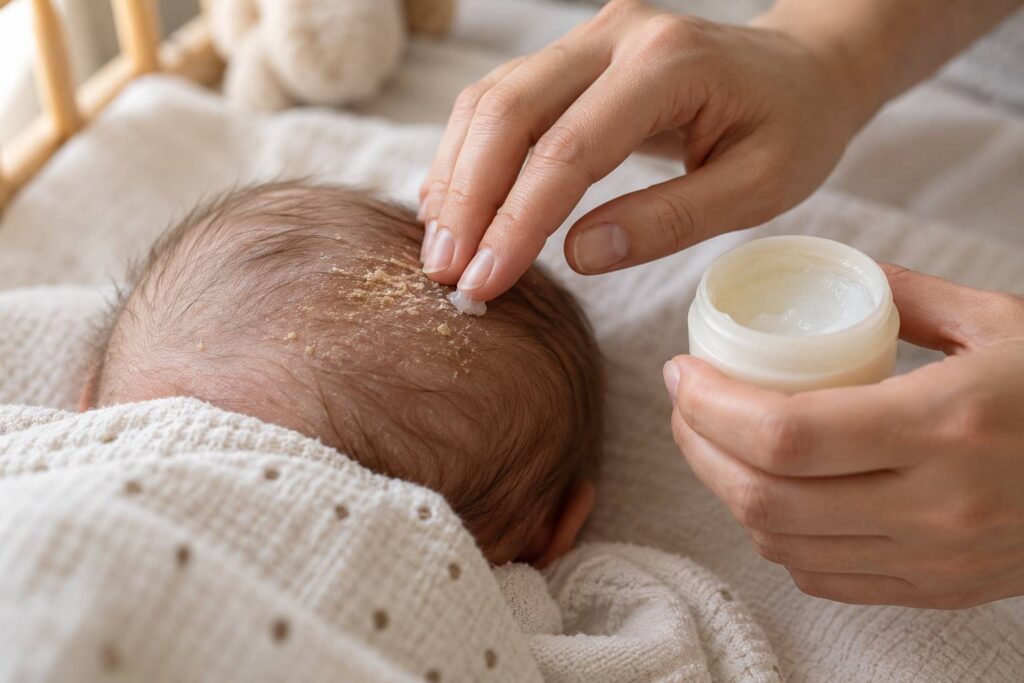
The most common form is dry or slightly greasy. It appears as small whitish flakes, yellow patches, or thicker deposits between the hair. Some areas may appear shinier, especially near the fontanelle, on the top of the skull, or at the hairline.
The patches can also appear on the eyebrows, folds behind the ears, around the nose, or on the upper forehead. Moderate extension to these areas remains compatible with seborrheic dermatitis. The term “cradle cap” then refers to the same skin tendency, even if it is not limited to the hair.
It is useful to distinguish cradle cap from infant acne. Acne usually manifests as small red bumps, sometimes with a whitehead, located on the cheeks and forehead. A guide on the causes and care of infant acne can help to observe this difference without multiplying products.
Atopic dermatitis, often called eczema, presents a different picture. The skin appears dry, red, rough, and frequently itchy. The cheeks, folds of the arms or legs are more commonly affected. Seborrheic crusts, on the other hand, are often greasy and initially not very bothersome.
Parents sometimes notice that their baby rubs their head against the sheet or their shoulder. This gesture does not always mean that the patches itch. It may reflect the search for support, tiredness, warmth, or the still uncoordinated movements of the first months. Real discomfort should however be taken seriously when accompanied by redness or crying on contact.
| Observed aspect | What it most often suggests | Appropriate response |
|---|---|---|
| Yellow, greasy patches with little redness on the scalp | Usual cradle cap | Gentle emollient, delicate washing, and removal without scratching |
| Very dry, red, and rough skin on cheeks or folds | Possible atopic dermatitis | Medical advice to choose appropriate care |
| Small red or white bumps on the face | Possible infant acne | Simple washing and monitoring of evolution |
| Weeping, painful patches or with honey-colored crusts | Superinfection or other skin condition | Medical consultation within a short timeframe |
Most cradle cap appear between the second week and the first months. They often spontaneously decrease during the first year, as sebaceous gland activity stabilizes. Some skins maintain a more scaly tendency longer, without this indicating a lasting disease.
A patch does not need to be removed immediately for your baby to be well. When the scalp remains supple, not red or painful, observation and regular but moderate gestures are often enough. An infant’s skin repairs better when it is not overstimulated.
Recognizing usual signs and those requiring medical advice
Ordinary cradle cap has a fairly recognizable appearance. They stick to the scalp, appear yellow, whitish or light beige, and can form an uneven layer between the hair. Their appearance is sometimes impressive, especially when the hair is fine and patches become very visible after bathing.
A baby with simple seborrheic dermatitis usually remains comfortable. He/she feeds, sleeps, and wakes according to their usual rhythm. The scalp should not be warm, very red, or painful when you touch it gently.
The presence of greasy scales without fever, pain, or weeping most often corresponds to a calming evolution. This distinction helps to avoid treating too aggressively a skin that mostly needs time and gentleness.
The so-called wet form deserves more attention. It is characterized by a shiny appearance, secretions, macerated skin, or patches that stick to the fingers. This does not automatically indicate an infection, but it requires examination if it persists despite gentle care or if it spreads.
Red bumps around patches, small pustules, areas that bleed, or honey-colored crusts should be shown to a doctor. These signs may suggest marked irritation or a secondary bacterial infection. Scratching, even involuntary, weakens the skin barrier and facilitates this complication.
An unusual odor, local warmth, or sharp pain on touch also constitutes useful indicators. Your baby may stiffen, cry as soon as their head touches the mattress, or constantly try to rub the area. This behavior change counts as much as the skin’s appearance.
Patches located on the fontanelle often cause concern. This membranous area is protected by several layers of skin and tissue. Very light massage to apply an emollient product cannot reach the brain, but firm pressure or the use of rigid objects has no place in this care.
A large skin rash on the body should not be too quickly attributed to cradle cap. Some viral infections cause diffuse bumps, sometimes associated with fever, mouth lesions, or a change in general condition. The signs described in this article on hand-foot-and-mouth symptoms illustrate why not every rash requires the same response.
Consultation becomes relevant when patches resist appropriate care for several weeks and their extent increases. The pediatrician or general practitioner will check that it is indeed seborrheic dermatitis. A soothing cream, a local antifungal care, or a short-term anti-inflammatory treatment may sometimes be proposed, depending on the clinical examination.
A cream containing cortisone should never be applied on one’s own initiative on the face or scalp of an infant. It can be very useful in certain situations, but its concentration, duration, and area of application must be chosen by a professional. A suitable soothing cream is not synonymous with a medicated cream.
Perfumed products, essential oils, alcohol, vinegar, or scrubs should be avoided. Sensitive skin absorbs certain substances more easily and reacts quickly to irritants. Methods reputed to be quick may create more inflammation than the patches themselves.
Turning to a professional does not mean the situation is serious. It often helps to break a series of home trials that tires the parents and irritates the baby. Infant skin responds better to a simple protocol, observed over several days, than to using multiple products.
Regular photography of a heavily affected area can help to follow the evolution over a week. Visual memory is often misleading when examining the scalp daily. Progressive improvement is sometimes better seen from one bath to another rather than hour by hour.
When the appearance remains compatible with simple cradle cap, care can remain minimal. The next step is to choose a consistent gesture and repeat it patiently without trying to get a perfectly clean scalp after a single bath.
Treat cradle cap with gentle gestures adapted to sensitive skin
Treatment of cradle cap is first based on softening the patches. Trying to remove them when dry causes microlesions. The scalp then becomes redder, more reactive, and the scales can reform a thicker layer.
A neutral emollient suitable for infants can be applied in small amounts to the affected areas. Pure petroleum jelly, some fragrance-free emollient balms, or a properly chosen vegetable oil are sometimes used. The goal is not to make the product penetrate deeply, but to soften the layer of sebum and dead cells.
Applying a thin layer of emollient for fifteen to thirty minutes before the bath often allows removal of the softest scales without irritating the skin. A longer application time is not necessarily more effective, especially if the skin is already greasy or if the hair is thick.
After this application time, wash the hair with a mild shampoo for infants, without strong fragrance and without stripping agents. Lather between your hands before applying to the head. Fingers are sufficient to massage in slow movements, without using nails.
A very soft brush or a fine-toothed comb can remove patches that have already loosened. The gesture must remain gentle and stop if you encounter resistance. A still-adherent crust can remain in place until the next care without causing problems.
- Apply a small amount of emollient on the patches and massage with fingertips, without pressing.
- Wait fifteen to thirty minutes while keeping your baby under supervision and preventing them from putting greasy hands in their mouth.
- Wash the scalp with a mild shampoo, then rinse carefully with lukewarm water.
- Remove only the scales that come off easily with a soft brush or a clean comb.
- Dry by patting with a soft towel, without rubbing the head.
Choosing an oil requires some nuance. Sweet almond oil is sometimes recommended in family practices, but it should be avoided if your child has an allergic background, significant eczema, or a family history of food allergies. When in doubt, pure petroleum jelly or an emollient product formulated for babies offers a more predictable option.
The term natural treatment often attracts because it seems reassuring. However, it does not guarantee tolerance or effectiveness. A vegetable oil can irritate fragile skin, turn rancid if poorly stored, or maintain a too greasy environment when left on the scalp for a long time.
Liniment, mainly used for the diaper area, can occasionally soften a small area in some children. Its greasy composition is however not suitable for all facial or head skin. Useful guidelines are detailed in this content about the use of liniment in baby care.
Breast milk is sometimes mentioned as a home remedy for cradle cap. Its application is not recommended as a reference method. It contains sugars and proteins that can leave a moist film on already macerated skin, without solid proof of a benefit superior to a simple emollient.
The frequency of care depends on the state of the scalp. For thick patches, the ritual can be repeated two to three times a week for a few days. For fine scales, gentle washing every two or three days and occasional emollient application is often sufficient.
If the hair is very thick, separate it into small strands with your fingers to see the patches without pulling the hair. This attention avoids confusing shampoo or milk residues with real scales. A long rinse with lukewarm water also limits deposits that can accentuate dandruff-like aspects.
The bath can be an appropriate moment, but it is not necessary to prolong immersion to treat the scalp. Water that is too hot and baths that are too long weaken the hydrolipidic film. Between 5 and 10 minutes in water around 37 degrees Celsius is generally sufficient for an infant.
Improvement sometimes appears after a few treatments, sometimes after several weeks. Patches do not always disappear uniformly and can return in small areas. This fluctuation reflects the gradual maturation of the skin, not the failure of the care provided.
Regularity protects the scalp better than insistence. A short protocol, tolerated by your baby and easy to maintain, has more value than intensive care that irritates their skin or turns the bath into an uncomfortable moment.
Adjust baby hygiene to limit the recurrence of greasy patches
Baby hygiene does not consist of cleaning more when cradle cap appears. Daily washing of the scalp can dry the skin and stimulate, in some children, a defensive reaction with increased sebum production. The right frequency depends on the warmth, sweating, and your baby’s tolerance.
In most cases, washing every two or three days is sufficient. In hot periods, if your baby sweats a lot from the head or often wears a hat, more frequent washing can be considered with a very mild product. Clear water between shampoos does not necessarily replace washing, but it is not problematic if kept brief.
An infant’s scalp needs to be clean and supple, not perfectly degreased. This difference guides all care and avoids using harsh shampoos, adult soap, or anti-dandruff products not suitable for the age.
Textiles in contact with the head also deserve simple attention. Fitted sheets, swaddles, and hats collect sweat, sebum, and sometimes regurgitated milk. Regular washing with low-fragrance detergent limits irritants, without requiring systematic disinfection.
A clean swaddle can be placed under the head during breastfeeding or bottle feeding to absorb small refluxes and protect textiles. It must be changed when damp. Practical uses are explained in this article on how to use a swaddle with baby.
Avoid constantly covering your child’s head indoors. Heat and humidity maintain maceration, especially under a thick hat or hood. At home, a temperature between 18 and 20 degrees Celsius generally allows the scalp to breathe without your baby feeling cold.
After the bath, dry the head with a clean towel by patting. Using a hair dryer is rarely necessary and can heat already sensitive skin. An infant’s fine hair dries quickly in the air in a temperate room.
Scalp massage can be pleasant when brief and done with clean fingers. It should not become an attempt at systematic detachment. Gentle, circular pressure for a few seconds mainly helps to spread the emollient before shampooing.
Watch out for products that pass indirectly over the forehead and head. Body massage oils, highly perfumed creams, textile sprays, or family shampoos can leave irritating residues. Contact reactions sometimes cause diffuse redness that mimics worsening seborrheic dermatitis.
Parents are often tempted to alternate oil, cleansing foam, specific shampoo, and soothing cream. This accumulation makes it difficult to identify a poorly tolerated product. Keeping a short routine for about ten days allows clearer observation of the real effect of each gesture.
If your baby also has patches in the neck folds, behind the ears, or on the chest, dry these areas carefully after the bath. Folds easily retain moisture. A soft and clean fabric, placed without rubbing, is enough to limit maceration.
So-called “leave-on” cosmetics are not necessary on a scalp covered with scales. Rinsing remains useful to remove loosened sebum, traces of emollient, and dead cells. A very simple routine is often better tolerated than care left permanently on the skin.
A smell of sweat alone does not justify repeated shampoos. The infant has skin finer than an adult’s and their skin balance evolves quickly. A short and regular washing better respects this maturation period.
When patches decrease, gradually space out emollient application instead of maintaining the same pace out of habit. This adaptation avoids unnecessarily greasing a scalp that has become more balanced. Care follows skin evolution, not a rigid schedule.
Choosing a soothing cream and knowing when medical treatment becomes necessary
A soothing cream can have its place when the skin around cradle cap becomes dry, red, or irritated. Its choice depends on the area concerned. The scalp tolerates very simple textures better, while the face requires products that do not run into the eyes.
Fragrance-free emollient care, formulated for infants, can strengthen the skin barrier when scales are accompanied by dryness. They do not replace medical advice if the skin weeps or patches seem infected. A cream does not treat all causes of a rash.
Persistent redness, rapid extension, or visible discomfort in your baby justify an examination before adding an active product. The professional will decide if a simple emollient is enough or if targeted treatment is necessary.
The doctor may recommend a specific shampoo in some thick forms of seborrheic dermatitis. They may also occasionally prescribe an antifungal cream when Malassezia proliferation seems to maintain the patches. These treatments are used for a defined duration and according to a frequency adapted to the child’s age.
A low-dose dermocorticosteroid can be proposed if inflammation is significant. This type of treatment is very different from a moisturizing cream. It can quickly calm a red area but must be used in a thin layer, for a short duration, and under medical indication.
The pediatrician will also check that the appearance does not correspond to atopic dermatitis, infant psoriasis, bacterial infection, or a more extensive fungal infection. These conditions can resemble each other to the untrained eye. Location, texture of patches, and the child’s general state guide the diagnosis.
A consultation within the following days is recommended when you observe one or more specific situations.
- The skin becomes bright red, warm, painful, or very swollen around the patches.
- Weeping, pus, unusual odor, or honey-colored crusts appear.
- Your baby cries when touching the scalp, sleeps worse due to noticeable discomfort, or scratches intensely.
- The rash spreads quickly to the face, trunk, or folds, especially if accompanied by fever or behavior change.
- Gentle care performed for two to three weeks produces no improvement or worsens the skin’s appearance.
Urgent consultation is necessary if your baby under three months has a rectal temperature of 38 degrees or more, with a widespread rash or unusual state. Cradle cap alone does not cause fever. This association invites searching for another cause.
Medical treatment does not aim to immediately achieve a flawless scalp. It aims to reduce inflammation, prevent complications, and restore your child’s comfort. Residual patches may take a few days to detach after the skin starts to improve.
Persistence of scales after 12 months is not always concerning but deserves mention during a follow-up consultation if they are thick or recurrent. After 2 years, significant and lasting patches warrant investigating other dermatological causes. Evolution over time is valuable information for the professional.
Cradle cap usually does not leave scars and does not prevent hair growth. Slight hair loss may accompany the detachment of a thick patch, as hairs remain trapped in the scales. Regrowth then occurs within the usual hair cycle.
The way these patches are viewed also matters. They can be visible in photos or during visits and provoke awkward comments. Your baby is not less clean, less cared for, or more fragile because their scalp goes through this frequent phase. Maturing skin does not respond to the same rules as adult skin.
Frequently asked questions about baby cradle cap
Do cradle caps hurt the baby?
Simple cradle caps are generally not painful. Discomfort may appear if the skin becomes red, weeping, very dry, or infected. Crying when touched, local heat, or intense scratching justify medical advice.
Can cradle caps be removed with a comb?
Yes, but only after softening the patches with an emollient and after a gentle shampoo. The comb or brush must be soft, clean, and used without forcing. A patch that resists should remain in place until the next treatment.
Should baby’s hair be washed every day?
No. Washing every two or three days is often sufficient. More frequent washing may be useful in case of high heat or significant sweating, provided a mild product suitable for infants is used.
Can cradle cap come back after disappearing?
Yes, patches can reappear periodically during the first months because sebum production evolves. A moderate recurrence without redness or discomfort remains frequent and is managed with the same gentle care.