In brief
- The choice of a baby crib starts with the age, the child’s actual mobility, and the room where they sleep.
- A safe sleeping place combines a compliant structure, a firm and precisely fitting baby mattress, and an intentionally empty bed.
- Cradle, co-sleeping, barred crib, and convertible bed correspond to different stages. The transition from one model to another mainly depends on motor development.
- Accident prevention is based on simple actions, notably laying the baby on their back, keeping the room close to 19 °C, and removing cushions, blankets, and crib bumpers.
Choose a baby crib suited to your child’s age and movements
The crib choice often depends on available space, budget, and night organization. These criteria matter, but the main reference remains your baby’s motor development. A newborn does not move like a five-month-old who turns over, nor like a nine-month-old who straightens up by grabbing hold.
During the first months, many parents appreciate a cradle, an approved basket, or a co-sleeping bed properly attached to the parents’ bed. Their small size may seem more enveloping for an infant, whose sensory system is still adjusting to the outside world. This alone does not make sleep deeper, but a stable, calm, and predictable space helps the baby avoid unnecessary stimulation at bedtime.
A cradle, basket, or co-sleeping bed remains usable only as long as your baby does not try to straighten up, actively turn over, or support themselves on their hands. This transition often occurs before six months, sometimes earlier. The age indicated by the manufacturer is therefore never the only criterion. As mobility increases, low or soft edges no longer sufficiently protect against falls or tipping over.
Co-sleeping can facilitate nighttime awakenings and feedings in the first weeks by limiting trips when you are tired. However, it must be securely fixed, with no gap between the parent’s mattress and the baby’s mattress. A side opening must never create a space where the infant’s face or body could get stuck. The baby keeps their own mattress and sleeping space, without adult pillows or blankets.
The barred crib can be chosen from birth. It is often the most durable solution when the room is ready or buying several beds does not fit the family budget. A 60 × 120 cm model usually accompanies the child until two or three years old depending on their height and agility. The 70 × 140 cm models offer more time but take up more space in a small room.
The adjustable bed base improves crib ergonomics for parents. In the high position, it avoids bending deeply during the first postpartum weeks. This height should be lowered as soon as your baby begins to turn over regularly, then placed at the lowest level when they sit up alone or try to stand. The action is simple but directly contributes to child safety.
A convertible bed can become a junior bed thanks to removable sides or an extension of the bed base. Its price is often higher, without guaranteeing better safety. Its interest lies in its longevity and adaptability to the family space. If the furniture is transformed, check that the original parts are well used and that the removed elements leave no sharp corners or accessible fixings.
The travel crib meets another use. It is practical when traveling, at grandparents’ or during holidays, but its original mattress may be firmer and thinner than a fixed bed. This remains suitable when intended by the manufacturer. Adding a second mattress not designed for this model can create dangerous gaps against the walls. A spare bed does not need to be luxurious to be safe, but it must be fully assembled and used without improvised additions.
Check safety standards and bed structure
A reliable baby crib is not recognized by its Scandinavian style, color, or price. Safety relies on concrete measures, stable materials, and compliant manufacturing. For a barred crib, look for the NF EN 716 standard. Cradles fall under NF EN 1130 and baskets under NF EN 1466. These references allow verifying that the product meets resistance, stability, and design requirements.
The bars must be spaced less than 6.5 cm apart. This distance prevents a baby from passing their head between them. Old beds are sometimes attractive, passed down in the family or found second-hand, but require careful examination. Standards have evolved and some old models have spaces that are too wide, damaged paint, or fragile closing systems.
Child safety depends on an intact structure, no play in fixings, no missing parts, and no spaces where a baby’s limb or head can get stuck. Before the first bedtime, gently shake the assembled furniture once. It should neither sway nor creak. Check screws regularly, especially for a bed moved or dismantled several times.
Wheels are convenient for moving a cradle around the home, but they must have a reliable locking mechanism. A mobile bed should not be left near stairs, windows, a radiator, a blind cord, or a lamp. As the baby grows, their desire to grab and pull increases quickly. An accessible cord can wrap around the neck, even if the child seemed immobile just a few weeks before.
The wood finish also deserves your attention. Your child will probably chew on the bed’s edge when teething or exploring their environment. Peeling paint, cracked varnish, or rough edges are not trivial. Prefer a smooth, resistant surface without visible flakes. If a bed has been repainted, use paint suitable for children’s furniture and perfectly dry before any installation.
Baby bed accessories often attract because they give a cocoon impression. Yet, decorative elements fixed inside the bed have little use for the infant and can alter air circulation. Mobiles are placed out of reach. As soon as your baby tries to grab them, remove or raise them. Hanging pockets, garlands, textile bows, and decorations fixed to the bars remain away from the bed.
Accident prevention also involves location. The bed is kept away from furniture the child could climb on, heavy shelves, and frames not attached to the wall. A nearby dresser must be anchored to the wall. From eight to ten months, many babies pull themselves up, test their support, and pull on everything around them. This development is expected and does not indicate particular carelessness by your child.
If you get a bed second-hand, ask for its manual and look for any product recalls. The absence of a manual, marking, or identifiable parts justifies giving up the item. Childcare furniture is not an ordinary decorative object. It supports a child who sleeps many hours and gradually rolls, sits, stands, and attempts to overcome barriers.
These checks may seem meticulous when setting up the room. They quickly become automatic, just like closing a door or fastening a car seat. The structure creates the material framework for safe sleep, then the bed’s contents make all the difference.
Choose a firm, fitted, and breathable baby mattress without overloading the bed
The baby mattress is the piece that most directly influences bedding quality. It must be firm, flat, and perfectly suited to the bed’s internal dimensions. An infant does not benefit from a soft welcome like an adult. Their body is light, head control is still limited, and their face can more easily sink into a mattress that is too soft.
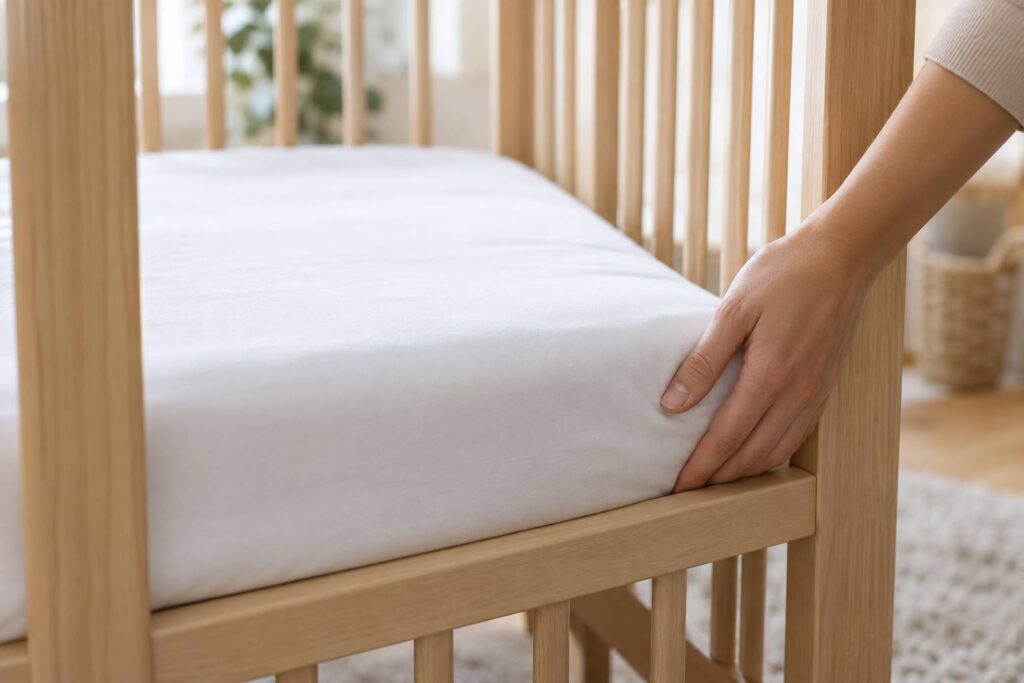
A gap between the mattress and sides represents a risk of becoming trapped. It must not be possible to slide more than two fingers between the mattress edge and the frame. This check is done once the mattress is installed with its fitted sheet. A mattress too small, even by a few centimeters, does not become safe thanks to a bumper, rolled towel, or blanket placed in the empty space.
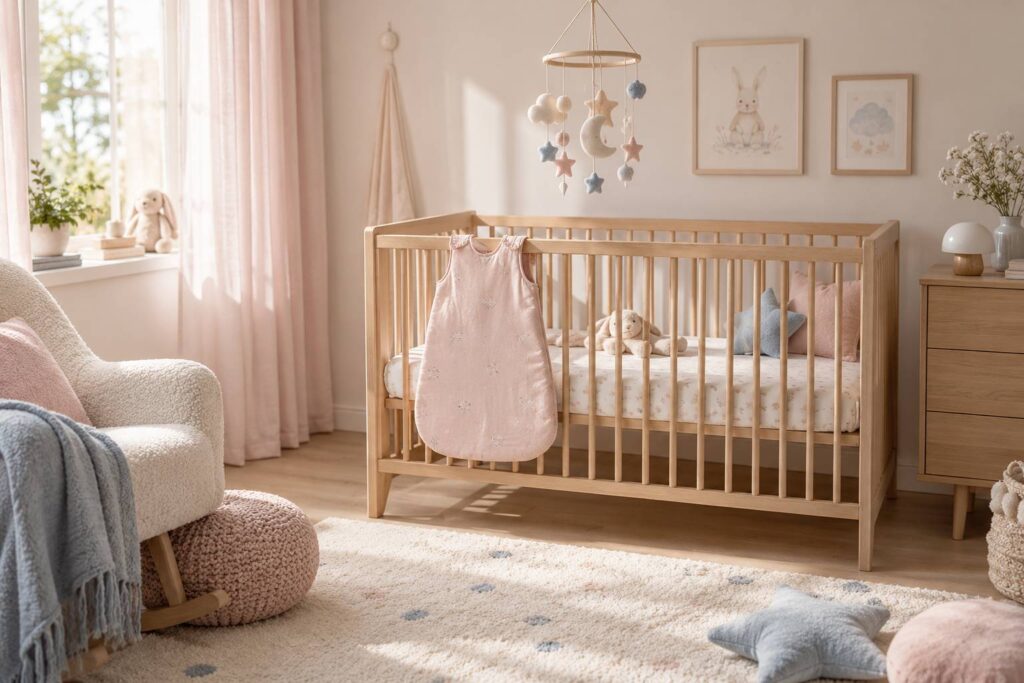
For safe sleep, the bed contains a firm mattress, a fitted sheet, and a sleeping bag adapted to the room temperature. Nothing else is necessary for a healthy baby sleeping on their back. This simplicity may seem austere compared to the images of very decorated rooms, but it meets the infant’s physiology. Their thermal regulation system is still immature and their ability to free their face is limited.
Duvets, blankets, pillows, baby wedges, non-integrated bed reducers, and stuffed animals increase the risks of face covering or overheating. They do not promote sleep autonomy. A baby is not reassured by the number of objects around them. They calm down thanks to simple sensory markers, familiar voices, predictable gestures, and a comfortable temperature.
The crib bumper is also discouraged. It can reduce air circulation and become a support point when the child begins to pull themselves up. Parents afraid their baby will bump into the bars can be reassured on this point. Small contacts with the bars are generally harmless. The risk related to a padded bumper is more worrying than waking up after a slight knock. The subject is detailed in this article on the risks of crib bumpers for infants.
| Bedding element | Safety reference | What to avoid |
|---|---|---|
| Mattress | Firm, flat and exactly sized to the bed | Soft mattress, doubling or gaps against the edges |
| Bedding | Tightly fitted sheet and suitable sleeping bag | Duvet, loose blanket, pillow or cushion |
| Decoration | Empty bed during sleep | Stuffed animals, braids, crib bumpers and baby wedges |
| Temperature | Room near 19 °C, depending on clothing | Layer accumulation and overheated room |
The sleeping bag is chosen according to the child’s size. The neckline must not allow your baby to slip inside. Its thermal index, often called TOG, adapts to the room’s actual temperature. A lightweight model suits a temperate room, while a warmer sleeping bag fits a cool environment. To adjust layers without overheating the baby, the guidelines provided for choosing baby nightwear start from concrete criteria.
To check if your child is too warm, touch their neck or upper back rather than their hands and feet, which are often cooler. A damp neck, wet hair, very red cheeks, or unusual breathing should lead to removing a layer and checking room temperature. Conversely, cold extremities alone do not necessarily mean the baby is cold.
Respiratory difficulty, bluish or gray color, unusual limpness, fever in a baby under three months, or a child hard to wake require urgent medical advice. These signs are not limited to discomfort with bedding. They require rapid evaluation by a healthcare professional.
Set up a safe sleeping environment without confusing baby comfort and accumulation
Baby comfort is not measured by the number of textiles in their bed. It relies on stable temperature, fresh air, a clear bed, and a sufficiently regular routine for their brain to anticipate rest. In the first weeks, the circadian rhythm is still immature. It gradually sets in between six and twelve weeks, influenced by daylight, repeated care, and neurological maturation.
A newborn often sleeps between fourteen and seventeen hours out of twenty-four, with large individual variations. Their cycles are short, about fifty to sixty minutes, and awakenings are frequent because their stomach is small and food needs are close together. A good bed does not suppress these awakenings. It provides a stable place where your baby can sleep safely between feedings.
Laying on the back, in a clear bed placed in the parents’ room for the first six months, remains the strongest reference to reduce sleep-related risks. Room-sharing also facilitates observing your baby and responding to awakenings without exposing them to bedding in the adult bed. Sharing the same bed can pose additional risks, especially in cases of extreme fatigue, tobacco, alcohol, sedative medication, a couch, or a soft mattress.
The room can remain simple. Soft light is sufficient for changes and night feedings. Very bright nightlights, screens, and continuous music are not necessary for a newborn. Before two or three months, discreet continuous white noise can sometimes reduce household sounds, but it should be distant from the bed and at low volume. A machine placed too close to the ear can tire hearing.
The evening ritual does not need to be long. A change, a nursing or bottle, a few calm words, then the sleeping bag and bedtime make a sufficient sequence. Timings can vary from day to day, especially in the first weeks. Repetition of gestures, more than the exact time, gives predictable signals to the baby.
- Always place your baby on their back at the start of each sleep, even if they already know how to turn over alone.
- Make sure their face remains completely clear and that the sleeping bag does not ride up towards their chin.
- Keep the bed away from heat sources, windows, cords, and any furniture that could tip over.
- Check the neck once after bedtime to adjust clothes, then leave the environment calm.
When your child turns over independently from back to belly and belly to back, you continue to lay them on their back, without repositioning throughout the night at each movement. The firm mattress and empty bed then become even more important. The baby explores their motor skills during sleep as during wakefulness.
Crying at sleep time does not automatically mean the bed is poorly chosen. Before four months, it often reflects accumulated fatigue, hunger, need for closeness, or a nervous system still poorly able to move from wakefulness to rest alone. Responding does not create a bad habit. Your presence helps your baby regulate an activation they do not yet know how to soothe alone.
A sudden change must be taken seriously when accompanied by breathing difficulties, major and repeated snoring, observed pauses in breathing, painful reflux with refusal to feed, or weight loss. In these situations, the pediatrician can look for a cause unrelated to the furniture or room organization.
Adjust the budget and evolve the baby crib without compromising accident prevention
The budget dedicated to bedding varies greatly. In 2026, the observed ranges remain wide depending on materials, brand, and offered functions. An approved basket often costs between 60 and 200 euros. A cradle can range from about 80 to 500 euros. For a barred crib, the price commonly extends from 75 to 800 euros, while a convertible model often exceeds 290 euros and can reach 1,000 euros.
These differences alone do not define sleep quality or safety. A simple barred crib, compliant with safety standards, combined with a good mattress and a clear installation fully meets an infant’s needs. Conversely, an expensive model loses its interest if the mattress is poorly fitted or if accessories clutter the bed.
When the budget is tight, prioritize bed compliance, mattress firmness, and structure stability before decorative or convertible functions. This hierarchy protects your child without imposing complicated equipment. Buying second-hand is possible if the bed is undamaged, meets current measurements, and all parts are present. The mattress, however, is best bought new in most cases, as its internal condition and hygiene are hard to assess.
Moving to a larger bed is not decided only at the second birthday. Some children remain comfortably in their barred crib beyond three years. Others try to climb out before that age. As soon as your child puts a leg over the barrier, attempts to support themselves on nearby furniture, or succeeds in getting out, the change becomes necessary to prevent falls.
A low junior bed can then be a reassuring transition. A suitable protective barrier can limit nocturnal falls without confining the child. The room deserves to be secured as a whole, because a child who can get out of bed can also explore alone. Medications, household products, small objects, cables, and unstable furniture must be kept out of reach.
The convertible bed interests some families because it limits successive purchases. This option works when planned from the start according to the room. Before investing, measure the space once the bed is deployed, check the availability of a mattress suitable for each transformation, and inquire about parts needed for the junior mode. A promise of six or eight years’ duration only has value if the furniture really remains adapted to the child’s size and habits.
The stroller bassinet should only be used for prolonged sleep when explicitly approved for this use and placed on a stable surface. The harness, when present, must not obstruct the face or breathing. The car seat, reclined stroller, and transport equipment do not replace a flat sleeping place at home. The infant’s head can tilt forward in certain positions, which obstructs their still narrow airways.
In the room, let the bed evolve with your child, not with trends. The first months require a clear space close to you. The following years require a lowered barrier at the right time, a secure environment, and attention to new motor skills. These regular adjustments make the bedding a protective reference, even when nights remain restless.
Can a baby sleep in a barred crib from birth?
Yes. A compliant barred crib, equipped with a firm mattress perfectly fitted, is suitable from birth. The baby sleeps on their back, in a sleeping bag, without pillows, blankets, stuffed animals, or crib bumpers.
When to stop using a cradle or co-sleeping bed?
The change is required as soon as the baby actively turns over, tries to straighten up, supports themselves, or reaches the indicated weight limit. This stage often occurs before six months.
Should a second mattress be added in a travel crib?
No, except if the manufacturer provides a mattress specifically designed for this model and authorized in the manual. An inappropriate addition can create dangerous gaps against the walls.
When to switch to a big kid’s bed?
The transition becomes necessary when the child tries to climb out of the barred crib or succeeds in getting out. The age usually varies between two and three years, depending on their height and agility.