
In brief
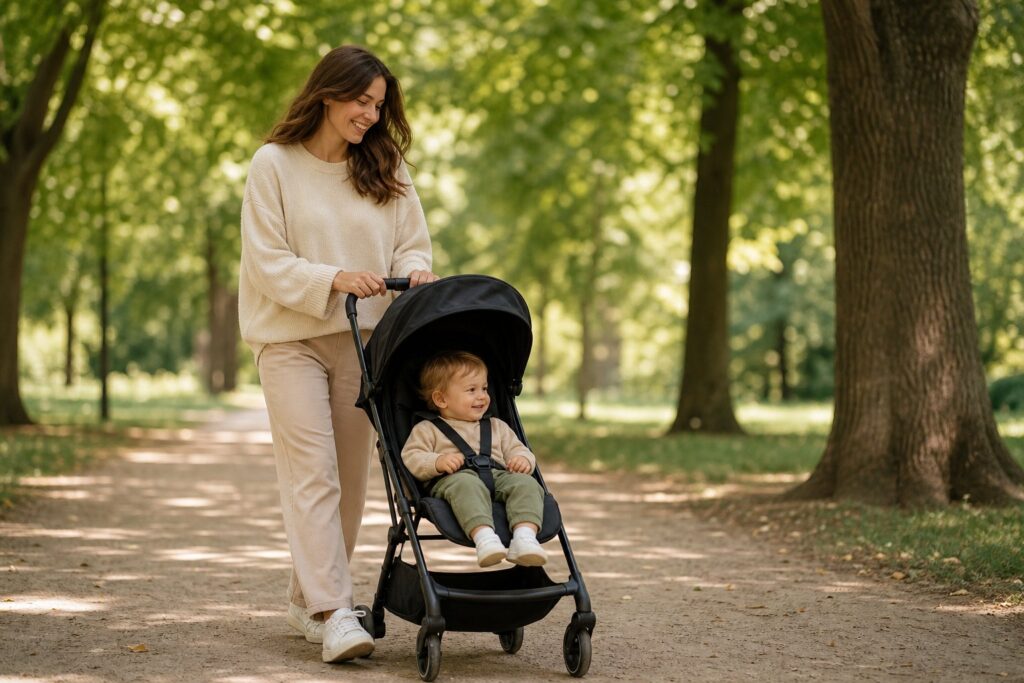
- The umbrella stroller becomes relevant when the baby can sit stably and hold their head effortlessly, often around 6 months old, with normal variations depending on development.
- The ideal age is not just a number: it is read in the trunk tone, tolerance for the seated position, and ability to remain well aligned during the walk.
- Some models advertised from birth are acceptable only if the backrest reclines significantly (close to 150° to 180°), with an appropriate harness and compliance with EN 1888.
- For safety and comfort, the umbrella stroller remains more demanding than a “newborn” stroller: uneven terrain, long naps, and cold require more vigilance.
- Intelligent use rests on a simple rule: the umbrella stroller serves the mobility of parents when the child already has a solid posture, especially after the first months.
Ideal age for an umbrella stroller: developmental milestones rather than a simple number
In the first months, a baby’s body is still developing. The neck gradually strengthens, the rib cage opens, and trunk tone organizes. These are visible but also very physiological stages. When the head “falls” forward or to the side at the slightest braking, it is not clumsiness. It is a sign that the sitting posture is not yet ready to absorb the micro-movements of a walk.
Most recommendations place the use of an umbrella stroller starting from 6 months old. This threshold is not arbitrary. It often corresponds to a period when many babies can sit with better stability, control their head, and straighten up after a small imbalance. Some achieve this a little earlier, others later, especially if they are very tonic or, conversely, tire quickly in an upright position.
The right question is not “at exactly what age” but “how the baby holds themself”. An umbrella stroller requires a more vertical posture than a pram. It also exposes to more direct vibrations because the wheels are often smaller and the suspension lighter. A baby who sits for two minutes on a mat can still slump after ten minutes of walking, as postural effort is more costly when the body must compensate for jolts and the environment.
Concrete signs indicating that the baby is ready
The most reliable benchmark remains alignment. The pelvis is at the back of the seat, the back does not curve strongly, the head stays above the shoulders. Hands explore, gaze stabilizes, breathing is regular. A ready baby does not constantly fight gravity.
A child ready for the umbrella stroller holds their head and trunk without slumping to the sides during a walk. This sentence can guide decisions more reliably than a calendar.
Signals suggest waiting a little. The head tips as soon as the stroller slows down. The chin comes to the chest when the child dozes, with a “C” posture. The baby gets upset quickly even when everything seems “well settled”. Often, this is not a personality issue. It is neuromuscular fatigue.
Why some parents feel pressure to “switch” to the umbrella stroller
Daily life weighs down. Climbing stairs, catching a bus, folding the trunk, carrying a bag. The umbrella stroller seems more practical, and it is. Family mobility changes, especially in the city. The point of vigilance is not to ask the baby’s body to compensate for discomfort caused by equipment chosen too early.
The transition becomes smoother when done in stages. First on very short trips, on smooth terrain, with a well-reclined backrest. Then, depending on the baby’s reaction, the duration is increased. This gradual progression respects postural development and also protects the outing atmosphere.
Safety and comfort in umbrella strollers: what really changes for the baby
Safety in umbrella strollers hinges on three axes: body support, protection against falls, and how the stroller reacts to road movements. The difference with a “newborn” stroller is not a matter of range. It is a matter of design. The seat is simpler, the frame lighter, and the child is more exposed to terrain variations.
The primary protection is the harness. A well-adjusted 5-point harness distributes constraints to the shoulders and pelvis, prevents the baby from sliding forward, and limits trunk rotation. A loose harness gives the illusion of comfort but increases the risk of poor posture and slipping. The straps must be adjusted as close as possible, while still allowing two fingers at the chest level to avoid compression.
Backrest recline and breathing during sleep
Many babies fall asleep during walks. This is normal. Regular rocking eases falling asleep, especially when the nervous system is still immature. The tricky point is the head position when the child sleeps. A too-vertical backrest favors the chin falling to the chest. This flexion can hinder airway freedom, especially in a young baby, although it usually remains reversible by straightening the head.
A reclining backrest is a true comfort criterion. Between 150° and 180°, the baby can rest with better alignment. This does not replace a carrycot for a newborn but makes naps more physiological for a baby who already holds their head well.
Wheels, terrain, and micro-traumas
Small wheels transmit more irregularities: cobblestones, sidewalks, park paths. A 7 or 8-month-old baby, still organizing balance, may experience these vibrations as a sensory assault. The result is sometimes an agitated baby who arches their back and refuses the stroller. It is thought to be a “phase,” while it is sensory overload.
Some so-called “all-terrain” umbrella stroller models now exist, with slightly bigger wheels and improved suspension. They do not turn an umbrella stroller into a hiking stroller but reduce vibration levels and can make the use more pleasant daily.
Consultation box
An evaluation by a professional becomes relevant if, after several short and calm trials, the baby repeatedly shows one of these signs: head dropping forward as soon as they fall asleep despite correct recline, noisy breathing or difficulty catching breath in a seated position, significant vomiting linked to position, clear back pain, persistent trunk asymmetry, or systematic refusal with intense crying each time placed in the stroller. A midwife, pediatrician, or pediatric physiotherapist can help distinguish postural fatigue, reflux, and mechanical discomfort.
The next section helps choose a model without getting lost in commercial promises, keeping simple and observable criteria.
Choosing a suitable umbrella stroller: standards, weight, recline, and real daily use
The choice of an umbrella stroller is often made in a hurry. A train trip, a journey, limited trunk space. Yet, the best stroller is the one that fits real use, not the one with the most options. An umbrella stroller can be a valuable ally if it meets three conditions. It must comply with standards, be adapted to the child’s size and weight, and be consistent with the types of outings.
The European reference standard is EN 1888, which controls stroller safety. This mark does not guarantee comfort but secures critical elements: stability, resistance, locking systems, harness. A model advertised “from birth” requires careful reading. For an infant to be installed, a nearly flat position, a harness usable on a very small baby, and a design limiting body curling are needed.
Age and use reference table (with normal variations)
| Baby’s age | Often observed postural abilities | Most consistent type of use | Safety/comfort caution point |
|---|---|---|---|
| 0–4 months | Axial tone developing, Moro reflex still present until 4–5 months, frequent sleep | Carrycot or fully reclined seat approved for newborns | Unsuitable sitting position, risk of curling and head tipping |
| 5–6 months | Better head control, beginning of trunk stability depending on baby | Very short umbrella stroller trials only if strong recline and excellent support | Quick fatigue, need for recline, precise harness adjustment |
| 6–12 months | More stable sitting, visual curiosity, alternating wakefulness/naps | Umbrella stroller for urban trips and public transport | Vibrations on cobblestones, more comfortable naps with reclined backrest |
| 12–24 months | Motricity blooming, walking, need for “walk/carried/stroller” alternation | Light umbrella strollers for short outings and travel | Check max weight, footrest durability, and curb stability |
| 2–4 years | Independent walking but tiring on long distances | Auxiliary stroller for long days, airports, long trips | Wide enough seat, effective brake, maneuverability in crowds |
A list of concrete criteria before purchase
- EN 1888 certification clearly indicated and instruction manual accessible.
- Recommended maximum age and weight by manufacturer, keeping some margin if the child is tall for their age.
- Incline sufficient for naps, with a stable adjustment that does not slip.
- 5-point harness easy to adjust, with straps that don’t twist.
- Brake accessible and reliable, testable with one foot even when loaded.
One detail greatly changes the experience: handle height. An umbrella stroller that is too low forces parents to bend over, and back pain arrives quickly. A slightly higher handle or a suitable handlebar makes outings smoother. Parents’ comfort matters because it influences carrying quality, patience at stops, and willingness to go out.
The next part addresses common mistakes. Not to worry, but to avoid the little traps that turn a simple outing into a complicated moment.
Common mistakes when using an umbrella stroller and simple adjustments
When an umbrella stroller “doesn’t work,” the problem rarely comes from the baby. It often comes from an installation detail, a mismatch between equipment and outing, or an overambitious expectation. Umbrella strollers are practical, but they require some precision. Adjustments are simple, and they change everything.
Moving too early to a seated position “because they see better”
Baby’s curiosity is a powerful driver. As soon as their gaze opens to the world, the temptation is great to straighten the backrest. The price to pay is sometimes subtle. The pelvis slips, the back rounds, the head goes forward when fatigue comes. The baby becomes cranky, then cries. Many parents interpret this as frustration from not being able to move, whereas the body simply asks for a more supportive posture.
Progressive adjustment helps. Reclined backrest at first, then straightened during wake phases, then reclined again as eyelids grow heavy. This alternation respects physiology, especially between 6 and 10 months, when alertness fluctuates quickly.
Multiplying accessories that “prop up” but hinder alignment
Thick cushions, unsuitable reducers, rolled blankets. The intention is good. The risk is modifying the original seat and creating pelvic curling or trunk rotation. A baby needs firm support under the pelvis and a supported back, not soft stacking.
Useful accessories are those that support without twisting. A headrest adapted to the model, a footmuff that does not push the shoulders forward, a harness protector that avoids chafing. If an accessory causes the harness to slip toward the neck or opens the straps, it must be removed.
Choosing an ultra-compact stroller for “all-terrain” use
The promise of compactness is attractive. It comes at a cost. Smaller wheels and lighter frame make cobblestones and paths painful. If usual outings take place in an old neighborhood, a park with uneven paths, or a countryside with gravel, a too minimalist umbrella stroller can become a source of agitation.
The good compromise is often a light stroller, but with suspension, slightly wider wheels, and a seat that properly supports the thighs. The baby is better installed, and the walk becomes a time to breathe rather than a logistical challenge.
Forgetting that thermal comfort matters as much as the seat
Umbrella strollers are more open. Wind passes through, rain splashes faster, the sun hits if the canopy is short. A still baby cools down quickly, even in mild weather, especially at the extremities. Cold hands, agitation, crying. The answer is not always “they want arms.” Sometimes it is a need for warmth.
A baby who fusses in the stroller may signal postural fatigue, sensory overload, or thermal discomfort, not a tantrum. This understanding changes how one responds, without rigidity.
The following section deals with duration of use and the transition to walking, with a guiding idea. The umbrella stroller serves freedom of movement, it does not replace it.
Until what age to use an umbrella stroller: fatigue, walking, and family mobility
The question of the age limit arrives faster than one thinks. A child walks, then runs, then sometimes refuses to get in. Yet, over a long day, the legs tire. The umbrella stroller then becomes a regulation tool. It prevents ending the day with exhausting carrying or endless negotiation on a sidewalk.
Many models support a maximum weight defined by the manufacturer. It varies, often around 15 to 22 kg depending on the stroller. This benchmark matters more than age. A 3-year-old child can be very light, a 2-year-old can already approach the limit of a compact model. Overloading makes the stroller unstable, wears wheels, and increases the risk of tipping when climbing a curb.
From 18 to 24 months, use is often very comfortable… if the child has the right rhythm
Posturally, many children between 18 and 24 months benefit greatly from an umbrella stroller. The trunk is solid, the head remains stable even when drowsy, and the child can alternate walking and resting. This age range is also when frustration can rise quickly if the child feels “tied down.” The response is rarely to eliminate the stroller. It rather consists in organizing short, secure free-walking moments, then offering the stroller for transitions.
In practice, the stroller becomes a logistical base. You walk to the park, install the child to cross a busy street, let them walk in a calm area, then put them back in the stroller to go home. This alternation respects the need for exploration while maintaining a safety framework.
After 2 years, the umbrella stroller as an “auxiliary tool” without guilt
Some narratives suggest that a child who walks should no longer be pushed. The reality is simpler. Days are long, distances sometimes imposed, and toddler fatigue is not comparable to adult fatigue. A child might walk 800 meters then collapse, especially if they have slept little or are stimulated by crowds.
The umbrella stroller then keeps its place for travel, airports, family gatherings, markets, visits. It prevents tense arms and sore shoulders. It also allows the child to rest when their nervous system is overwhelmed. Parents often see this. The child becomes calmer as soon as contained, provided the installation is comfortable.
When stopping becomes obvious
At some point, the child gets on and off constantly, bends their legs in all directions, and the seat becomes too narrow. The stroller is no longer a rest, it is a constraint. The clearest sign is discomfort. The child tries to get out, twists, systematically demands walking even over long distances, and tolerates a small backpack or scooter better. This transition often happens between 3 and 4 years, with big variations.
Finally, a simple thought helps keep on course. The umbrella stroller is neither a “baby” symbol nor a sign of “delay.” It is a mobility tool, to be adjusted to the child’s real pace and daily realities.
At what age is an umbrella stroller recommended?
The most common recommendation is around 6 months old, when the baby can sit stably and hold their head without support. The ideal age depends on postural development. If the baby slumps after a few minutes, it’s better to wait or choose a model with greater recline.
Can an umbrella stroller be used from birth?
Some models offer this, only if the backrest reclines close to 150° to 180°, with a harness adapted to newborns and EN 1888 compliance. For a newborn, a carrycot or fully reclined position is often more comfortable, especially for long outings and sleep.
What adjustments improve a baby’s comfort in an umbrella stroller?
A slightly reclined backrest, a 5-point harness adjusted snugly (without compression), good pelvis support at the bottom of the seat, and appropriate thermal protection (canopy, light footmuff if needed) greatly improve the experience. On uneven terrain, a stroller with suspension limits vibrations.
What signs should prompt seeking medical advice?
Advice is relevant if the head systematically falls forward during sleep despite correct recline, if breathing becomes noisy or difficult while seated, if the baby seems in pain, or if trunk asymmetry persists. A pediatrician, midwife, or pediatric physiotherapist can help adjust posture and check for any specific issues.