
In brief
- Infantile acne often appears between the 2nd and 6th week, mainly on the forehead, cheeks, and chin, and usually disappears within a few days to a few weeks.
- In most cases, it is a transient cephalic pustulosis, more common than “true” infantile acne, and without long-term consequences.
- The most common causes of baby acne are hormonal imprinting from pregnancy and, sometimes, an inflammatory reaction linked to the skin yeast Malassezia.
- The typical symptoms of baby acne are white microcysts and/or small superficial pustules, limited to the face, without fever or major discomfort.
- Infantile acne care is based on gentle cleansing, stopping greasy products, and avoiding manipulation of the spots.
- A consultation is necessary if the eruption persists beyond 3–4 months, spreads, is accompanied by oozing, thick crusts, pain, or alteration of the general condition.
Recognizing infantile acne without misdiagnosis
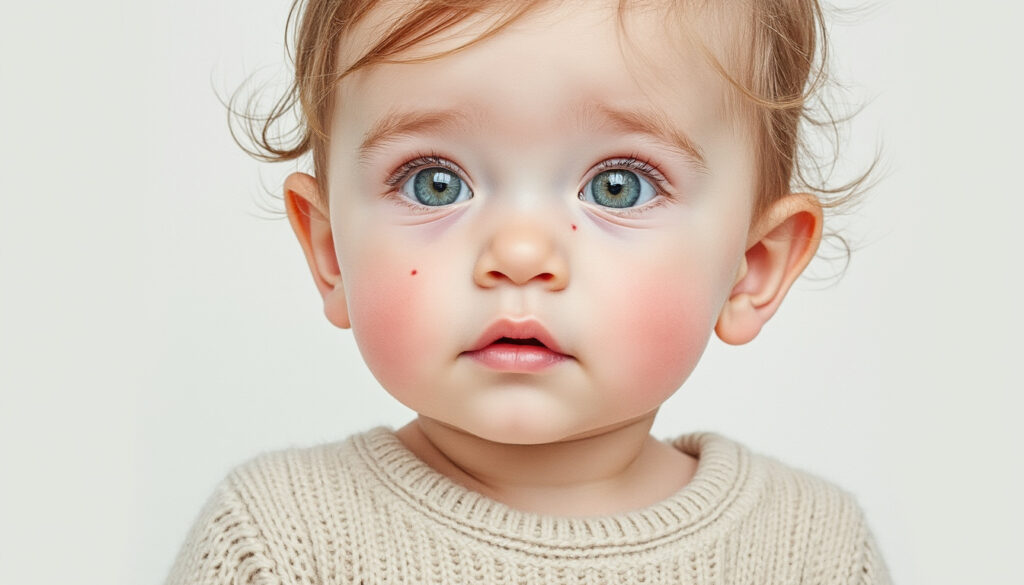
Seeing spots appear on baby’s skin can be unsettling. Parents often describe a sudden contrast between a smooth face and, within a few days, a relief of small white or red dots. In most situations, this picture corresponds to what is commonly called infantile acne, even though medically, the term covers several realities.
Age is a big clue. The most frequent form occurs in the first weeks, often before 6 to 8 weeks, and can be seen up to the 3rd or 4th month. Lesions concentrate on areas rich in sebaceous glands, where sebum tends to accumulate more. The forehead, temples, chin, and cheeks are the most typical sites, with sometimes a slight overflow towards the upper chest.
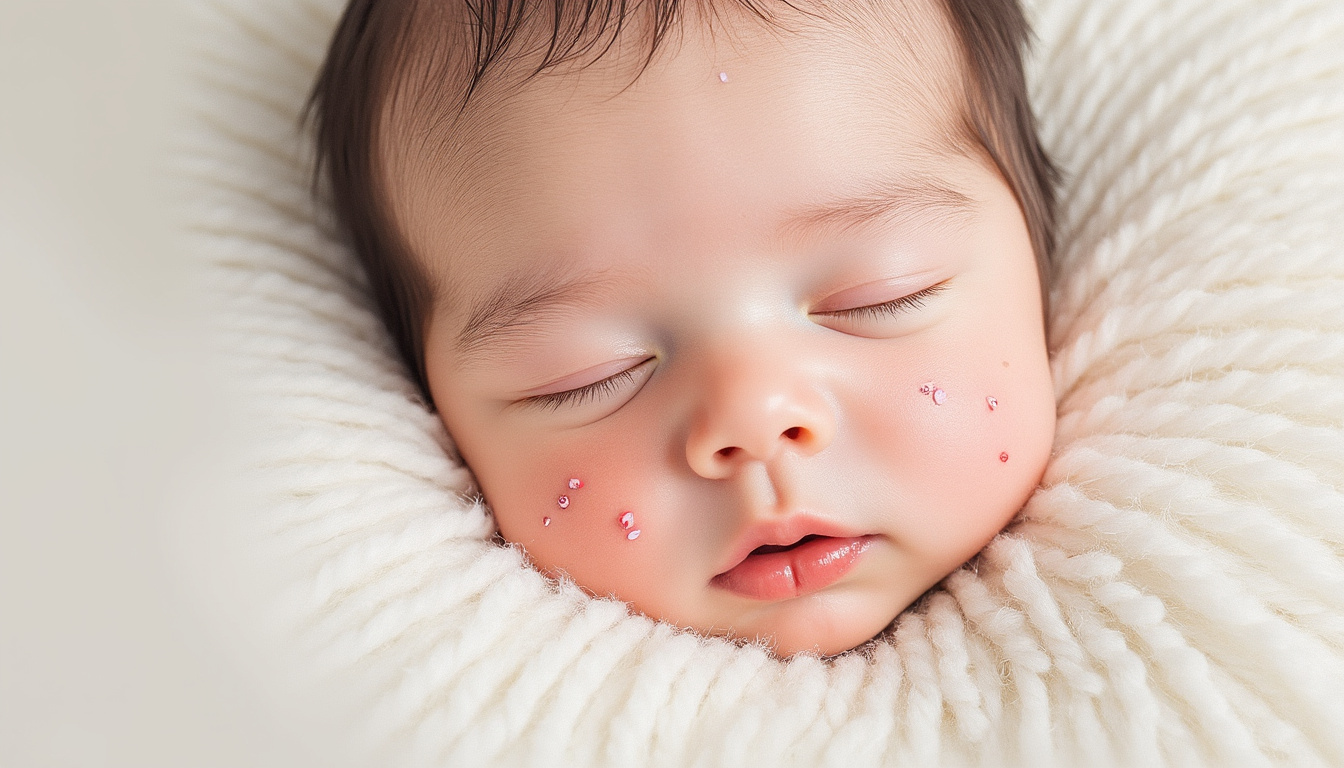
Visually, two aspects often recur. On one side, closed comedones, also called microcysts, look like white spots under the skin. On the other, small superficial pustules may appear. They are striking because they resemble the “infected” spot of teenagers, although they are mostly limited, shallow, and transient.
Infantile acne, milia grains and other spots
The most frequent confusion concerns milia grains. They are also white but often harder, more “pearly”, sometimes present on the nose and around the eyes, and can be seen on the scalp. They correspond to a superficial obstruction of a follicle and disappear spontaneously, without direct link to excess sebum.
Another trap is to attribute any red spot to acne. An isolated red papule may also be a sign of a different baby skin inflammation, such as the beginning of eczema. Heat, sweating, and a febrile episode can also cause an eruption of small red spots, more diffuse, sometimes on the trunk, which have nothing to do with acne.
The location is helpful. Infantile acne mostly stays on the face. A diffuse baby erythema over the body, rough itchy skin, or oozing patches rather point to dermatitis or irritation. To refine, a visual guide on common eruptions can help put the right words, such as this article on different types of baby spots.
One last nuance matters because it changes the level of attention. The word “acne” is used for convenience, even though the most common situation a few weeks after birth corresponds to transient cephalic pustulosis. “True” infantile acne is rarer, lasts longer, and can leave marks if inflammatory and deep. This distinction provides guidance for the next steps, especially regarding duration and monitoring.
When spots remain superficial, limited to the face, and the baby is well, the expected course is a gradual disappearance without heavy treatment.
Causes of baby acne: hormones, sebum and skin microbiota
Understanding the causes of baby acne often soothes more than a “it’s common”. An infant does not develop comedones for the same reasons as a teenager. The skin of the little one is adapting. It goes from the intrauterine environment, humid and stable, to a dry, variable environment with friction, care, textiles, and temperature changes.
The first driver is hormonal. During pregnancy, maternal hormones stimulate the baby’s adrenal glands and sebaceous glands. As a result, in the first weeks, the skin can produce more sebum. This skin oil has a protective role but can also favor the obstruction of certain follicles and the appearance of microcysts. Full-term babies seem slightly more exposed, probably because their glands had more time to respond to this stimulation.
The second driver concerns the skin microbiota. The skin naturally hosts microorganisms. Among them, a yeast called Malassezia can colonize hair-sebaceous follicles. In some infants, this colonization is accompanied by a small inflammatory reaction, causing superficial pustules on the face and sometimes the scalp. This mechanism corresponds precisely to transient cephalic pustulosis and explains why the eruption often appears a few weeks later, when colonization settles in.
Why some babies get it and others don’t
Variability is normal. The density of sebaceous glands, skin sensitivity, adaptation speed of the hydrolipidic film, and microbiota composition differ from one baby to another. The environment also plays a role. An overheated room, overly rich products, or too frequent cleansing can unbalance the skin barrier and make spots more visible.
Overly greasy cosmetic products are a classic factor. Some oils or balms, even very popular postpartum for massages, may be comedogenic on a baby’s face. The skin clogs more easily, and the eruption persists. Homemade preparations are not always suitable, not by principle, but because their stability, tolerance, and comedogenic potential are difficult to predict on immature skin.
Breast milk is sometimes considered a local care. There is no restriction in applying a drop, but the expected effect remains limited. The anti-infective factors in milk exist but in small amounts for punctual skin application, and infantile acne is not, in most cases, an infection to treat. The best service to the skin is often to let it return to balance with simple gestures.
When understanding that the skin reacts to hormonal imprinting and a developing microbial balance, we look less for the “erasing product” and more for the gesture that does not worsen things.
To continue this logic of sobriety, the next point focuses on precise signs that guide towards acne rather than another condition, and what should raise the flag for consultation.
Symptoms of baby acne and signs warranting medical advice
The symptoms of baby acne are better described with concrete criteria than with impressions. The lesions are often small, grouped, and centered on the face. They may alternate between white spots (microcysts) and small pustules. The surrounding skin is sometimes a bit pink, but inflammation remains moderate. The baby keeps normal behavior, feeds or bottles as usual, and has no fever related to this eruption.
Timing is a strong clue. A typical flare-up lessens within a few days to a few weeks. Spots change appearance and then disappear. Variations from day to day can occur, especially with heat, friction, or after applying a richer cream.
Differentiating acne, eczema, irritation and infection
Infant eczema tends to produce red, dry patches that spread, with rough skin and sometimes cracks. Itching is not always obvious at this age, but a baby may be more restless during diaper changes or dressing if the skin pulls. Baby erythema related to irritation is mostly seen in folds or diaper area, with friction and moisture logic.
Bacterial skin infection is more often accompanied by thick honey-colored crusts, oozing, rapid extension, or tenderness to touch. In such cases, the infantile acne diagnosis is no longer correct, or not the only one. Clinical evaluation helps avoid the classic mistake of “letting pass” a lesion that requires appropriate local treatment.
| Observed aspect | Usual location | Frequent hypothesis | Practical guideline at home | When to seek advice |
|---|---|---|---|---|
| Fine white spots, microcysts, sometimes small pustules | Forehead, cheeks, chin, temples | Infantile acne / transient pustulosis | Gentle cleansing, no greasy products on the face, no manipulation | If persists beyond 3–4 months or worsens significantly |
| Dry, rough red patches, sometimes oozing | Cheeks, folds, possible spread | Atopic dermatitis (eczema) | Appropriate emollient on dry areas, avoid irritants | If discomfort, oozing, sleep disturbances, rapid spread |
| Diffuse redness with small spots after heat | Trunk, neck, folds | Heat rash | Lighten clothing layers, room temperature 18–20°C | If fever, general condition alteration, doubt |
| Thick crusts, oozing, extension, pain | Around nose, mouth, friction areas | Impetigo or superinfection | Do not scratch, hand hygiene, avoid sharing towels | Quickly, especially in newborns |
Consultation box: simple guidelines, without dramatizing
Pediatric or dermatological advice is considered if the eruption goes beyond the usual frame. The criteria observable by parents are fairly reliable.
- Persistence beyond 3 to 4 months with continuously active spots, especially if inflammation increases.
- Extension beyond the face, notably on the trunk with numerous lesions, or involvement around the eyes.
- Oozing, thick crusts, unusual odor, painful to touch, or sensation that the skin “burns”.
- Fever, decreased feeding, marked drowsiness, or a baby “different” from usual.
- Appearance of deeper nodules or marks that seem to deepen, suggesting a rarer form requiring more thorough infantile acne diagnosis.
When the eruption persists beyond 6 months, the discussion changes. Infantile acne, rarer, can last a long time, sometimes into the first years of life, and is treated as a full dermatological condition. This situation requires specialized evaluation, because scar prevention becomes a real issue.
A baby who is well, with superficial spots limited to the face, and fluctuating evolution over a few weeks, is generally in the simplest scenario.
The next section focuses on concrete daily gestures, because infant skin often responds better to a minimalist routine than to a succession of products.
Infantile acne care: a short, precise routine respectful of the skin barrier
Effective infantile acne care shares a common point. They reduce friction, limit comedogenic greasy substances, and support the skin barrier without stripping it. Infant skin has a fragile hydrolipidic film. Cleaning too hard or too often can paradoxically stimulate irritation and then make spots more visible.
The basic gesture remains simple. Washing the face once a day is usually enough, with a very gentle soap-free cleansing lotion, or saline solution on a compress. The movement is light. The goal is not to “extract” microcysts but to remove residues of milk, saliva, and sebum without aggression. Drying is done by patting, not rubbing.
What often worsens without us realizing it
Too rich products on the face top the list. A cream intended for the body, a balm for chapped skin, or a generously applied oil can clog follicles. When hydration is needed, a light, non-comedogenic texture, tested on infant skin, is more suitable. The face does not always need to be “nourished” like the rest of the body.
The second trap is manipulation. Popping a spot, scratching a crust, “smoothing” a microcyst, all increase the risk of local infection and marks. The baby’s skin heals well, but repeated inflammation can leave temporary discoloration. Patience is a care in itself here, because physiology is on your side.
The sun is sometimes seen as drying, thus “useful”. In an infant, direct exposure is to be avoided. The skin is thinner, the risk of sunburn is rapid, and the idea of treatment by sun has no place at this age. Physical protection by shade, a hat, and appropriate timing remain the reference.
A realistic routine in 3 steps
- Cleanse once a day with saline or gentle soap-free cleanser, then dry by patting.
- Stop greasy products on the face during the flare-up, especially homemade preparations and thick balms.
- Let it evolve without touching or popping, simply monitoring extension and appearance.
The question of infantile acne treatment comes up often because the word “treatment” reassures. In most cases, no medication is to be applied. When a professional suspects a more inflammatory or persistent form, they may propose age-appropriate management, sometimes anti-inflammatory or antifungal depending on the mechanism. This is decided case by case, after examination, and never based on a single photo or generic advice.
For baby skin hygiene, coherence matters more than sophistication. An overheated bathroom, very long baths, perfumed products, or repeated wipes on the face can irritate. Skin likes stability. Parents too, because a short routine can still be maintained after a broken night.
Some parents wonder about pregnancy and postpartum impact on skin, especially with hormonal changes and the appearance of adult facial spots. To stay rigorous, there are also guidelines on these topics, such as alternatives and explanations regarding the pregnancy mask, which helps understand how hormones modify pigmentation and skin reactivity.
When the routine is gentle, stable, and low-intervention, the skin often regains balance faster than when “helped” by an accumulation of gestures.
Once the routine is established, an often underestimated dimension remains: the environment and daily practical details that reduce friction and inflammation.
Preventing baby skin inflammation daily: textiles, heat, saliva, and hands
An infant’s skin is not only confronted with hormones and skin microbes. It lives in a world of friction, moisture, and repeated micro-aggressions. When baby skin inflammation adds to infantile acne, spots appear redder, skin is more reactive, and healing seems longer. The key is to reduce what maintains irritation.
Textiles matter. A hat or hood that rubs the forehead, a collar that touches the chin, a rough tag, all can locally stimulate redness. Breathable materials like cotton, and clothing that fits without tightening, reduce heating. Washing clothes with mildly scented detergent, well rinsed, also avoids an excess of irritants.
Heat and sweating: adjust without overprotecting
A baby who is hot sweats, and sweat can irritate. A sleeping room around 18–20°C suits many infants, with adaptation according to season and child temperament. A very active baby who moves a lot may need one layer less than a calmer baby. Observing the neck is often more reliable than looking at the hands, which are often cool in little ones.
When acne is mostly visible in the evening, after a day in a sling or stroller well covered, heat and friction sometimes played a role. This does not mean giving up carrying. Adjusting the fabric, wearing more breathable clothes, or a break to air the face often suffice to limit irritation.
Saliva, milk and friction: the chin on the front line
Around 1 to 4 months, some babies drool a lot. Saliva soaks the chin and cheeks, especially if a damp bib remains in place. This moisture favors irritation which can mix with acne and give the impression of worsening. Changing the bib as soon as it’s wet and gentle cleansing with water or saline after feedings often makes a visible difference within days.
Parents sometimes notice more diffuse redness after repeated kisses, especially if the beard or a woolen fabric touches the cheeks. Without depriving contact, it is possible to reserve more fragile skin areas for lighter caresses and to favor skin-to-skin on the torso, where skin is often less reactive.
Hands and nails: a detail that changes everything
The reflex to put hands on the face is very frequent in the first weeks. Slightly long nails can scratch a pustule and create a small superinfection. Keeping nails short and filed, and occasionally using mittens if the baby scratches a lot, reduces this risk. Adult hands also count. Simple hygiene before face care limits bacterial transfer to already inflamed skin.
This environmental approach is especially helpful when parents have already adopted a gentle cleansing routine and wonder why spots persist. Sometimes the solution is not in a new product, but in fine-tuning irritation factors.
Less heat, less friction, less stagnant moisture often give calmer skin, even if some spots still take time to fade.
Additionally, some families appreciate visual supports and video explanations. Two YouTube resources can help recognize common eruptions and understand skin care for the little one without aggressive gestures.
These videos do not replace clinical advice but can help calm the urgency felt when seeing spots for the first time.
After watching a video, the useful exercise is to compare what is shown with what you really observe on your baby, taking into account location and age. An eruption overflowing on the body or accompanied by major discomfort deserves advice, even if online content looks “about right”.
How long does infantile acne last?
The most frequent flare-up fades within a few days to a few weeks. Fluctuating evolution is common. If spots remain active beyond 3 to 4 months, pediatric or dermatological advice helps verify it is not a rarer form or another condition.
Should a cream or infantile acne treatment be applied?
In most cases, no medication is necessary. Care relies on gentle cleansing once a day, stopping greasy products on the face, and avoiding manipulation. Treatment is only considered if a professional identifies marked inflammation, unusual persistence, or another cause (e.g., a component linked to Malassezia).
How to avoid confusing acne with baby erythema or eczema?
Infantile acne most often limits to the face with microcysts and small pustules. Eczema causes rather dry, red and rough patches, sometimes oozing, with possible extension. Erythema is more related to irritation and usually appears in folds or diaper area. Thick crusts, oozing, pain or rapid extension warrant medical advice.
Can spots be popped to speed up disappearance?
No. Popping or scratching increases the risk of skin infection and marks. The best option is to let it evolve, with gentle and stable baby skin hygiene, simply monitoring appearance and duration.