
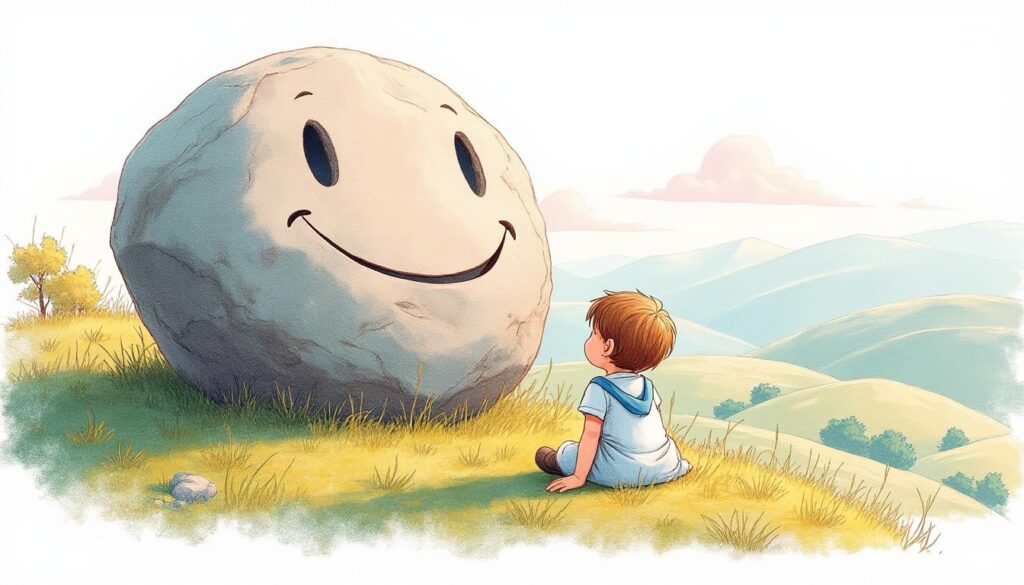
In brief
- Sisyphe becomes an accessible story when the stone and the mountain are told as a great adventure of repeated efforts.
- The myth speaks of cunning, choices, and consequences, without scaring children.
- The scene of the rock falling back helps talk about perseverance and discouragement, with words that resemble everyday life.
- Depending on the age, the story is simplified or enriched, to keep meaning without overload.
- Concrete gestures transform reading into a moment of exchange, like replaying a scene, drawing the slope, or naming the felt emotion.
Telling the myth of Sisyphe to children without weighing it down, while keeping meaning
In the evening, when tiredness makes emotions stronger, children often latch onto stories that repeat the same scene. The rock going up, slipping, starting again, resembles moments when a task comes back over and over. The myth of Sisyphe is then told as a simple adventure, at a child’s level, without turning fear into a driver.
The setting can remain clear. Sisyphe is a character from Greek mythology, known for being very clever. He founded an important city, Corinth, formerly called Ephyra. He lives in a world where gods watch humans and react to their deeds. This background gives breadth to the story, but it does not need to be detailed from the start.
At 3-5 years old, a story in a few sentences, focused on action and emotion
At this age, a child’s brain understands repetition very well but remains sensitive to anxiety-inducing details. The story works when it stays within 4 to 6 sentences, with a strong image and named emotion. Sisyphe pushes a big stone up a mountain. He breathes out, he slips, he starts again. The stone falls back just before the summit. Sisyphe feels angry, then he tries again.
Meaning arises when the adult puts a word on what the child already knows. Frustration, effort, pride in having tried, even when it is not “successful.” A short sentence is enough. Sisyphe learns to keep going, even when it is long. The lesson is there, without a speech.
At 6-9 years old, add cunning, responsibility, and consequence
Around 6-9 years, the child can link actions to consequences and understand that a character is both endearing and imperfect. Sisyphe then becomes more than a strong man. He becomes a clever man, sometimes too much. He helps his country that lacks water by negotiating with the river god Asopos. He saw Zeus abduct Aegina, Asopos’s daughter, and exchanges the information for a spring that never runs dry.
This part tells a concrete decision. It opens a simple discussion. Sisyphe chose to get water for his city, but he denounced a powerful god. Zeus’s anger comes as a consequence, not as an arbitrary punishment. Children understand a rule of the story better when it resembles life. An action has a price, even if the intention was to protect one’s own.
At 10 years and older, a philosophical reading that remains feasible in family
From 10 years old, some children like to discuss the “why.” Why does Sisyphe keep going? Why does a never-ending task exist in stories? The myth then becomes a door to broader themes, without entering an abstract lesson. Ancient stories often serve to talk about life, death, good, evil, loyalty, and the place of rules.
In a family, this discussion goes better when anchored in gestures. Read a passage, stop, ask the child to choose a word for the emotion. This can connect with other symbolic stories that talk about cycles and landmarks, like those found in a symbolic story of the zodiac, where the child learns to think in images without confusing image and reality. This continuity nurtures thought without rushing it.

Sisyphe, cunning and consequences: an adventure that helps the child understand choices
In the full version, Sisyphe is not just a man who pushes a rock. He is described by Greek authors as extremely cunning. Homer presents him as a very clever mind. Others, like Aristotle or Horace, judge him deceitful. This diversity of portraits is useful with children. A character can be admired for his intelligence and criticized for his lack of loyalty.
The story begins with a concrete situation. A city is thirsty. A permanent spring changes daily life. The exchange with Asopos gives the child a first key. Cunning is not “good” or “bad” in principle. It serves a goal, then it causes reactions. This nuance resembles childhood dilemmas. Telling the truth can protect someone and hurt another. Keeping a secret can reassure and isolate.
The scene of Thanatos: talking about limits without creating anxiety
When Zeus gets angry, he sends Thanatos, Death. Sisyphe manages to chain him. No one dies, everything freezes. For a child, this part can remain symbolic. A rule was twisted, the world unbalances. Zeus then sends Ares, god of war, to free Thanatos.
With children, the useful point is not violence. It is the limit. Some rules structure collective life. When they are bypassed, everyone pays. This idea is worked on with concrete, short examples. When the rule “we cross holding hands” is ignored, the whole group is in danger. The child understands the function of the rule, not just the sanction.
The return among the living: distinguishing intelligence and manipulation
Sisyphe asks his wife not to perform funeral rites. Before Hades, he gets the right to go back up to punish her, then he refuses to go back down. Again, the scene can be told without scary details. It illustrates one precise thing. Sisyphe uses cunning to avoid a consequence.
This distinction helps children who test limits. Intelligence is used to solve a problem. Manipulation is used to avoid answering for actions. The nuance does not need to be moralistic. It is formulated as a landmark. When the child invents a strategy to put on shoes alone, he gains autonomy. When he invents a story to blame another, he protects himself at the cost of the bond.
For parents, this reading relates to social development. Between 4 and 7 years, the child experiments with rule and exception. He gradually learns theory of mind, the ability to imagine what another thinks. It is a normal stage. It deserves a firm and calm response, not a label.
A short video can help set the images, especially for children who understand better by seeing the scene.
The stone and the mountain as a metaphor for perseverance, without turning effort into obsession
The final punishment is known. The gods condemn Sisyphe to push a stone to the top of a mountain, in Tartarus. Just before the summit, the rock slides back down. He starts again forever. Children first retain the repetition. Parents, in turn, hear a broader question. How to teach perseverance without locking the child into the idea that he must “hold on” no matter what?
The good entry point is physical. A child understands effort in his muscles. Climbing stairs with a bag, maintaining balance, learning to write letters, repeating a cycling gesture. The myth puts words on the experience. Effort tires. Failure discourages. Starting again requires external support, especially before 7-8 years old, when executive functions are still maturing.
What repetition teaches the child’s brain
When a child repeats, his brain strengthens circuits. Myelination progresses, gestures become more fluid. This mechanism is slow. It explains why learning seems “lost” one day and “acquired” the next week. Sisyphe’s scene makes visible this invisible work. The stone falling back is not a judgment. It is a step.
A concrete landmark helps. For a new motor skill, many children need daily repetitions over several weeks. Variations are wide depending on temperament, fatigue, coordination. A child can persevere while crying, then succeed the next day. The myth gives a stable image. The parent can then name the reality. “The body learns, even when it’s not visible.”
A list of simple gestures to turn the story into an emotional tool
-
Name the effort with a concrete word, like “heavy,” “stiff,” “hot,” so the child connects emotion and sensation.
-
Divide the mountain into three steps drawn on a sheet, and let the child place a dot where he feels today.
-
Choose a short phrase that accompanies repetition, for example “one step, then another,” and repeat it during a difficult task.
-
Set a healthy limit by allowing stopping when fatigue turns into agitation or persistent anger, then resume later.
This approach avoids a common trap. Perseverance is not an obligation of performance. It is the ability to return to a task after a break, with an adult who regulates. The difference matters, especially for anxious or perfectionist children.
When the “stone” looks like distress, and when to seek advice
A child can sometimes collapse in front of a repetitive task. This often happens at the end of the day, when fatigue accumulates and self-regulation drops. In most cases, a break, a snack, a movement time restore availability. Some signs, however, deserve a talk with a professional, without dramatizing.
| What looks like a frequent variation | What justifies a consultation | Appropriate professional |
|---|---|---|
| Occasional discouragement, especially in the evening, with recovery after rest | Intense and frequent crying over small demands, over several weeks, with very disturbed sleep | Pediatrician or general practitioner |
| Mild perfectionism, refusal to try once, then resumption the next day | Massive avoidance of all novelty, somatic anxiety, recurrent stomach aches before school | Pediatrician then developmental psychologist if needed |
| Anger related to frustration, with improvement when the adult puts into words | Long daily anger with significant aggression, inability to calm down despite help | Pediatrician, then specialized parental guidance |
The myth then serves as a common language. The stone becomes the name of a difficulty. The mountain becomes the path. The child feels less alone facing what he’s going through.
To vary supports, a second video format can be useful, notably for children who like to see a class telling the story.
Bring the story of Sisyphe to life in family: games, rituals, and age-appropriate discussions
Children understand a story better when it goes through the body, then through words. The myth of Sisyphe can become a little family theater, without complicated props. A rolled towel makes the stone. A cushion on the sofa makes the mountain. The game lasts five minutes. It is enough to anchor the idea that effort is felt and that emotion has its place.
The discussion also prepares in the way of telling. A 4-year-old child does not need the name Zeus to be touched. An 8-year-old child often likes names and connections. Saying that Sisyphe is son of Aeolus, linked to the wind, can give a color. Mentioning Merope, his wife, and their children, places Sisyphe in a family. It helps the child understand that a hero is not alone in the world.
Turn the “lesson” into conversation, without morality
The word lesson can remain discreet. It is not necessary to say “here is what you must learn.” Children integrate better when the adult describes and welcomes. Sisyphe gets discouraged. Sisyphe starts again. The child can say what he feels. A simple question suffices, without pressure. “At what moment does the stone become too heavy?”
The answer often gives valuable information about the child’s day. A need for a break. A school worry. A conflict with a classmate. The story serves as a mediator. It allows speaking “beside,” which protects the child from shame.
Connect Sisyphe to other stories without mixing registers
Families sometimes like to create a symbol library. A child can go from Greek myths to Nordic sagas, then to fairy tales. This feeds imagination and thought. When a child is interested in figures of strength and courage, a detour via the meaning of the name Odin can offer another type of story, with another universe of rules.
This variety also helps recall a nuance. Stories serve to think, not to predict. A symbol speaks of emotions, values, trials. It does not explain everything, and it does not replace a concrete conversation about daily life.
When the myth touches a parent: welcome the echo without imposing it on the child
Some parents recognize themselves in Sisyphe. Daily life with young children repeats tasks. Laundry, meals, bedtimes, nighttime awakenings, especially in the first years. The myth can then soothe, provided to stay on the child’s side. The parent can say “sometimes, it’s long,” without asking the child to bear adult exhaustion.
An image works well. Sisyphe is not only one who suffers. He is also one who moves forward, one step at a time. For a child, this posture becomes reassuring when embodied by the adult. A calm voice, a clear limit, an allowed pause. The mountain becomes less crushing.
At what age to tell the myth of Sisyphe to children?
From 3-4 years, the story can be very short and focused on action, with the stone going up and down. Between 6 and 9 years, the child better understands choices and consequences, cunning, and responsibility. From 10 years, a more philosophical discussion about the meaning of effort and repetition often becomes possible, depending on the child’s sensitivity.
How to avoid the story being scary with Death and the Underworld?
The vocabulary can remain symbolic and sober, without anxiety-inducing details. The scene mainly serves to talk about limits and rules organizing collective life. If the child shows worry at bedtime, return to the simple image of the stone and the mountain, then finish with a calming activity like drawing or slow breathing.
What lesson to teach without turning Sisyphe into a moral about performance?
The useful lesson concerns perseverance and regulation. Continuing does not mean forcing. It can mean taking a break, coming back later, asking for help, and accepting that the brain learns in stages. The child can associate Sisyphe with a concrete task he tames, like writing, biking, or reading, without affecting self-esteem.
When does this myth become a signal that the child is in real distress?
If the child collapses facing small demands frequently over several weeks, with very disturbed sleep, repeated somatic complaints, or massive avoidance of school and novelties, a medical opinion is advised. The pediatrician or doctor can first check overall health, then refer if needed to a developmental psychologist.