Key points to remember:
- Octopus coloring pages offer a fun and educational way to introduce children to the fascinating world of marine art.
- They come in simple, realistic, and kawaii drawings, suitable for all ages and motor skill levels.
- Coloring stimulates not only creativity but also concentration and knowledge of the marine world, promoting harmonious development.
- Differences between octopus and poulpe are linguistic nuances, while biologically it is the same animal, a symbol of flexibility and intelligence.
- The drawing and coloring process can be a precious moment of emotional connection, strengthening the emotional well-being of the little ones.
Promoting awareness of marine nature through free downloadable octopus coloring pages
Octopus coloring pages are a great opportunity to accompany children in discovering the marine world, a universe full of mysteries and natural beauty. By offering free downloadable drawings, accessible at home or at school, we invite the youngest to immerse themselves in the gentle and playful study of the poulpe, an animal fascinating by its atypical morphology, its eight arms, and sharp intelligence.
Nature awareness activities are no longer limited to simple images; the offered models are more diverse thanks to the distinction between simple drawings, allowing an accessible first approach, and more complex and realistic versions, encouraging observation of details such as suckers and the undulating movements of the tentacles. This variety offers each child the possibility to progress at their own pace while nurturing curiosity for natural sciences and marine art.
Besides the playful aspect, the regular use of these coloring pages stimulates key skills such as concentration and patience, essential from an early age. In some educational contexts, giant drawings can also encourage collaboration, turning this simple coloring into a moment of sharing between classmates or siblings.
For example, a class can organize a workshop where each child completes a part of the giant octopus, thus developing a sense of belonging and collective accomplishment around a common artistic project. This approach, in 2026 as before, remains a powerful lever to promote both emotional well-being and cognitive abilities of the child, a fundamental balance from the first steps of parenting and teaching.
Developing creativity and fine motor skills with kawaii and realistic octopus drawings
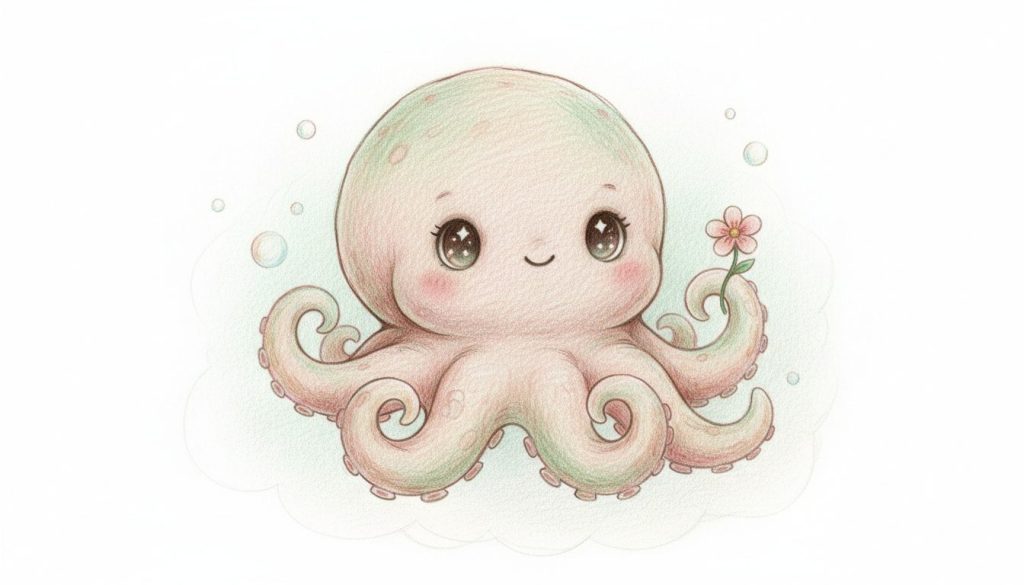
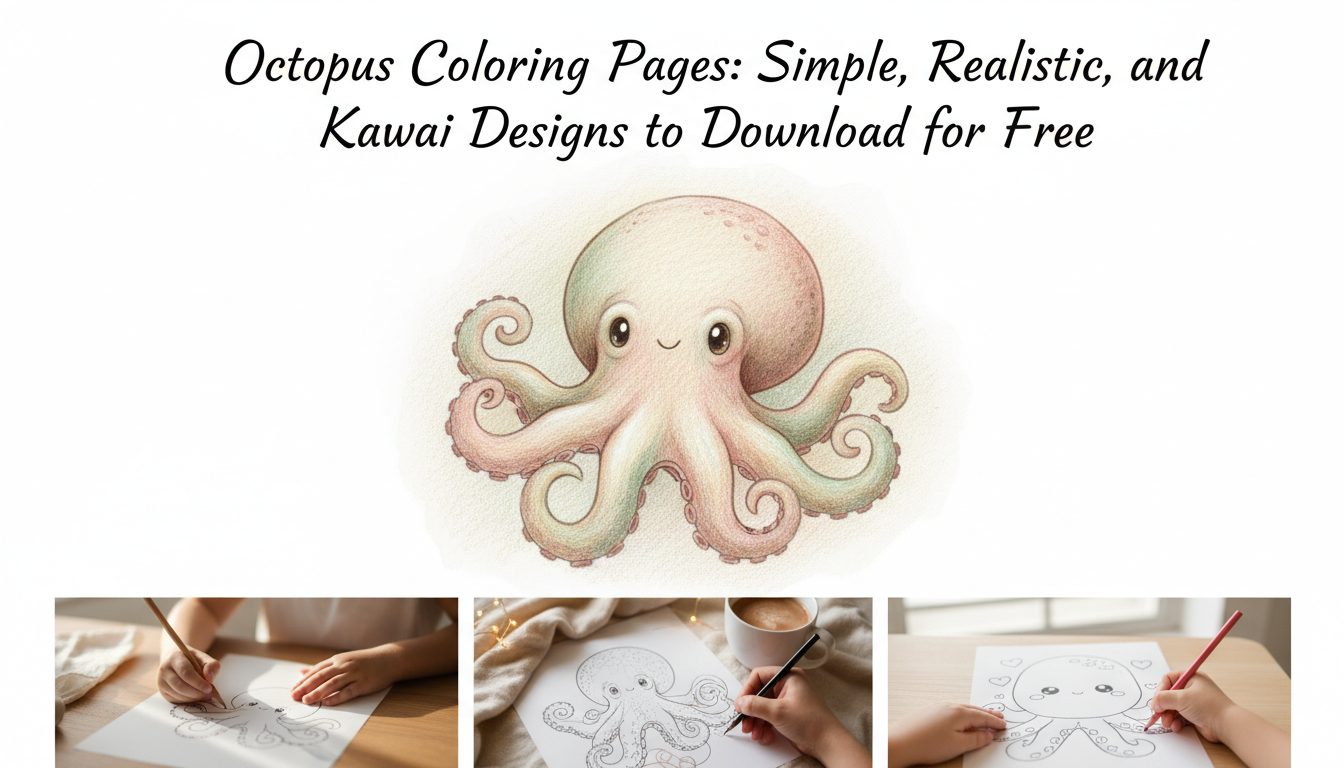
Beyond discovering the animal world, coloring plays a fundamental role in the child’s development. Choosing a kawaii octopus drawing, tender and smiling with big round eyes, invites an immediate emotional connection with the drawing. This soft and simple aesthetic reassures and encourages the youngest to handle pencils with confidence.
Realistic drawings, on the other hand, require close observation of morphological details, encouraging a more meticulous approach. The suckers, skin texture, or color nuances, when reproduced in watercolor or pencil, assist in developing patience and precision. These manual skills are essential, as they accompany brain development and eye-hand coordination, solid foundations for writing and other future learning.
Octopus coloring thus constitutes a comprehensive workshop, skillfully mixing art and natural sciences. It is possible to adapt the difficulty according to age, or even offer multicolored coloring pages, where the child can freely express their personality, combining creativity and emotions. Allowing a child to choose their shades, whether realistic or fanciful, is inviting them to affirm a certain inner freedom while developing their aesthetic taste.
For example, during a family activity, a younger child will start coloring by filling in the broad areas of the kawaii drawing. Meanwhile, an older child can venture to enhance the image with precise shades, a dual exposure that promotes intergenerational dialogue around discovering marine species and a caring artistic practice. It is an elegant and gentle way to support emotional and cognitive growth daily.
Create your own octopus drawing: an exercise to encourage personal expression
Inventing one’s own octopus drawing offers the child the possibility to go beyond simple coloring to integrate a creative process beforehand. This practice stimulates imagination, develops artistic skills, and consolidates self-confidence. Each step of the drawing invites meditation and concentration, like precursors for a habit of mindful attention, essential in the balanced development of the child.
Start by drawing a large circle for the head, then sketch the eight arms curling fluidly to create a framework within which the child can express their character. Adding details such as large round eyes and a smiling mouth brings the creature to life, strengthening the emotional bond with the drawing. Finally, the suckers under the tentacles, a technical touch, combine rigor and fantasy.
The coloring following the drawing allows tinting the work with personal emotions, between realism, kawaii, or multicolored. Delicately transcribing this plastic diversity is an exercise in emotion management and personal expression, both for the child and the adult accompanying them. This activity, far from trivial, opens the way to a privileged dialogue, source of calm and complicity, an emotional foundation to cultivate within the family nest.
The notion of creation not being reserved for artists alone, encouraging children to draw their own octopus also leads to the recognition of their uniqueness. It is a gentle encouragement to explore their sensitivity and accept that beauty also lies in the imperfection and authenticity of their creation, a precious value in a world often anxiety-inducing.
The deep meanings and mysteries of the octopus: a rich symbol to explore in coloring
The octopus, or poulpe, evokes far more than just a marine animal. This intelligent and adaptable creature embodies values that every parent and educator wants to pass on to the child: creativity, flexibility, and strategy. Its ability to solve complex problems, its unique way of changing color thanks to chromatophores, awaken admiration and curiosity.
Surprisingly, the octopus has blue blood, reflecting a specific biological adaptation: hemocyanin, a copper-based oxygen carrier, replaces the red hemoglobin found in humans. This detail stimulates intellect and invites pedagogy based on fascination with life, an essential source of wonder in the early years when the child is building themselves.
In many cultures, the octopus is also a symbol of mystery and marine power. This symbolic weight fuels imagination and invites meditation, especially through coloring, which as a meditative object, soothes and recenters. Addressing this symbolism during coloring sessions thus enriches an activity that then becomes a form of holistic awakening, making emotion, culture, and natural knowledge dialogue.
Understanding that octopus and poulpe denote the same animal, with different linguistic roots but identical biological realities, also illustrates the importance of language and meaning in education. These notions nurture children’s curiosity through an artistic project, reinforcing both vocabulary and cognitive structure in a gentle and caring context.
The educational and emotional benefits of octopus coloring pages for children
Far from being simple entertainment, octopus coloring fully contributes to the psychomotor and emotional balance of the child. This type of activity develops not only fine motor skills but also stimulates attention capacity, a foundation for all future learning. Discover in the table below the multiple benefits this practice can offer:
| Aspect | Benefits | Concrete example |
|---|---|---|
| Creativity | Develops imagination, allows exploring different styles (kawaii, realistic, multicolored) | Choosing colors and styles to personalize one’s octopus |
| Fine motor skills | Improves precision and eye-hand coordination | Careful coloring of tentacles to avoid going outside the lines |
| Knowledge of the marine world | Discovering marine animals and their environment | Observing the suckers and movements of the poulpe in video |
| Emotional calming | Gentle activity promoting concentration and serenity | Coloring to soft music in a quiet space |
| Sharing and cooperation | Encourages collective work and dialogue around a project | Collaboration to color a giant octopus in class |
This wide range of positive effects reassures the interest of offering children these octopus coloring pages, which combine relaxation, knowledge, and personal expression. In a contemporary world where pressure often increases on families, these moments offer a bubble of softness and openness to the world, essential for balanced development.
Ultimately, integrating these coloring pages into children’s activities, whether at home, at school, or in a therapeutic setting, constitutes a genuine asset. They embody the link between nature and emotion, mental construction and creativity, with the elegant simplicity of an easy and free printable drawing.
What is the difference between an octopus and a poulpe?
There is no difference: both terms designate the same eight-armed marine mollusk. ‘Octopus’ is the common term in French while ‘poulpe’ comes from the Greek polypous, meaning ‘many feet’.
Why does the octopus change color?
The octopus has chromatophores, pigmented cells in its skin that contract or stretch, allowing it to change color to communicate or camouflage.
What benefits does octopus coloring bring to children?
It develops creativity, improves fine motor skills, stimulates concentration, encourages discovery of the marine world, and promotes emotional well-being.
How to draw a simple octopus for a child?
Start with a large circle for the head, draw eight curled arms, add large eyes and a smile, then suckers under the tentacles. Finally, let free rein to coloring.
Where can you download octopus coloring pages for free?
Many educational and artistic sites offer models to print for free, suitable for all ages and levels.