
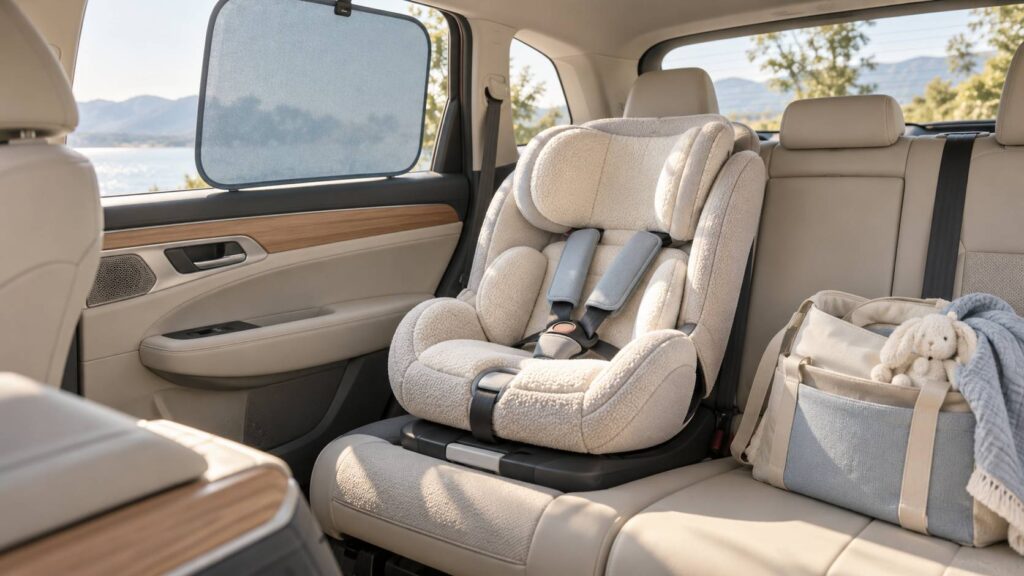
Choosing a Car Seat to Transport Baby in the Car from Birth
The first trip, often the return from the maternity ward, requires very practical preparation. A newborn cannot support their head nor adjust a position that hinders breathing on their own. The car seat is therefore not just another childcare accessory. It constitutes the protective system designed to distribute forces experienced during sudden braking or a collision.
For a baby, travel by car is only done in a certified car seat, adapted to their size and installed rear-facing. An adult’s arms, an unapproved carrycot, a baby bouncer, or a baby sling do not restrain the child in case of impact. Even at low speed, the body weight is projected with a force that no adult can control.
In 2026, newly sold seats must comply with regulation R129, often called i-Size. This certification classifies the child mainly according to their height, provides an evaluation during side impacts, and requires rear-facing travel until at least 15 months. Some older seats approved under R44/04 still exist in households but are no longer the reference for new purchases. R129 makes the choice clearer, provided the exact limits indicated by the manufacturer are checked.
The shell seat, also called a cosy, is generally suitable from birth. It holds the infant in a reclined position compatible with their muscular immaturity, if the insert provided by the brand is used according to the instructions. An adaptable seat can also be suitable from birth when it has a true neonatal recline and the baby’s morphology is well supported. The most durable model is not always the one that best fits a newborn of a few days.
Remaining rear-facing beyond 15 months provides superior protection. In young children, the head is proportionally heavy and neck muscles are still developing. In a frontal collision, the backrest supports the head, neck, and back over a large surface. Facing forward, the neck must absorb more strain. When the seat allows it, keeping this orientation until around 4 years old is a protective choice, without turning this duration into an unrealistic injunction for every family.
Understanding ISOFIX and Seatbelt Attachments for a Baby Car Seat
A seat can be fixed by the vehicle’s seatbelt or by ISOFIX connectors. ISOFIX reduces certain risks of incorrect installation thanks to connectors that clip into the vehicle’s anchor points. It often requires a support leg placed on the floor or a Top Tether strap, depending on the model. The belt remains a reliable attachment when it exactly follows the path indicated by the manufacturer and is properly tightened.
The decisive point is not only the system chosen. It is the compatibility between the seat, the bench, and the child. A highly rated seat can become less effective if it is installed crookedly, if its support leg rests on an incompatible floor box, or if the belt does not slide into the intended guides. Consulting the list of compatible vehicles published by the seat manufacturer provides a useful reference before purchase.
| Age and Size | Frequently Suitable Equipment | Priority Checkpoint |
|---|---|---|
| From birth | R129 shell or truly reclining newborn seat | Clear airways and adjusted harness |
| After the first months | Rear-facing seat according to permitted size | Stable support on the bench and proper recline |
| When the seat limit approaches | Next model compatible with the child’s size | Do not exceed size or weight indicated on the label |
A second-hand seat requires special vigilance. Its history must be perfectly known. After an accident, even when vehicle damage appears minor, a seat may have invisible deformations that affect its behavior in a subsequent impact. The manufacturing date, harness condition, absence of cracks, and presence of the manual must also be verified. Materials age under the effects of heat, sunlight, and repeated stress.
The choice of seat directly leads to its installation in the vehicle cabin because a suitable model loses part of its protective role if placed or adjusted roughly.
Installing the Baby Car Seat in the Car Without Compromising Protection
The rear seat is usually the most suitable place to transport a baby in a car. It keeps the child away from the front airbag and simplifies safety during boarding or alighting. Installing the seat next to the sidewalk can be practical when the car is parked along a street, as the adult places the child away from traffic. The rear center seat can offer better distance from side impacts, but only if the vehicle and seat allow a stable installation there.
A correct installation does not allow the seat to move noticeably at its base when firm pressure is applied from left to right. This check is done after each installation, then occasionally when the seat remains installed permanently. It does not involve pulling violently on the shell but checking that the attachment shows no obvious play.
The front passenger seat only becomes an option when no safe solution exists in the rear or in particular configurations. A rear-facing shell seat in front of an active front airbag exposes the baby to serious danger. The airbag must be disabled according to the vehicle’s procedure before placing the child in this area. When disabling is not possible or clearly confirmed, the rear remains the priority place.
Adjusting the Harness Close to the Body Without Adding Accessories
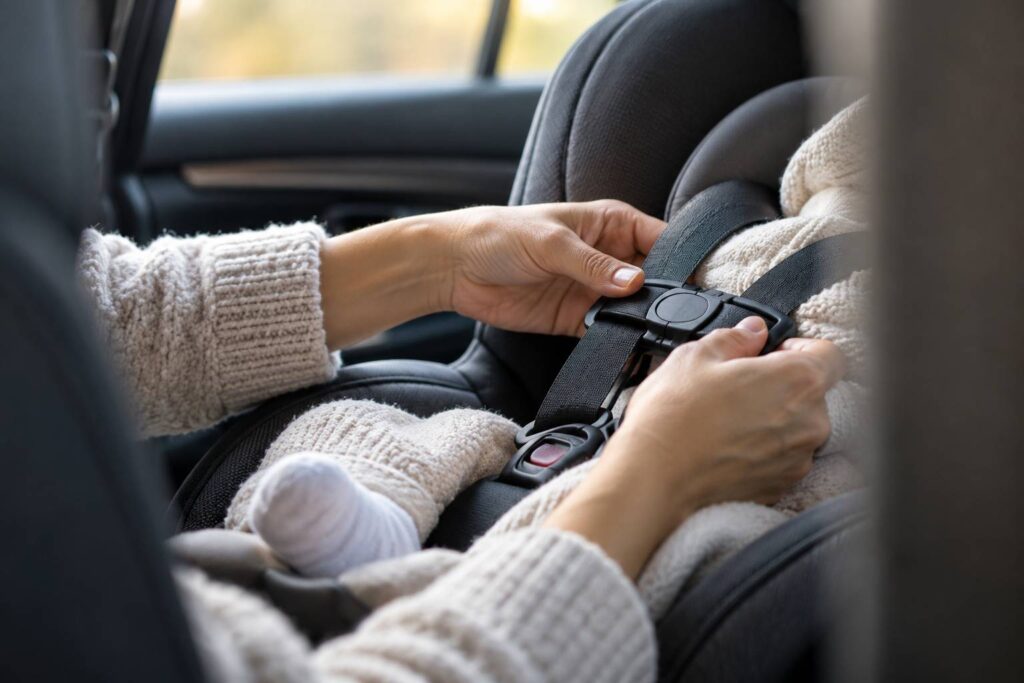
The harness restrains the baby effectively when it is close to the body. The straps must follow the intended paths, not be twisted, and reach the height recommended by the seat. Once the buckle is closed, it should be hard to pinch a strap fold at shoulder level. This reference prevents a too loose harness, which would allow the body to move forward before being restrained.
Thick coats, pilot suits, and footmuffs placed under the straps create false volume. After padding compression during an impact, the harness can become too loose. In winter, dress your baby rather in several thin layers, fasten them, then place a blanket over the harness. This blanket is easily removed if the cabin warms up. It does not change the strap path.
Accessories added without manufacturer validation pose a similar problem. Universal head cushions, non-provided inserts, thick harness protectors, rigid trays, or toys attached to the seat can alter the baby’s position or become projected objects. The shell is tested with its own elements. Adding a device attractive on paper can reduce the benefit of these tests.
-
Check that the back of the seat is in contact with the bench and that the ISOFIX indicator, if it exists, confirms locking.
-
Check the harness before each departure by removing bulky clothing that prevents fitting it close to the chest.
-
Keep the face visible and the chin clear, without extra cushions that might alter posture.
-
Store heavy objects in the trunk or secure them so they do not cross the cabin during braking.
The head position deserves calm attention. In a very young infant, a head that falls forward for a prolonged time can reduce air passage since their airways are narrow and neck tone limited. A car-appropriate recline, an original insert, and regular breaks help more than an added cushion. If the baby seems very compressed, breathes noisily, turns pale, turns blue around the lips, or seems hard to awaken, stop the vehicle as soon as possible and call emergency services if signs persist.
A mirror can allow seeing the child rear-facing but never replaces watching the road. It must be securely fixed and not encourage the driver to turn their head. The need to reassure parents must not create a new distraction at the wheel.
A verified installation before departure frees attention during driving. The journey can then be organized around the baby’s actual rhythm rather than trying to fix a rough installation once on the road.
Organizing Car Trips with Baby According to Their Age and Rhythm
A car seat protects during travel but is not designed as a place for prolonged sleep outside the car. The infant’s body remains weak, the head is heavy, and their respiratory system immature. In a semi-upright position maintained for a long time, some babies may slump more, especially during the first weeks. This explains the recommended caution for continuous trips.
For a long trip with a baby, plan a stop at least every two hours, and more often in the first weeks if your child is very small or uncomfortable. The break does not consist of leaving the baby strapped while adults rest. They benefit from time outside the shell, held by an adult or lying on a suitable and supervised surface, time to drink, be changed, and regain free posture.
The reasonable duration depends on age, possible prematurity, tone, health condition, and tolerance specific to each child. A premature infant or one followed for respiratory problems deserves advice from the team who knows them before a long trip. Parents should not bear this decision alone. A professional can specify relevant precautions for their baby.
Preparing Departures, Meals, and Breaks Without Disrupting the Baby
Leaving after a meal may seem practical since some babies fall asleep quickly. However, feeding just before settling can also favor regurgitations depending on the child’s digestive sensitivity. A few minutes in arms, in a calm upright position, often allow observing comfort before leaving. No universal schedule exists. Your baby’s feeding rhythm provides a better reference than that displayed by the GPS.
Newborns eat frequently, sometimes every two to three hours, with large variations according to breastfeeding, bottle feeding, and growth periods. It is reasonable not to transform the trip into a timed ordeal. Planning extra time avoids feeding a baby in haste or delaying too long a clear hunger need.
An accessible bag, without having to empty the entire trunk at a rest area, really simplifies breaks. It can contain changing needs, light clothes, diapers, wipes, a cloth, the planned meal, and usual treatments if your child uses any. Heavy objects remain in the trunk, while small supplies are stored so they do not slide under the pedals or onto the seats.
Screens are not suitable for a small baby. Before 2 years old, attention is mainly built through direct interaction, voices, contrasts, and real movements. On a trip, calm speech, a familiar song, or a break respond better to agitation than a tablet fixed in front of them. A soft, lightweight, and firmly attached toy can be offered when age allows, without multiplying objects in their space.
Crying in the car does not automatically indicate an emergency but deserves careful reading. Hunger, heat, an uncomfortable harness, a need for contact, or overtiredness can trigger the same reaction. The driver does not try to solve this distress while driving at all costs. As soon as a stop is possible and safe, take the time to check the child. Responding to crying does not create an excessive habit in the infant. Their nervous system still largely depends on regulation provided by the adult.
Very long trips benefit from being broken up. An overnight stop, a staggered departure, or a route with identified rest areas often reduce tension more effectively than extra equipment. A baby does not know how to adapt to vacation urgency. Adults, however, can reorganize the plan.
Preparing driving time comes with another concrete vigilance. The driver’s temperature, light, and fatigue state directly influence the child’s safety.
Adapting Baby’s Safety in the Car to Heat, Cold, and Unexpected Events
A car parked in the sun heats up rapidly, even when the outside air seems bearable. An infant regulates temperature less efficiently than an adult. Their body surface is large relative to their weight, water reserves are limited, and they cannot remove a layer of clothes or move away from a heat source on their own. The cabin must be aired before installation, never leaving a baby alone in the car, even for a few minutes.
In summer, the goal is to cool the cabin before fastening baby, then maintain a moderate temperature without blowing cold air directly on their face. Air conditioning set with moderation, around 21 to 23 degrees when possible, can provide comfort. The feeling of freshness also depends on humidity, sunlight, and clothing. Touch the neck or upper back rather than the hands and feet, often cooler without the child being cold.
Rear window sunshades limit glare and direct radiation. They do not eliminate the need to check temperature because tinted glass does not cool the car. A cover placed on the empty seat when the vehicle is parked can prevent surfaces from becoming hot, provided it is removed before installing the baby if it is not provided by the manufacturer. Water, meals, and stops must be anticipated according to the child’s age and diet, without imposing water on a newborn breastfed or bottle-fed without medical advice.
Managing Winter Without Thickening the Car Seat Harness
In winter, car heating can give the illusion that a thick suit has no consequence. Yet the problem arises during harness adjustment. A compressible coat creates a gap between the straps and the body. The correct method is to fasten the baby with thin clothing, then cover their legs and torso over the straps with a light blanket. The face always remains uncovered.
The driver also needs a safe environment. Defogged windshield, clear windows, tires suited to conditions, sufficient fuel, and charged phone reduce rushed decisions. A breakdown becomes easier to handle when the vehicle is prepared before departure. A reflective vest, signaling equipment required by local regulations, a first aid kit, a blanket, and spare clothes can stay in the trunk.
In case of accident or breakdown, the priority is to protect the area and avoid further exposure to danger. Hazard lights are turned on as soon as the situation allows. The baby remains strapped in the seat as long as there is no immediate danger, such as fire, smoke, immersion, or risk of secondary collision. Removing them too quickly, without necessity, may worsen unseen injuries after impact.
When calling emergency services, explicitly report the presence of an infant and describe their observable condition. Difficult breathing, loss of consciousness, repeated vomiting after impact, unusual drowsiness, inconsolable crying associated with different behavior, or visible injuries require urgent assessment. After a collision, the car seat must be replaced according to the manufacturer’s and insurer’s instructions. It must not be reused for convenience alone.
Long trips in hot or cold weather increase adult fatigue. A baby who agitates does not allow the driver to turn around, handle an object, or unfasten a harness while driving. Stopping in a suitable space provides much better protection than trying to calm the child from the front seat.
Maintaining Vigilance While Driving When Baby Travels in the Rear
Driver vigilance easily diminishes with a baby, especially during the first months. Nights are often fragmented, meals may be close together, and parents discover constant attention to slightest sounds. This fatigue is not poor organization. It really alters reaction time, sustained attention, and the ability to process multiple pieces of information simultaneously.
When the driver is exhausted, the most protective choice is to postpone the trip, hand over the wheel, or take a real break outside the vehicle. Opening a window, turning up the radio, or drinking coffee does not permanently restore driving abilities. Known signs to take seriously include heavy eyelids, repeated yawns, difficulty remembering the last kilometers, less stable trajectory, or late braking.
The baby may cry, lose their pacifier, or fall asleep in a worrying position for adults. None of these situations is resolved by turning around. The driver keeps eyes on the road and calmly indicates that a stop is coming as soon as possible. A passenger can intervene if it does not compromise their own safety but never unfastens the child while the car is moving. This rule seems strict because it prevents impulsive decisions when attention is already divided.
Reducing Distractions Without Giving Up Travel Comfort
Before starting, setting the GPS, choosing music, placing the phone out of immediate reach, and checking the bag’s accessibility removes several micro-decisions from driving. Notifications are not trivial. A second’s glance at a screen is enough to cover a considerable distance without watching the road. Calls can wait or be taken when stopped.
The mirror facing the baby meets an understandable need. However, it must remain an occasional tool, not a source of repeated checks. A brief glance like a rearview mirror is acceptable when conditions allow. Turning the head for a long time to interpret each movement of the child weakens driving, especially on highways, roundabouts, or approaching pedestrian crossings.
Preparation can also include role distribution. If two adults travel, one drives and the other manages the baby’s needs during breaks or from the rear when properly strapped in. If only one adult travels with the child, a short route, a better departure time, and acceptance of an unexpected stop are realistic adaptations. The good trip is not the one that follows the schedule to the minute but the one that keeps the driver available.
Rules vary from country to country, notably for signaling equipment or driving-related obligations. For travel in Spain, autoescuelasancarlos.es provides an independent guide to understand the Spanish driving license and points system, a useful reference before taking the road with a child. French rules concerning car seats remain to be checked in updated official sources, especially before a cross-border trip.
Daily safety is also built during very short trips. Travel to daycare, doctor’s office, or relatives requires the same adjusted harness, the same fixed seat, and the same attention as vacations. Accidents frequently happen near home, where familiarity can reduce vigilance. Taking a few seconds to install baby correctly is a concrete way to protect their still fragile body, without expecting parents to be perfect.