
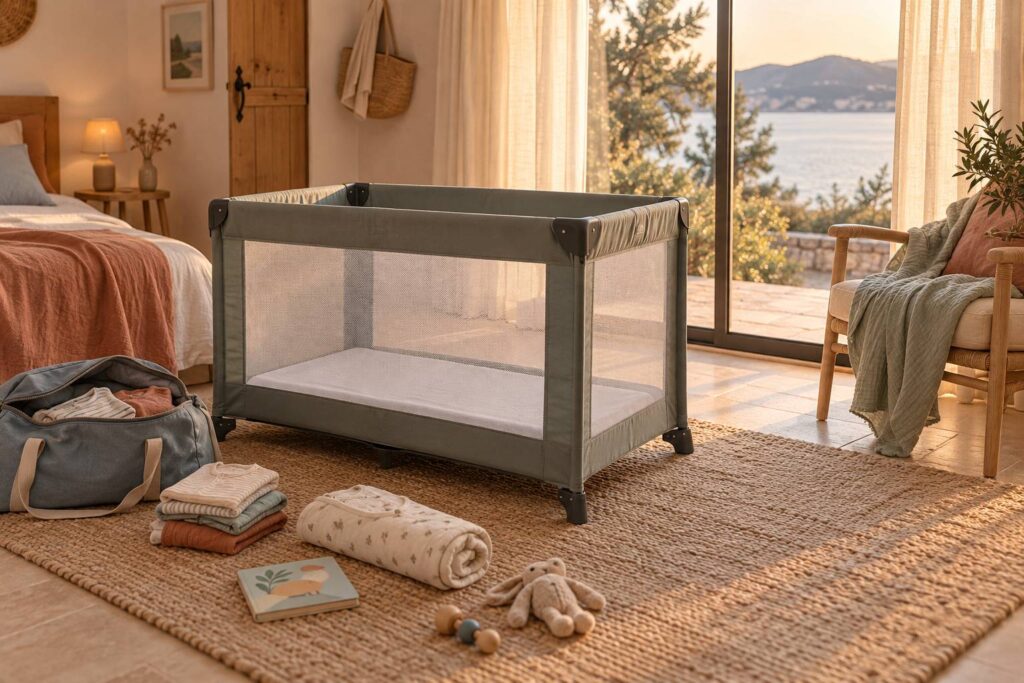
In brief
- A travel cot is first chosen according to the mode of travel, the weight it can support, and the frequency of nights away from home.
- The bedding provided by the brand should remain alone in the bed. An added mattress topper can create a dangerous space around the baby’s body.
- For a newborn, a folding cradle may suffice for short stays. A classic portable baby bed often accompanies the child until about 3 years old.
- Models with a changing table, raised level, or playpen function offer user comfort but often make the equipment heavier.
- Baby safety relies on stable installation, an adapted mattress, and an empty sleeping area, even away from home.
Choosing a travel cot according to your actual travel rhythm
The best travel cot is not necessarily the one that accumulates accessories. It is the one that fits into your departures without turning every weekend into a logistical operation. A stay at grandparents’ one hour away, a train trip with a connection, or a journey with a child by plane do not require the same equipment.
The first criterion remains weight. A model around 6 to 8 kg is easier to carry in a station, fits better in an already full trunk, and tires less the parent travelling alone with a baby. More complete versions can reach 10 to 15 kg, sometimes more with their accessories. They are very comfortable when they remain in a holiday home or with relatives, but their transport becomes less smooth.
A compact cot is useful when its folded volume truly matches your trip, not just a tempting product sheet. Look at the dimensions once packed, the presence of a sturdy cover, and the length of the bag. A long and narrow shape fits well behind a car seat. Conversely, a bulky cover can become impractical in a train corridor or at the airport.
Lightweight models for frequent departures
Lightened models meet the needs of families who regularly sleep away from home. Their structure is often designed to limit the number of parts to assemble. Some unfold in a format close to a pop-up, while others use traditional central folding with rigid sides that lock.
This practicality has a downside. A very light model may offer a sleeping area closer to the ground, which requires more bending to lay down an infant. For the first months, when awakenings are frequent and parental backs are still sensitive after childbirth, this detail matters. A side opening can simplify setting up a bigger baby, but it does not replace a good sleeping height for a toddler.
A parent who plans two or three occasional nights a year may favor a simple, sturdy, and affordable model. A family that often alternates between two homes, or who spends many weekends on the road, will benefit from investing in a mechanism tested several times before the first departure. Folding should remain manageable even at the end of the day, with a tired baby in arms and little space around.
Equipped versions for prolonged occasional use
Some travel cots offer a higher level for small babies, a removable changing table, storage pockets, or transformation into a playpen. These features can facilitate long stays. A changing table avoids looking for a stable surface in unsuitable accommodation, provided the child is never left without physical contact, even for a few seconds.
The high position is generally reserved for the first months and must be removed as soon as the baby begins to roll over or push up. Motor development varies, but many children roll from back to tummy between 3 and 6 months. The manufacturer’s manual is the reference for weight limits and usage conditions.
The budget often ranges between 80 and 300 euros depending on weight, materials, mattress, and accessories. A comparison of travel cots suited to nomadic uses allows putting these profiles side by side before purchase. Expensive equipment alone does not improve nomadic sleep. The familiarization of the baby with their sleeping place, the consistency of the routine, and the room temperature weigh just as much.
The right choice thus starts with a very concrete scenario. Think about the trunk, stairs, type of vacation, and number of setups planned in the year. This projection avoids buying a bulky cot for three nights or a ultra-light model while looking for a stable occasional sleeping space at the grandparents’.
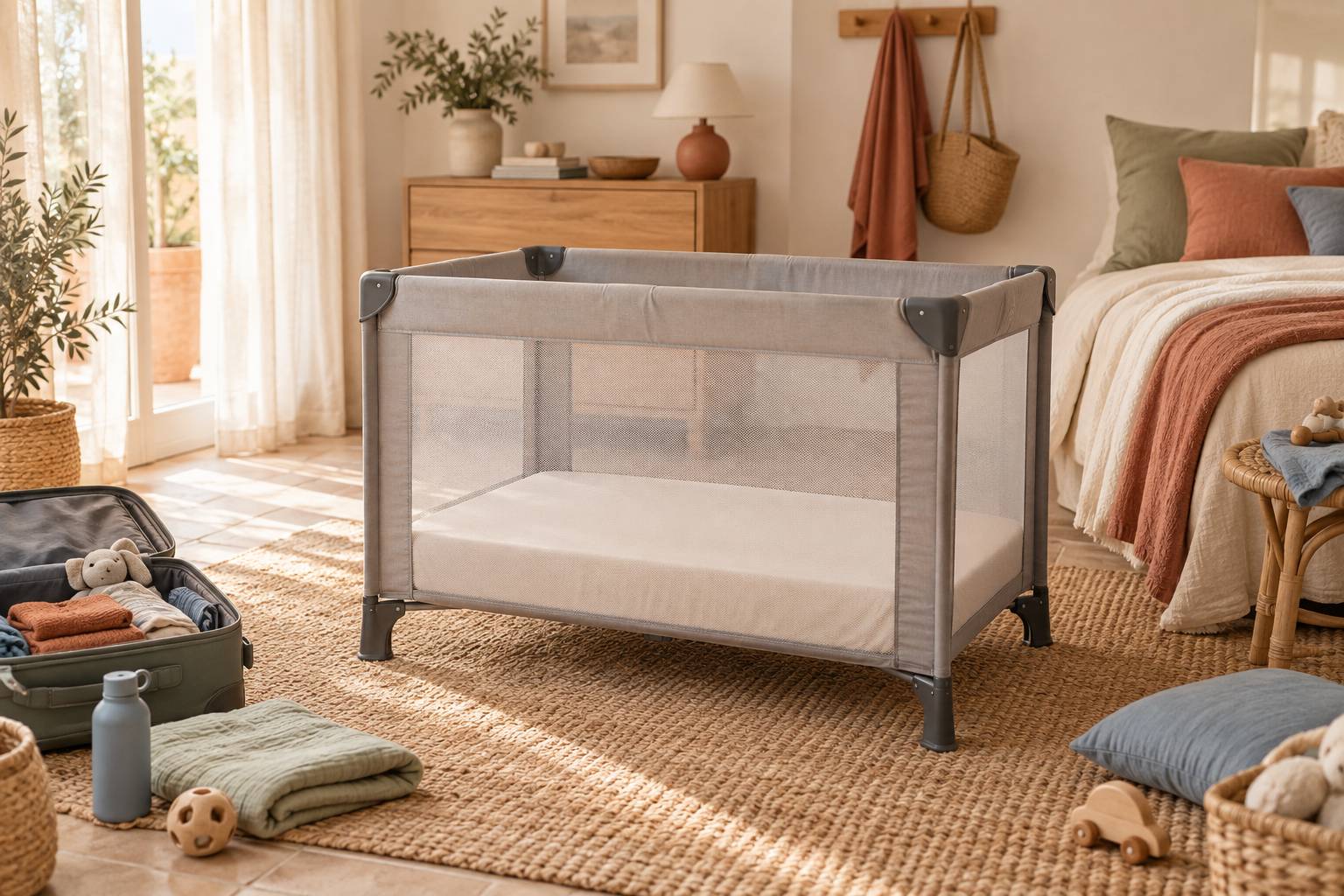
Essential portable baby bed models and their uses
Essential models do not form a single category. They meet different needs, which also evolve with the child’s age. The newborn sleeps a lot, often between 14 and 17 hours out of twenty-four, but sleep periods are fragmented. A 6-month-old may need a larger space to roll over, while a 2-year-old mainly requires a known and secure setup.
The folding cradle or travel bassinet is suitable for the first weeks when stays are short. It is more enveloping and generally easier to set up near the parental bed. Its use is limited by motor milestones and limits indicated by the manufacturer. As soon as the baby tries to sit up, roll, or reaches the maximum allowed weight, this type of bedding is no longer suitable.
A classic travel cot often offers the widest usage period, from birth with a compatible reducer up to about 3 years depending on the child’s size and weight. Its low base provides appreciable stability when a mobile baby stands up. It must never be used as a prolonged confinement place during waking times, even when the model has a playpen function.
| Model profile | Most suitable use | Point of caution |
|---|---|---|
| Compact folding cradle | Short stays with a newborn | Strictly respect the indicated age, weight, and motor abilities. |
| Classic travel cot | Regular nights at relatives and car vacations | Check full locking of sides before each bedding. |
| Light travel cot | Train, plane, and frequent travel | Test folding at home and check stability on site. |
| Cot with accessories | Prolonged stays with limited changing space | Anticipate weight, volume, and removal of modules that become unsuitable. |
Baby comfort also depends on familiarity
A child does not sleep better in a sophisticated bed just because it is new. The nervous system calms more easily when it finds known cues. The parental voice, a short repeated routine, and the same sleeping bag adapted to room temperature can be more powerful landmarks than the appearance of the bedding.
Between 4 and 6 months, sleep cycles progressively structure and awakenings between two cycles become more noticeable. Change of place can accentuate these awakenings without signaling a sleep disorder. Keeping the same bedtime steps, for example changing diaper, meal, a few quiet minutes, and laying on the back in the bed, supports the transition.
An unfamiliar room deserves a simple check. The recommended temperature is generally around 18 to 20 °C. Keep the bedding away from radiators, slightly open windows, blind cords, and accessible outlets. A discreet night light can help you move around, without strongly lighting the child’s face at every awakening.
The travel cot can also become an occasional sleeping place in the context of shared custody or nights shared between several homes. The child does not need two identical universes. They need consistent landmarks, a securely installed bed, and adults who respond to their rest needs. Resources on organizing shared custody with a young child can help think about this continuity without rigidity.
A well-chosen model leaves room for real life. It can be moved, assembled without tension, and used without multiplying adaptations that disturb the child’s sleep or exhaust adults.
Setting up safe nomadic sleep with the supplied mattress
Baby safety does not stop because the family sleeps elsewhere. The travel cot must reproduce the home sleeping rules. An infant is laid on their back, on a firm and flat surface, in a clear space. This position keeps airways freer and remains the standard during the first year of life.
The mattress supplied with the travel cot sometimes seems thin to adults. This thinness often helps maintain the dimensions expected by the structure. Adding a thick mattress, mattress topper, rolled blanket, or cushions to “improve” baby comfort can create a gap between the mattress and the walls. An infant’s face can then be against a soft edge or in a space where breathing is hindered.
In a travel cot, use only the mattress designed or explicitly approved by the manufacturer for this exact model. This rule also applies to mattresses sold separately with the “universal” label. Two beds with similar dimensions can have enough difference to leave a dangerous gap.
An empty bed protects better than a heavily furnished one
The bedding remains empty during sleep. No pillow, duvet, bed bumper, plush toy, baby wedge, or nest reducer not designed for sleeping in this bed. A sleeping bag adjusted to the child’s size suffices in most situations. It limits the risk that a blanket rises toward the face and avoids temperature variations linked to uncovered sheets.
Before 4 or 5 months, the Moro reflex can suddenly wake the baby. Arms spread, the body jerks, and cries sometimes follow. This phenomenon corresponds to still incomplete neurological maturation. It does not justify adding objects around the baby. A well-fitted sleeping bag and a calm ritual remain safer responses.
When the baby starts to roll over alone, they may choose to lie on their tummy during sleep. Continue to put them on their back initially. It is not necessary to constantly turn them if they have acquired movement both ways, as long as the bed remains empty and the mattress is firm.
Check the mechanism before each night
An incomplete assembly may seem stable at first glance. Check that each side is fully locked, the base is properly lowered, and the support straps under the bed are fixed according to the manual. These straps prevent certain models from folding accidentally and help maintain correct base tension.
Install the bed away from furniture on which the child might lean as they grow. A baby who stands up might pull on a curtain, grab a cable, or try to climb a nearby coffee table. The risk increases between 8 and 12 months, a period when many children pull themselves up with normal variations of several weeks.
A baby who sleeps poorly in a new place is not necessarily bothered by their bed. Nasal congestion, teething, a room too warm, or stimulation accumulation can fragment the night. In case of a blocked nose, suitable measures and signs to watch for are detailed in this guide on cold symptoms in babies. Respiratory distress, chest retractions, bluish lips, high fever in an infant, or unusual drowsiness require prompt medical evaluation.
A simple bedding may seem less reassuring for adults, but it precisely matches the still immature respiratory and motor capacities of the young child. Safety does not negotiate with hotel room decor.
Test folding and transport before the first trip with child
A travel cot becomes pleasant to use when the assembly is known before departure. Waiting for the first night in an unfamiliar accommodation exposes to hesitant gestures, a lost manual, and fatigue that makes each handling more difficult. A trial at home also allows the baby to discover their future sleep place without the cumulative stress of the journey and excitement.
Most traditional models fold from the center. After removing the mattress, the base rises then the sides unlock in a precise order. The bed then takes the shape of a narrow column that the mattress encloses in its cover. Quick-open models follow a different logic, sometimes with flexible frames to fold in several steps.
A mechanism that resists must not be forced, as a poorly positioned bar or reversed sequence can damage the structure. Open the manual on your phone or keep it in the cover. This precaution seems simple, but prevents confusing a safety lock with a manufacturing defect.
A storage routine that preserves the equipment
After the child leaves the bed, start by unfastening the Velcro straps placed under the structure when the model has them. Then remove the mattress. The sides or bars then fold according to the brand’s instructions, without suddenly pulling on the fabric or joints.
- Remove fitted sheet, sleeping bag, and any sleep object before handling the bed.
- Clean visible small marks with a product compatible with the fabric, then let it dry completely.
- Fold the structure in the planned order and wrap it with the supplied mattress when it serves as protection.
- Store the manual and accessories in the cover to avoid searching for them on the next trip.
Drying deserves particular attention. A bed stored damp after a stay at the beach or a night of spit-ups can develop a lasting odor, even mold on textiles. Leave it open in a ventilated room until complete disappearance of moisture, then store it sheltered from a very cold garage or a damp cellar.
On a plane, the portable baby bed is generally checked in the hold. A padded cover or additional protection limits damage from shocks, without guaranteeing that the equipment will be treated gently. Check hinges, feet, and fastenings on arrival. If a bar no longer locks clearly, the bed must not be used before verification by after-sales service.
Transport by car seems simpler, but a bed placed loosely can become bulky during braking. Secure it in the trunk, without a heavy object on the mechanism. Detachable accessories benefit from traveling in a separate bag to avoid deforming the fabric or frame.
Travel comfort starts before the journey. Equipment whose folding you master saves time, energy, and a precious part of availability when your child simply needs to find their arms and rhythm again.
Compare prices, options, and usage duration in this buying guide
A useful buying guide does not aim to designate a single winner. Needs change with accommodation, number of children, mode of transport, and baby’s age. A cot that seems too simple in a store may become very satisfying if it opens in under two minutes, fits in your trunk, and respects sleeping rules.
The price range observed for a travel cot frequently goes from about 80 to 300 euros. At the lower end of this range, the structure is often heavier and options more limited. This does not mean it is less safe. Compliance with applicable standards, good locking, and respect of the manual matter more than sophisticated decoration.
More expensive models usually justify their price by weight gain, superior textile quality, faster assembly, or a mattress better designed for travel. The parent can then evaluate a very concrete point. Does this extra really reduce a difficulty encountered at each departure, or is it responding to occasional use that does not require so much equipment?
Options that are of interest depending on your situation
The newborn level can relieve the back during the first months, notably after cesarean birth, stitches, or persistent physical fatigue. Its use remains short. Once the first rollovers are observed, the baby must be installed at the bottom of the bed, even if still light.
The changing table can be useful in a cottage without an adapted changing surface. Check its stability, fastening system, and availability of one hand on the child at every moment. Changing is a time when a fall can happen very quickly, even in the first weeks, because some babies suddenly push themselves away with their legs.
The playpen function relates to waking periods, for a limited time and under supervision. A baby needs to move on the floor, turn the head, grab their feet, and test supports. Between 4 and 8 months, these movements gradually organize coordination and tonicity. The playpen can secure a short meal preparation, but it does not replace exploration times on a firm mat.
The choice of fitted sheet requires the same precision as that of the mattress. It must match the exact dimensions of the bedding, remain perfectly taut, and not come loose when the baby moves. A cloth that is too large can form wrinkles near the face. Sheets sold with the model or offered by the same brand often provide the most reliable option.
To deepen common criteria between fixed and nomadic bedding, consult this guide to choose a baby bed according to age and available space. The major difference lies in the folding mechanism, but landmarks of stability, ventilation, and clear bedding remain the same.
A baby under 3 months who suddenly refuses all bedding, cries unusually when laid down, drinks significantly less, or presents a rectal temperature of 38 °C or higher must be evaluated quickly by a health professional. For an older child, unusual noisy breathing, repeated vomiting, marked drop in alertness, or obvious pain also justify medical advice. The bed is then probably not the sole cause of the awakening.
The best investment remains the one that allows you to set up sleeping with clear gestures, without improvisation and unnecessary tension. Your child will gradually recognize that this small folding space can also become a stable resting place.
Up to what age can a travel cot be used?
Most models accompany the child up to about 3 years old, provided the weight and size limit indicated by the manufacturer are respected. A baby who tries to climb out of the bed requires increased vigilance and may need different bedding.
Can a thicker mattress be added in a travel cot?
No, unless this mattress is designed or explicitly certified by the manufacturer for the exact model. An addition can create dangerous gaps between the mattress and the sides, or make the surface too soft for an infant.
Is the travel cot suitable for a newborn?
Yes, if the instructions allow use from birth and if the baby is placed on their back, on the supplied mattress, in an empty bed. A folding cradle may also be suitable for very short stays, depending on its usage limits.
Why does my baby sleep less well in their travel cot?
Changing place, light, noises, and temperature can fragment sleep, especially between 4 and 6 months when awakenings between cycles become more noticeable. Repeating the same bedtime steps and using the same sleeping bag often helps the child orient themselves.