In brief:
- Grandmothers’ Day is a celebration that has become a key moment to express intergenerational love and strengthen family tradition.
- Created in 1987 for commercial purposes, it has established itself as a true tribute to grandmothers within French cultural heritage.
- Family memory and genealogy play a fundamental role in this celebration, recalling the importance of grandmothers’ historical roots.
- All around the world, variations of this celebration highlight the precious role of grandparents, in a universal outpouring of affection and respect.
- Recent civic initiatives, such as “1 letter 1 smile,” illustrate how this celebration can also translate into social engagement and support for the elderly.
The unique origins of Grandmothers’ Day: between commerce and nostalgia
Grandmothers’ Day, as it is known today, draws its roots from an original approach mixing commercial strategy and symbolic tribute. Instituted in 1987 by the coffee brand “Café Grand’Mère,” this celebration quickly found its place in the French cultural landscape. The initiative, born from a desire to bring generations closer around a feeling of affection and recognition, continues today in simple gestures such as giving a bouquet or crafting a handmade gift.
However, this recent creation must be placed in a much older context, marked by the oral transmission of memories and the veneration of grandmothers within families. Honoring grandmothers is therefore not limited to a commercial operation but is part of a deeply rooted family tradition where collective memory acts as a social cement. Thus, every first Sunday of March, a moment chosen for its springtime mildness, becomes an opportunity to reconnect with these ties imbued with a double tenderness: that of the past and that of the present.
The choice of date, fixed but not officially recognized by a national institution, ensures this celebration a flexibility conducive to a warm reception in households, inviting everyone to appropriate this occasion according to their own emotional codes. The ritual then takes various forms, between affectionate phone calls, visits filled with attentions, and occasional gestures that testify to filial love.
From the perspective of a midwife and expert in child developmental psychology, this celebration also serves to highlight the fundamental role of grandmothers in the extended family network, particularly in transmitting emotional and educational knowledge that influences the emotional roots of younger generations. Interaction with grandmothers thus contributes to building a secure bond, promoting a beneficial emotional balance.
A tribute to grandmothers: the essential place of grandmothers in memory and genealogy
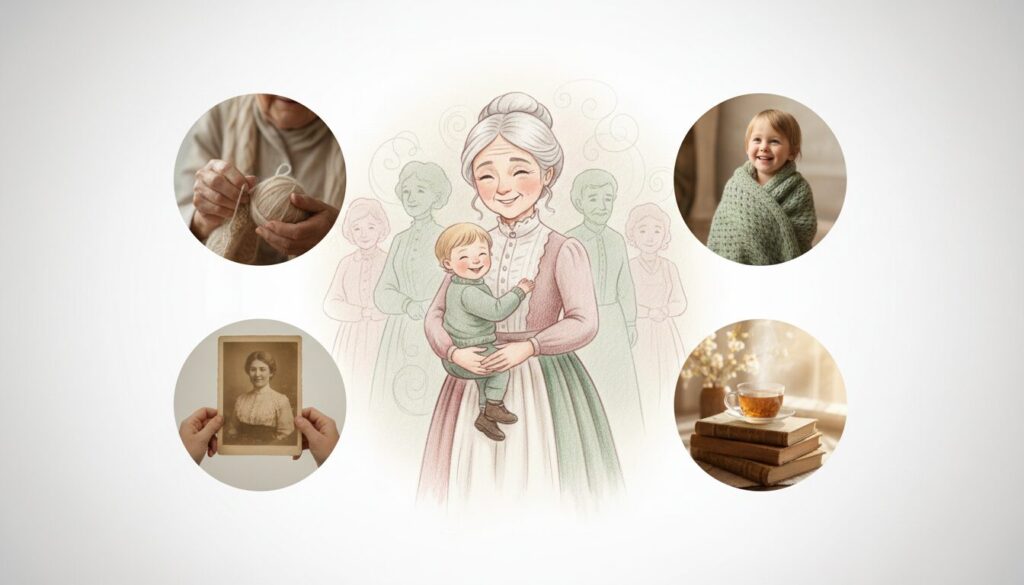
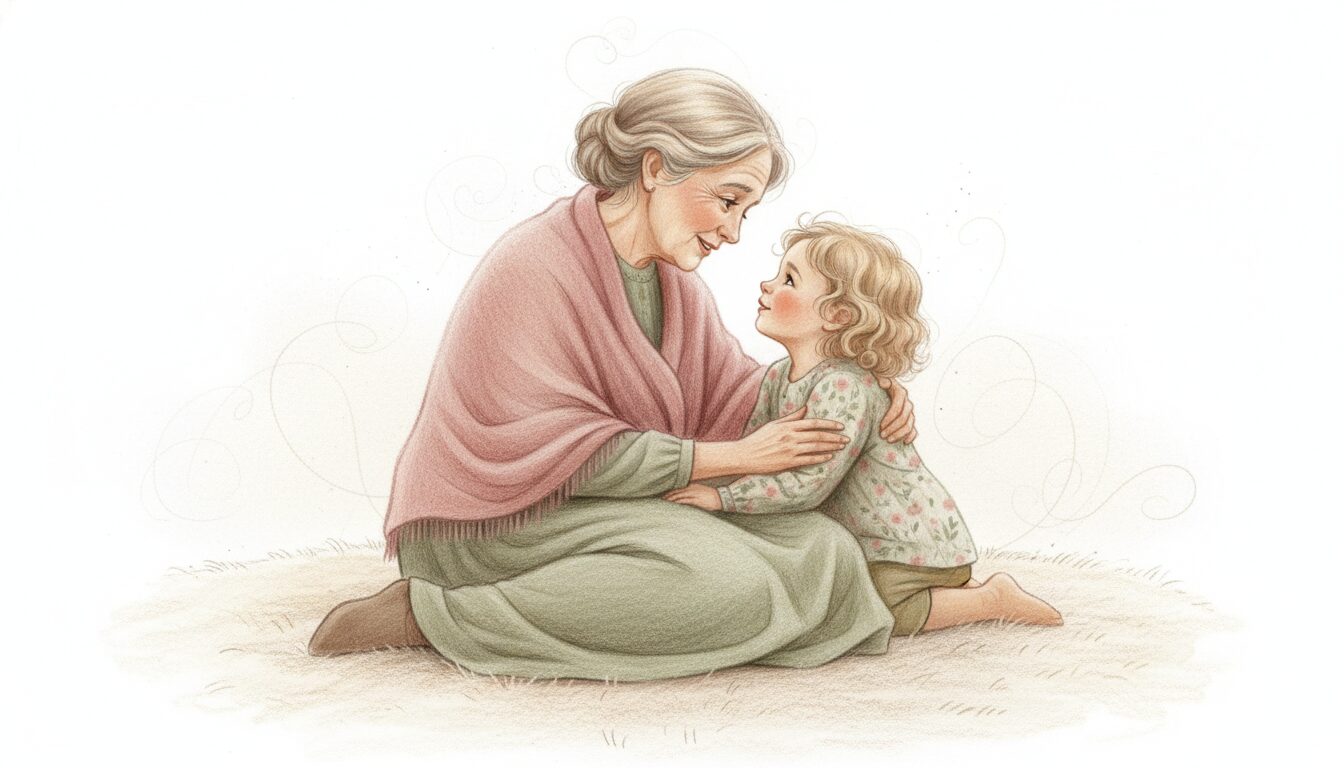
Beyond its festive scope, Grandmothers’ Day embodies a true tribute where family memory and genealogy intertwine. Grandmothers occupy a pillar position at the heart of the home, true guardians of traditions and bearers of an intangible heritage essential to family cohesion.
Every shared memory, every story told during intergenerational moments enriches the fabric of a genealogy that is not limited to the visible family tree but encompasses the emotional wealth transmitted from one generation to another. These bonds help construct a family identity, stabilized by the support of grandmothers who embody the existential roots of each person.
The significance of this tribute can be measured by the perspective on old age. In a world where youth often predominates, recognizing the wisdom and experience of grandmothers is also laying a cornerstone in the edifice of respect for human transmission. This recognition resonates particularly in families where the physical or emotional presence of the grandmother conditions a sense of emotional security for children.
Over the decades, books and studies have highlighted the soothing and educational role of grandmothers in the development of young children. Their gentle voice, reassuring tone, and tender gestures contribute to an environment conducive to emotional flourishing. Honoring these women during this celebration also values these affective dynamics that ground family tradition.
It is therefore important to consider this celebration as a privileged time, allowing everyone to reconnect with their roots and to inscribe, within the family heritage, the living trace of an extended maternal presence. It is also an encouragement to preserve and transmit this emotional capital, guaranteeing meaningful continuity.
Grandmothers’ Day around the world: diversity and similarities across cultures
While this celebration takes on a particular significance in France, it remains an international phenomenon, stemming from a universal admiration for elders. Many countries have indeed adopted different but convergent ways to honor grandparents, thus reinforcing a global feeling of intergenerational love.
For example, Bulgaria celebrates its grandmothers on the first Wednesday of December, while Poland dedicates two separate days in January to honor both grandmothers and grandfathers. In the United States and Canada, this celebration, generally joint for both figures, occurs on the first Sunday of September, creating an annual break dedicated to family heritage and shared affection for elders.
In Italy, October 2nd is reserved for grandparents’ devotion, a date where particular emphasis is placed on the transmission of values and knowledge. More originally, in Taiwan, the celebration takes place on the first Sunday of August, highlighting the universal importance of these relationships while integrating local culture.
This range of practices highlights how the notion of grandmothers is not fixed but rather alive, constantly redefined according to cultural needs and sensitivities. It results in a celebration nourished as much by family tradition as by adaptation to contemporary contexts.
A kindly view of these different practices reflects a common will: to preserve the heritage of human relationships within families, regardless of their configuration. Thus, understanding this diversity enriches the perception of Grandmothers’ Day as a powerful vector of social harmony, international and dynamic.
A simple gesture to express intergenerational love: gifts, visits, and words from the heart
As Grandmothers’ Day approaches, families are invited to cultivate a moment of attention and tenderness, embodying the discreet but profound love that unites generations. While flowers and gifts naturally find their place, the simplicity of a handmade gift by the youngest often carries a powerful symbolism of transmission.
These gestures, whether delicate bouquets, cards decorated with children’s drawings, or affectionate phone messages, have a unique meaning in the context of a family tradition. They concretize a dialogue between past and present, a place where memory comes alive.
For parents, supporting this emotional expression fosters a finer understanding of the passing of time and the place of the grandmother. It is also an opportunity to involve the child in an act of love that goes beyond immediate play, encouraging a healthy and lasting bond with the grandmother figure.
More concretely, here are some ideas that well reflect this spirit of tribute:
- Write a letter or poem evoking shared moments.
- Prepare a cake or a signature dish, nourishing with memories.
- Create a photo album gathering precious family moments.
- Offer an aromatic plant, a symbol of constancy and rooting.
- Organize a themed day, encouraging exchange and complicity.
These examples illustrate that the most important is not material value, but the richness of the bond woven through these attentions, giving rise to a celebration both intimate and meaningful.
| Type of gesture | Symbolism | Emotional impact |
|---|---|---|
| Giving flowers | Ephemeral beauty and renewal | Expresses tenderness and delicacy |
| Handmade gift | Creativity and personal involvement | Strengthens the intergenerational emotional bond |
| Written card | Transmission of thoughts and emotions | Highlights family memory |
| In-person visit | Presence and shared time | Consolidates the trust relationship |
| Phone call | Closeness despite distance | Maintains the emotional connection |
Social engagement around Grandmothers’ Day: beyond family tradition
The celebration of grandmothers also fits into a civic dimension that goes beyond the simple family framework. The initiative “1 letter 1 smile,” supported by “Café Grand’Mère,” perfectly illustrates this dynamic. Launched in 2020, this approach aims to break seniors’ isolation by offering them, through letters, smiles and a tangible reminder of their precious place in society.
This project has enabled the distribution of over a million letters in nursing homes for dependent elderly persons (EHPAD) across France, thus highlighting the importance of collective commitment for the well-being of elders. This broader perspective on Grandmothers’ Day gives a new dimension to this celebration, which becomes a call for intergenerational solidarity.
From a wider viewpoint, such initiatives remind us that family heritage, like genealogy and historical roots, can also nourish a shared social responsibility. This tribute to our grandmothers thus has a dual vocation: cherish memory and cultivate bonds within the community.
Grandmothers’ Day, rich in its history and symbolism, therefore invites both an intimate and heartfelt celebration, while opening up to concrete gestures of care for those who, sometimes isolated, still have so much to pass on.