In brief
- A dive into wind instruments begins with a simple and reassuring idea for the ears of children as well as adults. The sound originates from a vibrating column of air, then shapes into melodies.
- The two main families, woodwinds and brass, are not about the material but about the mechanism. Bevel and reeds on one side, lips and mouthpiece on the other.
- Breath techniques mainly serve to stabilize air pressure, manage the attack of notes, and build a harmony that does not tire.
- In the orchestra, each instrument occupies an emotional place. The flute lights up, the oboe “speaks”, the horn rounds out, the tuba anchors.
- For a child, learning progresses better when the body is respected. The mouth, breathing, and posture develop in small steps.
Understanding how air becomes music in wind instruments
In a house where a baby finally sleeps in short intervals, silence is never complete. There is the breath of a parent, the rustling of fabric, a breath that settles. Wind instruments start from the same point. An invisible substance, air, passes through a conduit and begins to vibrate.
What is reassuring is the logic. Sound does not “come out” by chance. It appears when a column of air is set in motion and a stable vibration establishes. The pitch mainly depends on the effective length of this air column, as if the inner tube “chooses” the frequency that stands upright.
Vibration, resonance, and pitch, without unnecessary jargon
A wind instrument imposes a path on the air. The air is accelerated, then slowed, and this alternation creates a vibration. The body of the instrument then amplifies certain frequencies. This is resonance, comparable to a swing that goes higher when the impulse arrives at the right moment.
When the holes close on a recorder, or when keys are pressed down on a clarinet, the acoustic length changes. The note follows. In brass instruments, this length varies with pistons or a slide, but also via the harmonic series. The same tube can produce several pitches depending on the tension of the lips and the speed of the air.
What “blowing” means for the body
Breath techniques are not about sending as much air as possible. They aim rather for regular pressure, a precise direction, and a face that remains relaxed. A tense mouth tires quickly and makes the sound unstable, somewhat like a baby who becomes restless when the external rhythm is unpredictable.
A useful image for parents accompanying a child musician is that of a water stream. Too strong, everything overflows. Too weak, nothing moves forward. The breath that works is the one that holds over time, with lowered shoulders and an engaged belly, without apnea.
Woodwinds and brass, a distinction primarily of mechanism
The separation between woodwinds and brass rests on how the vibration starts. In woodwinds, air is directed toward a bevel or vibrates a single or double reed. In brass, it is the lips that vibrate in the mouthpiece.
The term “woodwinds” is historical. A saxophone, often made of brass, remains a “woodwind” because it uses a single reed. This point avoids much confusion among children who observe the instrument and conclude too quickly based on the material.
A correct note is built first by a stable vibration, not by force. What follows naturally leads to recognizing the sound personality of each instrument, as one gradually learns a baby’s voice among others.
When these basics are set, the ear begins to differentiate colors. It is the ideal moment to explore the palette of timbres.
Woodwinds and brass: spotting timbres and manufacturing secrets
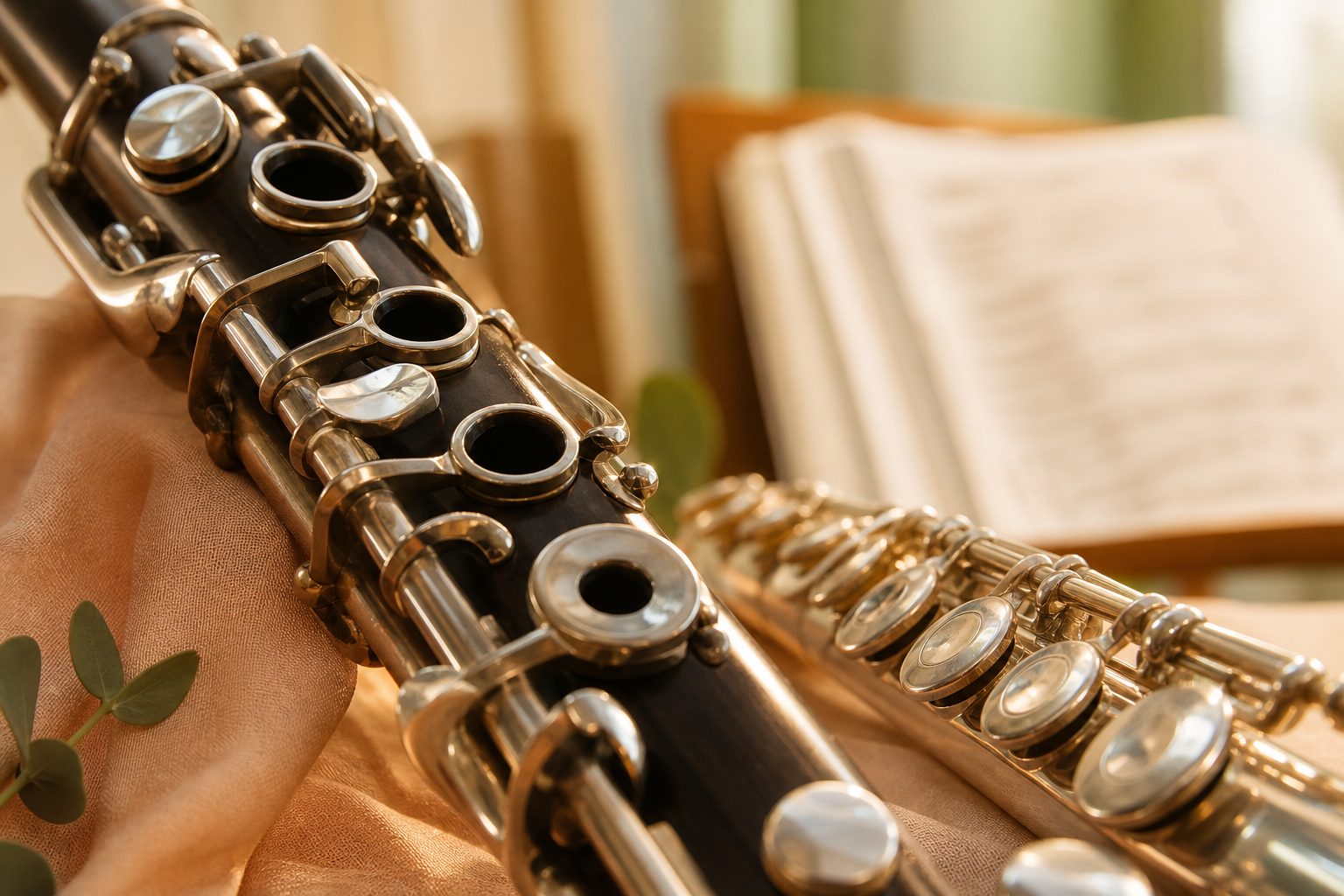
In an attentive dive, the secrets are not mysteries reserved for expert musicians. They are often hidden in concrete details. The shape of the tube, its conicity, the placement of holes, the quality of pads or pistons. All of this changes the response under the fingers and the color of the sound.
A child quickly perceives the difference between a sound that “comes out” easily and a sound that “resists.” This resistance is not a flaw. It is part of the instrument’s identity, and it guides the gesture. Understanding this reduces frustration, especially in the early months of learning.
Why a flute doesn’t sound like a clarinet
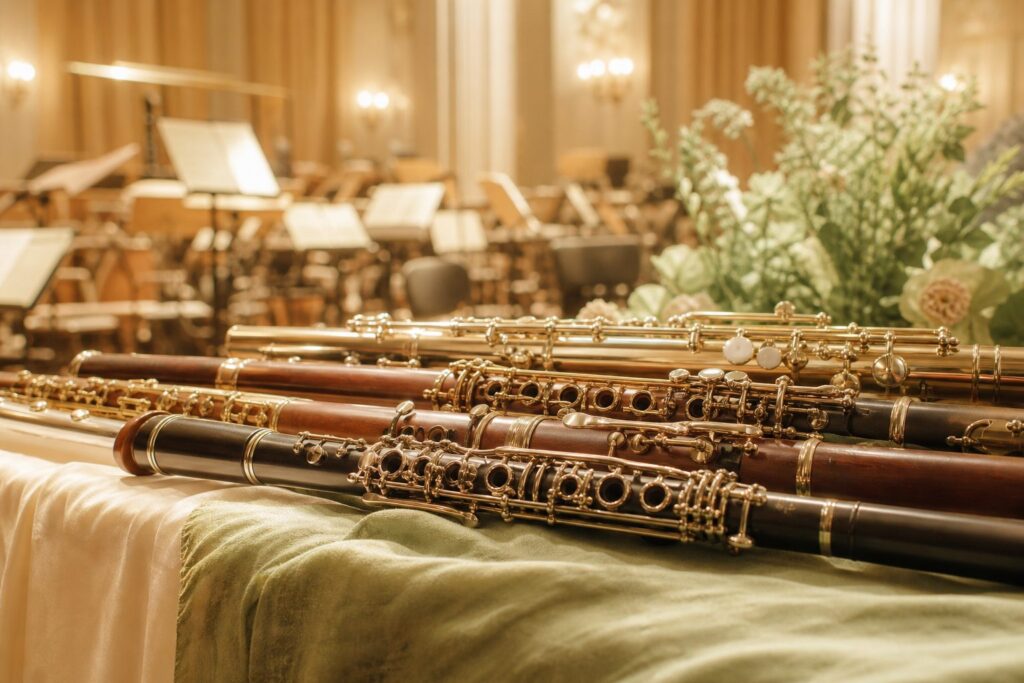
The transverse flute produces a clear timbre because the air is cut on a bevel. The attack is quick, and the sound may seem bright. The clarinet, with its single reed, offers a rounder tone, sometimes close to a voice telling a story.
The oboe and bassoon use a double reed. This creates a particular tension, often described as more “nasal” for the oboe, more “earthy” for the bassoon. This tension has a practical consequence. The embouchure is worked finely and can tire at the beginning, hence the interest of short and regular sessions.
Brass, between brilliance and depth
Among brass, the trumpet can cut through an orchestra thanks to a spectrum rich in high harmonics. The trombone, with its slide, allows glissandi and very direct pitch precision, provided the ear is guided.
The French horn is distinguished by a round sound, often used to link sections. The tuba, on the other hand, anchors the bottom. It gives weight to the chord, like a stable floor under a house. This role is very noticeable in film music, where the bass sets a feeling of safety or tension.
The piccolo, the high pitch that wakes the orchestra
The piccolo, a small transverse flute, plays an octave higher than the standard flute. Its air column is shorter, so the frequency is higher. In the orchestra, it serves to enhance the brightness of a passage or to create a point of tension.
For sensitive ears, especially those of young children, this high register can be impressive. A simple rule helps. Volume is more effectively controlled by working on the angle of the breath and relaxing the face than by “blowing less.” A child tense on a piccolo often produces a more aggressive sound, not a softer one.
| Instrument | Family | Vibration mechanism | Commonly perceived sound color | Attention point to start |
|---|---|---|---|---|
| Transverse flute | Woodwinds | Air directed on a bevel | Clear, light | Breath angle and arm posture |
| Clarinet | Woodwinds | Single reed | Soft, expressive | Embouchure stability, register transition management |
| Oboe | Woodwinds | Double reed | “Nasal” leaning, very present | Lip endurance, fine control of attack |
| Trumpet | Brass | Lip vibration | Bright, piercing | Effort economy, accuracy on harmonics |
| Trombone | Brass | Lip vibration + slide | Powerful, full | Inner ear and positional precision |
| Tuba | Brass | Lip vibration + valves | Low, deep | Long breath and upper body relaxation |
A “difficult” instrument is often one that requires finer coordination, not an instrument reserved for certain children. The following section places this coordination at the center, to turn effort into observable progress.
Breath techniques and harmony: guiding a child without forcing the body
When a child starts an instrument, the temptation is to correct the note. More useful is to correct the gesture that makes the note stable. The breath, the posture, the relaxation of the jaw. These are adjustments close to those the body learns in the first months of life. Coordination builds through short repetition, not exhausting training blocks.
Breathing is an automatic function. It becomes voluntary when used to play. This shift tires at first, especially if the child holds their breath without realizing it. Blocked breathing makes the sound tight and can cause neck pain or a sensation of a heavy head.
Establishing effective breathing in 3 concrete steps
A parent can accompany without turning the session into an exam. The benchmark is comfort. A child who plays must be able to talk between attempts without being excessively out of breath, and the shoulders must stay low.
- Trunk stability with feet planted and pelvis well supported on the chair, to avoid compensation by the neck.
- “Long” breath on a single note, 5 to 10 seconds at first, then a little longer depending on age and instrument, aiming for a constant volume.
- Gentle note onset by working on the attack. On flute, the angle of the air. On reed instruments, the tongue gently touching. On brass, lips vibrating without crushing the mouthpiece.
Fatigue, tension, discouragement, recognizing useful signals
A little fatigue is normal after a session, especially for the lips and cheeks. Persistent pain is not. A tingling or numbness sensation in the lips that lasts beyond 30 minutes, jaw pain, dental discomfort, or regular headaches during play justify discussing it with the teacher and, if persistent, with a healthcare professional.
The point is not to dramatize. It is to spot compensations early. A child who clenches their teeth may manage for a few weeks, then get stuck. An embouchure is built like fine motor skills. Too much intensity too soon causes regression.
Building harmony, even with few notes
The search for harmony does not wait for an advanced level. Two or three notes played with a stable sound already create a sensation of chord. It is a powerful driver for a child. The ear understands that music is not a sequence of exercises, but an organization of tensions and relaxation.
Simple duets, a drone held by a parent on the piano, or an app that provides a reference note can help. The goal is to offer an auditory “ramp.” The child adjusts without feeling evaluated, and accuracy progresses faster.
A detail often changes the home atmosphere. An 8-minute session, repeated four times per week, is better than a long session ending in tears. The next part explores the choice of instrument and integration into an already busy family routine.
Choosing and living with a wind instrument daily: home, music school, and concrete benchmarks
A wind instrument does not only fill an artistic function. It joins the family rhythm. It takes up space, requires maintenance, changes the living room’s sound level, and demands finding a time slot when the child is not already drained. This reality counts as much as the timbre quality.
The choice does not need to be perfect. It benefits from being realistic. Age, dentition, hand size, noise sensitivity, and class availability. A child can change instrument after one or two years without it being a failure.
Age, morphology, dentition: what really changes
The recorder is often offered early because it is easy to hold, and the instrument is light. For a clarinet or saxophone, the weight and reed management require more postural stability. A young child can manage it, but supervision must be attentive.
For brass, mouthpiece pressure on the lips and respiratory endurance matter. A child who pushes on the mouthpiece to “hold” the note tires quickly. A teacher can adapt by choosing a smaller instrument, a suitable mouthpiece, or a shorter repertoire.
Simple maintenance, without obsession
Woodwinds with reeds require particular care. A dry or too wet reed reacts badly. Regular cleaning limits odors and protects the instrument. Brass mainly needs lubrication of pistons and periodic cleaning of the tubing.
A concrete benchmark helps. An instrument becoming hard to sound, while the gesture hasn’t changed, requires checking the condition of pads, keys, or pistons. Better a quick visit to a repair technician than weeks of struggle that establish bad habits.
When music arrives during an already sensitive period
It happens that a child starts music when a baby has just been born. Adults are more fragile to noise, and the child may feel in competition for attention. This gap is better managed when a simple framework is set, with a fixed, short time and a defined space.
In the postpartum, many parents also discover a less smooth reality than expected. Daily life sometimes takes a rougher tone, and that is normal. This reading on the first days with a baby different from the imagined image puts precise words on this experience without weighing it down. A child practicing their instrument in this context needs calm benchmarks, not an additional demand.
Another resource can help bring back symbolism and meaning when the atmosphere is dense. Some parents like to connect music to family history and stories. This page on the origin of symbols and stories can nourish a conversation without falling into educational performance.
Consultation box: when to ask for external advice
A consultation is not meant to stop the music. It serves to protect the body and the pleasure of learning. Advice from a teacher, doctor, or orthodontist can be useful if one of these signs is present and persists.
- Repeated pain in the jaw, teeth, lips, or neck after each session, despite a short duration.
- Unusual shortness of breath for modest effort, or dizziness during play.
- Long-lasting emotional withdrawal, with anxiety before the session, sleep disorders, or somatic complaints that did not exist before.
Early adjustment prevents the child from associating music with physical constraint. Next is understanding how these instruments settled in our cultures and how their roles evolved since history often sheds light on how we listen.
History and cultures: from ancient secrets to today’s melodies
Wind instruments exist in almost all cultures. They respond to a very stable human need: turning breath into sound, then sound into connection. In Antiquity, instruments close to flutes and oboes were already circulating. The earliest forms of wooden wind instruments date from very ancient periods, with archaeological traces evoking Prehistory for certain flutes.
Metal instruments developed progressively. In the Middle Ages, brass shapes diversified and gained in use, first to carry sound far outdoors, then to integrate into more elaborate ensembles. Technical evolution, pistons and valves, later opened a world of chromaticism and modulation.
The Western orchestra, an organization of textures
In the orchestra, woodwinds often provide the narration. The flute can outline an aerial line, the clarinet offers a more intimate timbre, the oboe brings a color that cuts through. Brass establish grandeur, tension, clarity of calls, but also softness when played piano.
Composers’ choices are not arbitrary. They respond to expected timbres and to each instrument’s capacity to convey emotion. Contemporary film music makes much use of these codes. A rising horn section can widen the mental space. A supporting tuba changes the perception of danger or stability.
Jazz, pop, folklore, breath as a signature
The saxophone, although made of metal, acoustically belongs to woodwinds. Its rich timbre marked jazz, then pop. In many folk musics, instruments like the bagpipe or harmonica extend this idea of continuous breath, sometimes with an air reservoir or a free reed system.
These “apart” instruments remind that classification is never a straitjacket. An accordion, for example, is not listed among woodwinds or brass, even if it relies on moving air. For a curious child, this detour is often joyful. They understand that music is not a list to learn, but a family of solutions invented by humans.
The body at the center, always
One point remains stable through the centuries. The instrument responds to the body that breathes. When fatigue sets in, it is almost always a signal of coordination to improve. Breath needs a free path. The rib cage mobilizes, the diaphragm participates, and the throat stays open.
In a family where growth of a child is sometimes monitored, music can also become a marker of overall health. Without reducing a child to curves, some information helps to situate physical fitness and endurance. This resource on the child’s BMI and benchmarks can bring clarity, especially when a child tires quickly and the question of breathing causes concern.
Melodies change according to eras, breath remains a common foundation, and that is what makes these instruments so close to humans.
How to know if a wind instrument is too difficult for a child?
An instrument is often considered “too difficult” when the child lacks tools to coordinate breath, posture, and embouchure. A simple gauge is recovery. After a short session of 5 to 10 minutes, the child must be able to speak normally, without persistent lip or jaw pain. If pain or breathlessness returns at every session despite reduced time, a discussion with the teacher and, if necessary, medical or orthodontic advice helps adjust the instrument, embouchure, or posture.
Woodwinds or brass, what really changes in terms of breath?
The common principle is the stable air column, but the starting point of vibration differs. In woodwinds, air strikes a bevel or sets a reed in motion, requiring a fine embouchure and precise tongue control. In brass, the lips vibrate in the mouthpiece, and the child must learn to produce sound without crushing, conserving effort. In both cases, regular breath and a relaxed throat yield a more stable sound.
What is the highest standard wind instrument and what is its role in an orchestra?
The piccolo is generally considered the highest standard wind instrument in Western tradition. It plays an octave above the transverse flute thanks to a shorter air column. In the orchestra, it enhances brightness, emphasizes a climax, or creates a tension effect. For young ears, its register can seem loud. Volume is mainly controlled by breath angle and embouchure relaxation, not by blocking air.
What simple techniques can help improve pitch and harmony at home?
Pitch improves when the child has a stable auditory reference. A drone on the piano, a sustained note on an app, or a very simple duet allow the ear to calibrate. Working 30 seconds on a long note with constant volume, then linking two close notes while maintaining the same sound quality, quickly enhances stability. If the child tenses, returning to shorter and regular sessions avoids developing compensation.
Simple duets, a drone held by a parent on the piano, or an app that provides a reference note can help. The goal is to offer an auditory “ramp.” The child adjusts without feeling evaluated, and accuracy progresses faster.
A detail often changes the home atmosphere. An 8-minute session, repeated four times per week, is better than a long session ending in tears. The next part explores the choice of instrument and integration into an already busy family routine.
Choosing and living with a wind instrument daily: home, music school, and concrete benchmarks
A wind instrument does not only fill an artistic function. It joins the family rhythm. It takes up space, requires maintenance, changes the living room’s sound level, and demands finding a time slot when the child is not already drained. This reality counts as much as the timbre quality.
The choice does not need to be perfect. It benefits from being realistic. Age, dentition, hand size, noise sensitivity, and class availability. A child can change instrument after one or two years without it being a failure.
Age, morphology, dentition: what really changes
The recorder is often offered early because it is easy to hold, and the instrument is light. For a clarinet or saxophone, the weight and reed management require more postural stability. A young child can manage it, but supervision must be attentive.
For brass, mouthpiece pressure on the lips and respiratory endurance matter. A child who pushes on the mouthpiece to “hold” the note tires quickly. A teacher can adapt by choosing a smaller instrument, a suitable mouthpiece, or a shorter repertoire.
Simple maintenance, without obsession
Woodwinds with reeds require particular care. A dry or too wet reed reacts badly. Regular cleaning limits odors and protects the instrument. Brass mainly needs lubrication of pistons and periodic cleaning of the tubing.
A concrete benchmark helps. An instrument becoming hard to sound, while the gesture hasn’t changed, requires checking the condition of pads, keys, or pistons. Better a quick visit to a repair technician than weeks of struggle that establish bad habits.
When music arrives during an already sensitive period
It happens that a child starts music when a baby has just been born. Adults are more fragile to noise, and the child may feel in competition for attention. This gap is better managed when a simple framework is set, with a fixed, short time and a defined space.
In the postpartum, many parents also discover a less smooth reality than expected. Daily life sometimes takes a rougher tone, and that is normal. This reading on the first days with a baby different from the imagined image puts precise words on this experience without weighing it down. A child practicing their instrument in this context needs calm benchmarks, not an additional demand.
Another resource can help bring back symbolism and meaning when the atmosphere is dense. Some parents like to connect music to family history and stories. This page on the origin of symbols and stories can nourish a conversation without falling into educational performance.
Consultation box: when to ask for external advice
A consultation is not meant to stop the music. It serves to protect the body and the pleasure of learning. Advice from a teacher, doctor, or orthodontist can be useful if one of these signs is present and persists.
- Repeated pain in the jaw, teeth, lips, or neck after each session, despite a short duration.
- Unusual shortness of breath for modest effort, or dizziness during play.
- Long-lasting emotional withdrawal, with anxiety before the session, sleep disorders, or somatic complaints that did not exist before.
Early adjustment prevents the child from associating music with physical constraint. Next is understanding how these instruments settled in our cultures and how their roles evolved since history often sheds light on how we listen.
History and cultures: from ancient secrets to today’s melodies
Wind instruments exist in almost all cultures. They respond to a very stable human need: turning breath into sound, then sound into connection. In Antiquity, instruments close to flutes and oboes were already circulating. The earliest forms of wooden wind instruments date from very ancient periods, with archaeological traces evoking Prehistory for certain flutes.
Metal instruments developed progressively. In the Middle Ages, brass shapes diversified and gained in use, first to carry sound far outdoors, then to integrate into more elaborate ensembles. Technical evolution, pistons and valves, later opened a world of chromaticism and modulation.
The Western orchestra, an organization of textures
In the orchestra, woodwinds often provide the narration. The flute can outline an aerial line, the clarinet offers a more intimate timbre, the oboe brings a color that cuts through. Brass establish grandeur, tension, clarity of calls, but also softness when played piano.
Composers’ choices are not arbitrary. They respond to expected timbres and to each instrument’s capacity to convey emotion. Contemporary film music makes much use of these codes. A rising horn section can widen the mental space. A supporting tuba changes the perception of danger or stability.
Jazz, pop, folklore, breath as a signature
The saxophone, although made of metal, acoustically belongs to woodwinds. Its rich timbre marked jazz, then pop. In many folk musics, instruments like the bagpipe or harmonica extend this idea of continuous breath, sometimes with an air reservoir or a free reed system.
These “apart” instruments remind that classification is never a straitjacket. An accordion, for example, is not listed among woodwinds or brass, even if it relies on moving air. For a curious child, this detour is often joyful. They understand that music is not a list to learn, but a family of solutions invented by humans.
The body at the center, always
One point remains stable through the centuries. The instrument responds to the body that breathes. When fatigue sets in, it is almost always a signal of coordination to improve. Breath needs a free path. The rib cage mobilizes, the diaphragm participates, and the throat stays open.
In a family where growth of a child is sometimes monitored, music can also become a marker of overall health. Without reducing a child to curves, some information helps to situate physical fitness and endurance. This resource on the child’s BMI and benchmarks can bring clarity, especially when a child tires quickly and the question of breathing causes concern.
Melodies change according to eras, breath remains a common foundation, and that is what makes these instruments so close to humans.
How to know if a wind instrument is too difficult for a child?
An instrument is often considered “too difficult” when the child lacks tools to coordinate breath, posture, and embouchure. A simple gauge is recovery. After a short session of 5 to 10 minutes, the child must be able to speak normally, without persistent lip or jaw pain. If pain or breathlessness returns at every session despite reduced time, a discussion with the teacher and, if necessary, medical or orthodontic advice helps adjust the instrument, embouchure, or posture.
Woodwinds or brass, what really changes in terms of breath?
The common principle is the stable air column, but the starting point of vibration differs. In woodwinds, air strikes a bevel or sets a reed in motion, requiring a fine embouchure and precise tongue control. In brass, the lips vibrate in the mouthpiece, and the child must learn to produce sound without crushing, conserving effort. In both cases, regular breath and a relaxed throat yield a more stable sound.
What is the highest standard wind instrument and what is its role in an orchestra?
The piccolo is generally considered the highest standard wind instrument in Western tradition. It plays an octave above the transverse flute thanks to a shorter air column. In the orchestra, it enhances brightness, emphasizes a climax, or creates a tension effect. For young ears, its register can seem loud. Volume is mainly controlled by breath angle and embouchure relaxation, not by blocking air.
What simple techniques can help improve pitch and harmony at home?
Pitch improves when the child has a stable auditory reference. A drone on the piano, a sustained note on an app, or a very simple duet allow the ear to calibrate. Working 30 seconds on a long note with constant volume, then linking two close notes while maintaining the same sound quality, quickly enhances stability. If the child tenses, returning to shorter and regular sessions avoids developing compensation.