In brief:
- The name Odin draws its roots from the rich Norse mythology, evoking a figure both divine and human, symbolizing wisdom and strength.
- Carried by various personalities, this name conveys gentleness as well as deep sensitivity, essential elements for growing up with confidence and balance.
- Its meaning and associated symbols are part of a cultural tradition that speaks as much of history as personal evolution, making it a name full of promise for a child.
- Understanding the origin and symbolism of the name Odin allows one to approach the parent-child bond with an awareness nourished by an ancestral and benevolent heritage.
- The article reveals the subtleties of Odin’s personality to support parents in guiding a child who is gentle, sensitive, but also courageous.
The name Odin: a journey into the heart of Norse mythology and its heritage
The name Odin is much more than a simple word: it embodies a bridge between centuries of history, myths, and legends deeply embedded in Norse culture. Odin is the name of a major god in this mythology, often considered the ruler of Asgard, the home of the gods. This figure is associated with wisdom, war, poetry, and magic, dimensions that nourish its symbolic richness.
According to ancient tales, Odin represents self-sacrifice, notably when he hung himself from the world tree, Yggdrasil, to acquire the knowledge of runes. This quest for knowledge teaches a lesson of humility and perseverance, which can inspire beyond beliefs. In the context of 2026, where the search for identity and meaning is central, this name resonates with this deeply human drive, beyond mere nomenclature.
Parents who consider this name for their child often choose a name full of meaning, bearing a fertile link between past and present, between myth and their own family. Indeed, naming one’s child Odin is to offer a story, a narrative, a heritage to cherish.
Practically, this historical dimension invites reflection on how a name acts as a foundation for identity awakening. For a newborn, this choice gently affects their relationship to culture and values that one wishes to transmit.
Choosing Odin is also paying tribute to a complex figure, capable of balancing strength and vulnerability. This name invites kindness and the recognition of the multiple facets of human nature. It thus recalls that the abilities to listen, learn, and adapt are also major strengths to cultivate to support a child in a constantly changing world.
What is the deep meaning of the name Odin in the family context?
Beyond its mythological aura, the name Odin reveals a very human dimension when considering its psychological and emotional meaning, especially within the family context. This name acts as an invitation to authenticity and gentleness in the person who bears it.
Children named Odin are generally described as calm, sensitive individuals in search of affection. This emotional particularity deserves benevolent attention and reassuring presence from parents. In this context, understanding Odin’s affective needs is essential to his flourishing: he has difficulty with conflict and prefers peaceful open spaces where he can recharge.
For example, creating proximity rituals, such as a daily walk in nature or a shared quiet moment, can greatly support his personal balance. This regularity helps to weave a secure bond based on trust and respect for the child’s emotions.
Moreover, this heightened sensitivity can sometimes manifest as vulnerability. It is therefore essential for parents to adopt an encouraging stance, valuing every small step made without exerting unnecessary pressure. This appreciative gaze fosters the gradual building of a stable and lasting self-confidence.
This affective dynamic enriches both the child and their close ones, transforming the name Odin into a symbolic key where gentleness and inner strength converge. Kindness then becomes the main pillar to promote serene growth.
Finally, the emotional meaning of Odin also opens up an active listening space. Encouraging the expression of feelings in a gentle and thoughtful child fosters their ability to establish nurturing, balanced relationships, necessary both in childhood and later in adult life.
Some practical consequences for parents:
- Favor calm environments conducive to relaxation.
- Establish regular outdoor times to stimulate his need for nature.
- Support confidence with encouragement tailored to the challenges faced.
- Encourage emotional exchanges without judgment.
- Accompany his pronounced sensitivity with patience.
The symbols and representations related to the name Odin: a universe full of meaning
The name Odin is also surrounded by a set of powerful symbols, linked to its divine origin and culturally rich. These symbols help better understand the depth and multiple facets of the name, especially in its contemporary appropriation.
Among the most frequently associated motifs, we find for example:
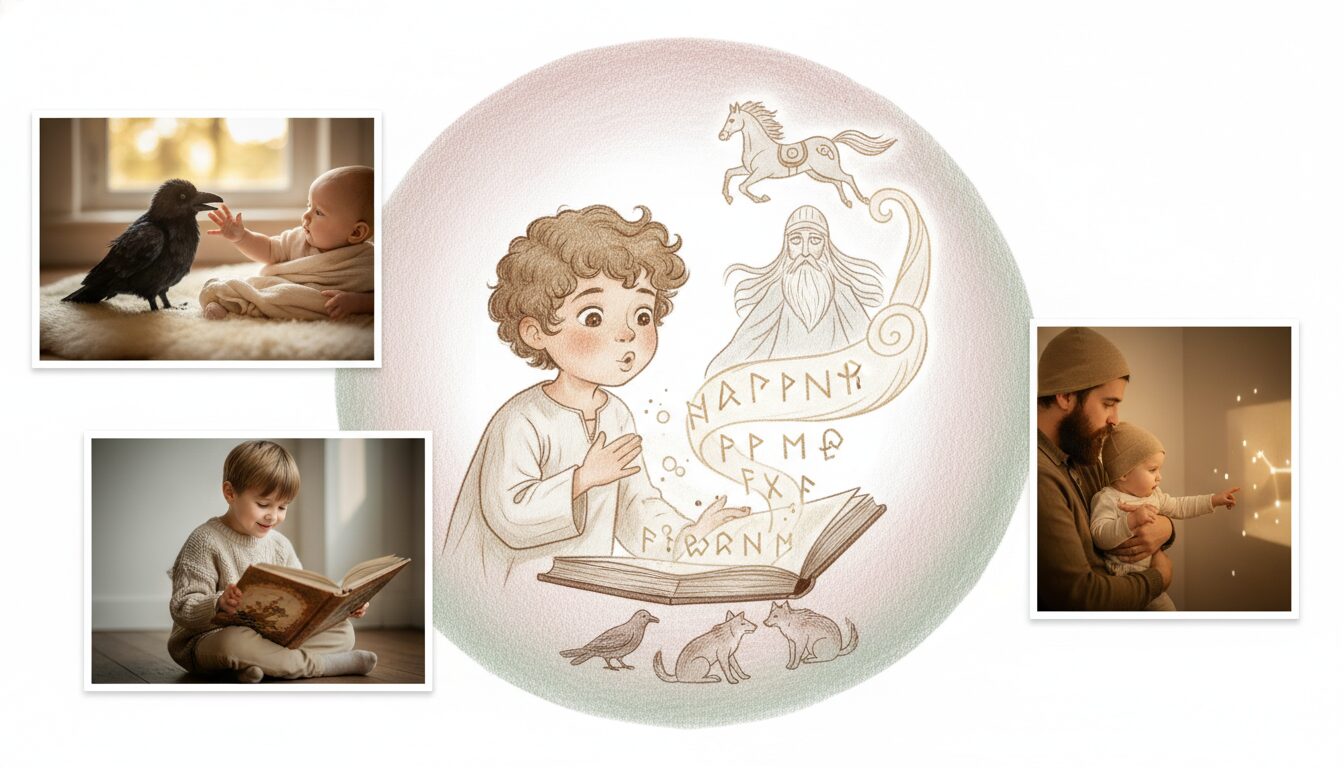
- The raven, symbolizing wisdom and memory. Odin is often depicted accompanied by two ravens, Huginn (thought) and Muninn (memory), who bring him news from around the world.
- The tree Yggdrasil, the immense cosmic ash that connects the worlds, evokes interconnection and permanence. It reminds us that the quest for knowledge is a path of patience and depth.
- The spear Gungnir, a mark of power and determination, manifests the ability to carry through one’s endeavors.
- The Valhalla, resting place of brave warriors, symbolizes the reward for courage and honor.
These elements offer a symbolic reading which, without denying the legendary aspect, also sheds light on what can be passed on to a child today. For example, encouraging a little Odin in discovery, in openness to his environment, and in respect for life’s cycles fits nicely into this symbolic inspiration.
These symbols nourish a narrative that parents can choose to transmit, through readings, objects or associated practices, subtle and respectful. They act as a gentle guiding thread while leaving room for the uniqueness of each child.
Table of the most evocative symbols of the name Odin with their meanings
| Symbol | Meaning | Concrete application for parenting |
|---|---|---|
| Raven (Huginn & Muninn) | Wisdom, thought, memory | Encourage curiosity and learning in a gentle environment |
| Tree Yggdrasil | Interconnection, quest for knowledge, patience | Promote observation and respect for nature |
| Spear Gungnir | Determination and personal power | Encourage autonomy while supporting challenges |
| Valhalla | Courage, honor, and reward | Value efforts without unnecessary pressure |
Contemporary figures bearing the name Odin: inspirations for today’s families
The name Odin is not only rooted in the past. It is also a name borne by many personalities living in a contemporary world, bringing a living and dynamic extension to this heritage.
Among the best known, we note:
- Odin By Farstad, Norwegian speed skater born in 1997, who embodies through his discipline and perseverance the combative yet serene spirit associated with the name.
- Odín Patiño, Colombian footballer born in 1983, symbol of determination on the field, mixing strength and gentleness.
- Odin Bailey, young English footballer born in 1999, illustration of a calm temperament with clear will.
- Odin Langen (1913-1976), American political figure whose career shows responsible and thoughtful commitment.
- Odin Thiago Holm, Norwegian footballer born in 2003, representative of new generations where the name regains fresh vitality.
These figures attest that the name Odin crosses generations with consistency, nurturing a positive imagination but also a form of excellence in different fields. Their diversity illustrates that this name adapts to varied life paths while retaining strong values.
This observation can reassure parents regarding the choice of this name. It reflects a rich identity, capable of flourishing in multiple contexts. It also carries an invitation to gently cultivate the qualities it evokes, in a delicate balance between ambition and self-listening.
The personality and characteristic traits of children named Odin: an invitation to gentleness and courage
The psychology of the name Odin reveals a particular profile, which enlightens parents about their child’s needs and strengths. This knowledge fosters attentive support, where kindness and gentle firmness blend harmoniously.
In detail, the child Odin often appears as a calm personality, seeking affection and emotional security. This gentle nature is a precious asset, contributing to a serene family climate, but it also calls for a patient and reassuring presence to help overcome fragile sensitivity.
Moreover, Odin does not shy away from the taste for challenge. This ambivalence – gentleness and determination – is at the heart of this name, translating a balance between vulnerability and inner strength. He does not hesitate to set goals and stick to them, which can manifest in the child as constant motivation, even in the face of difficulties.
Concrete example: a child named Odin might feel anxiety in conflictual or new situations but will gradually find his way thanks to constant emotional support. Encouraging his initiatives, valuing his achievements – whatever their size – contributes to harmonious and confident development.
Accompanying Odin in this duality means creating an environment where his need for love and quest for accomplishment coexist with respect and balance. This educational perspective fits fully within conscious and nuanced parenting, far from any injunction or performance.
Keys to supporting a child named Odin:
- Listen actively to his emotions without minimizing his sensitivity.
- Value perseverance more than results.
- Offer adapted and progressive challenges designed to legitimize his efforts.
- Create reassuring routines that strengthen his emotional anchoring.
- Promote a warm, inclusive, and non-conflictual environment.
What is the exact origin of the name Odin?
Odin is a name of Nordic origin, directly inspired by Scandinavian mythology where it designates the chief god, symbolizing wisdom, war, and poetry.
Is the name Odin suitable for a sensitive child?
Yes, Odin is often associated with traits of gentleness and sensitivity. It requires benevolent and encouraging parental support, fostering emotional balance.
How to transmit the symbolism of the name Odin to one’s child?
Through reading tales inspired by Norse mythology, using symbolic objects such as figurines or illustrations, and exchanges around the values of listening, courage, and wisdom.
Is the name Odin still popular in 2026?
The name Odin enjoys some popularity, carried by contemporary personalities, attesting to its renewed appeal, especially among parents attached to culture and depth of meaning.
Can Odin be a unisex name?
Traditionally masculine, Odin can today be chosen more freely, some parents appreciating its strong sound and symbol, regardless of gender.