In brief:
- Corsica reveals itself through a map rich in contrasts, marked by the unique union between the Mediterranean Sea and mountains with powerful reliefs.
- Its territory offers exceptional geographical diversity, blending wild coastlines, preserved forests, and rugged massifs, where hiking initiates sensory encounters and landscape learning.
- Iconic cities like Ajaccio and Bastia play a key role in the island’s dynamics, between history and modernity, complemented by island jewels like Bonifacio or Calvi.
- Exploring Corsica requires understanding its regional division and physical particularities for a harmonious journey, adapted to the emotions evoked by these landscapes between sea and mountain.
- This cartographic reading invites awakening to discreet beauties, to marked but rich sensory paths, crucial for any parent seeking to offer their child a natural space balancing well-being and wonder.
Sensitive reading of Corsican geography: when the map reveals the soul of an island
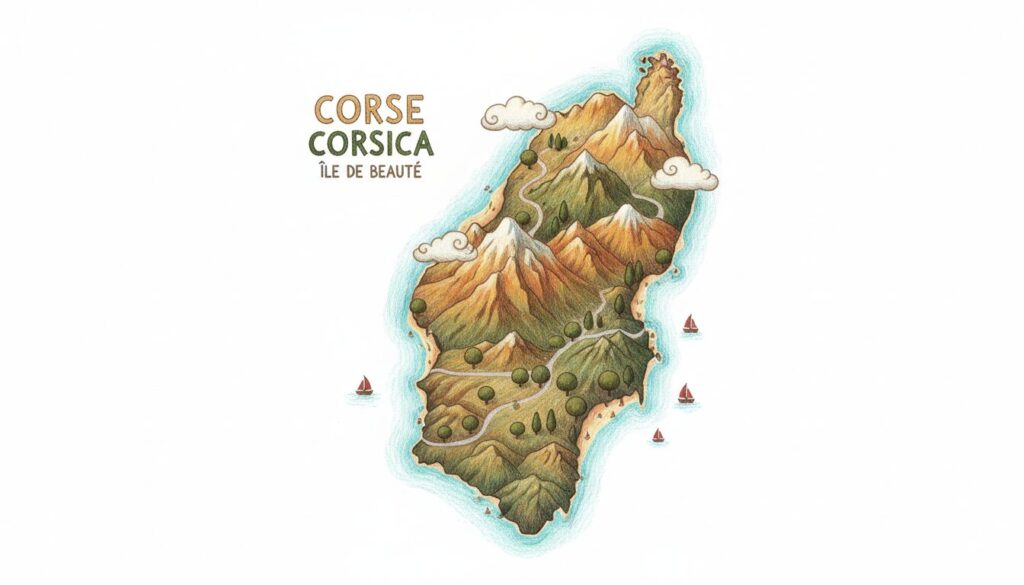
Corsica, often nicknamed the Island of Beauty, invites exploration where the map becomes much more than a simple tool: it becomes an intimate guide revealing the quintessence of a territory shaped by the exchange between the sea and its mountains. Its relief, complex and generous, extends over just over 8,700 square kilometers, offering a panorama where each contour tells a story, each river winds like a line of emotion to grasp.
The gaze cast on the map highlights two major entities: Northern Corsica, dominated by Bastia, and Southern Corsica, centered around Ajaccio. This regional division, while resembling an administrative segmentation, also reflects an essential climatic and topographic duality in discovering the island. In the North, the mountains rise more abruptly, claiming their role as sentinels of the surrounding sea. In the South, the broader beaches alternate with fertile valleys, a gentle conference between sea and land.
This geography is not limited to the arrangement of reliefs and coastal areas. It subtly informs about lifestyles, rhythms, and colors that imbue each village, each path. It is on these routes that the visitor discovers the richness of the natural and cultural heritage, listening to an island that keeps deep within its secrets and mysteries, illuminated by the changing gleam of the Mediterranean.
The Corsican coastline: a promise of calm and wonder along the water
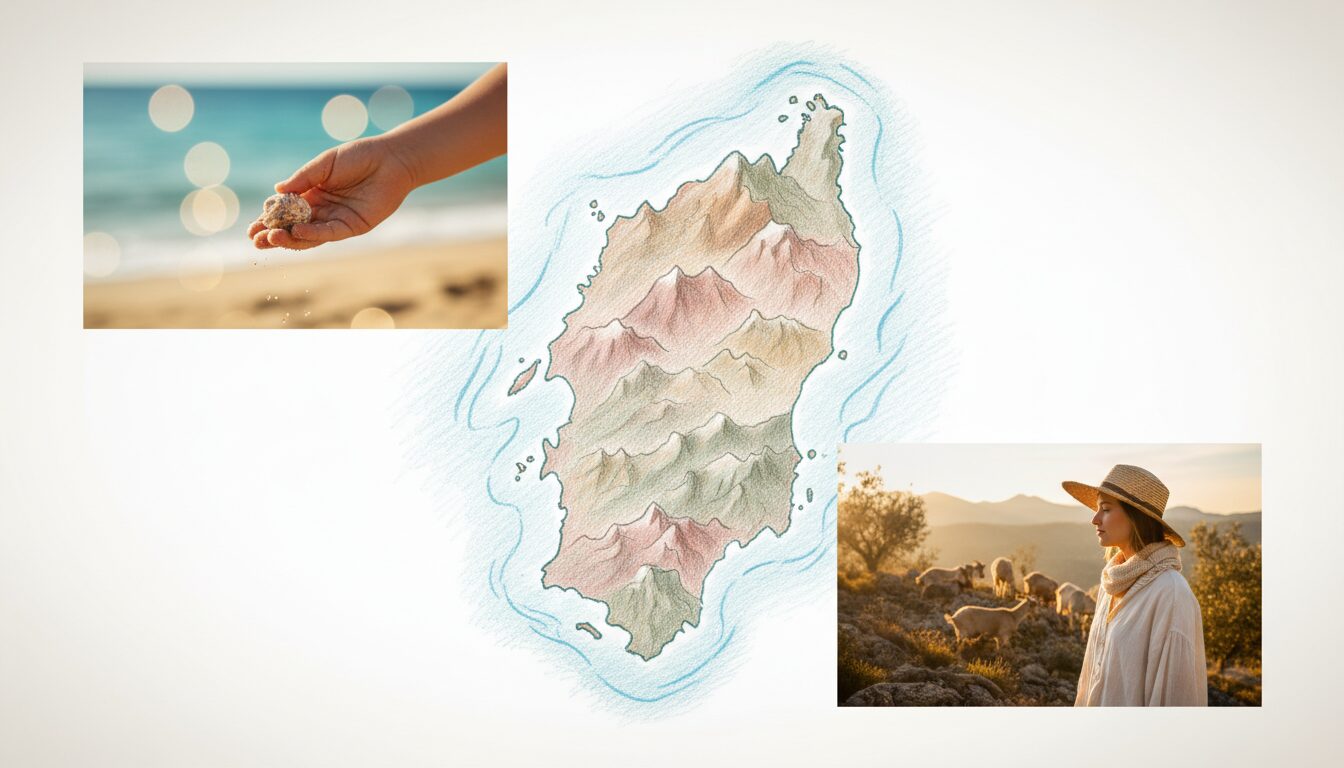
The great wealth of Corsica is first expressed in the relationship it maintains with the Mediterranean Sea. Stretching over approximately 1,000 kilometers, the Corsican coastline invites careful discovery, where the water surrounds the island with infinite turquoise shades.
On the map, this maritime hyphen appears as a moving setting around major coastal cities such as Ajaccio, Bastia, or Ile Rousse. These urban centers have long lived off trade linked to their ports, but also from a tradition of fishing and a deep respect for the nourishing sea, rooted in local practices. The observation of the map also reveals the presence of numerous coves, inlets, and natural beaches, forming havens where calm and beauty settle.
The seaside escapade, whether contemplative, sensory, or sporty, is a privileged moment to match one’s breath with that of the waves. Nothing is more soothing than watching the marine landscape come alive with shifting light, while gently climbing the coastal paths along the shore. The map thus details the main beaches, perfect for family strolls, offering a soft ground to awaken the senses of little ones while promoting emotional balance.
- Calvi: A bay with crystalline waters, ideal for safe marine observation initiation.
- Bonifacio: Its steep cliffs plunge into an intense sea, offering breathtaking panoramas conducive to reflection and serenity.
- Propriano: A more intimate stop, perfect for a pause in insular gentleness.
- The Sanguinaires Islands: A mysterious archipelago accessible from Ajaccio, offering a true dialogue between land and sea.
Each coastal stop thus reveals a different facet of the Corsican soul, reinforcing the idea that the relationship to the sea is also a regenerating breath for the body and mind. This harmony is an indispensable foundation for any family seeking renewal, a place where nature soothes the heart’s questions.
The Corsican mountains: sanctuaries of nature and places of intimate learning
Far from the gentler rhythm of the coasts, the interior of Corsica unfolds into a true mountainous setting, ardent and secret. On the map, these reliefs form a complex canvas made of wild ridges, dense forests, and valleys where time seems suspended. Between sea and mountain, the island thus reveals two faces that enrich each other, fostering a singular dynamic of balance.
At the heart of these heights, hikes present invitations to deep discovery, where each step is a celebration of the senses. The trails offer a tactile and sensory geography, allowing both introspection and renewed enthusiasm in the face of natural surprises. The presence of massifs such as Monte Cinto, the highest peak at over 2,700 meters, or the Niolo region strengthens this idea of intensity and inner exploration.
For parents attentive to the bond that unites the child to nature, these mountain spaces legitimize a gentle and wondrous approach. They are places conducive to teaching patience, progressive discovery of the moving body, as well as respectful contemplation of natural rhythms, essential for emotional development.
| Mountain Site | Approx. Altitude | Dominant Characteristics | Recommended Activities |
|---|---|---|---|
| Monte Cinto | 2,706 m | Highest peak, extensive panoramas | Hiking, wildlife observation |
| Monte Rotondo | 2,622 m | Rocky massif, technical trails | Trekking, botanical exploration |
| Monte d’Oro | 2,389 m | Dense forests, rugged relief | Family walks, nature learning |
| Niolo | Varies according to peaks | Preserved valley, pastures | Gentle hikes, cultural discovery |
This intimate connection with the high Corsican reliefs unfolds a gentle invitation to slowness and respect for the fragility of natural spaces, a guarantee of shared serenity, essential to family harmony. It is a promise that the map can only reveal to those who listen patiently.
Corsican cities and villages: stops of authenticity and rooted life between sea and mountains
The detailed map of Corsica also highlights the presence of cities where time seems to follow a particular rhythm, belonging to each region and rich in cultural heritage. Bastia and Ajaccio, respective emblems of Northern and Southern Corsica, are major gateways, witnesses to an intense history marked by the island’s political and social evolution.
Bastia, a former port city with discreet charm, retains in its alleys the vibrant energy of a hearth turned towards the sea. Ajaccio, for its part, shines through its connection to Napoleon Bonaparte and its strategic position on the western coast, playing a central role in island life.
Around these capitals, smaller villages like Calvi, Bonifacio, Propriano, or Ile Rousse embody the Corsican soul in its purest expressions. These villages are chosen refuges, where one can live the spontaneity of a family stroll between shaded squares and local markets. Their location highlights both the strength and gentleness carried by this land, between mountains and seas, backed by a living heritage.
- Calvi: Its citadel overlooks the bay, reinforcing the feeling of protection and discovery.
- Bonifacio: With its houses perched on cliffs, it offers a deeply moving spectacle, conducive to the gentle contagion of silence necessary for rest.
- Propriano: Known for its beaches and quiet port, a perfect stop to cultivate two-step relaxation.
- Ile Rousse: Imbued with a warm atmosphere, it expresses conviviality gently, between gustatory discoveries and human encounters.
These urban stops shape the journey, revealing a balance between modernity and traditions, where every corner invites taking time to observe, breathe with an open heart, and soak up an authentic and gentle life, in a magnificent natural setting.
Practical cartography: keys for a successful exploration between nature, hikes, and Corsican landscapes
To fully benefit from discovering Corsica, it requires an attentive preparation, where the map is not only a reference but a tool for sensitive understanding. Hiking, a privileged experience between seas and mountains, is thus facilitated by precise reading of the reliefs and villages.
It promotes awareness of routes adapted to emotions and well-being of everyone, especially the little ones. Tourist maps available in 2026, often interactive, offer the most nature-integrated routes, minimizing effort where the pleasure of discovery is maximal. Tourism crowds should not alter this intimate and precious experience; the map helps guide travelers toward more confidential and less frequented trails.
To support this dynamic, here is a list of essentials to consider during a family exploration:
- Balance between mountain hikes and time by the sea: alternate to maintain vitality and calm.
- Choice of stopover villages: favor places offering both warm welcome and spaces conducive to relaxation.
- Respect for children’s natural rhythms: do not overload days, provide sensory breaks.
- Proper preparation: topographic maps, water, clothing suited to fluctuating temperatures between coast and altitude.
- Sensorial learning: invite the child to observe, touch, listen, cultivating a respectful relationship with nature.
In short, the journey begins with the careful consultation of the map, where the biogeographical balance between sea and mountain becomes a source of wonder and shared well-being. This meticulous study before departure is a guarantee of serenity, the best insurance for a gentle, caring, and invigorating adventure.
What is the current capital of Corsica?
Corsica has two regional capitals: Bastia for Northern Corsica, and Ajaccio for Southern Corsica, reflecting the island’s administrative division.
What are the main Corsican mountain massifs?
The main massifs include Monte Cinto, Monte Rotondo, and Monte d’Oro, offering varied landscapes conducive to hiking and nature observation.
What activities are recommended for families on the island?
Gentle hikes, seaside walks, village discovery, and nature awareness are all suitable and enriching activities for families.
How to prepare a hike in Corsica with children?
It is essential to adapt routes to children’s abilities, plan regular breaks, and encourage sensory observation and dialogue with nature.
Why choose Corsica for a family trip?
The diversity of landscapes between sea and mountain, cultural richness, and protected natural setting make Corsica an ideal destination for balanced and soothing family experiences.