
In brief
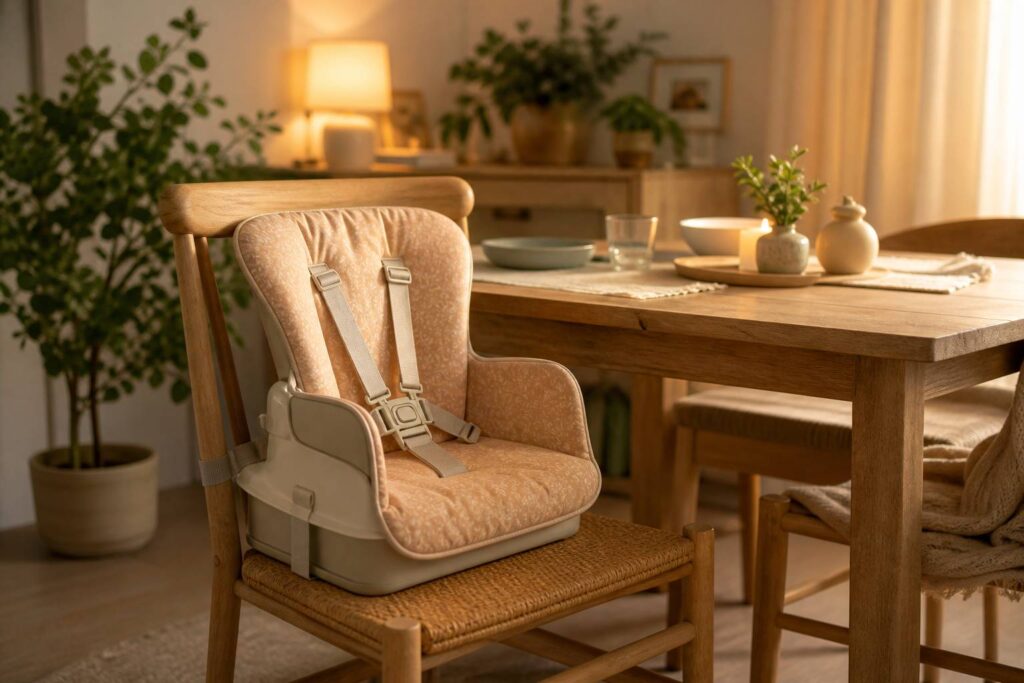
- An official alert concerned a Maxi-Cosi booster seat, the model Jay Plus Elegance Graphite (gray and beige), with two references GTIN 3220660009701 and 3220660009718.
- The critical point does not concern the seat itself, but the removable play tray with arch, from which pieces may detach after repeated handling.
- The identified danger is a risk of choking on small parts, which makes this accessory forbidden for use in the state described by the recall procedure.
- The brand requests to stop using the tray with arch and to contact consumer service for an exchange, with a procedure active until December 1, 2025.
- Concrete markers help secure meals at home and distinguish what is normal prevention from what requires a consultation.
Alert on the Maxi-Cosi Jay Plus Elegance Graphite booster seat: understanding the usage prohibition
Meals of a toddler are often the moment when parents relax a bit. The baby watches, touches, sometimes throws, then tries again. This curiosity is healthy, but it also puts objects to the test, especially those adding playful accessories above a tray.
On Monday, July 20, 2025, a recall procedure was published on the Rappel Conso website concerning a booster chair sold by Maxi-Cosi, in gray and beige colors, named Jay Plus Elegance Graphite. Two identifiers are associated with it, GTIN 3220660009701 and 3220660009718. The recall affected the entire France, with reported presence in many points of sale, including stores and platforms frequently visited by young parents.
This type of alert is not trivial. It fits into a logic of regulation and quality control where the smallest element likely to become a small movable piece counts. A baby explores with their hands but also with their mouth. Between 6 and 18 months, the oral phase remains very active, even after diversification. It is not “a bad reflex,” it is a sensory learning mode that exposes more to the danger of small detachable elements.
The procedure explains that the product does not conform to standards applicable to this kind of equipment because of an accessory present on the tray. It is a play arch fixed on a removable tray. The described defect is mechanical and progressive. If the child manipulates the arch back and forth, the end can weaken and then break after several cycles, releasing small parts.
The word “forbidden” sometimes surprises, as if the entire chair suddenly became dangerous. The nuance given by the brand is useful. Only the removable play tray with arch must no longer be used. The booster and the standard tray would remain usable daily according to the recall. This distinction avoids two common pitfalls. The first is continuing “just for tonight” with the problematic accessory. The second is throwing away a complete product when only one part is concerned and an exchange procedure is planned.
The main theme here is safety at mealtime. The next angle is to understand what a real choking risk means for a young child and why a small piece of plastic can turn a situation around in seconds.

Choking risk: what really happens when a small part detaches
The danger mentioned in the recall procedure is choking. This term covers several mechanisms, and confusing them prevents fast and adequate action. In young children, a small object can either obstruct the airways, cause a false route with coughing and breathing difficulty, or trigger a gag reflex without obstruction. The common point is the potential emergency, especially when the object is sized to pass to the back of the mouth.
Between 6 months and 3 years, fine coordination of “eating-breathing-swallowing” improves but remains immature. Chewing is not like an adult’s. Molars arrive late. Even with good habits, a somewhat dry food or a toy manipulated mechanically can end up in the wrong place. When an accessory releases fragments, no “big visible accident” is needed. A tiny piece is enough.
The scenario described in the alert fits well with daily reality. A baby seated on a booster can push, pull, vibrate an arch. The gesture is rhythmic, self-soothing, and can increase when the child is tired or frustrated. The plastic then undergoes repeated tension cycles. The defect occurs not on the first day, but after multiple uses, which misleads vigilance. An object “that has always held up” can suddenly break.
Recognizing moments when risk increases during the meal
The risk is not limited to the presence of a small piece. It increases when several factors combine. Evening fatigue is a classic. Between 6 p.m. and 9 p.m., many babies have fewer self-regulation resources. Movements become more abrupt. Concentration on food decreases. Hands grab what is within reach, including an arch placed nearby.
The risk also increases when the baby starts standing while holding on, or when throwing objects to observe the reaction. This is not provocation. It is cause-and-effect experimentation. An accessory that breaks in this context can release a piece unnoticed by the adult, especially if it falls into a bib, plate, or seat fold.
Concrete prevention at home without turning every meal into a control
The useful prevention is the one that lasts over time. A good marker is checking the meal environment as one would check a coffee table before the arrival of a baby starting to crawl. Parents benefit from adopting a simple routine. Before placing the child, a quick glance at the tray, the fastenings, the torsion zones, and any protruding accessory.
Another effective gesture is to reserve toys for the floor or play mat and keep the chair for eating. The baby’s brain quickly associates contexts. When the chair becomes a play place, the movement of pulling, tearing, shaking increases, especially at the end of meals. Transitions then become harder, and the object is subjected to more mechanical stress.
This understanding of risk makes the conduct clearer. The next point, more pragmatic, helps identify the product, know exactly what to remove, and navigate the exchange procedure without wasting time or energy.
A reliable demonstration video, focused on airway clearing in infants, helps turn anxiety into memorized actions. The goal is not to live in fear but to have a clear plan if an incident occurs.
Recalled booster: identification, affected products, and what remains authorized for use
In a product recall, precision protects. A model can exist in several variants. A color can change. A production year may differ. The safest way is to rely on the official identification. Here, it is the Maxi-Cosi booster Jay Plus Elegance Graphite, gray and beige, associated with two GTIN codes. These codes correspond to identifiers used for logistical tracking and sales.
The announced distribution being national, the product could be found in varied circuits. Specialized baby stores, marketplaces, regional distribution networks. This explains why a parent might have bought it without feeling “at risk,” simply because the product was present in a trusted store or on a well-known platform.
What is prohibited and what is not
The brand’s wording is clear. The removable play tray with integrated arch must no longer be used. This is the element linked to non-compliance with standards. The rest of the booster, as well as the standard tray, is indicated as potentially continuing in daily use.
In practice, this means that a parent can continue to seat the child in the booster if the play arch is completely removed and kept out of reach. “Out of reach” matters. A 10-12 month-old baby can move quickly, pull an object left on a low buffet, and immediately bring it to the mouth. Keeping it high or in a closed cupboard prevents forgetting.
Reference table to decide quickly, without interpreting the regulations
When fatigue is present, deciding becomes harder. A simple table helps move from information to action, especially when several adults take turns (parents, grandparents, childminder).
| Situation at home | Risk level | Prevention conduct | When to seek professional advice |
|---|---|---|---|
| Jay Plus booster is used with the standard tray (without arch) | Usual mealtime risk, not related to recall | Check the straps and stability, supervise the child during meals | If the child slips despite adjustments or if posture is unstable |
| The removable play tray with arch is still assembled | Increased risk related to detachable parts | Stop use immediately and remove the accessory | If a fragment is missing, if the child has put an element in their mouth |
| A piece is found on the floor, size “small part” | Immediate risk if ingestion possible | Check the environment, monitor breathing, coughing, coloring | If persistent cough, breathing difficulty, unusual vomiting |
| The product was purchased via an online platform | Variable risk, depending on the accessory involved | Note the GTIN, contact consumer service for exchange | If no response within a reasonable time and unable to secure use |
This sorting of “what is concerned / what is not” avoids impulsive decisions. It also prepares the next step, which matters for long-term safety, the exchange procedure, and how to manage the transition period without exposing the child.
A step-by-step demonstration of checking a recall and using product codes helps families act quickly, especially when the item was gifted or bought several months ago.
Exchange procedure until December 1, 2025: act without delay and secure meals
The recall mentions an active procedure period until Monday, December 1, 2025. Even if this date has passed in some homes when this information circulates, the issue remains the same. A recalled product may remain in a kitchen, cellar box, vacation home. It may also be resold or given away without ill intent. Clear information protects the entire chain.
The brand requests to stop using the concerned product and contact consumer service. The device planned is an exchange rather than a refund. For parents, exchange is often preferable if fast, as it allows maintaining a seating solution without urgent repurchase.
The realistic sequence when there is only one booster at home
When only one seat is used both for diversification, meals, and sometimes quiet activities, removing the problematic accessory can disrupt. The simplest solution is to separate “sit to eat” and “occupy oneself.” A washable placemat, a small training spoon, a single-piece teething ring can suffice during meals. Toys with parts, arches, clip-on elements remain on the floor, supervised, in a dedicated time.
If another booster must be used temporarily, prevention involves two points. Stability first. A booster is reliable only if securely attached to a stable adult chair with seat strap and back strap when present. Posture second. The pelvis must be at the back, the back supported, and feet ideally resting on a footrest to limit sliding and sudden movements that increase traction on accessories.
A short checklist before each meal, that holds even on difficult days
- Completely remove the play arch and store the accessory out of reach, not on a nearby chair.
- Check that the tray used is the standard tray and that it shows no cracks or abnormal play.
- Verify that the child is buckled as intended, without twisted strap, and that the adult chair does not tip over.
- Keep direct visual contact during food intake, especially late in the day when fatigue increases movements.
A parent does not have to master everything to protect their child. The goal is to reduce the probability of an incident and increase response capacity if something happens. This naturally opens a broader question. How to recognize a high chair, booster, or accessory compliant with standards, beyond brand or design?
Standards, regulation, and choosing a booster in 2026: concrete markers for lasting safety
Baby equipment sometimes gives a false impression of “everything is regulated, so everything is equal.” Regulation exists, but conformity can be compromised by design flaws, fragility in a series, or an accessory added to make the product more attractive. A recall like this reminds us of a reality. The safety of a seat depends not only on the seat itself but also on what is within hand and mouth reach.
A booster serves a simple function: raising the child to table height with correct support. As soon as an accessory introduces moving parts and break points, the level of requirement rises. This is not criticism of play, it is a mechanical and developmental reading. An 8-month-old baby tests resistance. A 14-month-old baby seeks effect. A 20-month-old baby may disassemble. The same object goes through these stages, while its materials do not change.
Details that truly protect daily
The first marker is the simplicity of parts in direct contact. A monobloc tray, smooth edges, fastenings accessible to an adult but not easy for a child to manipulate. The second marker is overall stability. A booster must remain stable even if the child leans forward to grab a fallen spoon. The third marker is maintenance. A tiny crack, a whitened stress area, a new “click” on a piece are signals to take seriously.
The fourth marker is usage consistency. If the seat is meant for eating, the play tool can be moved to another space. Many domestic accidents occur when functions mix without adults realizing. A baby does not understand the difference between “playing roughly” and “eating calmly” while their inhibition system is immature. This capacity develops progressively between ages 2 and 5, with wide variations depending on temperament.
Consultation box: when safety calls for medical advice
An incident does not always lead to emergency, but some signs justify seeking advice without delay, particularly after suspected ingestion of a small part.
Consult quickly if the child shows breathing difficulty, unusual persistent cough, wheezing, changes in voice or crying, bluish lip color, or unusual drowsiness. Medical advice is also indicated if a fragment is missing and not found, even without immediate symptoms.
This approach links product information to the child’s bodily reality. Vigilance relies on observable signs, not diffuse anxiety. A final angle stabilizes the situation over time, organizing the home so that recalls are not “news” but an adaptable safety routine.
How to know if the booster at home is part of the recall?
The concerned model is the Maxi-Cosi Jay Plus Elegance Graphite (gray and beige). The most reliable verification is done with GTIN codes 3220660009701 and 3220660009718, generally present on the product label or packaging. If the play arch is present on the removable tray, it must be removed and set aside during the exchange process.
What exactly is forbidden to use?
The usage prohibition targets the removable play tray equipped with the arch. The described defect can cause breakage after repeated handling and release small parts, with a choking risk. The Jay Plus booster and its standard tray are announced as usable daily by the brand, provided the accessory with arch is no longer used.
What to do if the child put a piece in their mouth or if a piece is missing?
If a fragment may have been swallowed or inhaled, monitoring should focus on concrete signs such as persistent cough, breathing difficulty, wheezing, change in cries, unusual vomiting or bluish coloration. These signs justify rapid medical advice. If a piece is missing and not found, it is reasonable to seek advice even without symptoms, as some foreign bodies can go unnoticed initially.
How to secure meals during the product exchange?
Remove the arch and use only the standard tray if intact. Secure the booster firmly to a stable chair, buckle the child according to the provided system, and limit objects on the tray to mealtime essentials. Reserving toys for the floor in a dedicated time reduces abrupt handling and the temptation to pull or shake an accessory.