

In brief
- Vercingetorix is an Arvernian aristocrat who became the main face of the Gallic Rebellion against the Roman conquest in 52 BC.
- His authority is based less on stable royalty than on his ability to unite, for a time, peoples with often divergent interests.
- He achieves a major success at Gergovia, where Julius Caesar’s legions have to halt their attack and retreat.
- At Alesia, the Roman siege strategy, exhaustion of supplies, and insufficient arrival of reinforcements lead to the Gallic defeat.
- His fate, known mainly through Caesar’s writings, has become a powerful symbol of resistance and a lasting cultural figure in ancient French history.
Vercingetorix, a Gallic leader born in a Gaul already under Roman pressure
Vercingetorix does not appear in a peaceful Gaul, suddenly disrupted by a single confrontation. When he takes the lead of the Gallic Rebellion in 52 BC, Julius Caesar has already been conducting a military campaign in Gallic territories for several years. The Roman legions have defeated peoples, established alliances, extracted resources, and imposed their presence on strategic routes. War transforms the lives of communities, exchanges, and local political balances.
Gaul does not form a unified state. It brings together a mosaic of Celtic peoples, including the Arverni, the Aedui, the Bituriges, the Sequani, and the Carnutes. Each has its leaders, commercial networks, rivalries, and interests. Some groups have chosen an alliance with Rome, sometimes by calculation, sometimes under duress. Others refuse to see their autonomy diminished. This division explains the difficulty of any common resistance against an army organized around a single command.
Vercingetorix is generally presented as the son of Celtillos, an Arvernian aristocrat who allegedly aspired to exercise royal authority. According to the account transmitted by Caesar, Celtillos was executed by his own people for this ambition. The details of his son’s childhood escape historians. His date of birth remains unknown, although it is often placed between 82 and 72 BC. Available sources do not allow for a precise reconstruction of an intimate biography. They mainly outline the path of a young noble trained in war, eloquence, and alliances.
His name is often interpreted as “great king of warriors” or “supreme leader of fighters.” This translation helps understand the prestige associated with the figure, but it should not lead one to believe in the existence of a centralized Gallic kingdom. Vercingetorix becomes powerful because he gains the allegiance of warriors and peoples in a wartime context, rather than because he governs a unified Gaul. His authority thus depends on his ability to persuade, delegate responsibilities, and maintain a fragile coalition.
Ancient authors themselves must be read with caution. The main source is Julius Caesar, in the Commentaries on the Gallic War. This text is valuable because it provides a chronology of the campaigns and describes military operations. It also serves the political interests of its author. Caesar writes to highlight his decisions, courage, and victory. Vercingetorix appears there both as a dangerous adversary and as proof of the greatness of the Roman victor.
The portrait of the Arvernian leader thus rests on two overlapping realities. There is a historical man, engaged in a brutal war, whose choices were subjected to constraints of supplies, distances, and alliances. There is also a figure reconstructed over the centuries. Textbooks, statues, and popular works have retained the image of a proud leader defying Rome. This image sometimes simplifies the complexity of the moment but reflects a lasting memory of political freedom.
The strength of Vercingetorix comes from having understood that internal rivalries had to be suspended to face Roman power. The Gallic peoples do not suddenly become alike. They rather accept a common military leadership because the danger seems immediate. This limited-time cohesion already represents a significant break in the history of Caesar’s campaigns.
The rise of the Arvernian leader thus prepares a war where individual bravery is no longer sufficient. Facing the legions, coordination of cavalry, protection of fortified places, monitoring of supply routes, and enforcement of collective discipline are necessary. It is in this organization, as much as in legend, that Vercingetorix’s stature is formed.
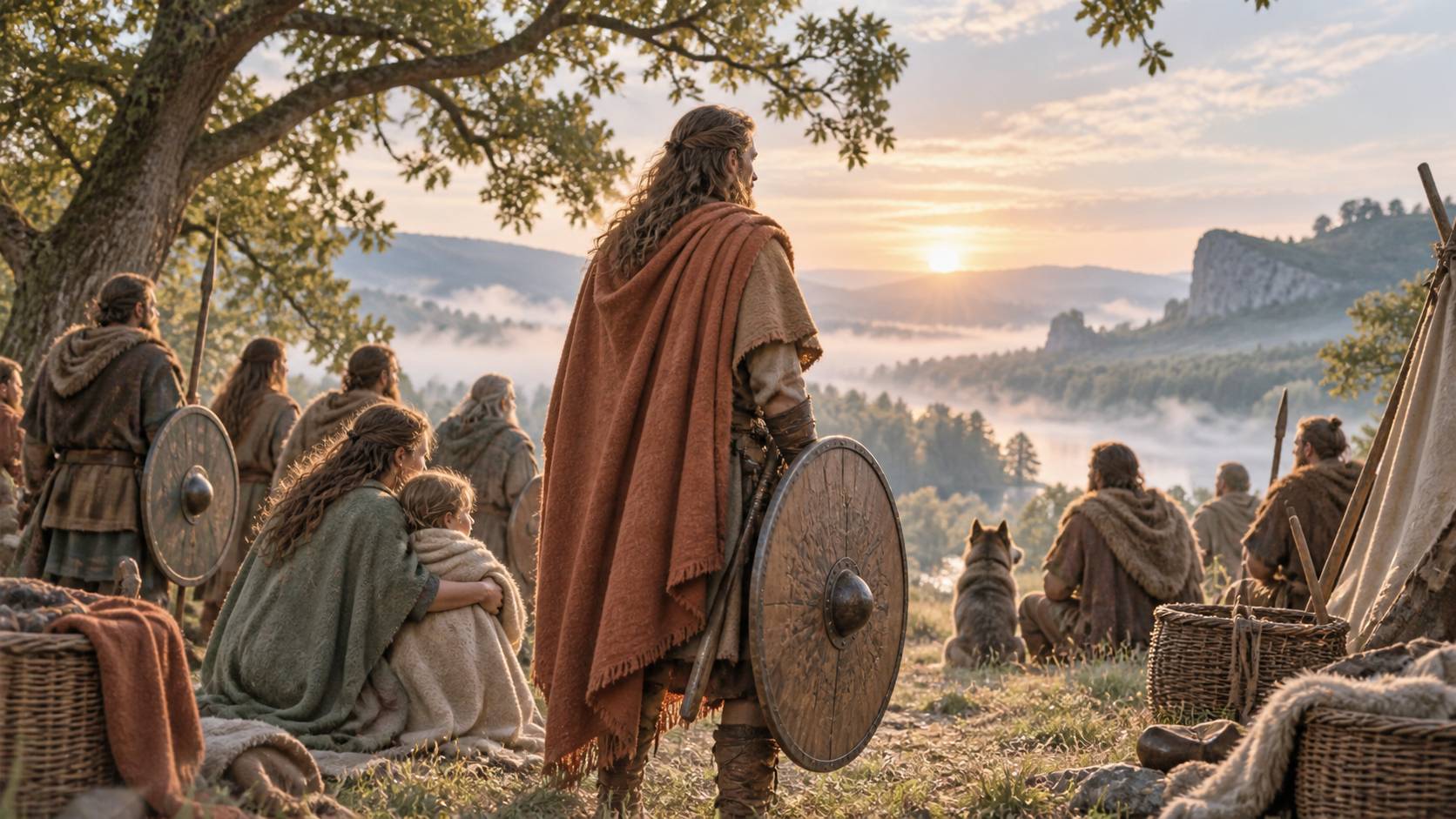
The Gallic Rebellion of 52 BC and the art of uniting the peoples of Gaul
The great insurrection of 52 BC does not arise from a single order launched from Arvernian territory. It is part of an accumulation of grievances. Roman demands weigh on local elites, hostages guarantee alliances, and successive defeats modify the balance of power. The Carnutes initiate the movement by massacring Roman citizens at Cenabum, present-day Orléans. The episode acts as a signal in several regions of Gaul.
Vercingetorix then tries to mobilize the Arverni. Caesar’s account indicates that he first meets opposition from part of his aristocratic entourage, who expel him from Gergovia. Nevertheless, he gathers supporters in the countryside and returns with sufficient force to take command. This sequence reminds that his rise to power was not a peaceful succession. It results from a political struggle within his own people.
The peoples who rally to him do not all renounce their interests. Some join the coalition late. Others negotiate their participation. The Aedui, long allied with Rome, also experience divisions. A military alliance of this scale demands concrete guarantees. Contingents must be provided, cavalry made available, stocks gathered. Resistance is not based solely on speeches of courage. It depends on costly decisions for the communities engaged.
Vercingetorix’s initial success is based on a simple yet demanding idea: deprive the legions of resources rather than systematically confront them in open battles. This tactic is often called scorched earth policy. The inhabitants evacuate and destroy certain supplies, some dwellings, and supply zones likely to feed the Roman army. The aim is to make Caesar’s movements more dangerous and more costly.
This decision has a considerable human cost. Burning a village or abandoning crops means weakening the families living there. Populations must carry what they can, find refuge in oppida, and accept a more precarious life. Oppida are large fortified sites, often situated on heights. They serve as political, economic, and defensive centers. They are not isolated castles but occupied spaces protected by ramparts, ditches, and controlled access points.
The city of Avaricum, associated with the Bituriges, shows the limits of this strategy. The inhabitants obtain that their city be spared because it appears well defended and richly supplied. Yet Caesar besieges it and takes it after great difficulties. The losses reported by ancient sources are very heavy, although exact numbers remain impossible to verify. This episode recalls the violence of war and the vulnerability of civilians caught between opposing military decisions.
To understand the role of this Arvernian leader in the Gallic War, one must look beyond the image of a solitary warrior. He must convince distant peoples, contain hesitations, and circulate information across vast territory. Cavalrymen play a major role in transmitting orders, monitoring enemy movements, and attacking scouts. The speed of circulation becomes a weapon.
The Gallic coalition remains vulnerable, however. Rome has an army accustomed to building camps, moving supplies, and obeying a stable hierarchy. Gallic dissensions do not disappear just because a common danger has brought them closer. They remain in the background, ready to reappear in the most difficult decisions. The campaign of Gergovia will show that this unity can produce a victory, though it does not guarantee the outcome of the war.
The Battle of Gergovia, the victory that confirms Vercingetorix’s prestige
Gergovia occupies a special place in the memory of Vercingetorix. It represents the clearest victory won against Caesar during the great Gallic Rebellion. The site is located on a plateau overlooking the Limagne plain, near present-day Clermont-Ferrand. Its elevated position offers defensive advantages. The slopes complicate the approach for Roman troops and give defenders a better view of enemy movements.
After the capture of Avaricum, Caesar seeks to regain the initiative. He heads toward Arvernian territory, the political heart of his adversary. Vercingetorix avoids being trapped in a battle chosen by Rome. He positions his forces on the heights and protects the access routes. Fighting occurs in a difficult environment, where each movement depends on terrain, visibility, and the ability to keep units grouped.
Ancient accounts describe a Roman maneuver aiming to feign an attack on one part of the Gallic line in order to strike another. The strategy fails. The legionaries, carried by their momentum, advance further than expected. They find themselves exposed before Gergovia’s defenses and facing fighters who know the terrain. The Gauls repel the assault. Caesar admits defeat and mentions notable Roman losses, though the figures are not considered certain by all specialists.
At Gergovia, Vercingetorix takes advantage of the terrain, coordination of his forces, and the enemy’s impatience rather than lasting military superiority. This nuance helps understand the real significance of the event. Caesar is not annihilated, his legions are not destroyed, and his command chain remains operational. However, the Gallic victory is considerable politically. It proves that Rome can be contained and encourages new defections.
The battle strengthens the credibility of the Arvernian leader. In a coalition where each people evaluates the risk of engagement, defeating the legions lends weight to his word. Hesitant communities see that organized resistance is possible. The Aedui, long close to Rome, then switch to revolt. This change shifts the regional balance, as the Aedui control territories and useful routes between central Gaul and southern zones.
The victory also reveals the difference between two ways of conducting war. The Gauls favor their cavalry’s mobility, knowledge of the plateaus, and protection of oppida. The Romans rely on very disciplined units, rapid fortification works, and robust logistics. None of these forces alone guarantees victory. Command must choose the time, place, and type of engagement that favor it.
| Observed element | Vercingetorix’s forces | Caesar’s forces |
|---|---|---|
| Terrain | Mastery of heights, access routes, and local paths | Ability to recognize terrain and adapt maneuvers |
| Mobility | Numerous and fast cavalry to harass or transmit orders | Disciplined infantry, capable of long marches and rapid constructions |
| Organization | Large coalition but dependent on variable loyalties | Centralized chain of command around legates and Caesar |
| Supply | Ability to deprive the enemy of local resources | Military logistics and ability to seize or protect stocks |
After Gergovia, the outcome seems open. Caesar must withdraw and join other Roman forces. However, this stage does not mark the end of the Roman conquest. The Roman general keeps his composure, gathers his troops, and notably benefits from the support of German cavalrymen. The war then changes rhythm. Local successes now must be turned into durable strategic advantage, which implies not allowing the adversary to rebuild its means.
Gergovia thus remains a real victory, not just an episode shaped by national memory. It recalls that the legendary Gallic chief managed to impose a setback on one of the greatest military commanders of his time. But it also shows the fragility of a victory when it is not accompanied by lasting control of roads, resources, and alliances.
Alesia, the Roman strategy that traps Gallic resistance
After Gergovia, the campaign moves east. Vercingetorix tries to exploit Roman difficulties, notably through cavalry. Near Dijon, during a confrontation whose exact location remains debated, Gallic forces fail to defeat the German cavalry engaged alongside Caesar. This cavalry gives the Romans a decisive advantage in mobile combat. The Gauls then retreat into the oppidum of Alesia.
The site of Alesia is today generally identified with the Mont Auxois, near Alise-Sainte-Reine, in Côte-d’Or. Archaeological research since the 19th century, then reinforced by modern investigations, have uncovered traces compatible with the siege described by ancient texts. The debate was long lively because Alesia took on a symbolic dimension. Archaeological data strongly support the Burgundian identification, without erasing all discussions about operation details.
The choice to take refuge in a fortified place may seem logical. Alesia offers defenses, a high position, and a place to concentrate forces. It becomes dangerous, however, if the enemy controls the surroundings. Caesar refuses a frontal assault. He chooses a slower method, but adapted to his army. His men build a line of circumvallation facing the oppidum to prevent the besieged from exiting. They add a second line facing outward, called contravallation, to resist the announced relief army.
At Alesia, Caesar turns time into a weapon by cutting exits, securing his own positions, and waiting for supplies to run out among the besieged. Roman works include ditches, earthworks, palisades, towers, and traps. Their exact extent is debated according to interpretations, but the principle is clear. Rome builds a fortress around a fortress and places the enemy at the center of a complex defensive system.
The situation of the inhabitants and fighters trapped quickly becomes critical. Food supplies decrease. Ancient sources report the expulsion of non-combatants from the oppidum, hoping they will be taken in or fed. Caesar claims to have refused them. This fact is reported by a directly involved author and calls for caution, but it says something about the extreme harshness of the siege. War does not strike only those who bear arms.
A Gallic relief army comes from outside. It gathers contingents from several peoples, but the numbers announced by Caesar are probably exaggerated. Ancient figures often serve to magnify a victory. The decisive question is not only the number. The external attackers must coordinate their attack with the defenders enclosed, on terrain crowded with Roman fortifications. Communications are difficult, assault timings must be exactly chosen, and every delay benefits Caesar.
Fighting succeeds each other for several days. The Gauls seek weak points, notably on slopes where Roman works are more vulnerable. Caesar moves his reserves, sends his cavalry, and concentrates his men where pressure is greatest. The relief efforts finally fail to break the encirclement. The external fighters disperse or retreat. Inside Alesia, hunger, fatigue, and the disappearance of hope for reinforcements radically change the situation.
The siege probably lasted several weeks, often estimated around forty days, without daily precision possible. Traditional images sometimes show a simple duel between two leaders. The military reality is more collective. Thousands of people build, fight, carry, watch, and suffer. Alesia results from strategic choices but also from Roman superiority in siege art and the ability to maintain an army under pressure.
The defeat does not reduce the Gauls’ courage to an illusion. It exposes the limits of a coalition facing a war machine seasoned in protracted war. The battle of Alesia and Vercingetorix’s fate remain studied because they show conquest is played as much in works, supplies, and communications as in close combat.
The surrender of Vercingetorix and the birth of a legendary hero
After the failure of the relief army, Vercingetorix surrenders to Caesar. The scene is known to all, but its details are less certain than one might think. Caesar writes that the Gallic leader comes out of Alesia, approaches him, and places his fate in his hands. Later representations have amplified the gesture. They often depict Vercingetorix on horseback, richly armed, throwing his weapons at Caesar’s feet. This famous image comes mainly from 19th-century painting, sculpture, and popular culture.
The Roman account does not give a complete description of the meeting. It does not allow certainty about the Arvernian chief’s attire, Caesar’s posture, or the exact form of the surrender. This caution does not diminish the event. It allows distinguishing the historical fact, the capitulation of the coalition’s main leader, from the staging elaborated by generations who wanted to give a face to defeat.
Vercingetorix is taken to Rome and remains captive for several years. In 46 BC, Caesar celebrates his triumph after his military victories. The most widely accepted historical tradition indicates that the Gallic prisoner was displayed during this ceremony, then executed, probably by strangulation, in a Roman prison. Sources do not precisely describe his last moments. His body has never been found and later accounts of a hidden death in Gaul are not upheld by mainstream historiography.
Vercingetorix’s death ends his political role but does not close the memory of resistance to Rome. The Gallic War continues after Alesia. Caesar still has to conduct operations against centers of revolt. The Roman conquest therefore does not reduce to an instant victory nor the disappearance of a single man. Roman authority is gradually established by force, through agreements with local elites, and through administrative integration of territories.
In Roman Antiquity, Vercingetorix was known first through the winner’s perspective. He became a major figure again in the 19th century, when France sought origin tales and characters able to embody national continuity. Napoleon III showed strong interest in Caesar and Gallic War sites. He commissioned a monumental statue of Vercingetorix from Aimé Millet. Installed in 1865 at Alise-Sainte-Reine, it helped anchor the hero in the landscape and collective imagination.
This national appropriation has its limits. Contemporary France does not simply descend from a homogeneous Gaul. The history of the territory results from migrations, conquests, cultural mixtures, and successive political constructions. Vercingetorix is therefore not the “first Frenchman” in the strict sense. He belongs to a very distant era when collective identities, languages, and borders do not correspond to today’s.
His image also established itself in popular culture thanks to Asterix. René Goscinny and Albert Uderzo place his surrender at the beginning of Asterix the Gaul, published in 1961. The comic deliberately plays with history. The weapons thrown at Caesar’s feet, the defiant tone, and names ending with “-ix” do not form a scientific reconstruction. Yet they made the character familiar to several generations. The album The Daughter of Vercingetorix, published in 2019, further extends this presence in fiction.
The historical portrait benefits from preserving this dual reading. Vercingetorix was an Arvernian leader, confronted with a concrete war and sometimes tragic choices. He also became a collective reference, reinterpreted according to eras. His symbolic value does not rest on an imaginary perfection. It comes from the mark left by an attempt at unity against a military domination that seemed then difficult to stop.
In museums, on archaeological sites, and in works of fiction, his face changes according to the expectations of those who look at him. Historical work consists of returning to sources, comparing accounts, and recognizing their silences. This method takes nothing away from his strength. It restores to the Gallic chief his human dimension, that of a man placed at the heart of a conflict that durably shaped the ancient history of Western Europe.
Who was Vercingetorix?
Vercingetorix was an aristocrat of the Arvernian people. In 52 BC, he took the lead of a coalition of Gallic peoples revolting against Julius Caesar and the Roman armies.
Which battle did Vercingetorix win against Rome?
His most famous victory is that of Gergovia. Gallic forces there repelled the Roman attack and forced Caesar to withdraw from the area.
Why did Vercingetorix lose at Alesia?
The Romans surrounded the oppidum with vast fortifications, blocked exits, and resisted the Gallic relief army. Hunger, exhaustion, and failure of reinforcements made the position untenable.
How did Vercingetorix die?
After several years of captivity in Rome, he was probably executed in 46 BC following Caesar’s triumph. Strangulation is the hypothesis favored by most historians.
Is Vercingetorix a historical figure or a legend?
He is indeed a historical figure, mainly known through Julius Caesar’s writings. Much of his current image nevertheless comes from artistic, educational, and popular representations created long after his death.