

In brief
- Advent calendars are no longer just for waiting until Christmas: they become objects of decoration, family rituals, and sometimes real keepsake boxes.
- The right choice depends on your household’s pace in December, budget, and children’s ages, with particular attention to small pieces before age 3.
- On the shopping side, 2020 marked the explosion of “hybrid” formats: reading + treats, beauty + reusable object, DIY + photo personalization.
- A calendar can also support an educational or social intention, with solidarity proposals designed to trigger simple family exchanges.
- The elegant and original options are not opposed: they meet when content quality, presentation, and use after the year-end holidays are consistent.
Shopping 2020: why Advent calendars have become elegant and useful rituals
December, in many households, has a particular texture. Time fragments into micro-moments, between school pickups, year-end fatigue, meals to organize, and rising excitement. Advent calendars have taken on a role far beyond the little daily surprise. They structure the month, provide an anchor point, and allow the creation of a short, stable, reassuring routine, even when everything else moves fast.
In 2020, brands understood something very true. Families weren’t just looking for a “cute” object, they were looking for an experience. This led to more elaborate calendars, sometimes elegant in graphic design, sometimes original in promise. This evolution remains very current because it meets a concrete need. A repeated ritual, at a fixed time if possible, helps children anticipate and wait. The child’s brain learns the sequence. This waiting ability develops gradually, and a well-thought-out calendar acts as support without demanding “perfect behavior.”
The choice of calendar deserves a simple benchmark. Before age 3, the issue is not just content but safety. Small pieces, magnetic elements, mini-figures—all increase ingestion risk. At this age, a “story to read” format, a visual calendar with large windows, or a DIY filled with non-ingestible items remains more comfortable daily. Starting from ages 3-4, construction and figurine calendars become more suitable because fine motor skills and understanding game rules are steadier, even though vigilance remains necessary.
Another often underestimated point concerns mental load. A calendar that requires heavy staging every evening ends up abandoned. An autonomous format, placed in the same spot, with simple opening, avoids the 6:30 p.m. tug-of-war. The ritual holds better when short, repeatable, and without endless negotiation. A calendar can be very beautiful yet exhausting if its use doesn’t align with household reality.
In the 2020 selection, this search for practicality is evident in the success of “mixed” calendars. The Disney calendar, 24 stories (Hachette) offered a clear response. One story per evening is also a decompression gateway. Reading aloud, even ten minutes, promotes physiological calming through gradual activation decrease. The voice’s rhythm, proximity, shared gaze—all regulate. Families with difficult bedtimes often notice this without explaining it. A book-calendar transforms waiting into concrete bonding without overstimulation.
The “hybrid” logic is also found with Kinder x Ravensburger, which pairs mini-books and chocolates. This duo works because it combines immediate pleasure and a lasting activity. The child is not “rewarded” for being good. They receive a time marker and an attention proposal. This shift is subtle, yet it changes December’s atmosphere.
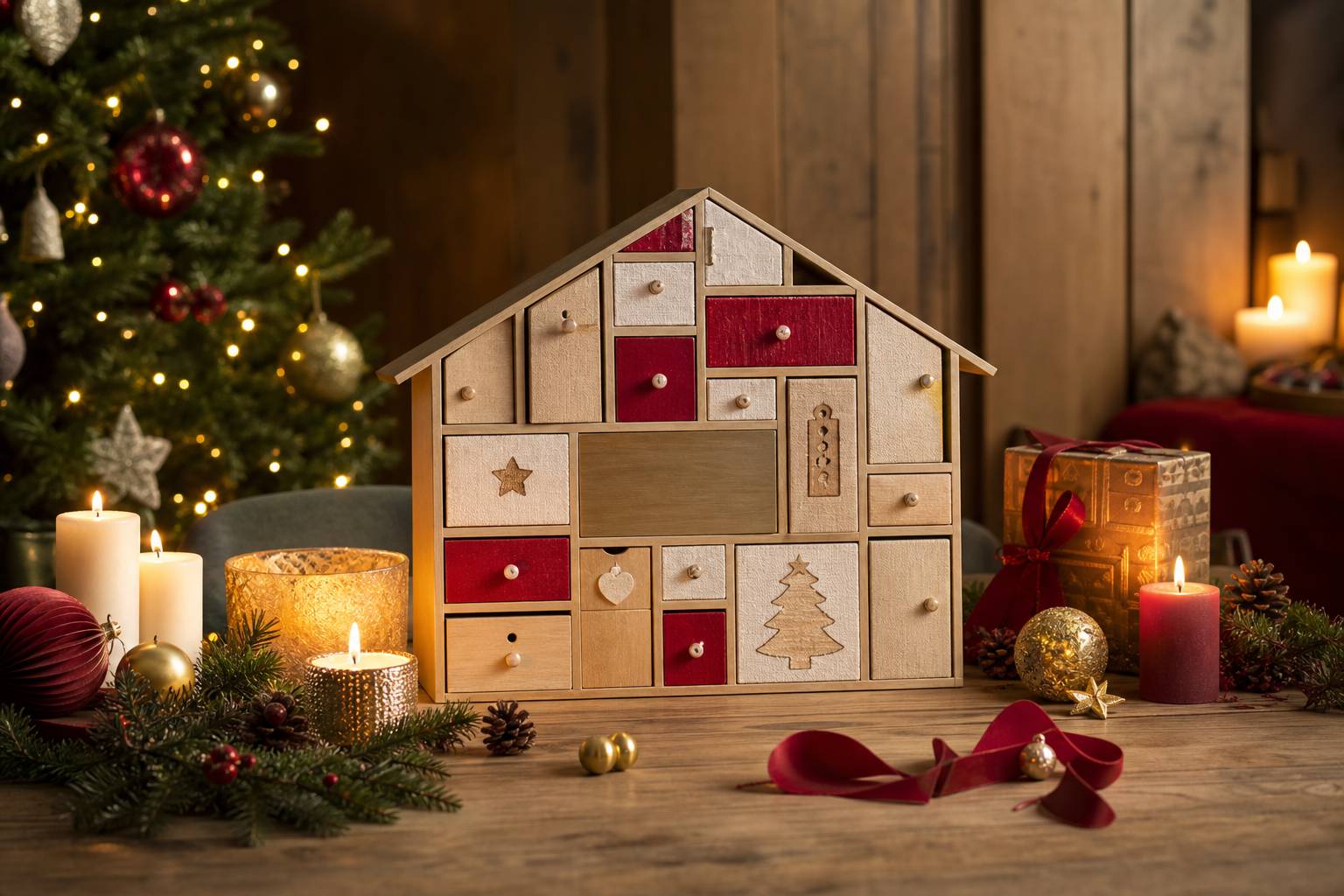
The logical next step, when the object matters as much as its content, leads to more decorative calendars. Some become small houses, drawers, reusable boxes. This “to keep” dimension is not a whim. It responds to a need for continuity. After the 24th, the object remains in the bedroom or bathroom and extends a pleasant feeling without depending on constant purchases. This idea naturally opens onto the second part, beauty and well-being calendars, which have established themselves as real gifts for the year-end holidays.
Beauty Advent calendars 2020: an elegant shopping that respects the skin and year-end rhythm
Beauty calendars often attract adults, but their usefulness is not limited to “pleasure.” December tires the skin. Heating, dry air, more frequent makeup, sometimes shortened sleep. A skincare calendar, when well constructed, becomes a guided routine. It removes some decisions. One day, a hand cream. Another, a lip balm. The benefit comes as much from regularity as from the product itself.
In 2020, several brands offered coherent formats with real range narration. The Nuxe calendar gathered 24 products around its references, including Huile Prodigieuse. The price was in the “box set” range, around €80, which remains a significant budget. The useful question is not “is it worth it?” but “will it be used?” If the calendar ends up on a shelf, value evaporates. If the opening is done in the evening, when the day closes, the routine lasts better.
The Yves Rocher calendar played a different tune, more accessible, mixing face, body, hair care, perfume, makeup. This variety pleases but can also scatter. Sensitive skin appreciates repetitions of already tolerated products. Skin that reacts easily to fragrances or actives benefits from introducing novelty every 2-3 days, not every day. This nuance avoids irritations that spoil the period.
Some 2020 calendars integrated a “reusable object” dimension, which changes the relationship to shopping. Nocibé’s Premium Beauty calendar, designed to transform later into a jewelry box or makeup storage, met this need. The gesture of keeping the case extends the care sensation. This continuity is precious in postpartum too, when self-image changes quickly and sensory benchmarks matter. A hand cream applied for two minutes, with a familiar scent, can reduce tension. Without unrealistic promises, these are micro-resources.
The Rituals calendar, with its Christmas village and generous formats, is typically a “ritual” calendar. The packaging is very decorative, almost a decoration element on its own. This aesthetic works well when it fits into the home. A simple rule helps. If the calendar has no designated place, it becomes a stray object and banalizes. Placed on a dresser, a mantelpiece edge, or an out-of-reach shelf for toddlers, it keeps its function and prevents accidents.
The luxury register was represented by Charlotte Tilbury with 12 iconic products in travel or large format, in a very festive case, around €185. This type of calendar is not made for random discovery. It better serves someone who already knows the brand, their skin tolerance, and who wants usable formats up to spring. It becomes a targeted gift, not an impulsive purchase.
An interesting intermediate option was MylittleBox, with 10 accessories and 14 products from partner brands, for a selling price around €50-55 depending on profiles. The psychological mechanism behind this success is simple. Variety gives the impression of a large number of daily “small victories.” This logic works well when December is busy and the brain seeks short positive benchmarks.
A point of vigilance deserves to be clearly stated. Beauty calendars are not suitable for baby skin. Scented products, essential oils, certain preservatives are too irritating. For a toddler, skin has a more permeable cutaneous barrier. Care must remain simple. If a “family” calendar is within reach, it’s better to secure it because the child will explore. The temptation to “do like the grown-ups” comes early.
After beauty, the other major 2020 pillar remains indulgence. Here too, elegance is not just about taste. It depends on how sugar and frustration are managed at home, without dramatizing and without turning the food into a taboo. This is the subject of the next section.
Gourmet Advent calendars 2020: chocolate, biscuits, and teas without turning December into a permanent negotiation
Chocolate calendars have immediate appeal. Quick pleasure, a rewarded wait, a reassuring tradition. In 2020, versions diversified. The Kinder Choco + Biscuits calendar offered a precise assortment, with mini chocolates, mini bars, Happy Hippo-type biscuits, and Cards, for about €10. The format is designed to “please for sure.” It also raises a concrete question in families. How to avoid the opening becoming a battle to take two, three, then four?
The child’s brain, especially before ages 6-7, poorly manages stopping a sweet pleasure once activation is triggered. The dopaminergic reward system lights up quickly; inhibition takes longer to settle. A simple strategy helps. Open the window after a stable activity, rather than right after school when tiredness and hunger mix. Snack, then calendar. Or calendar, then tooth brushing if the chocolate is small and organization fluid. The goal is not to forbid but to choose the right moment.
The M&M’s 100% calendar with its three varieties (chocolate, peanut, crispy) was another 2020 example, more voluminous. Here, the useful benchmark concerns the portion. When a packet is “generous,” the temptation to take more is stronger. A small bowl placed next to it, into which the day’s portion is poured, helps materialize the limit without long talk. The child sees it. The frame becomes concrete.
“Biscuit” calendars have also taken an elegant place. Delacre offered 24 varieties with a thin format, easy to slip on a shelf. Bonne Maman, in a limited edition, focused on a “tea time” indulgence, with jams, infusions, biscuits, and a final surprise. This type of calendar changes the atmosphere. It invites slow tasting. Parents often find an unexpected benefit. Ten minutes sitting, a hot drink, a biscuit, restore a minimum physiological regularity in a fragmented day.
Tea and infusion calendars exploded around 2020 and remained popular afterward. The “tea selection” calendar sold around €21.90 offered a variety of green, black, rooibos teas and infusions, with a midnight blue and gold aesthetic. Clipper offered a very accessible format in mass retail, with 24 organic sachets at a low price. Pukka played the organic blends card, often more aromatic. For a family, this type of calendar has an advantage. It doesn’t excite. It accompanies late afternoons when children are more sensitive to emotional surges.
A detail counts in households with young children. “Gourmet” infusions and some Ayurvedic compositions sometimes contain licorice, fennel, or physiologically active plants. For adults, it’s harmless. For a child, especially a small one, it’s better to stick to water, milk, or an appropriate herbal tea validated by a professional if needed. A child with abdominal pain, reflux, or transit disorders does not need a “random” plant calendar. Parents benefit from keeping the tea calendar for themselves and offering children a parallel ritual, like a story or creative activity.
This coherence between pleasure and regulation opens a very rich path. Calendars do not have to be edible. They can be creative, constructive, narrative, and support attention without overstimulation. This is often where the most durable original is found.
Advent calendars 2020 for children: play, read, build without overstimulation
December puts children in a state of permanent anticipation. Lights, music, adults’ conversations, packaging—all increase excitement. A calendar designed for the child can help channel or, conversely, amplify it. The benchmark fits in one sentence. A calendar that adds “calm” play at the end of the day soothes more than one that multiplies noisy micro-toys.
Figurine calendars such as Playmobil “The toy shop” (ref. 70188) offer characters and accessories to assemble in a setting. The developmental interest is real. The child creates scenarios, works the sequence, language, symbolic representation. This type of play is particularly fruitful between ages 3 and 7, with great variability depending on temperament. A very active child will need a physical “discharge” time before sitting down. A more contemplative child will dive directly into staging.
The “Cars” calendar with mini-racers is in the same category. A few vehicles, accessories, and the possibility to tell stories. Here too, regulation depends on timing. Opened in the morning, it can excite all day. Opened late afternoon, it can support calm play before dinner.
“Universe” calendars also have a cultural dimension. The collector edition “Back to the Future” by Playmobil reconstructed the town hall square with figurines and mystery windows. This type of calendar speaks more to parents often because of nostalgia. This nostalgia can become an intergenerational bridge. A parent tells the film story; the child listens, even if they don’t see it. This gentle transmission creates a bond, without imposed screen time.
Creative calendars like Auzou Créatif offer jewelry and decorations to make, sometimes a glitter pen, with hidden windows in a setting. They are very useful for children who need to occupy their hands. Fine motor skills are worked. The brain concentrates. An anxious child often benefits from this focus. Vigilance lies with small elements. If the child still puts many things in their mouth, adapt, keep pieces out of reach, and do the activity accompanied.
The Clementoni “24 magic tricks” calendar has another strength. It transforms surprise into progressive learning. Each day adds a skill. The child experiences error, repetition, presentation. For some, it becomes support to gain confidence. Magic has a reassuring “control” dimension. December’s world is unpredictable; magic repeats. When the trick works, the child holds something stable.
“Story to read” calendars like the Disney 24 stories have a particularly interesting effect on sleep. Between 6 and 12 weeks, a baby gradually sets its circadian rhythm, but an older child remains sensitive to evening rituals. A repeated story, in the same place, even very short, lowers emotional intensity. It helps switch from “action” mode to “recovery.” That does not solve everything. A child who wakes at night, has frequent nightmares, or marked anxiety may need more specific support. A ritual is not a treatment; it is support.
A clear box helps avoid trivializing what deserves attention. Families often experience restless bedtimes in December. Most of the time, it is transitional. Some signals, however, justify professional advice without waiting for January.
| Situation observed in December | What often falls under normal variation | Signs justifying consultation | Professional to contact |
|---|---|---|---|
| Longer time to fall asleep | Excitement related to the holidays, need for calm time, occasionally shifted bedtime | Persistent insomnia beyond 2-3 weeks, major parent exhaustion, panic attacks at bedtime | Child psychologist, pediatrician depending on context |
| Night awakenings | Rhythm disturbed by outings, irregular naps, occasional nightmares | Significant snoring, breathing pauses, night sweats with difficult breathing | Pediatrician, pediatric ENT if needed |
| Irritability late in the day | Sensorial overload, fatigue, multiple transitions | Marked loss of interest, social withdrawal, daily sadness, worrying remarks from verbal child | Pediatrician, psychologist |
| Conflicts around sweets | Inhibition difficulty, excitation, fluctuating boundaries | Food compulsions, induced vomiting, intense anxiety about food | Pediatrician, specialized dietitian, psychologist |
When the calendar is chosen with this reading grid, it becomes a regulation tool, not an object dispenser. The transition to the next section happens naturally, because many families today want to personalize the ritual, create a calendar to fill, or slip in softer, more social, sometimes solidarity intentions.
Advent calendars 2020 to fill, customizable and solidarity-driven: the surprise that looks like your family
The most successful calendar is not the one that costs the most. It’s the one that fits daily life without friction. In 2020, fill-it-yourself formats gained ground, and this trend continued. It responds to a very simple reality. Families don’t all share the same values, constraints, or relationships with sugar, screens, or objects. A DIY calendar allows adjusting the dose of “stuff” and restoring meaning to the surprise.
The paper calendar from Maisons du Monde (Urban), with its compact dimensions, offered a structure to fill and surprises to hang. This type of support has an advantage. It becomes a full-fledged decoration, and its aesthetic holds even when windows are empty. Filling can be done in one go or in two 20-minute sessions, which remains realistic. The parent chooses. The child only sees the result. This avoids promising a “big calendar” and running out of ideas by December 18.
The Draeger Paris kit with 25 small houses to assemble and fill, plus numbered stickers, is another example. Assembly done with family is already an activity. Motor skills, patience, cooperation are called upon. The child also learns that year-end holidays are prepared, not “falling” from the sky. This type of learning is very structuring.
Customizable photo calendars, like Cewe, added a strong affective dimension. A photo per day or a calendar with Kinder or Ferrero chocolates is a way to anchor the period in family memory. The child’s brain encodes memories better when associated with a stable ritual and moderate emotion, not when everything is excess. A daily photo, commented on in two sentences, creates a gentle continuity. The parent doesn’t need to make a lengthy speech.
Cheerz also offered customizable calendars, including one with chocolates and another 100% photos. The idea of later transforming the object into decor is not anecdotal. Children like to review, touch, handle. A calendar that becomes a bedroom object extends the ritual, helping some children get through the “come-down” after Christmas, sometimes experienced as mini-frustration.
Finally, some 2020 calendars introduced an explicit solidarity dimension. The Serge Bloch solidarity calendar, benefiting Secours Catholique, offered quotes, action ideas, and information to discuss sharing. This type of calendar does not preach. It opens a conversation. Within a family, this can translate into a very simple action. Prepare a bag of clothes, write a card, sort toys, donate a book. The gesture must remain small, or it disappears. The child doesn’t need to “save the world.” They need to understand they can act at their level.
To keep this solidarity calendar compatible with young children, the parent chooses a concrete, short, visible action. The child participates with hands, not just words. This involvement engages the sensory-motor system, and learning becomes more stable. It is also a way to rebalance a period sometimes too focused on material gifts without making the subject heavy.
The final choice often comes down to a simple question. Is it a calendar to consume, to play with, to read, to keep, or to pass on? When this intention is clear, the act of shopping becomes calmer, and the object integrates better into the home.
Which Advent calendar to choose for a child under 3 years old?
A format with large windows and non-detachable elements remains safer. “Story to read” calendars work very well at this age because they create a stable ritual without small pieces. If a calendar contains mini-figurines or accessories, supervision must be close and the object placed out of reach outside the opening moment.
Could a gourmet calendar disrupt the appetite in December?
For many children, daily indulgence increases excitement and makes stopping harder. The most effective benchmark is to choose a fixed moment, after a stable activity, and limit quantity visibly, for example by pouring the day’s portion into a bowl. If conflicts become daily or intense, a simpler framework or a non-food calendar can soothe the atmosphere.
How to spot a beauty calendar really suited for sensitive skin?
Tolerance builds on regularity and simplicity. A calendar with too many scented novelties can irritate. Sensitive skin benefits from progressively testing products, spacing introductions, and favoring already known textures. In case of persistent redness, itching, or patches, a dermatologist’s advice is better than “letting it pass” until the holidays.
Is a customizable calendar worth the effort?
Yes, if filling remains realistic for your pace. A fillable support allows dosing sugar, small objects, activities, and adapting to the child’s temperament. Photo calendars add lasting affective benefit because they extend the ritual after Christmas in the form of concrete memories.
When during the day should the calendar be opened to avoid evening excitement?
Many families find balance by opening it after the snack or dinner, depending on what triggers fewer tensions. If bedtime is fragile in December, opening late afternoon followed by calm time (reading, symbolic play, drawing) limits overstimulation. The goal isn’t the perfect moment but keeping a stable rhythm for several days in a row.