
In brief
- The menstrual cup collects blood instead of absorbing it, which changes the sensation, the flow monitoring, and feminine hygiene.
- A well-chosen cup can offer stable comfort for several hours, with retention mainly depending on folding and unfolding.
- The maintenance routine relies on three simple but non-negotiable steps for intimate health once the cup is adopted, especially at the beginning.
- The topic of the “suction effect” deserves to be understood without fear, particularly in case of an IUD, with a precise removal gesture.
- The ecological and reusable aspect is real if usage is regular and the lifespan is respected.
- The advantages are concrete, but adoption often takes 2 to 3 cycles, the time for the body and hand to learn.
Understanding the menstrual cup and what it changes during menstruation
The first times, the most striking change is a simple difference. The menstrual cup does not “drink” the blood, it collects it. This mechanism changes the sensation of dryness, the perceived odor, and the way the vagina remains lubricated by its usual secretions.
In intimate health monitoring, this nuance matters. An absorbent protection can dry out the mucous membranes in some people, especially at the end of periods or when the flora is fragile. Conversely, a cup leaves the mucous membrane in an environment closer to its usual functioning, provided the maintenance is rigorous.
Historically, the cup is not a recent fad. It was conceived in the 1930s in the United States, with a patent filed in 1937 by Leona Chalmers. Its distribution was long hindered by the taboos surrounding menstruation, but also by the lack of practical information on usage. The 2010s marked a turning point with awareness about waste, and debates on the composition of some disposable protections.
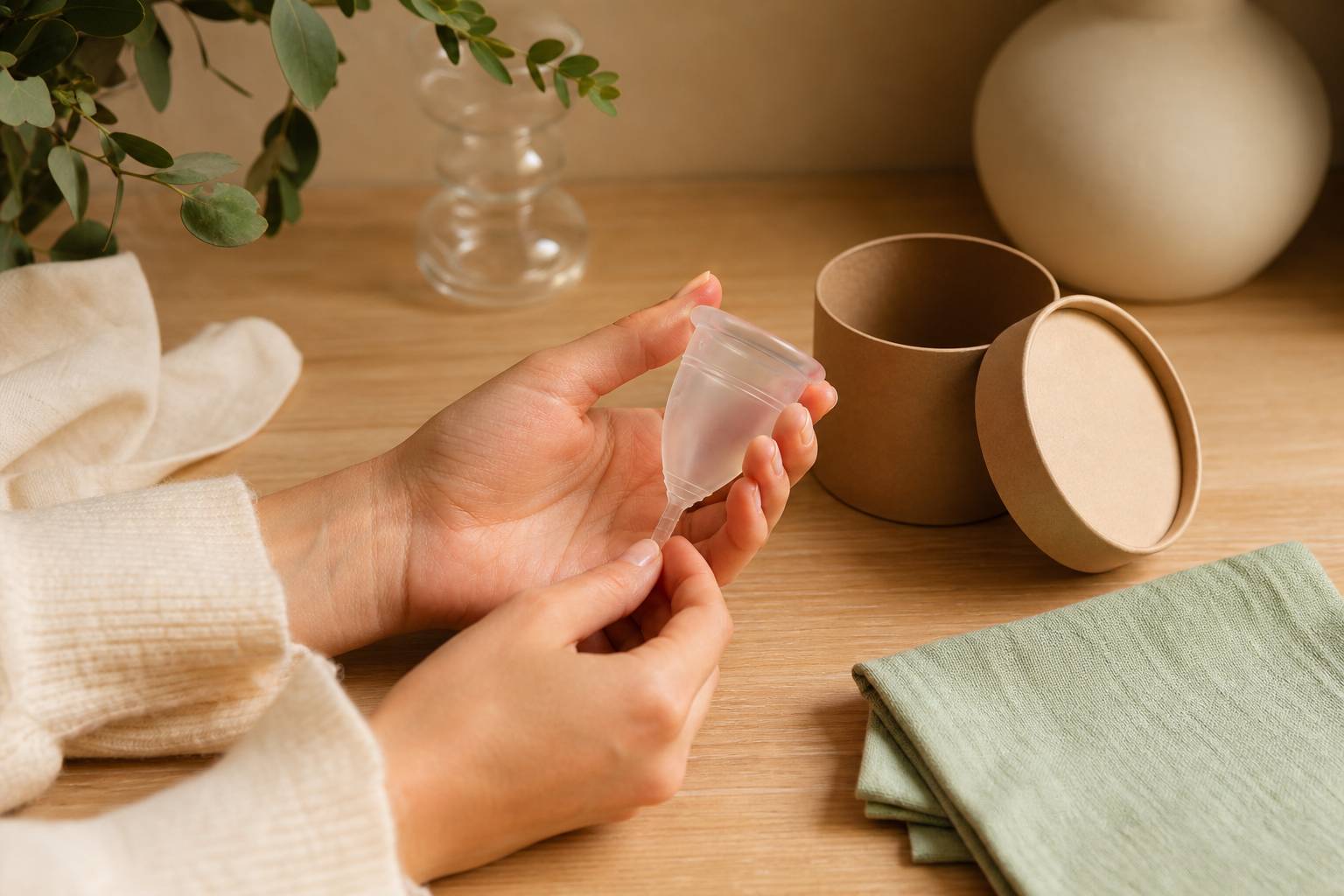
The cup looks like a small flexible receptacle, often between 4 and 6 cm in height, with a top diameter around 3 to 5 cm depending on the models. These figures give an idea but do not replace individual adjustment. A vagina is not a rigid tube; it is a musculo-membranous canal whose tone and length vary according to cycle days, pregnancies, sports activity, constipation, or simply fatigue.
The numerical landmark that often reassures is the actual menstrual volume. Many people imagine losing “whole glasses.” However, the average loss is around 40 to 80 ml of blood per cycle, with variations. A graduated cup allows visualizing this flow, which sometimes becomes useful when a doctor asks to estimate abundance.
The ecological dimension is no slogan if usage is regular. A reusable protection lasting 3 to 5 years, sometimes more depending on quality and maintenance, replaces hundreds of disposable protections. Classic tampons and pads take centuries to fully degrade, often estimated between 400 and 450 years depending on materials. The gain in waste is therefore tangible if the cup is adopted long-term.
In terms of comfort, the logic is counterintuitive at first. A well-placed cup is almost “unfelt.” If discomfort is present, it is usually due to too low positioning, a stem that is too long, or a cup too firm for that particular anatomy. This concrete reading prevents concluding too quickly incompatibility.
The next step is moving from understanding to use. The insertion and removal technique, when clear, makes adoption more serene.
Daily use instructions for the menstrual cup, without pain or leaks
The instructions become simple when based on precise gestures. The goal is not to “succeed on the first try.” The goal is to understand what the hand is trying to achieve inside, then repeat until the body cooperates.
A cup can be worn 4 to 6 hours depending on flow intensity. This range is not there to constrain; it mainly protects against prolonged use of an internal protection. On heavy flow days, the cup fills faster. On the last days of periods, it can remain more comfortable than other protections, but the maximum duration remains a guideline.
Insertion, folding, unfolding, and body landmarks
Before any manipulation, hand washing is a true gesture of feminine hygiene. Simple soap and careful rinsing suffice. Very long or irregular nails increase the risk of micro-scratches, a source of irritation. Gentle filing can change the experience.
The cup folds to reduce its diameter at insertion time. The most used folds are the C-fold and the S-fold. The C-fold gives a more stable shape but sometimes a larger diameter. The S-fold or “punch-down” fold (depending on brands) can help when the vaginal entrance is sensitive because the insertion point is slimmer.
Once inserted, the cup must unfold and create a gentle seal against the vaginal walls. This must not be painful. A useful tip is to pass a finger around the base to feel if it is fully opened. A “crumpled” or partially folded cup lets blood pass along the walls, which gives the impression of an ineffective cup when the problem is mechanical.
Placement height matters. Too low, the stem can bother and the cup can collapse with movements. Higher up, it often stabilizes better. This height varies according to the position of the cervix, which can be lower at the beginning of periods in some people. A “perfect” cup one month may require slight adjustment the next.
Removal without suction effect and toilet management
Removal requires a simple rule. Do not pull on the stem like a string. The stem serves to locate, not to extract. The hand must first break the seal by pinching the base or passing a finger to detach an edge. When air enters, the suction sensation immediately disappears.
It is possible to urinate with a cup in place. The cup is situated in the vagina, the urethra is in front and remains independent. A sensation of discomfort can appear in some people if the cup is very firm or slightly compresses surrounding tissues. In this case, a softer model, or a slightly higher insertion, often improves comfort.
To avoid leaks, the concrete tip is to check the opening and orientation. A cup can be open but misaligned relative to the cervix. Leaks “within the first hour” often point to this. Leaks “after several hours” suggest a rapid filling on heavy days.
The following question comes quickly in real life. How to rinse when there’s no sink in the stall? A small bottle of water, a rinsing spray, or a simple wipe with paper before complete rinsing at the next opportunity allow managing without turning the day into an obstacle course. The idea is to maintain a hygiene logic, not impossible perfection.
Once the technique is clearer, maintenance becomes central. A comfortable cup that is not properly cleaned jeopardizes intimate health.
Feminine hygiene, maintenance and sterilization to protect intimate health
A menstrual cup is reusable, which makes its maintenance more visible than that of a disposable protection. This visibility can cause concern. In practice, the routine relies on short, repeated gestures, and a simple principle. Everything in contact with a mucous membrane must be clean, rinsed, and regularly sterilized.
Between emptyings, rinsing with running water removes blood and reduces deposits. Lukewarm water suffices. Very hot water can, in the long run, accelerate the aging of some silicones. The key remains regularity and quality of rinsing.
Once a day during menstruation, washing with mild soap is a good guideline. The soap must be fragrance-free, free of essential oils, and well rinsed. Harsh products, household disinfectants or alcohol damage the surface of the cup and irritate the mucosa in the next cycle. Highly scented “intimate” cleansers sometimes give a feeling of cleanliness, but the mucosa does not benefit.
Sterilization for at least 7 minutes in boiling water is the most reliable guideline before first use, then at the beginning and end of each cycle. A dedicated pot can reassure. Microwave sterilization boxes also exist, with a protocol specific to each brand. The common point remains respecting the heating time and cooling without recontamination.
The vaginal flora is an ecosystem. Its balance notably depends on pH, the presence of lactobacilli, and the absence of repeated irritations. A well-maintained cup does not disturb this balance in most cases. Problems arise more easily when the cup is kept too long, poorly rinsed, or handled with insufficiently washed hands.
The subject of toxic shock syndrome deserves an explanation without dramatization. It is a serious, rare infectious disease linked to the release of a toxin (TSST-1) produced by certain strains of Staphylococcus aureus in carrier individuals. The risk increases with prolonged use of an internal protection beyond recommended durations. This mechanism concerns tampons and can also concern cups. Respecting wearing time, washing hands, and sterilizing according to the recommended rhythm are part of protective measures.
Identify signs that justify medical advice, without delay
Mild discomfort at first can exist, especially when the cup is too low or poorly unfolded. Sharp pain, burning sensation, or swelling should not be trivialized. The mucosa sends a simple signal when something is wrong.
A consultation with a midwife or doctor is indicated if any of these signs appear during use of an internal protection, including a cup. High fever, significant malaise, vomiting, diarrhea, widespread rash, unusual muscle pain, dizziness. These signs do not automatically mean toxic shock, but they justify rapid evaluation.
For repeated irritations, recurrent yeast infections or insertion pain, advice from a midwife is useful. Sometimes the problem is not the cup itself, but dryness, vulvodynia, infection, or need for pelvic floor rehabilitation. When examination is necessary, it is done gently, often providing concrete solutions.
Parents in postpartum also ask this question because the body changes. The return of menstruation, with its variability, can influence protection choice. A simple guideline is available here, with clear explanations on rhythm and bleeding after childbirth on the return of menstruation and its markers.
Once hygiene is well established, the most strategic question comes back. What size to choose, and how to reconcile cup, flow, and contraception?
Choosing your menstrual cup, understanding sizes and successful adoption according to your body
The market has densified, giving more choices but more hesitation. The right approach is to start from the body, not from a “typical profile.” Size, firmness, and stem length adjust to three parameters: flow, cervix height, and pelvic floor tone.
Flow is not just “light” or “heavy.” It can be concentrated over 24 to 48 hours, then calm down. Some people lose little but continuously, others lose more in peaks. With a cup, these nuances become visible. The reservoir capacity must correspond to the heaviest moment, otherwise the cup will be perfect three days out of five and constraining the other two.
Pelvic floor tone affects retention. A very tonic pelvic floor can crush a cup that is too soft, which favors leaks. A more relaxed pelvic floor may prefer a cup that unfolds better and holds without slipping. Intensive sports, dance, running, Pilates, but also chronic constipation modify this tone. Nothing is fixed.
Reference table to guide choice without getting lost
| Common situation | What happens mechanically | Choice guideline | Concrete adjustment |
|---|---|---|---|
| Leaks within the first hour | Misdeployed cup or off-center cervix | Model with easy unfolding, slightly firmer rim | Change fold, rotate base, check with finger |
| Discomfort at vaginal entrance | Too low cup or too long stem | Shorter model or trim-able stem | Insert higher, gradually trim stem |
| Need to empty too often | Insufficient capacity on heavy days | Larger size or “high volume” version | Use a bigger cup for only 1-2 days |
| Sensation of bladder pressure | Firmness compressing tissues | Softer silicone, less rigid rim | Place slightly higher, test different softness |
Cup and IUD, understanding the suction effect without fear
Compatibility with an intrauterine device, hormonal or copper, is a common question. The main risk is not “the cup sucking the uterus.” The anatomy does not work that way. The vagina and uterus do not share the same axis, and a properly placed IUD is held within the uterine cavity.
The real risk lies elsewhere. A suction effect can, in rare cases, contribute to displacement if the cup is removed without breaking the seal, especially if the cervix is low and the cup very sticky. The other risk is accidentally pulling on IUD strings if they are long and caught between the cup and fingers.
The safety move is concrete. Lower the cup by pushing gently as if going to the toilet, then pinch the base to let air in before removal. Sharp pain at removal requires stopping, relaxing, and retrying with a different grip. If pain persists, or if strings seem longer or shorter after the episode, consult a gynecologist or midwife to check positioning.
Copper IUDs can increase flow, especially in the first months. A larger capacity cup avoids having to empty too often, which reduces handling and improves feminine hygiene. This adaptation is often more effective than “gritting teeth” with a model that is too small.
Economically, the comparison is simple. A cup usually costs between 15 and 30 euros. Disposable protections can reach around one hundred euros per year depending on usage, a frequently cited estimate in the press. Over several years, the difference becomes visible, not even counting the mental load of purchasing and storage.
To delve into postpartum body experience and bleeding, it is useful to reread this article dedicated to return of menstruation markers, as the resumption of menstruation after birth varies according to breastfeeding, contraception, and individual physiology.
Adoption is not played only on the product. It is played on the hand, time, and confidence gained each cycle. And this confidence builds better when concrete questions have clear answers.
Can the menstrual cup stay in all night?
Most people sleep 6 to 8 hours. The recommended wearing guideline is around 4 to 6 hours depending on flow. Some therefore choose to empty just before going to bed and upon waking, remaining attentive to their flow. In case of very heavy periods, an additional external protection can secure clothing, or another type of protection may be better suited at night.
How to know if the cup is properly opened and well placed?
A well-opened cup has a round base, without a marked fold. A finger can follow the contour to check it is unfolded. If leaks occur quickly, the cup is often open but off-center relative to the cervix. A slight pivot of the base, or a different fold at insertion, frequently solves the problem in one or two tries.
Can the menstrual cup be used when having yeast infections or irritations?
In case of ongoing yeast infection, burning, insertion pain, or abnormal discharge, internal protection may worsen discomfort. A consultation allows identifying the cause and adapting the protection choice during treatment. When symptoms recur every cycle, it is useful to evaluate maintenance, soap used, and mucosa condition with a midwife or doctor.
How long does a cup last and when to replace it?
Depending on models and maintenance, a menstrual cup often lasts 3 to 5 years, sometimes longer. It is replaced if the silicone becomes sticky, shows micro-cracks, retains odor despite proper cleaning, or if the shape deforms enough to compromise seal. Air storage, in a breathable pouch, usually extends lifespan.