
In Brief
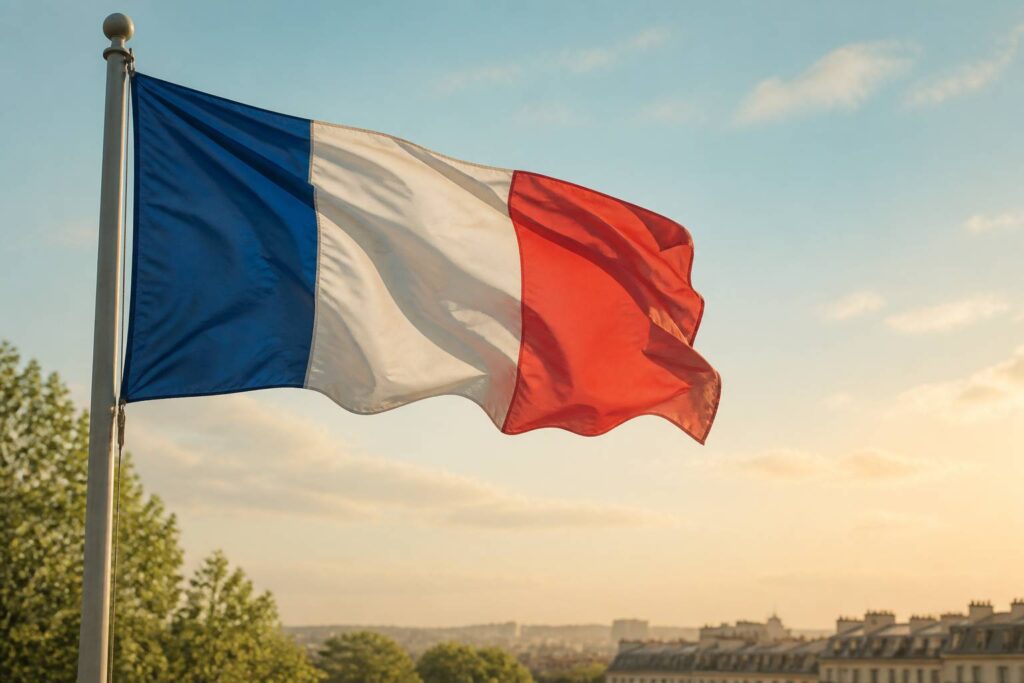
- The French flag blue-white-red is rooted in a political history where Paris, the monarchy, and the French Revolution respond to each other.
- The blue and red refer to the city of Paris and the National Guard, while the white preserves the trace of the former royalty, later reinterpreted by the Republic.
- The transition from a cockade to an official flag marks a scale shift, from a symbol worn on the chest to a national emblem visible to all.
- The law of 27 Pluviôse Year II (15 February 1794) sets the tricolor, and the order of the stripes is associated with the work of Jacques-Louis David.
- The symbolism of the colors is not fixed. It adapts according to the times, commemorations, and civic uses, without canceling its historical foundation.
- The blue-white-red exists elsewhere in the world, but each country constructs its own meaning through the shape, added emblems, and collective narrative.
Blue, White, Red: How the French Flag Embeds Itself in the Social Body
Some signs reassure because they are stable. In family life, these are often very concrete landmarks, like a 10-minute evening routine or a bath given at a regular time. In a country’s life, the French flag sometimes plays this silent role. It does not speak, it does not judge. It simply is there, above a town hall, in a schoolyard, on a war memorial.
What moves you, when you really look at the tricolor, is its ability to belong to different stories at the same time. One parent may see it as national holiday decor. Another recognizes an institutional framework, a promise of equality before school or justice. This gap is not a contradiction. It is a sign that a national emblem functions as a container. It welcomes experiences, sometimes opposed, without dissolving.
The symbolism of the colors does not act only through ideas. It also acts through perception. Three vertical stripes of equal width offer a simple and quick reading. This type of composition imprints itself like a visual nursery rhyme, even for children. The human brain retains short and regular sequences well, and repetition in public space reinforces this memorization. A small landmark can become an anchor, by being seen repeatedly in significant moments.
This presence is not limited to ceremonies. The tricolor is found on official buildings, but also in ordinary life scenes, such as a school pediment, a wedding hall, a local commemoration on November 11. There, adults often notice a change in attitude among the younger ones. The noise lowers, gestures slow down. It is not “memorized solemnity” in all cases. It is an emotional contagion. Children read the group’s micro-signals and adjust.
When parents ask how to convey a complex idea to a child, the most reliable answer is through the concrete. The flag offers a concrete support to talk about citizenship, freedom, common rules. A short explanation fits in two lines, then enriches over the years. Around 4-6 years old, the child mainly understands “this sign is that of the country.” Between 7-10 years old, they grasp institutions. Later, they better tolerate historical ambivalence, tensions, inheritances.
A simple landmark often helps more than a long speech: associating the flag with a place (the town hall) and an action (voting, marrying, commemorating) anchors the meaning in an experience. The following section retraces the thread, where the color first became a cockade, then a banner.
From Cockade to Flag: The Political History Fixing the Blue White Red Colors
Before being a flag that flies, the tricolor is a worn sign. The cockade appears as an immediate marker. It is fixed on a garment, shown in the street, recognized from a distance. In a turbulent period, where belonging can protect as much as expose, this type of sign has particular strength. The body becomes a support for symbolism.
Blue and red are linked to Paris. These two shades are associated with the city and the National Guard, at a time when the capital embodies a political engine. White, meanwhile, refers to the monarchy. This trio says something about a compromise. It is not about erasing what existed before all at once, but reorganizing landmarks around a new balance of powers. The assembly of the three stripes tells this tension instead of denying it.
The date of July 17, 1789, has the clarity of a symbolic gesture. Three days after the storming of the Bastille, a tricolor cockade is presented to King Louis XVI at the Paris City Hall. The event is often reported as a tipping scene. The old power accepts a new sign, at least in appearance, under the people’s watch. Objects matter in these moments. A cockade is not just fabric. It is a message carried at face height.
The transition to the official flag comes later. On February 15, 1794, a law by the Convention (27 Pluviôse Year II) formally adopts the tricolor flag. The painter Jacques-Louis David is generally associated with the design and specific choices. The order of the stripes, with blue near the hoist, aims for a sharp contrast and readability from a distance. The flag becomes a state object, with consistent, reproducible, controllable proportions. At a time when the circulation of symbols is rapid and sometimes chaotic, standardizing means stabilizing.
The French Revolution is often summarized by slogans. Parents know how much a summary can make people lose the essence of experience. Here, the issue is not only the idea of liberty. It is how a society recomposes its belongings. The flag becomes a shared landmark, not because everyone gives it the same meaning, but because it offers a common surface. White, for example, can be reread. On one side, it keeps the royal imprint. On the other, it can be understood as a central place, an area of mediation between two urban forces.
Red sometimes receives a more emotional reading, associated with spilled blood. This interpretation exists and leaves its mark. It gains intensity when mentioned during commemorations or wartime contexts. A symbol lives with the events that use it. It charges, discharges, recomposes.
When a color becomes a flag, it stops being decorative. It becomes a language. The next step is to look at how this language is taught, seen, and transformed in daily life, even in places frequented by children.
To continue this historical sequence without losing the thread, an educational clip can help visualize the chain of events.
What Colors Tell Today: Meaning, Symbolism, and Nuances According to Contexts
The same object can reassure or tense depending on the moment. Parents notice it with a simple door noise. The flag sometimes works the same way. In a stadium, it may express collective joy. In front of a war memorial, it carries silence. In a classroom, it becomes discreet, almost a decor element, until the day a civics lesson puts it back at the center.
The meaning of the colors is not summarized by a single legend. Blue and red refer to Paris, to a popular and urban dynamic, to the National Guard. White refers to the monarchy, then is absorbed into a republican reading. Depending on the times, white has also been perceived as a color of continuity, in the sense that a country does not rebuild by erasing everything. It recomposes, sometimes painfully, sometimes by successive adjustments.
Children first focus on order. Three stripes. A stable rule. A visual landmark. Adults can use this to explain a specific point without burdening the child with adult debates. A 6-8-year-old child may hear that these three colors were brought together during the French Revolution, and that the flag became one of the Republic’s signs, along with the motto and the anthem. This information is often enough. It provides a simple chronology.
As the child grows, the explanation becomes more nuanced. A middle schooler may understand that the flag is not “the truth” of a country. It is a representation. Sociologists often remind us. A symbol is a common object that allows interpretations. A parent can accompany this passage by setting concrete landmarks. Where is the flag displayed, and why? When is it taken down, when is it flown at half-mast? What are official uses, and which belong to individual expression?
To give substance to this story without making it heavy, a simple method is to link each color to a type of scene, rather than to an abstraction. Blue and red can be linked to the city, the crowd, the energy of political change. White can be linked to the institution, the center, to what structures. It is not a single truth, it is a useful reading grid, flexible enough not to confine.
A concrete gesture that works well at home is to look at an image of the flag, then ask the child to spot where they have seen it before. The child cites the town hall, school, a match, a passport. Then the adult can add a single dated historical fact, without widening the scope. Information overload rarely brings more understanding, especially at the end of the day.
A symbol can also awaken strong emotions in a parent, especially if the family history is crossed by exile, war, or loyalty conflicts. If these emotions become overwhelming, with disproportionate reactions or repeated disputes in front of the child, a space to talk with a professional can help. It is not a “flag problem.” It is often a sign that the family narrative needs to be secured, put into words, put back in its right place.
The strength of the tricolor also comes from its ability to support multiple readings without breaking. The following section focuses on the places where it is seen, and how these uses create common ground, sometimes without us realizing it.
When these notions are addressed at school, a longer resource makes it possible to place the symbols in their institutional framework.
Where the French Flag Lives: Monuments, Schools, Commemorations, and Shared Landmarks
A flag hung on a pediment makes no noise. Yet, it organizes space. Like a nightlight in a child’s room, it marks an identifiable “here.” In a school, it signals that the institution transcends the individuals present that day. In a town hall, it recalls the continuity of services, even when teams change. This continuity has a soothing effect on many families, especially when they are going through a fragile period, moving, separation, arrival of a baby.
On war memorials, the flag takes on a particular density. Commemorations, especially around November 11, 1918, associate the tricolor with the memory of fighters. There, children observe slow gestures. Laying of wreaths, moment of silence, anthem. A parent can explain without dramatizing. People died during wars. The ceremony serves to remember and thank. The child does not need violent images to understand seriousness. They need a clear framework and simple words.
The question of public use is linked to that of respect, and respect is better transmitted by example than by injunctions. When a parent stands straight during a minute of silence, when the voice lowers, the child internalizes a social rule. This rule is not an arbitrary constraint. It serves to allow the group to live a common moment without conflict. It is a social skill, just like queuing or waiting for one’s turn to speak.
Official uses also obey material codes. The way of raising a flag, lighting it at night according to places, flying it at half-mast during national mourning, follows protocols. Details vary by institution, but the idea remains the same. The flag is a language of the state. It announces a situation. It manifests solidarity. It signals a celebration. Older children may see it as a collective “emotional signage.”
For parents who want to approach these questions without getting lost, a small structured list helps keep a stable discourse, especially when the child asks questions in a row.
- Link the flag to a concrete place such as school or town hall, then name the role of the place in one sentence.
- Give a dated fact such as 1789 for the cockade or 1794 for the official adoption, without adding three events at once.
- Name an emotion when it appears, for example “here we remember”, rather than asking the child to be “good.”
- Clarify contextual differences between a celebration (July 14) and a commemoration, to avoid confusion.
One point deserves gentle vigilance. If a child shows persistent anxiety after a ceremony, with repeated nightmares longer than 2-3 weeks, unusual separation fears, or ruminations centered on death, a consultation with a child’s doctor or psychologist may be indicated. This type of reaction exists, especially in very sensitive children or after exposure to images too harsh on television. The key landmark is not the emotion at the moment. It is its persistence and impact on sleep, appetite, mood.
The flag becomes a landmark because it is encountered in places that structure collective life. To conclude this journey, it remains to understand why so many countries also use blue-white-red, and how to avoid confusion without losing the French uniqueness.
Blue-White-Red Elsewhere: Similarities Between Flags and the Singularity of the French National Emblem
Seeing the same colors on other flags can confuse a child, and sometimes even a hurried adult. This confusion is not surprising. The brain categorizes quickly. Three close shades, a feeling of déjà-vu, and the association happens. Again, a concrete landmark is often enough to restore the difference. Form counts as much as palette. Vertical or horizontal stripes, presence of a coat of arms, stars, a cross, specific proportions.
Several countries display blue, white, and red. Some, like Australia, add stars and a composition inherited from another history. The United Kingdom structures its colors with superimposed crosses. Iceland features a Nordic cross. Other flags can cause confusion because they remain tricolors with simple stripes. Luxembourg and the Netherlands, for example, use horizontal stripes. Croatia or the Czech Republic introduce a coat of arms or a geometric shape that modifies reading. Paraguay combines tricolor and coat of arms. Every detail tells a sovereignty and a specific national narrative.
To help parents and children distinguish without turning it into a lecture, a short visual table provides immediate clarity. It does not replace history, it gives structure.
| Country / Flag | Color Arrangement | Distinctive Detail | Risk of Confusion with the French Flag |
|---|---|---|---|
| France | Three vertical stripes blue–white–red | Stripes of equal width, no emblem | Reference |
| Netherlands | Three horizontal stripes red-white-blue | Horizontal orientation, reversed order | Medium |
| Luxembourg | Three horizontal stripes red-white-light blue | Lighter blue, horizontal orientation | Medium |
| Czech Republic | White and red horizontally + blue triangle | Blue triangle at the hoist | Low |
| Croatia | Three horizontal stripes red-white-blue | Central coat of arms | Low |
| United Kingdom | Blue, white, red | Superimposed crosses (Union Jack) | Low |
This detour through world flags opens an interesting door on the notion of borrowing and circulation of symbols. Countries respond to, distinguish themselves from, and position themselves in relation to each other. France is not “owner” of these colors. It created, at a given moment in its history, a combination that became immediately recognizable. The political gesture took a stable graphic form, and this stability explains its longevity.
In a contemporary context, including in 2026, this visual recognition remains strong. It is supported by institutional uses, but also by global events, sports competitions, international ceremonies, image dissemination. Children learn quickly to associate a flag with a country, then discover that similarities exist. This discovery can become an opportunity for openness rather than a school trap. It shows that symbols are codes, not walls.
Recognizing a flag means learning to observe a detail and connect it to a narrative. This skill far exceeds geography. It develops attention, memory, and the ability to tolerate nuance.
Why is the French flag blue, white and red?
Blue and red are associated with Paris and the National Guard at the time of the French Revolution. White refers to the monarchy, then integrates into the republican narrative as a central element of the tricolor. The assembly reflects a political recomposition, with symbolism that has been enriched through uses.
When did the tricolor flag become official in France?
The tricolor flag officially became the national emblem on February 15, 1794, by the law of 27 Pluviôse Year II. This adoption fixed a stable, reproducible model recognized by the State.
Who decided the order of colors on the French flag?
The order of the stripes is traditionally associated with the painter Jacques-Louis David, who is said to have chosen to place blue near the hoist and to keep three stripes of equal dimensions to strengthen readability and contrast.
Why do we see the French flag on schools, town halls and war memorials?
The flag indicates the presence of a Republican institution and serves as a collective landmark. On war memorials, it accompanies memory and commemorations, especially around November 11, by providing a common visual framework for acts of remembrance.
Which other countries have a blue-white-red flag and how to avoid confusing them?
Several countries use these colors, such as the Netherlands, Luxembourg, Croatia, the Czech Republic or flags with other symbols like the United Kingdom. To avoid confusion, one often just needs to observe the orientation of stripes, the presence of a coat of arms, stars or a cross, and the proportions.