
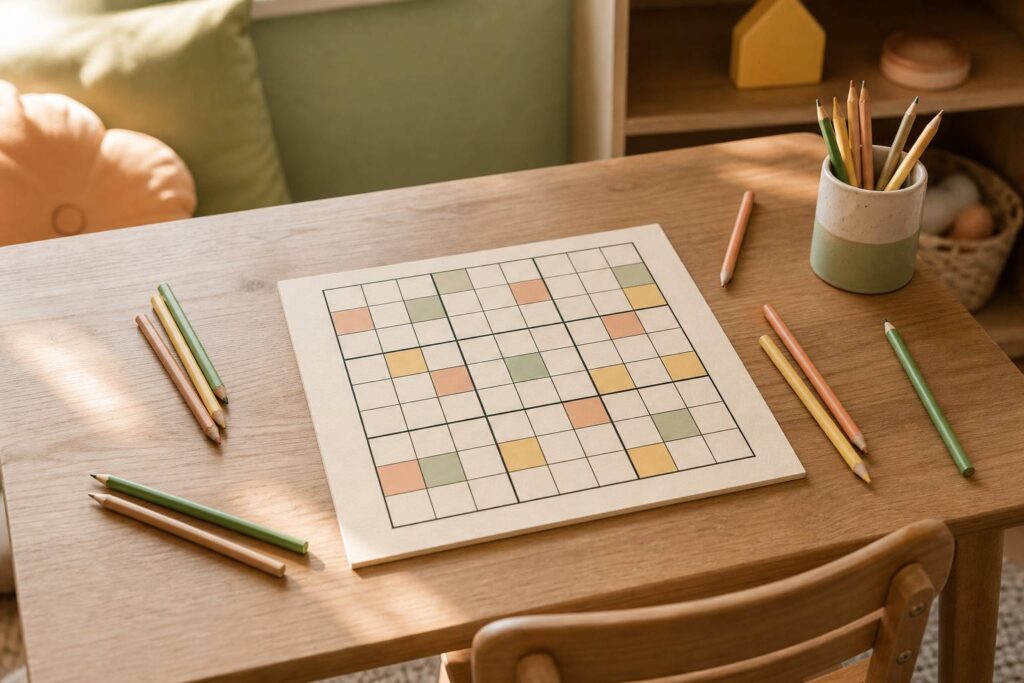
In brief
- Printable Sudoku for children comes in easy 4×4, 6×6, and 9×9 grids, with larger squares and visual cues that reduce cognitive load.
- The game becomes a logic puzzle accessible from ages 4-5 with colors, shapes, or images, then evolves towards numbers around age 6-7.
- A short routine, 10 to 15 minutes, turns solving into a time of learning and recreation without screens, struggles, or overstimulation.
- Sudoku acts on attention, mental flexibility, and working memory, functions that gradually develop during childhood.
- Parents can adjust the difficulty with a simple gesture by choosing the right grid format and modulating assistance without doing it “for” the child.
Printable Sudoku for children: a logic puzzle that respects the developmental pace
In an already busy day, an educational game that opens, closes, and requires neither complex setup nor endless negotiation changes the atmosphere of a late afternoon. Sudoku often fills this role when adapted. The “adult” version can discourage, not for lack of intelligence, but because it recruits executive functions still maturing.
In children, the ability to inhibit an impulse, hold multiple pieces of information in mind, and plan a strategy sharpens over several years. Working memory, for example, progresses significantly between ages 5 and 9, with normal variations depending on temperament, fatigue, or school period. A number puzzle that is too dense can then cause a rapid dropout, which looks like “he doesn’t like it,” when it’s mostly overload.
The Sudoku grids for children, offered for download to print, are designed to lighten this load. Squares are larger, numbers more readable, and the difficulty is graded. This ergonomics has a concrete effect. Visual perception is less strained; attention can focus on the “no duplicate” rule rather than detecting tiny symbols. A child who grips the pencil too tightly, erases constantly, or leans very close to the paper often gives a simple clue. Readability is not a detail, it’s support.
The principle remains stable and reassuring. Only one answer per square. A forbidden repetition rule. This framework is precious for children who like to understand “how it works.” The educational game then becomes a testing ground for a skill that will be useful everywhere. Searching for a solution, tolerating error, correcting, restarting. Logic is built as much in the outcome as in the path.
Sudoku also has a story that speaks to curious children. Born under the name “Number Place” in the United States, it was popularized in Japan, then renamed by publisher Kaji Maki from an expression meaning “numbers must remain unique.” The word Sudoku comes from this contraction. Telling this origin in two sentences sometimes creates a little spark. The game gains an identity, cultural anchoring, and the printed sheet becomes more than just an exercise.
A useful marker helps to start smoothly. A 5-6-year-old child “should not” succeed at a 9×9. They may manage, but it’s not the right starting point for most. The right level is the one that allows finishing a grid with real effort but without exhaustion, in 10 to 20 minutes depending on age and enthusiasm. The next section details this calibration, age by age, so the activity remains truly playful.
Choosing playful grids by age: easy 4×4, 6×6, 9×9 and variations without discouragement
When an activity “doesn’t engage” well, the first variable to adjust is not motivation. It’s the grid size and symbol type. A child’s brain does not approach complexity like an adult’s. A smaller grid reduces the number of constraints to hold in mind. The child can then mobilize logic rather than endurance.
Between ages 4 and 5, Sudoku often becomes a game of spotting and sorting, more than a number exercise. The 4×4 versions with colors, shapes, or images work well. They introduce a simple and stable rule. A symbol cannot appear twice in the same row. The child learns to scan the row with their eyes, then the column, then the small block, without needing to know numbers. This progression is consistent with kindergarten visuo-spatial development, where the child consolidates orientation and visual discrimination.
Around ages 6-7, numbers’ introduction into grids becomes smoother. Numeric 4×4 versions remain relevant, and 6×6 appear as a bridge. The child begins to tolerate a rule that repeats over a larger structure while keeping quick gratification. Patience is not a fixed trait. It depends on fatigue, time of day, and experience of success. A grid too ambitious cuts this learning mid-flight.
From ages 8-9, many children can approach an easy 9×9, especially if counting is well established. The word “easy” matters. The number of pre-filled squares changes everything. When a grid offers few clues, strategy demands more advanced anticipation and deduction capacity. Some children are very comfortable, others will need to stay on 6×6 longer. Both profiles are normal.
Simple reference table for printing the right grids
The following table serves as a compass, not a strict rule. It aims for an experience where the game remains playful and accessible while offering a real challenge.
| Indicative age | Recommended format | Type of symbols | Typical duration | Learning goal |
|---|---|---|---|---|
| 4-5 years | 4×4 | Colors, shapes, images | 5 to 10 minutes | Understand “no duplicates”, scan row/column |
| 6-7 years | 4×4 or 6×6 | Numbers (1 to 4, then 1 to 6) | 10 to 15 minutes | Stabilize rules, develop sustained attention |
| 8-9 years and up | Easy 9×9 | Numbers (1 to 9) | 15 to 30 minutes | More complex deductions, planning, self-correction |
Making the activity truly playful without “overdoing” it
There is a strong temptation to add rewards, timers, challenges. That sometimes works, but can shift attention. Sudoku turns into a race rather than reasoning. A more stable option is to vary the media. One day, a grid with letters. Another, a grid with animals. The child stays within the rule, but the sensory input changes.
The print format facilitates this variety. Just prepare a small “recreation” binder with three levels. An easy stack for tired days, a medium stack for ordinary days, a denser stack for moments when the child asks for a challenge. This kind of organization soothes tensions. The chosen sheet is already an adjustment to the day’s need.
A marker that protects momentum. When a child starts erasing a lot, sighing, or moving from one square to another without strategy, the level is often too high or the moment badly chosen. Changing grids is not “giving up,” it’s preserving learning. The next section explains how to guide without directing, with phrases that help logic emerge.
Sudoku rules explained to children: understand without reciting, with concrete tips
Classic Sudoku is based on a 9-row and 9-column grid, divided into 9 areas of 3×3. The goal is to fill empty squares following three rules. Each number from 1 to 9 appears only once per row, once per column, and once per area. Explaining this all at once can lose a child. A more effective explanation follows the order of gaze.
Start with one single rule. The row. The child looks for what is missing. Then the column. Then the area. This sequencing respects attention development. The child’s brain learns better when one constraint is stabilized before adding a second. The same principle applies to 4×4 and 6×6 grids. The structure changes; the “uniqueness” rule remains the same.
Language used at home makes a difference. Talking about “duplicates” and “free space” is often clearer than “constraint.” Words must be simple but precise. A useful formulation looks like this. Look in the row for what is missing, check the column if that number is already present, then look at the small block. This routine becomes a strategy, not a recitation.
Three guiding gestures that let the child do the reasoning
Parents’ role is often delicate. Helping too much and the child acts without understanding. Not helping at all and the child freezes. Three concrete gestures keep the balance, even when fatigue is present.
- Point without naming the answer by placing a finger on the relevant row or column, then allowing a moment of silence. The brain processes the information in that time.
- Limit the scope by offering two plausible options. “Here, it’s more likely a 3 or 4” helps stay within logic without imposing.
- Have them verbalize with a short sentence. “What’s missing in this row?” or “Which number is already in this block?” Reasoning becomes a transferable skill.
A very simple tip also helps. Circle in pencil the numbers already present in the explored area. This turns inhibition into a visual gesture. The child sees what’s “taken” and what remains possible. This technique is especially useful for impulsive children, who write a number “to try” without checking. Circling slows just enough for logic to take back control.
When difficulty exceeds, spotting the right type of help
A block does not always have the same cause. Sometimes the child doesn’t understand the rule. Sometimes they do understand but don’t know where to start. Sometimes they are simply overwhelmed. The guiding sign is the quality of attention. A child who looks, searches, makes mistakes then corrects, is making the right effort. A child who distracts, gets up, irritates, no longer has bandwidth. In this case, reducing the grid or taking a two-minute break is more effective than a longer explanation.
A concrete marker to protect the relationship. A well-calibrated Sudoku lets the child leave the paper with a feeling of competence, even if everything is not completed. The game remains a safe space. The next section explores cognitive benefits and how to support them without turning the activity into homework.
Benefits of Sudoku for children: attention, working memory, and pressure-free learning
Sudoku is not just a grid to fill. It is a discreet training of several cognitive functions. The first is the ability to hold a rule in mind while exploring options. This skill is often called “inhibitory control” and “working memory.” The child learns to resist the urge to place a number randomly, and to check before acting. This inhibition is not a tantrum or lack of will when it wavers. It is a neurological skill that matures, especially between ages 3 and 7, then continues to refine afterward.
Sudoku also supports sustained attention. The child stays on a task without immediate gratification every second. The sheet offers a stable framework, and each filled square becomes a micro-validation. This structure suits transitional moments well. After school, before dinner, during a trip, or in a waiting room. The activity becomes a calm recreation that does not excite the nervous system like some fast-paced games.
Visual memory is engaged interestingly. The child learns to “photograph” a row, spot a number already present, remember what they saw in the neighboring block. This skill then transfers to reading, mathematics, and even school material organization. Sudoku does not directly teach advanced counting, but it trains a way to browse information and test a hypothesis.
Turn Sudoku into a brief and stable learning ritual
A short, repeated duration is more effective than a long session. Ten minutes, three times a week, is enough to see progress, especially between 5 and 8 years old. The brain learns by spaced repetition. The printed sheet helps because it limits distractions. No notifications, no menus to navigate, no temptation to switch tasks with a click.
Parental posture matters as much as the grid. A child learns better when error is a marker, not a fault. Saying “it doesn’t work, let’s check” keeps logic central. Saying “you made a mistake” can freeze some children, especially those who quickly get discouraged. The visible result is very concrete. The child starts checking again, which is exactly the puzzle’s goal.
Some children love it, others resist. This resistance is not necessarily a sign of inability. It may indicate the format is not right. A very kinesthetic child, for example, may better engage with Sudoku by manipulating number tokens to place on the grid rather than writing. Writing comes next. An anxious child may prefer a grid with many clues to avoid the feeling of emptiness.
A bridge to other logic and creativity activities
Sudoku fits well into a “screen-free activity box.” It can be combined with sorting games, mazes, connect-the-dots, or tangrams. This mix avoids weariness. A subtle link can also be made with creativity, for example by printing a grid and then coloring the 3×3 blocks once solved. The child gets a final image, adding sensory gratification.
For moments when a manual activity is sought, crafting ideas and small creations to give can complement quiet time. An article like homemade gifts for dad offers ideas that fit well with times of focused attention without requiring heavy organization.
Consultation box
A persistent difficulty with logic games does not automatically require professional advice. A consultation can however help when certain signs are regular over several weeks, in different contexts. This includes, for example, marked visual fatigue with constant face-to-paper closeness, headaches after paper tasks, extreme agitation preventing any even short seated activity, or anxiety that overflows as soon as an error appears. A discussion with a pediatrician, orthoptist, or developmental psychologist then helps distinguish normal variation from a specific support need.
An insight that changes the approach to the game. Sudoku builds an internal checking skill. The child learns to say to themselves “I check” before “I place.” The last section shows how to prepare printable grids and organize space so this skill develops without tension.
Print Sudoku grids and set up a calm framework: materials, organization, and progressive autonomy
Printing Sudoku grids at home seems simple, but some choices make the experience smoother. Paper matters. A sheet too thin tears when erasing. Slightly thicker paper, about 100 g, holds up better to corrections. The pencil also. An HB or soft lead pencil limits gripping. A soft eraser avoids crumpling the page. These small details reduce irritation and prolong attention.
Print size plays a direct role in concentration. A large printed 4×4 grid, with space around, invites the child to place their gaze. A cramped grid, even easy, tires faster. When Sudoku becomes a moment of recreation, visual comfort is an ally. It allows the brain to devote resources to logic rather than symbol reading.
Organizing sheets by level simplifies family life. A “easy start” divider, a “challenge of the day” divider, a “for later” divider. The child can choose. This simple choice increases engagement because it gives control margin. The parent keeps coherence by only offering grids suited to the moment.
A short routine that fosters autonomy
A ritual works when it is predictable and time-limited. A concrete proposal is to place a sheet on the table, next to a glass of water, with a gentle 12-minute timer. The timer is not pressure; it’s a boundary. When it rings, the sheet can be put away even if unfinished. This rule protects the joy of the game and teaches the child to stop without frustration.
Another simple help is to print some grids with the solution separately, kept in an envelope. The child can check afterward, not during. This separation strengthens self-correction. It also avoids the scenario where the adult becomes the “solution on legs,” which tires everyone. The child learns to compare, spot where logic derailed, then correct.
Encouraging perseverance without turning it into performance
Progress is visible quickly when the level is well calibrated. In the first weeks, the child mainly gains method. They look better. They check more. They make fewer mistakes out of haste. Parents can support this by praising the process. “You looked in the column before writing” reinforces strategy. “You are fast” reinforces performance, which can make sensitive children fragile to failure.
When the child asks for more challenge, difficulty rises best in small steps. Move from 4×4 to 6×6, then to very guided 9×9, rather than jumping suddenly. Variations are also helpful. Sudoku with letters, colors, or visual themes. Logic remains central, but the entry is renewed.
Sudoku can become a shared time, without the adult taking charge. A pleasant option is to solve in parallel. The adult does their own grid beside, silently. The child sees a model of focus, without direct comparison. This calm presence resembles what best helps a young child regulate attention. The educational game keeps its place as a simple moment, and it is often here that it takes root.
{“@context”:”https://schema.org”,”@type”:”FAQPage”,”mainEntity”:[}}}}]}At what age can a child start Sudoku?
From 4-5 years old, with 4×4 grids using colors, shapes, or images. Around 6-7 years, numbers are more easily introduced on 4×4 or 6×6. From 8-9 years, many children can try easy 9×9 Sudokus, provided the grid is well guided and readable.
How to know if the printed grid is too difficult?
A grid is often too difficult when the child erases constantly, jumps from one square to another without strategy, or quickly gets frustrated despite a simple explanation. A good difficulty allows searching, sometimes making mistakes, then correcting, with visible progress in 10 to 20 minutes depending on age. Reducing the grid size or choosing a version with more clues helps immediately.
Is Sudoku a real educational game or just a pastime?
It is a logic puzzle that trains sustained attention, working memory, and self-correction. The child learns to check before acting, spot constraints, and adjust a hypothesis. It does not replace school learning but supports transversal skills useful in reading, math, and organization.
Should the child be corrected while playing?
The most effective help guides the gaze rather than giving the answer. Pointing at a row, limiting the choice to two possible options, or making the child verbalize the rule allows them to keep control. Complete correction by the adult tends to cut reasoning and reduce autonomy. Verification with a separate solution, after the attempt, is often more instructive.