

Wearing a sling brings the baby closer to their parent while allowing true freedom of movement throughout the day. Its adjustable fabric with rings enables quick setup, provided the height, face clearance, and pelvic support are respected.
- The sling is suitable from birth when the baby is properly supported, in an upright position and high enough on the carrier’s chest.
- Ring-by-ring adjustment prevents loose zones that can tire the parent’s back or cause the infant to slip.
- The baby’s knees remain higher than their buttocks, while their back maintains its physiological curve according to age.
- A short, well-adjusted, and repeated carrying often helps soothe discharge crying, especially at the end of the day.
Sling carrying from birth and newborn needs
In the first weeks, a baby leaves a containing, warm environment paced by maternal movements. Their nervous system is still immature. They cannot calm themselves alone in a stable way, nor organize their states of wakefulness, sleep, and alertness over time. Sling carrying offers a concrete sensory continuity thanks to body warmth, heartbeat, parental scent, and the micro-movements of walking.
For a newborn, physiological carrying supports nervous system regulation without replacing feeding, sleeping on a secure surface, or attention to health signals. A carried baby may doze off quickly because regular movement stimulates their vestibular system, located in the inner ear. This relaxation does not mean carrying should be prolonged when the adult becomes drowsy or settles into a chair to sleep.
The fabric sling appears as a strip of cloth equipped with two rings. Unlike a long wrap, it does not require complex tying. The fabric passes through the rings, then tightens according to the parent’s size and the child’s. This simplicity explains its success for short outings, transfers between car and home, crying moments, or days when a baby demands a lot of closeness.
The need for contact is particularly intense between birth and 3 months. This phenomenon is neither a habit to correct nor parental manipulation. The infant still depends on the adult to regulate their temperature, stress, and alertness. Responding predictably to their cries contributes to attachment security. The baby’s brain gradually learns that their signals receive an appropriate response.
Sling carrying can also facilitate breastfeeding or bottle feeding daily, without having to feed systematically in the fabric. A baby must be taken out or repositioned to feed while remaining visible, with the chin clear and swallowing observable. The lying position, hidden under the fabric, increases the risk of nose and mouth obstruction. Baby comfort always starts with free breathing.
Useful closeness without confusion with safe sleep
An infant can sleep against their parent in a carrier during a stroll or calm activity, under active supervision. Their face remains fully visible. Their chin does not touch their chest. Their back is supported, and their body does not curl to the point of compressing the airways. After falling asleep, the parent regularly checks the face’s color, head position, and breathing rhythm.
Main sleep, especially during the first months, takes place on the back in a suitable bed or cradle, on a firm and clear mattress. A sling is not a sleeping device. This distinction protects the baby without taking away carrying’s relational interest. Ergonomic transport is measured as much by posture as by the parent’s ability to remain attentive and available.
Parents who have just given birth may appreciate the sling because it distributes weight diagonally across the torso. However, this asymmetry requires alternation. A 3 to 4 kg baby can be carried easily on one shoulder for a few minutes, but a longer duration may cause cervical or lumbar tension. Switching the carrying shoulder, reducing duration, and adjusting the fabric prevent sought relief from turning into pain.
Visual demonstration often helps more than a written explanation between two night wakings. Parents can watch a precise video, then repeat the gestures in front of a mirror before going out. The fabric must be prepared calmly, not tightened hastily on a baby already crying loudly.
The good reference remains simple. The baby is high enough for the parent to kiss their forehead without bending, while keeping the face visible at all times. This closeness allows quick response to discomfort, regurgitation, or position change.
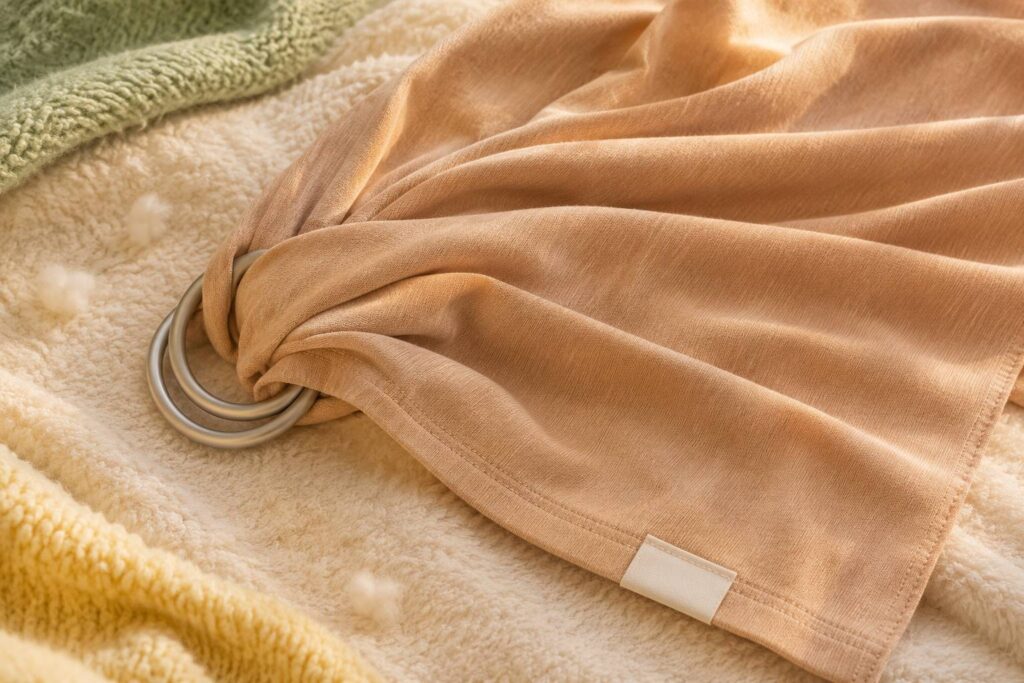
Setting up the sling baby carrier for ergonomic transport
Adjustment quality matters more than the brand or fabric thickness. A poorly tightened sling gives a heavy feeling and pulls on the shoulder. The baby moves away from the body, their pelvis tilts, and their back is insufficiently supported. Conversely, fabric fitted like a garment close to the body allows the parent to walk without constantly holding the child’s buttocks with one hand.
The baby must be carried vertically, belly against the parent’s chest, high enough to be kissed on top of the head and close enough so their body does not sag. This setup supports the head in newborns whose neck muscles do not yet allow stable control. Between 3 and 4 months, many babies hold their heads better, but support needs still vary depending on fatigue, sleep, and temperament.
The fabric spreads from one knee to the other. It forms a deep seat under the thighs, without pressing the legs downward. The knees lift slightly above the buttocks, creating an M position. The thighs are supported without forcing hip opening. The pelvis rests in the fabric, while the back preserves the infant’s curve. A baby too upright or too flat gains nothing from a fixed posture.
- Place the rings high on the shoulder or just below the collarbone, never in the middle of the back where they become difficult to adjust.
- Spread the sling fabric over the shoulder and back, without twisting, then form a pocket wide enough to hold the baby.
- Position the child against your chest supporting their neck and pelvis before pulling up the fabric behind their back.
- Tighten progressively, zone by zone, starting with the top edge that supports the neck, then the middle of the back, and finally the seat under the thighs.
Tightening is done by pulling the fabric in the direction of the concerned rail, i.e., the edge or area that seems too loose. Pulling the entire width in one motion often creates folds and leaves part of the body less supported. This method requires a few attempts but becomes quick when repeated calmly with a demonstration doll or a relaxed baby.
Recognizing an adjustment that is too loose or too tight
An overly loose carry is easily spotted. The baby slides down toward the belly, their body shifts with each step, and the parent feels a pull in the upper back. Their head may bob if the top edge does not sufficiently support the neck. In this case, it is better to take the baby out, reset the sling, and start again rather than trying an approximate adjustment with a poorly positioned child.
An excessive adjustment can also be uncomfortable. The fabric then compresses the back, pulls behind the knees, or presses the child’s head against the chest. The baby must be able to move slightly, breathe freely, and turn their head sideways without their face being buried. For infants, breathing freedom always takes precedence over the appearance of a very tight setup.
| Observation | What it indicates | Useful adjustment |
|---|---|---|
| The baby slides downward | The fabric lacks tension at the back | Tighten the central panel and place the rings higher. |
| The legs hang unsupported | The seat does not extend from one knee crease to the other | Spread the fabric under the thighs and lift the knees slightly. |
| The parent carries the weight on one painful spot | The shoulder or back is not properly spread out | Distribute the fabric over the shoulder and alternate sides each outing. |
| The face is hidden by fabric or breast | Child safety is not ensured | Immediately reposition the head to see the nose, mouth, and chin. |
Early setups should be short, five to ten minutes at home, in front of a mirror and without a thick coat. The parent thus learns the gesture before using it when leaving in a hurry. Stability comes from fine adjustment, not from force exerted on the rings.
Carrying positions and baby comfort according to age
Carrying positions are not interchangeable at all ages. The newborn needs overall support, with particular vigilance for the head and airways. The 4 to 6-month-old baby, once they hold their head steadily, can look more around from ventral carrying. After about 6 months, depending on tone and weight, carrying on the hip often becomes comfortable for short periods.
The safest position in a sling remains the vertical, facing the carrier, with the face clear and knees supported higher than the buttocks. It respects the needs of a child who easily falls asleep against their parent and does not yet master head adjustments. This rule holds true when the baby has a cold, is tired, or after a vaccination, moments when tone may be less stable.
Facing outward carrying is not recommended in a sling. The pelvis is difficult to support, legs often dangle, and the child receives many stimulations they cannot modulate. Between 3 and 6 months, a baby becomes more curious about faces, contrasts, and movement. This curiosity does not mean they must be placed facing outward. They can observe sideways from a ventral position, then take refuge against the adult when tired.
Hip carrying is possible when the baby firmly controls their head and trunk, often around 6 months, with normal variations of several weeks. The fabric must always form a seat under the thighs, not only support the crotch. This position is practical for a child who wants to alternate between observing and snuggling. It remains asymmetric for the parent, so better suited for short trips or frequent side alternation.
The sling facing awakening and regulation needs
A 2-month-old baby does not perceive their environment like a 9-month-old child. Their vision is still developing, and they tire quickly facing bright light, rapid movements, or many voices. In carrying, the parent becomes a stable sensory base. The baby can look for a few moments, then bury their gaze against the chest when needing to reduce stimulation.
Around 4 months, neurological maturation often changes sleep and environmental availability. Cycles become more organized, but micro-awakenings also become more frequent. A sling can help navigate a restless end of day, without being presented as a technique to make all babies sleep. Some children relax quickly in it. Others get upset when tired, then accept carrying better after a few minutes of slow walking.
A baby who cries regularly between 6 p.m. and 10 p.m. is not necessarily suffering. This time slot often corresponds to accumulated stimulation and difficult regulation at day’s end. Calm carrying in a dimly lit room can reduce sensory overload.
To preserve baby’s well-being, observe signals rather than the time displayed on a watch. A relaxed face, open hands, regular breathing, and a supple body generally indicate comfortable positioning. Continuous crying, an arched back, stiff legs, or increasing restlessness invite checking a diaper, feeding need, excessive temperature, or uncomfortable adjustment.
A light muslin can protect clothes during regurgitation, provided the face is never covered nor an unnecessary layer of warmth added. Concrete references on using muslin with a baby allow use without hindering face observation. Carrying fabric does not replace attentive supervision, especially when a child falls asleep.
The right position is one that allows the baby to breathe, relax, and stay supported without the parent compensating with their arms.
Child safety in sling and signs that require advice
Child safety in a baby carrier relies on simple checks repeated before every departure. Rings must be intact, without cracks or deformation. The fabric must have no holes, unraveled seams, or worn areas. A second-hand sling can be useful, but its condition deserves thorough inspection. Very soft textiles stretched by years of use can become more difficult to adjust properly.
The baby’s face remains visible, their nose and mouth completely free, and their chin must stay away from their chest throughout carrying. The chin-to-chest position can reduce air passage in a very young infant whose airways are narrow and muscle control still limited. A sleeping baby is not a baby to watch less. On the contrary, visual checks must be regular then.
Clothing must suit the heat produced by two bodies close together. Under a sling, one less layer is sometimes enough, depending on outside temperature and fabric thickness. The neck, nape, and chest provide better comfort indicators than hands or feet. A very hot, sweaty nape, very red cheeks, or rapid breathing invite removing a layer and moving out of the heat.
Carrying also requires adapting adult gestures. Drinking a hot beverage above the baby, cooking, smoking, handling household products, or carrying a heavy bag unnecessarily exposes the child. Stairs are climbed slowly, with one hand free on the railing when possible. The center of gravity changes, especially after a cesarean, recent epidural, or marked postpartum fatigue.
Precise signals not to be trivialized
Crying does not always reveal a sling-related problem. A baby may ask for feeding, need changing, or show digestive discomfort. However, unusual noisy breathing, bluish or grayish lip coloring, a very limp child, repeated difficulty waking, or a face buried in the fabric require immediate removal and urgent medical help.
An infant under 3 months with a fever of 38 °C or more must be evaluated quickly by a healthcare professional, even if carrying seems to soothe. Carrying must not hide a concerning general state. Severely reduced feeding, fewer wet diapers, green vomiting, inconsolable crying associated with a very tense belly, or fast breathing also deserve medical advice.
- Contact a doctor quickly if the baby becomes unusually drowsy, refuses several successive meals, or has a temperature of 38 °C or more before 3 months.
- Seek advice from a midwife, pediatric nurse, or carrying instructor if the baby systematically curls up, slips, or cries as soon as the fabric is adjusted.
- Consult a healthcare professional if the parent feels persistent back, perineum, cesarean scar, or shoulder pain despite adjusted fitting.
A carrying workshop can be particularly helpful after premature birth, in case of low weight, significant reflux, or unusual tone. These situations do not automatically exclude sling use. They require individualized assessment, sometimes with the pediatrician, physiotherapist, or the team following the child.
Caution does not detract from the gentleness of carrying. It allows the parent to rely on visible references instead of trusting only a feeling of comfort.
Daily sling carrying guide and parent comfort
The sling is particularly suited to short and frequent moments. It can accompany daycare return, local errands, cold meal prep, a medical appointment, or slow walking after a day indoors. Its main asset lies in quick setup. Once the fabric is prepared to the right width, the parent can place the baby without retying completely.
For comfortable sling carrying, weight must stay close to the body, and fabric must be widely distributed over the shoulder, never concentrated in a cord compressing muscles. A baby carried far from the chest feels much heavier than their actual weight. The upper back compensates, the lumbar curves deepen, and the shoulder endures continuous pull. Raising the baby a few centimeters and retightening the central panel often changes the sensation in seconds.
Acceptable duration depends on the child’s weight, parent’s physical condition, and type of outing. After recent childbirth, ligaments remain more flexible due to hormones for several weeks. Abdominal muscles and perineum recover at their own pace. Starting with ten to fifteen minutes, then observing no pain during and after carrying, allows realistic progression. Increasing discomfort should not be endured in the name of closeness.
Parents who alternate shoulders limit asymmetrical tension. This alternation becomes more useful when the child exceeds 6 or 7 kg, a very variable age according to growth charts. For a long hike or several hours of travel, a two-strap carrier can more comfortably distribute the load. The sling then retains its place as a compact solution, easy to slip in a bag, and precious for transitions.
Maintaining fabric and preserving simple gestures
Washing according to the label maintains the textile’s suppleness and durability. Rings do not require specific products, but must be dried and checked regularly. Clean fabric without slippery residue moves better through the rings. Parents also benefit from identifying which edge corresponds to the sling’s top before putting it on, avoiding unnecessary handling when the baby begins to get impatient.
Carrying is part of a flexible family organization. One adult can carry while the other showers, prepares a meal, or rests. This division does not reduce the child’s bond with either parent. The baby learns the smells, voices, and movements of each adult responding regularly to their needs. An adjustable sling generally allows switching carriers with just a few adjustments.
Some parents prefer a more enveloping wrap for long contact naps, others favor the sling’s quickness. No choice defines the quality of the bond. The best equipment is safe, suited to the baby’s size, and truly used without pain. To deepen adjustments and uses according to times of day, this detailed reference on sling carrying comfort usefully complements early setups.
Carrying can also become a time for calm narration. Around 4 to 6 months, the baby observes facial expressions more and reacts to voice variations. Simply describing what happens during a walk nourishes this exchange without trying to stimulate continuously. Short stories, nursery rhymes, and visual aids such as the Max and Lili books when they grow up can integrate these moments of closeness.
A simple gesture can accompany this week. Before going out, take thirty seconds to check baby’s height, their clear face, and fabric tension on their back. This brief routine makes carrying smoother even when the day is already full.
From what age can a baby use a sling?
A sling can be used from birth if the baby is carried vertically against the parent, with the head supported, the face fully visible, and the airways clear. A premature baby, a low-weight baby, or an infant with breathing difficulties requires individualized advice from a trained professional.
How long can a baby be carried in a sling?
There is no universal duration. The first sessions can last ten to fifteen minutes, then lengthen according to the comfort of the baby and parent. Regularly check breathing, temperature, leg position, and absence of shoulder or back pain.
Is the sling suitable for long walks?
It may be suitable for some parents for moderate walks, but its asymmetric carrying tires more quickly than a two-strap model when the baby gains weight. For several hours of walking, equipment distributing the load across both shoulders may be more comfortable.
Can you breastfeed in a sling?
It may be possible with experience, but the baby must remain visible, breathe freely, and be repositioned vertically after feeding. For first attempts, feeding outside the sling is often simpler and allows precise observation of breastfeeding or bottle feeding.