
In short
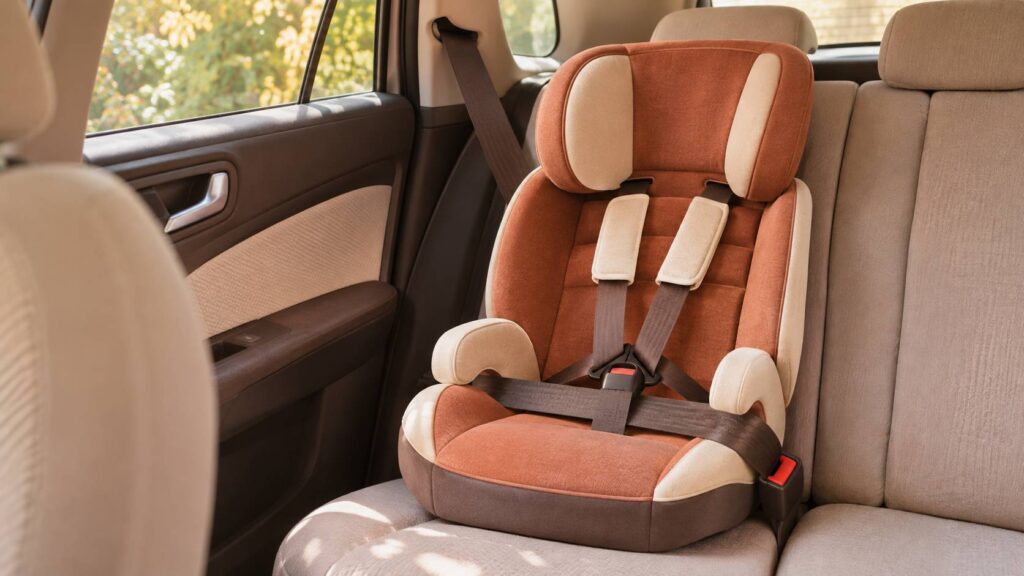
- The booster concerned is the Maxi-Cosi Jay Plus Elegance Graphite, grey and beige, identified by GTINs 3220660009701 and 3220660009718.
- The danger does not concern the seat itself, but the play arch attached to the removable tray, which may break after repeated handling.
- Small parts can then detach and create a choking hazard for the child.
- The recall published on July 20, 2025 requested to no longer use this play tray and to contact customer service for an exchange.
- The Jay Plus booster without this arch and with its standard tray remains usable according to the brand’s indications.
Safety alert on the Maxi-Cosi Jay Plus Elegance Graphite booster seat
A booster seat often accompanies meals as soon as the child can sit with enough stability, generally around 6 months, depending on their tone and the manufacturer’s recommendations. It brings the baby closer to the family table, supports emerging autonomy, and enables shared meals. This proximity must never make one forget that childcare equipment is subject to strict safety standards, since a poorly designed accessory can expose a young child to a sudden accident.
On July 20, 2025, an alert was published on the official RappelConso platform concerning the Maxi-Cosi Jay Plus Elegance Graphite booster. The product affected is recognized by its grey and beige colors as well as two GTIN references, 3220660009701 and 3220660009718. It was distributed throughout France, including via Amazon, Autour de Bébé, Bébé 9, Orchestra, JouéClub, Made in Bébé, Family, Bambinou, New Baby, and several specialized retailers.
The identified problem does not involve the booster shell nor the standard tray used during meals. It concerns the removable tray equipped with a play arch. When the child moves this arch repeatedly back and forth, one end can weaken and then break. Small pieces can then be released into the immediate space of the child.
In babies between 6 months and 3 years old, the risk linked to small objects is not limited to putting them in their mouth. At this age, oral exploration remains very active. Hand coordination develops faster than danger assessment. The child grasps, turns, nibbles, brings objects to their lips, and may suddenly inhale when a piece is in their mouth. This mechanism makes detachable parts concerning.
A piece that detaches from a toy or meal accessory is never insignificant when it remains within mouth’s reach of a child. Protection relies primarily on eliminating the source of risk, rather than perfect supervision every second. A meal already requires monitoring food textures, posture, child’s gestures, and family interactions. Adding a defective object to this environment has no place.
In 2026, the official recall period announced until December 1, 2025, is over. This does not make the arch concerned a safe accessory. Families finding this model in a cupboard, at grandparents’, in shared childcare, or among second-hand equipment can still identify it. The administrative procedure’s end date must not lead to putting the play arch back into use.
The distinction between parts of the product is useful. The Maxi-Cosi Jay Plus booster and its classic tray were indicated as safe for daily use by the brand. The play arch mounted on the removable tray, however, must be removed. This clarification avoids two frequent reactions, both tiring for parents. The first is to keep using the defective accessory thinking it will not break. The second is to discard all the equipment when only certain parts need to be set aside.
Why the play arch presents a choking hazard for the child
The reported danger results from mechanical wear. A play arch is designed to attract attention, encourage grasping, and occupy the child’s hands while seated. These repeated movements are part of normal development. Between 6 and 12 months, a baby willingly experiments with pulling, pushing, and rocking. They cannot know that a rigid piece has a limit of resistance.
When the arch is moved back and forth repeatedly, its end can break. The defect noted in the safety alert concerns precisely this risk of breakage after several cycles of handling. It is therefore not due to misuse by parents or the child. An accessory placed on equipment for small children must withstand the expected gestures of the age at which it is sold.
Small pieces are particularly problematic before age 3. A young child’s airways are narrow. A piece can partially or totally block the airflow. The child may cough, be unable to cry or vocalize, become silent, show bluish coloration around the lips, or quickly lose muscle tone. An effective cough remains a protective mechanism. In this case, it is preferable to let the child cough while staying close, without trying to remove an invisible object with fingers.
When a child can no longer breathe, does not cough effectively, or makes no sound, the emergency is different. Call 15 or 112 immediately and perform age-appropriate clearing maneuvers if you know them. For an infant, these include back blows and chest compressions. For an older child, the maneuvers differ. Pediatric first aid training provides concrete guidelines in situations where every second feels long.
The most reliable prevention is to remove the defective arch before a fragment can become accessible. A quick visual check is not enough. A part can be weakened inside or at a fixation point without fissures immediately visible. Occasional use is not a guarantee, since breakage depends on cumulative stress and how the child manipulates the accessory.
Differentiating a suitable developmental toy from an accessory to remove
A suitable developmental toy at the table is firmly attached, does not release small pieces under usual pulling, and does not hinder the harness or posture. However, it does not replace attentive supervision during meals. From the start of complementary feeding, the child also learns to recognize hunger and satiety signals. Too much visual or sound stimulation can distract their attention from chewing and make meals harder to interpret.
A removable arch may seem convenient during a wait or a short meal. It should not remain in front of the child while eating. Foods already require complex coordination between lips, tongue, jaw, and swallowing. A clear tray leaves more room for the spoon, cup, and foods offered in pieces adapted to the child’s skills.
Vigilance should not become constant tension. Removing the recalled accessory, checking objects placed on the tray, and keeping very small pieces out of reach are simple gestures. A young child’s brain learns by action, not by anticipating danger. The adult environment therefore carries part of this protection concretely.
Identifying the recalled booster seat and avoiding confusion with the standard tray
A recall alert becomes useful when it allows precise identification of the item at home. The model name concerned is Jay Plus Elegance Graphite, marketed under the Maxi-Cosi brand. Its grey and beige color combination can help spot it, but the most reliable verification relies on GTIN references 3220660009701 and 3220660009718 when they are still on the packaging, label, or purchase proof.
The point that requires particular attention is the presence of a removable play tray with its arch. This combination is what is recalled. The usual tray used as a meal support without a play arch was not presented as concerned. The booster itself can therefore continue to be used if it is in good general condition, if the harness works correctly, and if the manufacturer’s instructions are followed.
| Checked item | Situation indicated by recall | Appropriate decision |
|---|---|---|
| Maxi-Cosi Jay Plus booster | Structure and seat not targeted by reported defect | Use possible after checking harness and stability |
| Standard meal tray | Not concerned by arch defect | Use possible according to instructions |
| Removable tray with play arch | Risk of breakage and release of small parts | Stop using it and put it out of reach |
| Isolated arch found with second-hand equipment | Uncertain identification or product concerned | Do not attach to booster and contact the brand if needed |
The booster’s instructions remain useful for checking safety points not covered by the recall. A child must be strapped in every use, even for very short meals. The device must be fixed to a stable chair, without a thick cushion that reduces grip or changes the seating angle. The chair must not be pushed up against a table where the child could lean with their feet and tip backward.
Positioning also matters for swallowing. The back is supported, the pelvis sits deep in the seat, and feet ideally have adequate support. A child who slides or slumps may swallow less efficiently, get more agitated, and associate meals with discomfort. The booster must never be placed on a table, countertop, or other raised surface.
Good equipment is what keeps the child stable without multiplying detachable accessories around them. Daily safety is built in these discreet details, long before an incident occurs. A two-minute check before reinstalling the seat can catch a twisted harness, a loose strap, a cracked part, or an element that does not belong near a child.
To deepen the references related to equipment that must no longer be used, this page on the use of a banned or recalled booster helps distinguish an isolated defect from a broader usage restriction. Second-hand products deserve the same rigor, as they sometimes circulate without box, label, or information on a prior recall.
Protective measures to adopt after this booster alert
When a recalled item is found, the first measure is to remove the play tray with its arch from the meal area. Place it in a closed or out-of-reach place so it cannot be mistakenly put back during quick tidying. Do not try to reinforce the fixing with adhesive tape, glue, or a makeshift repair. These solutions alter the product without restoring factory-tested resistance.
The procedure published in 2025 planned an exchange rather than a refund. Even if the period mentioned in the notice ended on December 1, 2025, keeping proof of purchase, photographing references, and contacting Maxi-Cosi customer service remains a sensible step. Current conditions may differ from those at the initial recall. The brand alone can confirm the solution available for a part identified today.
- Immediately remove the tray with arch and check that no fragments have detached around the seat, under the table, or in the storage basket.
- Keep a photo of the model, GTIN references, and the condition of the accessory before any return or exchange with customer service.
- Use the standard tray only if it is intact, properly attached, and compatible with the booster according to the instructions.
- Temporarily choose another certified seat if the usual configuration depended on the recalled tray to keep the child comfortably seated.
A booster never replaces adult presence during the meal. This supervision helps respond to food misdirection but also to detect posture changes or attempts to stand up. Between 9 and 18 months, many children become more mobile, faster, and more determined. Their desire to participate in their surroundings grows, while their ability to understand the consequences of their actions remains immature.
Preventing domestic accidents benefits from being regular rather than anxious. Once a month, take time to look at straps, clips, visible screws, and plastic parts. A crack, deformation, abnormal looseness, or missing piece justifies stopping use until verified. This reflex is valid for the booster but also for high chairs, baby bouncers, and hanging toys.
European standards cover stability, material strength, and risks related to small parts. They are not a distant administrative formality. They reflect concrete scenarios such as tipping over, pinching, tearing off a part, or ingesting a fragment. When a product is declared non-compliant or recalled for a defective piece, removing the targeted part is a proportionate and protective response.
Meals remain a time for learning and bonding. Simple, stable equipment without fragile accessories facilitates this experience. The child can explore tastes, touch age-appropriate foods, and watch adults eat without the device in front becoming itself a source of risk.
Recognizing signs that require help after a safety incident
If the play arch has been handled, broken, or found with a missing part, first move the child away from the area and calmly search for pieces. Look in the seat, under the tray, on the floor, in the folds of a mat, and in clothing. A small piece can roll far without being immediately visible. If you know a fragment has been put in the mouth but spit out and the child breathes normally, careful monitoring remains appropriate.
Some signs require prompt medical consultation. An unusual cough persisting after the incident, respiratory difficulty, wheezing, repeated vomiting, sudden salivation, refusal to drink, or pain when swallowing may indicate an object has irritated or blocked a zone. A child becoming very drowsy, pale, blue around the lips, or unusually limp must be assessed urgently.
Breathing difficulty, inability to cry or cough effectively, or loss of consciousness justify immediately calling 15 or 112. Do not wait to see if the situation resolves itself. If the child breathes but ingestion of a piece is plausible, call a poison control center or doctor for appropriate guidance based on the object’s size and nature.
Adults’ reactions matter a lot in these moments. Speak slowly, move other children away, and clear limited space to reduce confusion. Avoid giving the child food or drink to “push down” an object. Also avoid shaking the child or inserting a finger into their mouth without clearly seeing an easy-to-grasp piece. These actions may push a fragment deeper into the airways.
Childcare devices are part of a busy daily life. Fatigue, meal preparation, and attention shared among several tasks make it understandable to miss an alert or put back a familiar tray. Safety does not rely on parental perfection. It relies on clear information, compliant products, and the ability to adjust equipment as soon as a risk is identified.
To check the conduct to follow when a recalled product is still at home, also consult guidelines dedicated to setting aside a booster subject to a usage restriction. Keeping the arch removed and favoring a stable seat helps preserve the meal as a simple moment, without exposing the child to a piece that should no longer be used.
Which Maxi-Cosi booster is concerned by the recall?
The recall targeted the Maxi-Cosi Jay Plus Elegance Graphite, grey and beige, bearing the GTIN references 3220660009701 and 3220660009718. It is especially important to check the presence of the removable tray with play arch.
Should the entire Jay Plus booster be thrown away?
No. According to recall information, the Jay Plus booster and its standard tray remain usable. The play tray with the concerned arch must be removed and no longer used.
Why does the play arch present a risk?
After repeated back and forth movements, one end can break and release small pieces. A young child may put them in their mouth, posing a choking hazard.
What to do if a small piece is missing after the arch breaks?
Remove the child from the area, look for the fragment, and monitor for any unusual respiratory or digestive signs. In case of breathing difficulty, inability to cough or cry, call 15 or 112 immediately.