
In brief
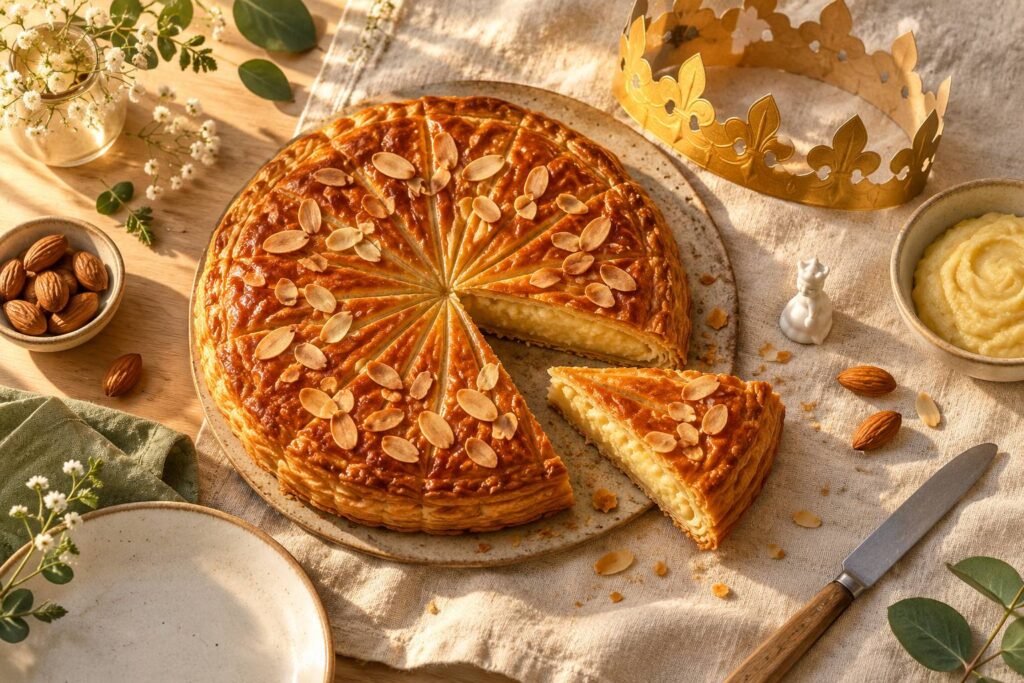
- The King’s Cake with frangipane combines two disks of puff pastry with a generous almond filling, soft without being liquid.
- The butter must be very soft, the seam carefully pressed, and the glaze applied in two stages to obtain a regular crust.
- A fève placed near the edge, never in the center, preserves the suspense at the time of sharing and limits the risk of cutting it with the first slice.
- A 30-minute baking at 180 °C gives a golden and crispy cake, provided the time is slightly adjusted to the actual power of the oven.
Choosing the ingredients for a traditional King’s Cake recipe with frangipane
The King’s Cake belongs to French pastry during the first days of January, when the Feast of Kings often brings several generations together around a dessert to share. Its success does not depend on a complicated gesture. It relies on the balance between well-chilled puff pastry and a smooth, flavorful frangipane that is stable enough not to escape during baking.
Two ready-to-roll round puff pastries offer a reliable solution when time is short. However, pure butter dough gives a cleaner puff pastry because the butter melts in the oven, releases steam, and separates the thin layers of dough. This phenomenon explains the puffing and the expected crispy texture when cutting.
The filling presented here is close to an almond cream, often called frangipane in family recipes. In a more technical bakery frangipane, the almond cream is enriched with pastry cream. For a quick and indulgent homemade cake, the mixture of butter, sugar, egg, and almond powder already gives a melting result, very pleasant with puff pastry.
The proportions that keep the filling soft
Plan for 125 g of very soft unsalted butter, 125 g of sugar, 150 g of almond powder, and 2 eggs for a cake of six to eight servings. Add a tablespoon of amber rum or a few drops of bitter almond extract if this flavor pleases your table. A pinch of salt highlights the roundness of the butter and avoids a uniform taste.
The butter must not be melted. When it becomes liquid, it mixes less well with the sugar, and the filling can become greasy after baking. Take it out 45 minutes to 1 hour before preparing the dessert, depending on the kitchen temperature, until a pressure with the finger leaves a clear mark without turning it into a flowing cream.
A successful frangipane remains smooth and flexible on the spoon, while holding in a small dome rather than spreading like a sauce. This consistency avoids a hollow or soggy cake. It also allows spreading the preparation without forcing on the edges, a zone that must remain clean for the two doughs to stick.
| Element | Recommended quantity | Role in the cake |
|---|---|---|
| Round puff pastry | 2 disks of 230 to 280 g | Form a crispy envelope and protect the filling |
| Soft unsalted butter | 125 g | Provide softness and carry aromas |
| Sugar | 125 g | Sweeten and help butter become creamy |
| Almond powder | 150 g | Give dense texture and typical frangipane taste |
| Eggs | 2 in the filling, 1 yolk for the glaze | Bind the cream and color the surface |
Almond powder deserves special attention. A fresh powder, kept away from heat, has a sweet and slightly milky aroma. If it smells like cardboard, old oil, or bitterness, it is better to replace it. Nuts contain fragile fats that go rancid faster than one might imagine.
This traditional recipe can accommodate a thin layer of apricot jam under the almond cream, but the amount must remain modest, around two tablespoons. Excess moisture prevents the bottom from becoming crispy. Simplicity is often what gives this dessert the appearance of a bakery cake.
A paper crown willingly completes the ritual, especially when children participate in sharing. The story of Melchior and its significance in the tradition of the Kings can fuel the conversation while the cake cools. The cake then becomes a cultural moment as much as a pleasure of French cooking.
Almonds require clear caution for the youngest. A finely incorporated powder in a cooked filling does not pose the same problem as a whole almond, but a known allergy requires choosing another preparation. A reaction with lip swelling, respiratory distress, repeated vomiting, or generalized urticaria after ingestion requires immediate medical advice.
Preparing a smooth frangipane for a homemade King’s Cake
Start by working the soft butter with the sugar in a large bowl. A manual whisk is sufficient because it is not about incorporating much air. The mixture whitens slightly and becomes creamy when sugar crystals distribute evenly in the fat.
Then add the eggs one by one, mixing after each. This progression limits the risk of the butter separating into small grains. If the cream seems slightly curdled despite everything, the almond powder will stabilize it as soon as it is incorporated.
Pour in the almond powder, salt, and chosen flavor. Mix until you get a homogeneous preparation, without insisting for several minutes. Almonds absorb part of the moisture from the eggs, which gives the cream its progressive consistency.
Spread the filling without weakening the edge
Unroll the first puff pastry circle on a baking sheet covered with parchment paper. Keep the paper supplied with the dough if it is clean and oven-safe. Place the almond cream in the center, then spread it with the back of a spoon or a spatula, leaving a free border of about 2 cm.
This empty border has a precise function. It will receive the light moisture that allows the two doughs to stick, without being invaded by the fat of the frangipane. A filling spread to the edge often causes an opening during baking because the steam pressure then seeks an escape.
The free zone around the edge should measure about 2 cm and remain perfectly clean before placing the second disk. If a trace of cream reaches the edge, remove it with absorbent paper. This simple gesture noticeably changes the firmness of the cake right out of the oven.
- Work on cold dough, as dough that warms becomes soft and difficult to seal.
- Spread the almond cream in a regular layer of about 1 cm so that baking is uniform.
- Slightly moisten the edge with water using a brush, without soaking it.
- Reserve the assembled cake for 10 minutes in the fridge if the dough becomes too soft before glazing.
The fève is placed in the frangipane near the edge, a few centimeters from the seam. It must not be placed on the outer circle where it could hinder closure. Avoid the center, as the first cut often passes through this area and would immediately reveal the crowned person.
When young children are present, the person cutting keeps control of the portions and clearly indicates the presence of the fève. This small hard object can pose a choking hazard before the child chews and understands the instruction not to swallow it. It is reasonable to remove the fève before serving a toddler or reserve a verified slice for them.
Cover with the second disk of dough. Gently chase the air from the filling towards the outside by smoothing with flat hands, without pressing in the middle. Then press the edge with fingers, mark it with the prongs of a fork, or make small regular slits with a knife.
This step creates a mechanical barrier. The steam produced by water contained in the butter, eggs, and dough must be able to rise without pushing the filling out of the cake. A firm but not crushed seal leaves enough room for the puff pastry to develop.
A demonstration video can help observe the exact pressure of the gesture and the regularity of the circle. The images are particularly useful when the puff pastry shrinks or slightly deforms at the moment of closing.
Once the cake is closed, place it in the refrigerator for a few minutes. The cold firms the butter in the dough and makes the decoration easier to trace. This short pause does not replace baking, but it promotes a cleaner surface and better-defined puff pastry.
Decorating the King’s Cake with frangipane with an even glaze
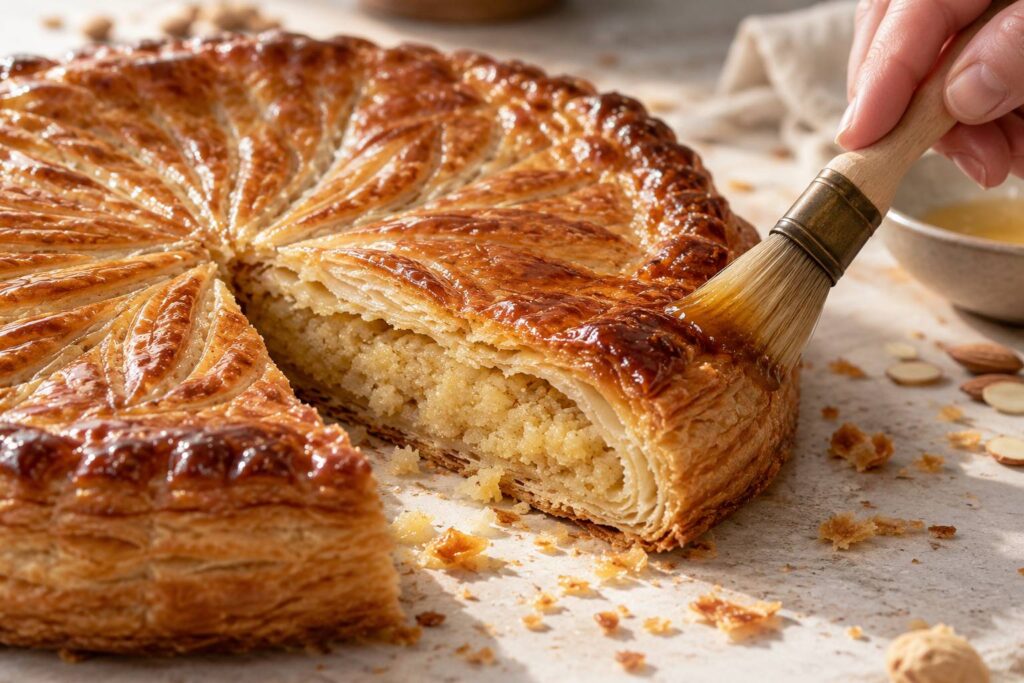
The glaze gives the cake its amber color and highlights the patterns engraved on top. Whisk an egg yolk with a tablespoon of water. The water thins the yolk and allows spreading a thin layer without creating too dark patches.
Brush the surface with a soft brush, from the center outward. Carefully avoid the edge and the sealed edge. When the yolk flows between the pastry layers, it acts as glue and limits the lift of the puff pastry.
Then place the cake in the fridge for 10 minutes. This wait may seem secondary, but it gives time for the first layer to dry slightly. A second application can then be applied without removing the first, which brings a more uniform shine after baking.
Engraving patterns without piercing the dough
After the second glaze, draw patterns with the back of a knife, never with the cutting part. Diamonds, rays radiating from the center, or arabesques work very well. The gesture marks the surface without cutting the layers, preserving the volume on top.
A small hole in the center, made with the tip of the knife, lets some steam escape. Without this discreet chimney, the pressure can irregularly lift the dough or create a crack on the side. The hole should remain thin, barely visible, so as not to disturb the decoration.
Two thin layers of glaze, separated by 10 minutes of chill, color the surface without blocking the development of the puff pastry. The result also depends on the oven, as some appliances heat more from the bottom or with a fan. Careful monitoring during the last ten minutes remains more useful than a timer followed without observation.
A circle of parchment paper under the cake facilitates transfer onto the tray and protects the bottom. If the dough is handmade or particularly rich in butter, a pre-cooled tray is preferable. A hot surface melts the first layers before baking and reduces the sharpness of the puff pastry.
The decoration can be a shared cooking moment with children old enough to handle a brush under supervision. They can choose the design, place the crown next to the cake, or count the servings. The knife intended for slits, however, remains in adult hands, as the work requires precision and stability.
The tradition of the fève echoes older stories than the simple January dessert. Curious families can explore the fascinating roots of corn to extend, during another meal, the discussion about seeds, cereals, and foods that cross cultures. Family cooking gains interest when it connects taste, matter, and an accessible story.
Do not overload the top with sugar before baking. Sugar melts quickly, caramelizes in places, and can mask decorative lines. A dusting of powdered sugar, if you wish, is applied after cooling, but the classic cake is often sufficient with its shiny glaze.
The sought color is blonde to golden brown, never dark brown. If the surface colors too quickly while baking is not finished, simply place a sheet of parchment paper on top without pressing it down. This protection reduces direct heat while allowing the inside to finish cooking.
An almond scent escaping from the oven is expected. A harsh odor, persistent smoke, or butter burning on the tray, on the other hand, require stopping the baking and checking the temperature. A successful cake should remain a serene pleasure, including in the practical details of preparation.
Succeeding in baking the King’s Cake and keeping a crispy puff pastry
Preheat the oven to 180 °C, ideally with fan heat if your appliance distributes hot air well. Bake the cake on a rack placed in the middle of the oven for about 30 minutes. This duration suits a common size of 26 to 28 cm, but domestic ovens often show temperature differences of 10 to 20 °C.
Baking transforms the almond cream into a firm and melting filling. The egg proteins coagulate with heat, while the butter gradually impregnates the almond powder. The center should no longer look like a wet cream, even if its texture remains soft once cooled.
Observe above all the base. A very golden surface does not guarantee that the underside is cooked enough. Gently lift an edge with a spatula after 25 minutes if possible to check that the lower dough is also beginning to take on a golden color.
Adjusting the time according to diameter and oven
A small 22 cm cake can be ready in 25 minutes. A large 30 cm size, more filled, may sometimes require 35 to 40 minutes at 180 °C. The time indications serve as a guide, not a rigid rule, because the thickness of the frangipane, the tray material, and the thermostat precision alter the result.
Baking is complete when the top is evenly golden, the edges have puffed, and the bottom is no longer pale or soft. Then take out the tray from the oven and let the dessert rest for 10 to 15 minutes. This time allows the filling to stabilize, which makes the servings neater when serving.
A hot cake appears more flavorful, but it cuts poorly and the fève remains hard to spot. Serve it warm, at a pleasant temperature in the mouth. A long blade, slightly heated under water then wiped, cuts cleaner through the pastry layers.
If the bottom lacks crispiness, two causes often return. The first is a tray that is too thick or an oven that heats little from the bottom. The second is a too-moist filling, especially when a compote, jam, or egg excess has been added without adjusting the proportions.
A simple temperature test with an oven thermometer lets you better know your appliance. Many family kitchens use a slightly approximate thermostat, without it being a problem as long as the food is observed. Controlled baking relies as much on color, smell, and texture as on a displayed number.
After baking, transfer the cake to a rack if the bottom seems wet. Air then circulates under the dough and limits condensation. If you leave it on a hot metal tray, steam stays trapped and the lower puff pastry loses its crispness faster.
A thin layer of syrup can bring a shiny finish. Heat a tablespoon of water with a tablespoon of sugar until dissolved, then brush very little liquid onto the still-warm cake. This gesture is optional and must remain light to avoid softening the crust.
French cooking often has this discreet precision. A resting time, a chilled dough, or a glaze applied without rushing do more for the result than an accumulation of ingredients. The cake thus keeps a strong almond flavor, carried by a light puff pastry.
Sharing this King’s Day dessert in complete serenity
The King’s Cake keeps at room temperature during the day if the room remains cool, around 18 to 20 °C. Cover it without sealing hermetically, for example under a dome or loosely placed parchment paper. An airtight box traps moisture and quickly softens the puff pastry.
To keep it until the next day, place it in the refrigerator in a loosely closed container, then reheat it 8 to 10 minutes at 150 °C. The oven restores crispness, while the microwave softens pastry layers. Let it warm a few minutes before serving because the almond cream can be very hot in the center.
Cutting deserves special vigilance when young children are present. The fève is not food and must never be left within reach of a baby or child who still easily puts objects in their mouth. An adult can check the portions before distribution or choose a large fève, easier to spot.
Adapting the cake to family habits and sensitivities
An allergy to nuts requires another recipe, not just removing some visible almonds. Almond powder is at the heart of the filling, and traces can be found on utensils, the tray, or hands. A cake filled with apple compote, pastry cream, or chocolate can then be prepared with carefully cleaned equipment.
A person following an alcohol-free diet can simply omit the rum. Vanilla extract, the very fine zest of an untreated orange, or a few vanilla seeds give another aromatic direction. These adaptations change the flavor profile without unbalancing the cake’s structure.
Sharing remains pleasant when the fève is announced, portions are checked for the little ones, and each guest knows the ingredients concerning them. This care avoids turning a festive tradition into a source of tension. It gives children the space to participate according to their age, without asking them for caution they cannot yet ensure on their own.
Older children can draw lots to choose the person in charge of distributing the servings, according to the table ritual. One of them sometimes sits under the table and designates guests without seeing the plates. This custom makes the distribution more playful but does not exempt the adult from staying attentive to the location of the fève.
The cake willingly accompanies tea, light coffee, or a glass of milk for children. Its richness in butter, sugar, and almonds makes it a festive dessert, enjoyed in reasonable portions after a meal or at snack time. The place of a food in family balance is built over time, without categorizing indulgent moments as missteps to fix.
Leftovers can be offered the next day, gently reheated, or cut into small portions to freeze. Wrap each piece in parchment paper then in a suitable container, and keep them up to one month. Putting back in the oven at 150 °C for 12 to 15 minutes, without complete thawing, restores a more pleasant texture than quick reheating.
The Feast of the Kings also offers an opportunity to talk about transmission. A traditional recipe evolves with tastes, allergies, available equipment, and each person’s time. What counts lies in the precise gestures repeated together, from the spread almond cream to the crown placed on the head of the person who finds the fève.
What is the difference between almond cream and frangipane?
Almond cream generally mixes butter, sugar, eggs, and almond powder. Pastry frangipane often combines this cream with pastry cream. For a homemade cake, almond cream provides a melting filling very close to the expected taste.
Why does my King’s Cake open during baking?
The filling has often been spread too close to the edge, or the seam has been soiled by the almond cream. Keep about 2 cm of free dough, slightly moisten this area, and press it firmly before decorating.
Can you prepare a King’s Cake with frangipane the day before?
The cake can be assembled the day before and kept raw in the refrigerator, well protected, then glazed and baked the next day. It can also be baked in advance and reheated for 8 to 10 minutes at 150 °C to regain crispness.
Where to place the fève in the cake?
Place it near the edge, in the filling, without sticking it to the seam. The center is not recommended as it is often cut first. With young children, check each portion or remove the fève before serving.