
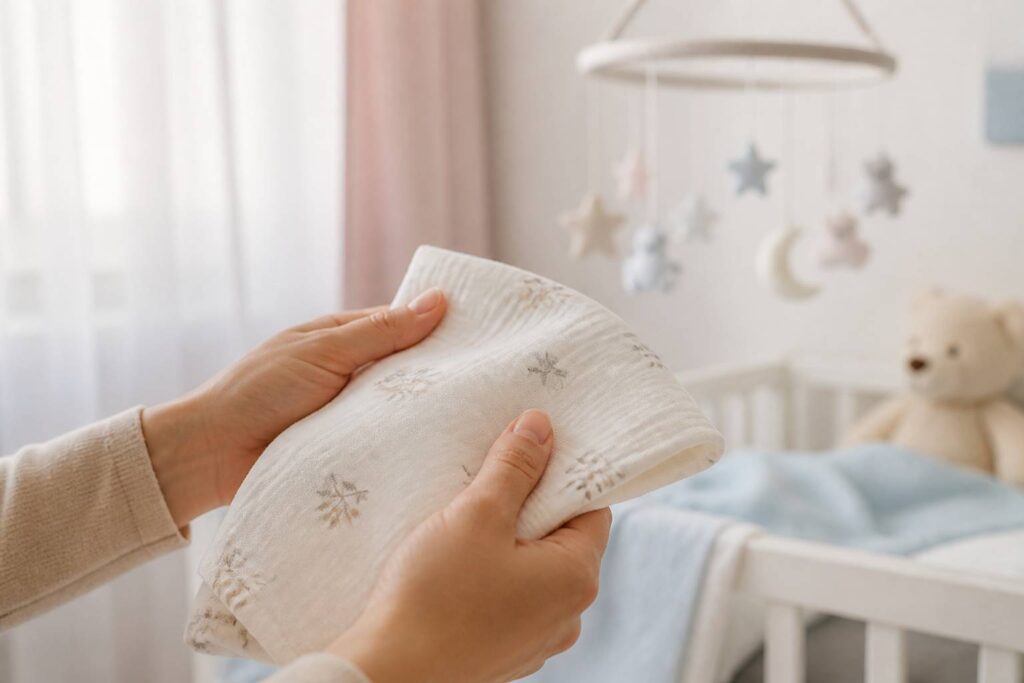
In brief
- A well-chosen muslin cloth becomes a daily ally for the baby around changing, meals, sleep, and outings.
- The material matters as much as the size. A washable textile in cotton, muslin, or double gauze limits friction and supports hygiene.
- Swaddling and wrapped baths require real attention to safety. Free legs, controlled temperature, stop as soon as the baby starts to turn over.
- A simple “on-the-go” use reduces the number of accessories in the bag. The ecological aspect comes from a well-thought-out rotation and appropriate care.
- Certain signals (overheating, breathing difficulties, very irritated skin) justify a medical check or professional advice.
Practical guide to the muslin cloth for baby: understanding its role between hygiene, comfort, and delicate skin
In the first weeks, many parents discover that the muslin cloth is not used « sometimes, » but often. It slips into a routine made of small very normal spillages. Regurgitations after a feeding, milk that drips during the let-down, drool that accompanies digestive and oral maturation, congested nose during a nursery cold.
This versatility comes from a simple point. The muslin cloth is a square or rectangle of thin fabric, designed to absorb and dry quickly. Its flexibility allows it to follow daily gestures without irritating the skin. An infant has an immature skin barrier, with a thinner stratum corneum and a hydrolipidic film under development. A rough or too thick fabric can increase redness and friction, especially around the mouth and neck.
Materials and skin tolerance: why the fabric changes the baby’s sensation
Cotton remains the most common reference, with variants that modify the feel. Airy cotton muslin traps less moisture, which limits the cold sensation on wet skin. Double gauze offers a light fluffiness, appreciated for comfort as a supplementary cover. Bamboo or hemp absorb well, but their feel depends on the quality of weaving and softening.
A certified textile (Oeko-Tex type) reassures about the absence of certain irritating substances. Organic cotton may suit very reactive skin because its cultivation uses fewer chemicals. This is not an « automatic » argument. Poor quality finishing can irritate even organic cotton. The benchmark remains concrete. Observe the skin after prolonged contact, especially in folds, and adjust at the first signs of persistent redness.
What is a muslin cloth really used for daily, beyond the “little fabric”
The first use, often underestimated, is gentle wiping. After a burp, a muslin cloth placed on the shoulder protects clothes and avoids rubbing the mouth with a dry tissue. During a cold, the same fabric moistened with warm water can gently remove secretions around the nostrils without irritating.
The second use is surface protection. In a restaurant, on a changing table that’s not very inviting, the muslin cloth becomes a quick mat. It also serves as a thin sheet under the head in the car seat or stroller, especially in summer, when sweating makes contact less pleasant. A thin fabric is replaced quickly, which helps hygiene without turning the outing into an expedition.
The third use touches on smell and sensory continuity. A muslin cloth held against the parent a few minutes before a nap takes on a familiar scent. Many babies calm down with this olfactory consistency because the sense of smell is one of the most functional senses from birth. This continuity is not a “caprice.” It is a regulation shortcut.
The logical next step is to move from the wiping gesture to more technical uses, such as swaddling or wrapped bathing, which require precise guidelines.
Thinking about sleep equipment also applies to fabrics in the bed. Some families wonder about permitted accessories. A useful reference point is found here, with a clear reading of risks and alternatives around the infant’s bed bed bumper and sleep safety.
How to choose the size and quantity of muslin cloths: concrete guidelines for changing, outings, and organization
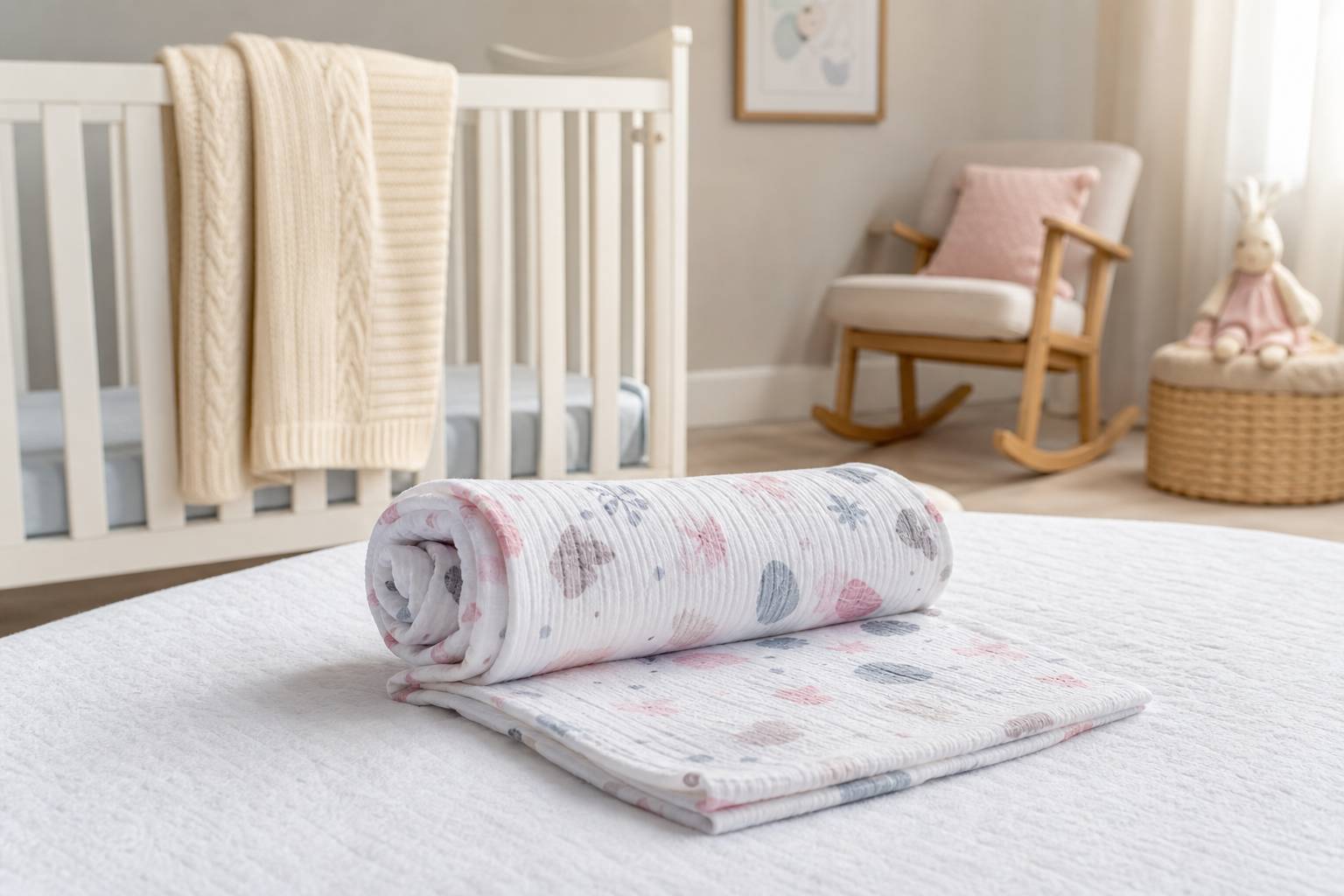
The choice of a muslin cloth depends on two concrete parameters. Size determines the possible use, and quantity determines the mental load. When laundry piles up, a tired parent doesn’t need a perfect system. They need a rotation that holds up.
In stores, common formats range around 60 x 60 cm, 70 x 70 cm, 80 x 80 cm, and maxi-muslins at 120 x 120 cm. A standard format is used for wiping, protecting the shoulder, making an improvised bib. A maxi-muslin serves to wrap, cover a stroller without tightening, or protect a mattress during reflux.
Reference table: sizes, uses, and age
Ages remain ranges because a slender baby and a chubbier baby don’t “fill” the fabric the same way. The most reliable reference is still the freedom of hips and knees and the ability to make a stable knot or fold without pulling.
| Muslin cloth size | Frequent uses | Age reference (normal variation) | Safety vigilance points |
|---|---|---|---|
| 60 x 60 cm | Wiping, burping, small bib, quick surface protection | Birth to 12+ months depending on build | Avoid covering the face in the stroller, watch for moisture on the skin |
| 70 x 70 cm | Wiping + swaddling in the first weeks if technique is mastered | 0 to about 6-8 weeks | Free hips, no chest tightening, stop if the baby turns over |
| 80 x 80 cm | Supplementary cover, protective sheet when out and about | 1 to 12 months | Limit layering to prevent overheating |
| 120 x 120 cm (maxi) | Wrapped bath, longer swaddling, improvised fitted sheet | From 4-6 weeks and beyond | Never restrict breathing, check baby’s temperature |
How many to plan for without overloading
A simple rotation works well in most households. For a use focused on wiping, mobile changing, and protection during burps, counting on 3 to 4 muslin cloths per day prevents being caught out by any accident. This estimate assumes regular washing. If laundry happens every two days, a dozen pieces provides a comfortable margin.
The calculation changes if the muslin cloths are used as washable diapers. Then it is no longer supplementary but a system. Needs increase significantly, and the organization must include storage, pre-washing, and washing machine frequency. Many parents then choose modern washable diapers, simpler to adjust, and keep muslin cloths for everything else.
The ecological aspect without rigidity: a realistic approach
The ecological benefit appears when the muslin cloth replaces several disposable products. It replaces a paper bib, paper towels, a backup mattress protector when out. It is not about aiming for zero waste at the cost of parental exhaustion. A model that works in real life is spotted quickly. The bag contains two clean muslin cloths, a waterproof pouch for the dirty ones, and a water point or liniment to rinse if needed.
The rest is about uses that directly affect baby regulation, such as swaddling and wrapped bathing. There, precision matters as much as softness.
For outings, babywearing is often associated with the muslin cloth because both respond to the same need for closeness and regulation. A helpful insight is found here, with concrete references on comfort and adjustments babywearing in sling and comfort.
Swaddling and wrapped bath with a muslin cloth: precise gestures and safety without rigidity
Swaddling can soothe some babies, especially during the first few weeks. The mechanism is known. A newborn’s nervous system is immature, and the Moro reflex, very present until 4-5 months, triggers startles that wake or disorganize. Gently wrapping the arms reduces the amplitude of these sudden movements and helps some infants regain a more stable state.
This practice is not universal. A very active baby may get upset if feeling constrained. A baby with reflux may be more comfortable in a slightly inclined and less tight position. The goal is not to get an immobile baby. The goal is to reduce disorganization, then gradually restore freedom of movement.
Swaddle with a muslin cloth without blocking the hips
The anatomical reference is clear. An infant’s hips must be able to stay bent and spread, a physiological position that protects the joint. A swaddle that forces the legs into extension and tightly pressed together increases the risk of poor positioning. The fabric must therefore contain the upper body, not “tie up” the lower body.
A safe swaddle leaves the knees free to rise and the hips free to spread. The fabric is placed steadily but without chest compression. A parent should be able to slip two fingers between the chest and the muslin cloth. Breathing must remain visible, regular, without retractions.
Duration and timing matter. For many babies, swaddling helps get through a phase of agitation, then eases off. As soon as the baby shows signs of turning over, even partly, swaddling must be stopped during sleep. The risk of ending up on the belly without being able to free the arms becomes too high.
Wrapped bath at 37 °C: soothing and sensory continuity
The wrapped bath, sometimes called a swaddled bath, involves placing the baby in a muslin cloth, then gently immersing them in water at 37 °C. This temperature is close to body temperature. The fabric maintains a containment similar to the one felt in utero, while leaving hands accessible if the baby tries to touch.
This bath has been widely used in neonatology, especially for premature babies, because it limits sudden stimuli. It then spread to maternity wards and families. Its benefit is seen in babies who cry a lot at bath time, stiffen, or breathe quickly as soon as air hits them. The muslin cloth serves as a transition. It maintains gentle pressure on the skin and reduces the “falling in space” effect when the baby is naked.
Safety relies on simple details. The water must remain warm and stable. The room must be sufficiently tempered. The face must remain out of the water, of course, and the adult’s hand supports the neck at all times. If the baby becomes pale, whines unusually, or seems to fatigue rather than relax, the bath should be stopped, warmed, and observed.
Concrete signals that require professional advice
A baby who seems uncomfortable does not need to be “tolerant.” They need adjustment. A consultation with a midwife, childcare nurse, or pediatrician is justified if swaddling or the bath is accompanied by clear signs. Breathing difficulties, grayish complexion, abnormal drowsiness, or on the contrary extreme agitation that cannot be calmed.
A persistent localized redness on the trunk or folds after contact with the fabric may indicate friction irritation or a reaction to detergent. If the skin oozes, crusts, or spreads quickly, medical advice is preferable. Infant skin problems often have multiple causes. A useful support point around plaques and scalp care is found here cradle cap in babies.
Once the technique is established, the muslin cloth returns to its favoured ground. Meals, changing, outings. There, simplicity becomes a strength, especially when days are fragmented.
Daily use of the muslin cloth for baby: changing, meals, outings, sleep, and comfort object
The muslin cloth gains value when it integrates into already existing gestures. No need to add a routine. It accompanies the one that is there. This approach respects a well-known post-partum principle. Anything that demands additional cognitive load ends up falling at the worst time, often at night or on the go.
At changing time: protect, absorb, keep the gesture fluid
Changing is a good example. A muslin cloth placed on the table or on the knees protects the surface and absorbs leaks while the diaper is open. The gain is not only practical. It avoids “freezing” the baby urgently to wipe everywhere. A smoother change often reduces agitation.
When a baby squirms, the cold sensation on the lower back can trigger a reflex cry. A warm muslin cloth, taken from the living room rather than the garage or balcony, limits this contrast. This detail counts a lot for infants sensitive to temperature variations.
At meals: burp, reflux, and small spillages
Placed on the shoulder, the muslin cloth replaces a protective bib for the adult. Folded in a triangle under the chin, it catches regurgitation. If the baby is breastfeeding, a muslin cloth within reach helps in case of strong ejection or leaks. Outdoors, it can also serve as a discreet windbreak. The fabric must remain breathable and never cover the baby’s face.
Mild reflux is common in the first months because the sphincter between the esophagus and stomach is still immature. The muslin cloth does not treat reflux but simplifies management. If regurgitations become very abundant, painful, with a break in the weight curve or traces of blood, consult the pediatrician.
On outings: stroller, car seat, sun and wind without overheating
A muslin cloth in the stroller protects against friction, absorbs sweat in summer, or cuts a slight draft. The point of safety is ventilation. A fabric placed like a dense “curtain” on a stroller can increase the internal temperature, even in mild weather. Better to fix the muslin cloth aerated on one side, leaving air to circulate.
In the car seat, the muslin cloth can protect the head area, but it must not create a fold that pushes the neck forward. The head-neck alignment is a simple reference. Chin clear, breathing visible, without snoring or pauses.
As a comfort object: attachment, smell, and simple rules
Many babies adopt a muslin cloth as a comfort object because it is thin, flexible, and easy to grasp. This is consistent with the maturation of grip. Between 2 and 4 months, the hand opens wider, fingers grip, the mouth explores. A light fabric becomes a sensory extension.
To reduce losses, some muslin cloths have a pacifier clip. Others tie to the main comfort object. The rule is clear during infant sleep. Before 12 months, any loose object in the bed increases the risk of suffocation. The comfort object and muslin cloth must stay out of the bed at sleep time, according to prevention recommendations. The transition happens during the day, in arms, or on a supervised play mat.
A short list of realistic uses that save days
- Fold the muslin cloth into a rectangle and keep it on the shoulder during burping to protect clothes and wipe the mouth without rubbing.
- Place it under the head in the stroller during summer naps to absorb sweat and change quickly if the fabric is damp.
- Turn it into an improvised changing mat on an unknown surface, with a second muslin cloth rolled as a small wedge under the knees.
- Use it as a protective sheet under the fitted sheet during a period of reflux, to avoid changing the entire bed in the middle of the night.
After these uses, a question often comes up. How to care for it without damaging softness, and how to keep the ecological benefit without creating a mountain of laundry. Care is a lever as important as purchase.
Care of washable muslin cloths: detergent, softness, ecology, and preventing irritation
A muslin cloth really becomes washable and durable when care respects two contradictory needs. Real cleanliness is required because the fabric touches the mouth, nose, sometimes stools during changing. The fiber must also be preserved to prevent it from hardening and itching. The balance is found in simple, regular gestures and not in a complex protocol.
Washing and hygiene: what works in a real home
A muslin cloth used to wipe milk or saliva can go in the machine without pre-washing if the cycle is frequent. A muslin cloth soiled with stool deserves rinsing in cold water before storage, then appropriate washing. Hot water fixes some proteins and can “cook” stains, which then complicates cleaning.
Washing temperature depends on use. For supplementary muslin cloths, 40 °C is often enough. For those used for changing protection or heavily soiled, 60 °C may be useful occasionally. The benchmark is not visual perfection but absence of odor once dry and fabric preservation.
Fabric softener, fatty soaps, and irritation: why the skin reacts quickly
Fabric softener leaves a film on fibers. This film can reduce absorption, which is counterproductive, and it can irritate some skin types. A baby who develops redness around the mouth or neck after repeated wiping may react to this residue. Additional rinsing or changing detergent often solves the problem.
Fatty soaps, very scented, can also leave a coating. The scent may please adults, but the baby’s sense of smell is sensitive. A strong fragrance can disrupt feeding or falling asleep in some infants. Laundry that smells “clean” without perfuming the whole room is generally better tolerated.
Drying and preserving softness
The tumble dryer can soften, but it wears out fibers faster. Air drying well spread preserves the fabric’s hold. If water is hard, the fabric can stiffen. An extra rinse cycle, or drying with a small wool ball in the dryer at low temperature, can restore softness without using fabric softener.
Storage also counts. A damp muslin cloth forgotten in a waterproof bag quickly develops a musty odor. Better to air it out, even on the go. A small breathable pocket in the diaper bag and a return for washing in the evening avoid bad surprises.
A consultation box not to trivialize some signs
Some symptoms are not just about detergent adjustment. Professional advice is justified when a baby shows any of these signs, especially if they persist or worsen.
- Widespread redness that thickens, oozes, or forms crusts after contact with the fabric, despite changing detergent.
- Signs of overheating under an improvised cover, with very hot neck, heavy sweating, unusual irritability.
- Noisy breathing, pauses, or chin falling on the chest in a car seat supported with fabric.
- Sharp cries on touching a skin area, or apparent pain during changing.
The muslin cloth is a simple tool, but it is at the crossroads of skin, breathing, and thermal comfort. When these three parameters are respected, the accessory becomes a discreet obvious choice. When one of them falters, an outside view often puts things back in place.
Can a muslin cloth be used as a cover in the baby’s bed?
Before 12 months, sleep risk prevention recommendations advise against loose covers in the bed because they can move and obstruct breathing. A muslin cloth can be used during the day, under supervision, or as a protective sheet under a well-stretched fitted sheet. For the night, a seasonally adapted sleeping bag remains the safest solution, with a room temperature around 18 to 20 °C in most cases.
When to stop swaddling with a muslin cloth?
Swaddling must stop as soon as the baby shows signs of turning over, even partially, because they could end up on their stomach without freeing their arms. For some babies, these signs appear around 2-3 months, sometimes earlier. Stopping is first done at night, then possibly lighter wrapping is kept during the day if it remains soothing and if hips and breathing are completely free.
How many muslin cloths to plan for daily use without washable diapers?
A comfortable rotation often involves around 10 to 14 muslin cloths, depending on laundry frequency. This allows having 3 to 4 pieces available per day for hygiene, burps, outings, and small improvised changes. If the baby has marked reflux or parents go out a lot, adding some units avoids running out during the most tiring part of the day.
How to prevent the muslin cloth from itching after washing?
Stiffness often comes from high calcium content, detergent overdosing, or insufficient rinsing. Reducing the dose, adding a rinse cycle, shaking well, and spreading the fabric as soon as the cycle ends noticeably improves the feel. Occasional low-temperature drying can also soften. If the baby’s skin redness persists despite these adjustments, changing detergent and professional advice are indicated.