In brief :
- Émile is a masculine first name with notable historical and cultural richness, whose origin dates back to Latin and a prestigious Roman family, the gens Aemilia.
- Its deep meaning refers to work, perseverance, and creativity, qualities often associated with gentle and dreamy temperaments.
- The name has crossed the centuries with peaks of popularity, notably at the beginning of the 20th century in France, and remains a favored choice for its elegant simplicity and timeless charm.
- Iconic figures such as Émile Zola, emblem of engaged literature, illustrate the lasting influence of this name in culture and the arts.
- Émile embodies a sensitive personality, sometimes dreamy, but marked by a quiet tenacity that echoes the essential qualities of attentive and caring parenting.
Émile: Origin and etymology of a name full of history
The name Émile draws its roots from an ancient world, originating from the Latin Aemilius, which designated a illustrious Roman family, the gens Aemilia. This patrician lineage held a lasting reputation, particularly for its ability to undertake arduous enterprises with obstinacy and dignity. The primary connotation of this name relates to the Latin term aemulus, meaning “rival,” “competitor,” or “diligent worker.” This association evokes an ambitious nature, a will to surpass oneself with persistence and honesty.
In the French cultural landscape, Émile has established itself long ago, spanning eras with a consistency that reveals a deep respect for tradition. Its use has blended both popular trends and a certain social elevation, embodying the noble simplicity of a timeless name.
Variants and derivatives of the name Émile
This name is not limited to its classic French form. Variations appear in several languages, attesting to its reach across cultures:
- Emil: common form in Germany, Scandinavia, and Eastern Europe.
- Emílio: in Portugal and Brazil, with a rhythmic and sunny sound.
- Emiliano: while keeping the Latin root, this Italian variant carries a more melodic and warm connotation.
These variants reflect the etymological richness of Émile and its elegant adaptation to local sensitivities. They also offer the possibility of a personalized choice while remaining faithful to the essence of the name.
Émile, a name whose meaning illuminates character
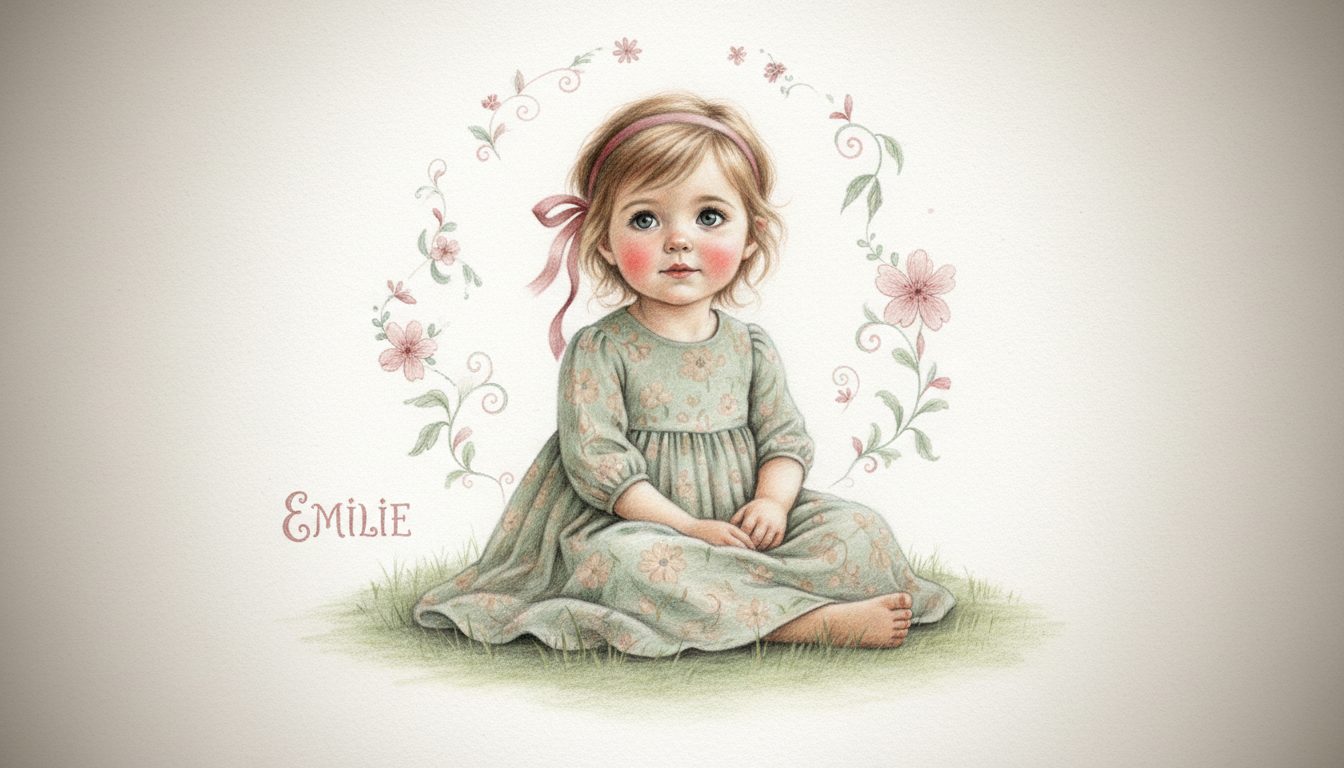
The name Émile, by its origin and meaning, conveys character traits that are particularly harmonious and nuanced. Derived from the primary sense of “emulation” and diligent work, it indeed symbolizes a determined nature, but also profoundly sensitive.
In developmental psychology, this combination of ardor and tenderness is often observed in children bearing this name. Émile frequently turns out to be a dreamer with a rich imagination, whose creativity easily expresses itself through drawing, music, or any other form of art. Sensitive to his environment, he needs a secure framework and constant benevolence to fully flourish.
A quiet perseverance and a caring sensitivity
These young Émiles exhibit remarkable perseverance, which can lead them to take on challenges with sincere enthusiasm. This quality, combined with a tendency to avoid conflicts, reflects a peaceful and thoughtful temperament. Their patience is sometimes tested by a certain tendency toward absent-mindedness or daydreaming, which requires calm attention from adults.
The family environment plays a fundamental role in supporting this development. Regular artistic activities and serene moments of exchange strengthen Émile’s inner balance, who then relies on this emotional stability to build his identity and achieve his goals with confidence.
In contemporary symbolism, Émile is often associated with the precious turquoise stone, a symbol of protection and soothing, which perfectly reflects the balanced and inspired temperament that this name suggests.
Popularity of the name Émile: a timeless and renewed appeal
Over the decades, the name Émile has experienced waves of popularity that reflect the socio-cultural evolutions in France. Highly favored at the beginning of the 20th century, it was given to nearly 5,000 newborns as early as 1906, a sign of its anchoring in the collective imagination. It then experienced a relative decline due to changing naming trends, before recently reappearing as a choice both classic and refreshing.
In 2026, Émile retains this discreet charm and appeals to more and more parents seeking a name that combines tradition and modern softness. This trend fits into a general context where authenticity and simplicity regain a major place in naming choices, a phenomenon observed in several European countries.
Numerical evolution of its use in France
| Year | Number of births | Rank among male names |
|---|---|---|
| 1906 | 4,943 | 5th |
| 1950 | 1,200 | 28th |
| 2000 | 400 | 75th |
| 2026 | 850 | 42nd |
This table clearly shows the gradual comeback of Émile, which today benefits from a new brilliance among families sensitive to the timelessness of classic names, but also to their ability to symbolize authenticity and intention.
Iconic figures bearing the name Émile and their cultural influence
Émile is a name borne by many personalities who have marked their era, whether in literature, politics, or the arts. The most famous among them remains undoubtedly Émile Zola, an engaged writer of the 19th century, whose monumental work profoundly nourished French literature and critical perspectives on society. His social commitment and intellectual rigor admirably illustrate the perseverance and quest for meaning attached to the name.
Other Émiles have left their mark in various fields:
- Émile Erckmann, renowned author, co-founder of the duo Erckmann-Chatrian, whose stories reflect a deep attachment to the region and its traditions.
- Émile Loubet, political figure of the early 20th century, President of the French Republic, symbol of balance and political moderation.
- Émile Blondet, famous literary character created by Honoré de Balzac, bringing a romantic and psychological dimension to the name.
Each of these figures contributes, in its own way, to the symbolic richness of the name Émile, which transcends simple usage to become a vector of exemplary human stories.
Keys to support a child named Émile in his harmonious development
Supporting a young Émile means understanding his natural duality between sensitivity and willpower. His dreamy nature requires a secure environment where the emotional bond is established with gentleness. Trust and patience then become essential allies to guide his projects, nurture his creativity, and support his constant efforts.
Parents and educators can encourage his development through adapted practices:
- Establish kind routines that offer a framework both reassuring and stimulating.
- Encourage artistic activities, such as drawing, music, or writing, to nourish his imagination and strengthen his self-confidence.
- Practice non-violent communication to respect his peaceful nature and help him express his emotions without fear.
- Foster social interactions in a gentle environment, to avoid conflicts while encouraging the development of his sociability.
Émile’s persevering and sensitive nature allows him to slowly but surely overcome the challenges that mark his childhood. Accompanied by light and constant attention, he learns to channel his energy and flourish fully.
What is the exact origin of the name Émile?
Émile derives from the Latin Aemilius, an ancient Roman family known for its perseverance and seriousness. The name symbolizes work and positive competition.
What qualities are attributed to the name Émile?
Émile is often associated with a sensitive, creative, and persevering personality, combining gentleness and a will to succeed.
How does the popularity of the name Émile evolve in France?
After a significant peak at the beginning of the 20th century, Émile had declined before gradually regaining a favored place among classic and gentle names in 2026.
Who are the famous celebrities bearing the name Émile?
Among the famous figures are Émile Zola, Émile Erckmann, and Émile Loubet, each recognized in their respective fields.
How to support a child named Émile?
Support should prioritize patience, kindness, and encouragement of creativity, in order to sustain his sensitivity and perseverance.